
By Sandeep Maurya · Reviewed by Arshi Chadha, Founder
1 kW Solar Inverter Price: On-Grid vs Hybrid Cost Breakdown
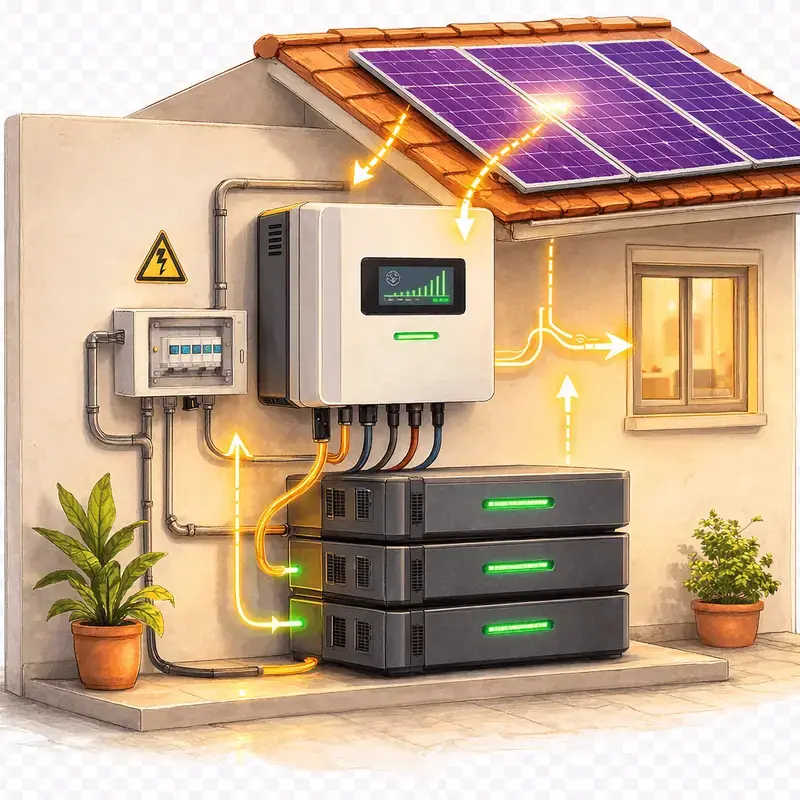
- •On-Grid 1kW Inverter: ₹6,500 – ₹9,000
- •Off-Grid (PWM) 1kW Inverter: ₹7,000 – ₹10,000
- •Hybrid/MPPT 1kW Inverter: ₹12,000 – ₹22,000
- •Efficiency: 95% to 98% (Technology dependent)
- •Best for: 1BHKs, small shops, or backup for critical lighting loads.
A 1 kW solar inverter price starts as low as ₹6,500 for a basic string unit, but that number is deceptive if you don't account for the specific technology—On-Grid, Off-Grid, or Hybrid—that your home actually needs. In the Indian market, particularly across solar in Delhi and the NCR region, we’ve seen homeowners often confuse a 1kVA home UPS with a dedicated solar inverter. While they look similar, the internal switching and charging technology dictate whether your electricity bill actually drops or if you're just buying an expensive battery charger.
We’ve installed over 5,000+ systems since 1990, and the most common mistake at the 1kW scale is underspending on the inverter's intelligence while overspending on panels. A cheap PWM controller will waste 30% of your panel's potential, making your "affordable" system a poor investment within two years.
Estimated Price Range for 1kW Inverters by Technology Type (2025-26)
The following table breaks down what you should expect to pay for the inverter unit itself. Note that these prices include GST but exclude panels, batteries, and mounting structures.
| Inverter Type | Technology | Price Range (Inc. GST) | Ideal Use Case |
|---|---|---|---|
| On-Grid (String) | Transformerless | ₹6,500 – ₹9,000 | Bill reduction with Net Metering |
| Off-Grid (PWM) | Square/Sine Wave | ₹7,000 – ₹11,000 | Remote areas, no grid access |
| Off-Grid (MPPT) | High Efficiency | ₹12,000 – ₹16,000 | Heavy loads, deep discharge cycles |
| Hybrid | Bi-directional | ₹18,000 – ₹25,000 | Savings + Power Backup |
| Microinverter | Module-Level | ₹18,000 – ₹22,000 | Shaded roofs, maximum safety |
Detail the price variation: On-Grid vs. Off-Grid vs. Hybrid
When you look at 1 kw solar inverter price lists, the massive gap between ₹6,500 and ₹25,000 comes down to how the device interacts with the grid and your batteries.
1. On-Grid Inverters (The Savings Specialist)
These are the most affordable. They don't have battery charging circuits. Their only job is to convert DC from your panels into AC and sync it with the DISCOM grid. If you are in a city like Noida or Gurgaon with 99% uptime, this is what you need. You'll use net metering to export excess power.
- Cost Factor: Very low because there is no complex battery management hardware.
2. Off-Grid Inverters (The Battery Boss)
These are essentially advanced home UPS systems. They prioritize charging your batteries from solar. A 1kVA solar inverter cost for an off-grid setup is slightly higher than on-grid because of the heavy-duty copper transformers often used to handle the "surge" when you turn on a fridge or a water pump.
3. Hybrid Inverters (The All-in-One)
This is where the price doubles. A hybrid inverter can export power to the grid (like an on-grid system) AND charge batteries (like an off-grid system). In Delhi NCR, where BSES Rajdhani or DHBVN net metering is efficient but power cuts still happen, a hybrid setup is the gold standard. You're paying for the "brain" that decides whether to send power to the fan, the battery, or the grid.
MPPT vs PWM Inverter Price: Why the Premium Matters
If you're hunting for a 1 kw solar inverter price, you’ll see "PWM" and "MPPT" labels everywhere.
- PWM (Pulse Width Modulation): These are the "old school" controllers. They basically act as a switch. If your panel is producing 18V but your battery is at 12V, the PWM controller just clips the extra voltage. You lose that energy. They are cheap (starting at ₹7,000), but you lose 20–30% of your solar power.
- MPPT (Maximum Power Point Tracking): Think of this as a DC-to-DC converter. It takes the excess voltage and converts it into extra current for the battery. In a 1kW system, an MPPT inverter can give you 2-3 extra units of electricity per day compared to a PWM one.
We always recommend spending the extra ₹4,000–₹6,000 for MPPT. If you save 2 units a day at a Delhi tariff of ₹8/unit, you’ve recovered the price difference in just one year.
Factors Affecting Your 1kW Inverter Price
Don't just buy the cheapest box on Amazon. Here is what actually drives the cost:
1. Warranty Terms
A standard string inverter comes with a 10-year manufacturer warranty. Cheaper off-grid local brands might only offer 2 years. At Bridgeway, we've seen that inverters are the only part of a solar system that might need a "brain transplant" (PCB repair) after 5-7 years. Paying for a longer warranty is essentially buying insurance.
2. Monitoring Features
Does the inverter have Wi-Fi? Can you see your generation on an app? Modern inverters like those from Growatt, Havells, or Microtek often include basic Wi-Fi dongles. This adds about ₹1,500 to the cost but is vital for troubleshooting low output.
3. Peak Surge Capacity
A high-quality 1kW inverter should be able to handle 2kW for a few seconds. This is necessary to start an induction motor or a large refrigerator. Cheap inverters will trip immediately, leaving you in the dark.
Talk to a solar engineer — not a salesperson
Enter your pincode and monthly bill. If we install in your area, an engineer answers on WhatsApp with your numbers.
What would solar save on YOUR bill?
Inverter Capacity vs. Total System Cost

A common mistake is thinking a ₹10,000 inverter means a ₹20,000 system. The inverter is usually only 15-20% of your total project cost.
For a 1kW system, you also need:
- Solar Panels: Approx. ₹25,000 – ₹30,000 (DCR panels are required for subsidy).
- Mounting Structure: A standard GI structure costs about ₹3,000.
- Batteries (for Hybrid/Off-grid): A 150Ah tall tubular battery adds ₹12,000 – ₹15,000.
- BOS & Installation: Cables, earthing, and DCDB/ACDB boxes add roughly ₹8,000.
You can use our Solar Calculator to see how these individual components scale up for larger homes.
Real Example: Small Shop in Rohini
A small retail shop in Rohini was paying ₹2,500 monthly in electricity bills. They installed a 1kW On-Grid system using a high-quality string inverter costing ₹8,500.
- Total Investment: ₹65,000 (No subsidy is available for 1kW as the PM Surya Ghar Yojana starts giving significant benefits from 2kW-3kW).
- Generation: 4 units/day (Avg).
- Monthly Savings: ~₹960.
- Payback: Approx 5.5 years.
If they had chosen a cheap PWM inverter, their generation would have dropped to 2.8 units/day, pushing their payback period to over 8 years.
From our installs
We recently serviced a 1kW off-grid system at a site in Faridabad. The customer had bought a "cheap" PWM inverter for ₹6,000 elsewhere. During our audit, we found the battery was never reaching a full charge because the inverter couldn't handle the high VOC (Voltage at Open Circuit) of the modern Mono PERC panels. We replaced it with an MPPT unit. The result: His backup time increased by 3 hours daily. The caveat: No matter how good the inverter is, if your panels are covered in dust (common in NCR), you will lose 25% efficiency regardless of the electronics.
FAQ
Can I run a 1.5 Ton AC on a 1kW inverter?
No. A 1.5 Ton AC requires a starting current that far exceeds the capacity of a 1kW inverter. You would typically need at least a 5kW system for AC loads. You can check the AC power consumption facts to understand why.
Is subsidy available for a 1kW inverter?
Under the PM Surya Ghar Muft Bijli Yojana, subsidies are structured for residential systems. While technically you can apply, the fixed costs of net metering and applications make 1kW systems less financially attractive than 3kW systems which get a ₹78,000 subsidy.
What is the difference between 1kVA and 1kW?
In solar terms, 1kVA usually refers to the "apparent power" and is often around 800W of actual usable power (Power Factor of 0.8). A true 1kW inverter is rated to handle a full 1000W load. Always check the wattage, not just the kVA rating.
Which brand is best for a 1kW solar inverter in India?
For on-grid, brands like Growatt and Solis are reliable. For off-grid or hybrid, Microtek, Luminous, and V-Guard offer decent local support. If you want high-end performance with module-level monitoring, Enphase microinverters are the premium choice.
Do I need a battery for a 1kW on-grid inverter?
No. On-grid inverters do not work with batteries. They only function when the grid is active. If you need power during a blackout, you must buy a Hybrid or Off-grid inverter and at least one battery.
If you are looking for a tailored setup, get a free quote from our engineers who can verify if a 1kW system actually fits your load profile.
Reviewed by: Gurubaksh Singh, Senior Solar Advisor, Bridgeway Power
Every 1 kW of solar on your roof offsets 1.5 tonnes of CO₂ per year
That's 40 trees planted — every year, for 25 years.
A typical 5 kW home system offsets 187 tonnes of carbon over its lifetime. That's equivalent to taking 8 cars off the road.
See your impact →How much can you save with solar?
Enter your electricity bill → get system size, subsidy amount & payback period
Get StartedLiked this article? Get a free solar quote
Tell us about your rooftop — we'll call with exact savings for your home.
Related Articles
What Is Captive Open Access Solar (100% Equity Model)
Learn how Captive Open Access Solar (100% Equity Model) helps Indian businesses cut electricity costs by 40% using off-site solar plants. Guide on rules, savings & ROI.
Read moreHow Rooftop Solar Can Eliminate Your Electricity Bill
Discover how Net Metering and PM Surya Ghar subsidies can reduce your monthly electricity bill to near-zero. Learn about system sizing, costs, and real-world savings.
Read moreSolar Subsidy in Uttar Pradesh 2026: ₹1,08,000 for Noida, Ghaziabad & Greater Noida
UP's stacked solar subsidy 2026: ₹78,000 central + ₹30,000 UPNEDA state top-up = ₹1.08L. Real PVVNL net-cost math for Noida, Greater Noida, Ghaziabad & Meerut.
Read moreRelated guides
Delhi Electricity Rate 2026
BSES & Tata Power per-unit rates, PPAC, subsidy — sourced from DERC.
ExploreDelhi Solar Policy 2026
Free rooftop solar up to 3 kW for homes under 400 units. Eligibility & apply.
ExploreSolar Panel Price in Delhi
Live 2026 rooftop prices in Delhi after ₹1.56L subsidy. 1,200+ installs.
ExploreSolar Company in Gurgaon
Gurgaon's rooftop solar installer — 800+ systems, ₹78K PM Surya Ghar subsidy.
ExploreSolar Company in Noida
Noida & Greater Noida rooftop solar — 500+ installs, ₹1.08L stacked subsidy.
ExploreSolar Panel Price in Faridabad
Live 2026 Faridabad prices after ₹78K PM Surya Ghar subsidy. 350+ homes.
Explore