
By Vansh Dahiya · Reviewed by Arshi Chadha, Founder
Mono PERC vs Half-Cut Solar Panels: Which Should You Buy?
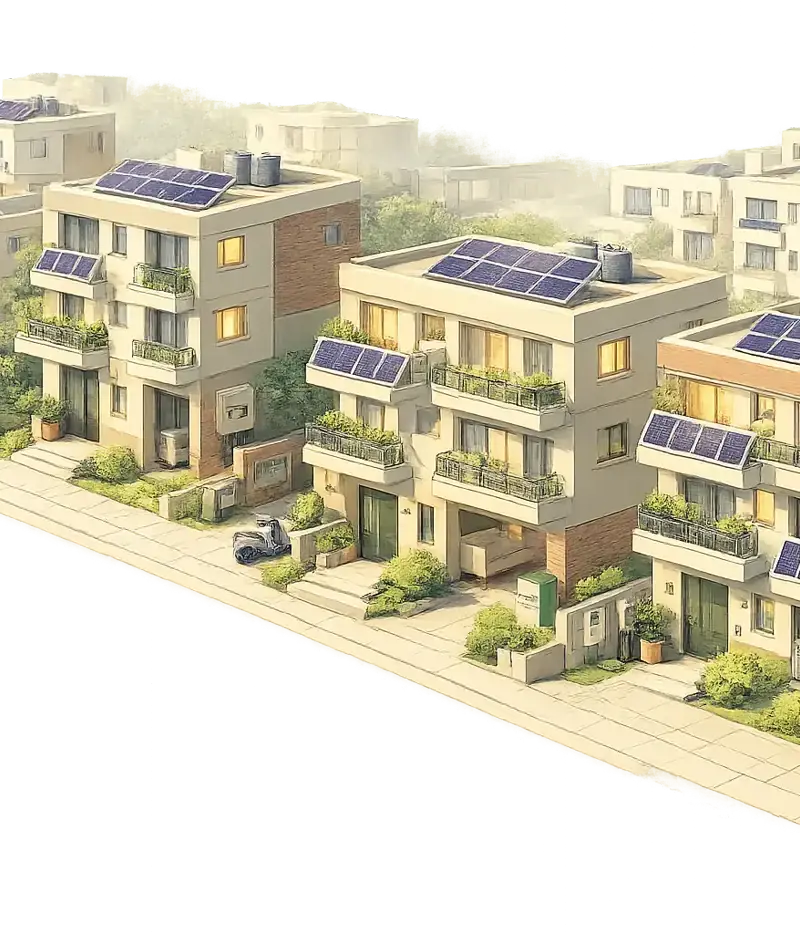
- •Technology Choice: Half-cut cells are the evolved version of Mono PERC, offering 21–23% efficiency.
- •Standard 3kW System Cost: Net price of ₹1,32,000 in Delhi (after subsidies).
- •Indian Benefit: Half-cut panels reduce power loss by 50% during partial shading (common in urban areas).
- •2026 Verdict: Half-cut Mono PERC is the value-for-money king; TOPCon is the premium, high-efficiency alternative.
If you are a homeowner in Delhi, Gurgaon, or Noida looking at quotes for rooftop solar, you’ve likely been bombarded with technical jargon. One installer promises "high-efficiency Mono PERC," while another swears by "Half-cut cell technology." It feels like choosing between a smartphone and a laptop when you just wanted something to make calls.
The truth is, determining the winner of mono PERC vs half-cut solar panels is slightly more nuanced because they aren't exactly "rivals." In the modern solar installation process in India, half-cut panels are actually the natural evolution of Mono PERC.
With electricity tariffs rising across North India—reaching as high as ₹8/unit in Delhi and ₹7.1/unit in Haryana—choosing the right technology is the difference between a system that pays for itself in 3 years and one that struggles for a decade. At Bridgeway Power, with 35+ years of electrical lineage, we’ve seen how these technologies perform under the brutal 48°C heat of an Indian summer.
Understanding the Technology: Mono PERC vs Half-Cut Solar Panels
To choose the best solar panel type India 2026, we first need to strip away the marketing fluff.
What is Mono PERC?
Mono PERC (Monocrystalline Passivated Emitter and Rear Cell) is the industry standard. "Mono" means the silicon is grown from a single crystal, making it more efficient than older polycrystalline panels. The "PERC" layer at the back reflects light back into the cell, giving it a second chance to generate electricity.
What is Half-Cut Technology?
Half-cut solar panels India are essentially Mono PERC panels where the solar cells are laser-cut into two equal halves. Instead of having 60 or 72 cells, a half-cut panel has 120 or 144 smaller cells.
By cutting the cell in half, you halve the electrical current. Since power loss is proportional to the square of the current ($P = I^2R$), halving the current reduces resistance losses by four times. This is why half-cut panels produce more power even when they use the exact same silicon as a standard Mono PERC panel.
The New Contender: TOPCon
While we focus on the mono PERC vs half-cut solar panels debate, you cannot ignore TOPCon (Tunnel Oxide Passivated Contact). TOPCon is the "Premium Plus" category for 2026. It offers better performance in low light and lower degradation over 30 years.
Table 1: Solar Panel Technology Comparison India (2025-2026)
| Feature | Mono PERC (Standard) | Half-Cut Mono PERC | TOPCon (Premium) |
|---|---|---|---|
| Efficiency Range | 20–22% | 21–23% | 23–25% |
| Typical Cost (₹/Wp) | ₹22–₹28 | ₹25–₹32 | ₹30–₹38 |
| Shade Tolerance | Low | High | High |
| Best For | Large, open budgets | Urban rooftops (shading) | Limited roof space |
| 2026 Market Status | Phasing out | Current Standard | Emerging Premium |
Why Half-Cut Panels Win in Indian Urban Conditions
Indian rooftops are chaotic. Between water tanks, dish antennas, and the neighbor’s taller building, "partial shading" is the number one enemy of solar generation.
In a standard Mono PERC panel, the cells are wired in series. If a pigeon leaves a dropping on one cell or a shadow from a parapet wall hits a single corner, the entire string’s output can drop by 50% or more.
However, half-cut solar panels India are designed with a split-circuitry. The top half of the panel operates independently of the bottom half. If the bottom half is shaded by a water tank, the top half continues to produce power at 100% capacity. This is why half-cut is the best solar panel type India 2026 for congested areas like Dwarka or Indirapuram.
Table 2: Performance in Indian Conditions (Heat & Shade)
| Parameter | Standard Mono PERC | Half-Cut Mono PERC | TOPCon |
|---|---|---|---|
| Heat Tolerance (45°C+) | Moderate | High (Less internal heat) | Excellent |
| Shading Response | Entire string drops | Only shaded half affected | Minimal impact |
| Micro-Crack Risk | Higher | Lower (Smaller cells) | Lower |
| Annual Degradation | ~0.55% | ~0.45% | ~0.40% |
| Hot-Spot Risk | High | Low | Very Low |
Panel Wattage: Which Size Should You Choose?
As technology improves, panels are getting larger. While a 335W panel was standard five years ago, today we rarely install anything under 540W. Choosing the right wattage depends on your roof size and your inverter capacity.
Table 3: Panel Wattage Options & Best Use Cases
| Panel Wattage | Typical Technology | Best Use Case | Dimensions (Approx) |
|---|---|---|---|
| 400W–450W | Mono PERC / Half-Cut | Small residential roofs | 1.7m x 1.1m |
| 540W–550W | Half-Cut Mono PERC | Standard 3kW to 10kW | 2.3m x 1.1m |
| 580W–620W | TOPCon / Bifacial | Large bungalows & C&I | 2.4m x 1.1m |
Note: For a 5kW solar system, using nine 550W panels is often more cost-effective and easier to mount than using thirteen 400W panels.
Talk to a solar engineer — not a salesperson
Check whether we install in your area, then get your answer on WhatsApp. No forms, no call centre.
What would solar save on YOUR bill?
Real-World Example: A 5kW Setup in Gurgaon
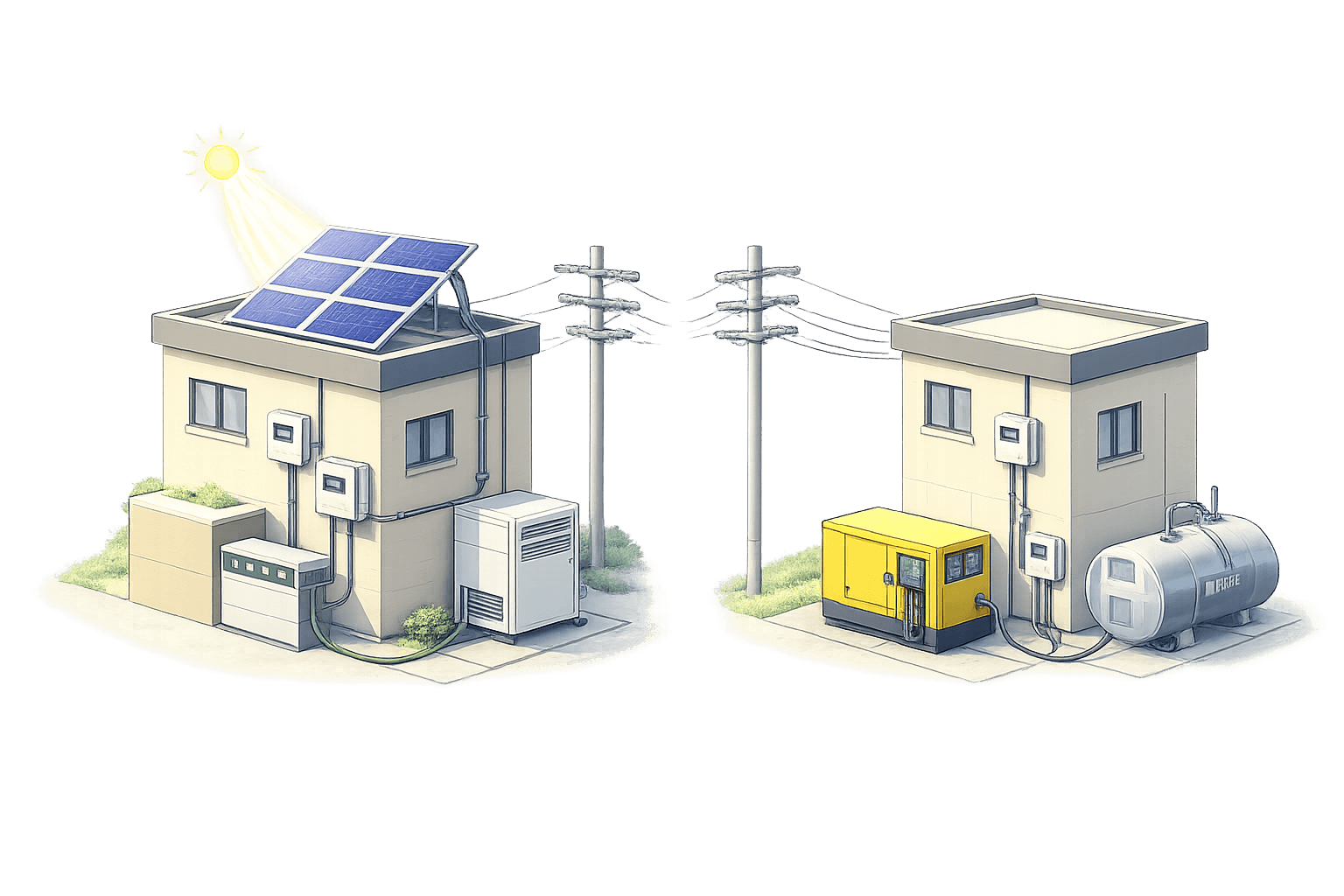
Consider a 3BHK bungalow in Sushant Lok, Gurgaon. The owner, Mr. Sharma, has a monthly bill of ₹8,000–₹10,000.
- Option A (Standard Mono PERC): Total cost ₹3.1 Lakh. Estimated generation: 600 units/month.
- Option B (Half-Cut Mono PERC): Total cost ₹3.43 Lakh. Estimated generation: 640 units/month.
While Option B is ₹33,000 more expensive, that extra 40 units/month (worth ~₹300/month in Gurgaon tariff rates) adds up. More importantly, Mr. Sharma’s roof has a chimney that casts a shadow every afternoon. With standard panels, those 2 hours of shade would kill his generation. With half-cut panels, he only loses 10% of Daily generation.
At Bridgeway Power, we helped Mr. Sharma secure a solar loan to cover the difference, ensuring his payback period remained under 4 years.
Comparing Costs and Subsidies
The PM Surya Ghar Yojana 2026 has made the transition to high-efficiency panels much easier. The central government offers a subsidy of up to ₹78,000, and states like Delhi provide an additional ₹30,000 capital subsidy.
When you invest in half-cut solar panels India, you are maximizing the surface area of your roof. Since the subsidy is capped by kW capacity, it makes financial sense to use the highest efficiency panels you can afford to ensure every square foot of your roof generates maximum revenue.
Calculate your potential savings with our Solar Calculator.
Why Quality of Installation Trumps Technology
You can buy the most expensive TOPCon panels in the world, but if they are mounted on a weak solar structure or wired poorly, they will underperform.
- Structure Matters: A 600W panel weighs about 28kg. In high-wind zones like the NCR plains, your structure must be able to withstand speeds of 150km/h.
- Maintenance is Key: Dust and pollution in cities like Noida can cause a 25% drop in generation. No matter if it's mono PERC vs half-cut solar panels, if they are dirty, they won't work. Check out our AMC Plans for professional cleaning.
- Inverter Logic: Half-cut panels have higher current (Ampere) ratings. Your inverter must be compatible with these high-current inputs to avoid clipping.
FAQ
Is half-cut better than mono PERC?
Yes, half-cut panels are objectively better than standard Mono PERC because they offer better shade tolerance, lower resistive losses, and a lower risk of hot-spot formation. Think of half-cut as the "Pro" version of a standard Mono PERC panel.
Are half-cut solar panels more expensive?
In the Indian market of 2026, half-cut panels generally cost about ₹3–₹5 per Watt more than standard Mono PERC. For a typical 5kW home system, this equates to an additional investment of roughly ₹15,000–₹25,000, which is usually recovered within 18 months through higher generation.
Does half-cut technology help with heat?
Yes. Because half-cut cells produce half the current of a full cell, they generate less internal heat. In Indian summers where rooftop temperatures can exceed 60°C, this lower operating temperature helps the panel maintain higher efficiency and slows down long-term degradation.
Can I mix half-cut and standard panels?
It is not recommended to mix different panel types in the same string. Each panel type has different current (Imp) and voltage (Vmp) characteristics. Mixing them will cause the entire string to perform at the level of the weakest panel, potentially leading to inverter errors or safety risks.
Which panel should I buy for a 3kW system in Delhi?
For a 3kW system in Delhi, we recommend 540W or 550W Half-cut Mono PERC panels. These offer the best balance of price, performance, and physical size. With the Delhi solar subsidy, you can get this entire setup for a net cost of approximately ₹1,32,000.
Conclusion
The debate of mono PERC vs half-cut solar panels is largely over in 2026—half-cut has won. It is the gold standard for residential solar due to its ability to handle the "real-world" problems of Indian roofs: heat, dust, and shading.
While TOPCon is a fantastic premium option if you have a massive budget or very limited space, for 90% of homeowners in cities like Faridabad or Ghaziabad, Half-cut Mono PERC represents the sweet spot of ROI.
Ready to switch to solar? Don't let technical jargon slow you down. Bridgeway Power offers a free site audit and personalized generation reports for your specific roof.
Every 1 kW of solar on your roof offsets 1.5 tonnes of CO₂ per year
That's 40 trees planted — every year, for 25 years.
A typical 5 kW home system offsets 187 tonnes of carbon over its lifetime. That's equivalent to taking 8 cars off the road.
See your impact →How much can you save with solar?
Enter your electricity bill → get system size, subsidy amount & payback period
Get StartedLiked this article? Get a free solar quote
Tell us about your rooftop — we'll call with exact savings for your home.
Related Articles
Net Metering in India: How to Sell Solar Power Back to the Grid
Learn how net metering in India allows you to sell solar power back to the grid. Discover state policies, savings examples, and how to reduce your bill by 90%.
Read moreWhat Is Captive Open Access Solar (100% Equity Model)
Learn how Captive Open Access Solar (100% Equity Model) helps Indian businesses cut electricity costs by 40% using off-site solar plants. Guide on rules, savings & ROI.
Read moreSolar Installation Cost in Delhi NCR 2026: 3 kW at ₹1.32L net
Updated 2026 guide to solar costs in Delhi NCR. Learn about PM Surya Ghar subsidies, system pricing from 1kW-10kW, and how to reach zero electricity bills.
Read moreRelated guides
Delhi Electricity Rate 2026
BSES & Tata Power per-unit rates, PPAC, subsidy — sourced from DERC.
ExploreDelhi Solar Policy 2026
Free rooftop solar up to 3 kW for homes under 400 units. Eligibility & apply.
ExploreSolar Panel Price in Delhi
Live 2026 rooftop prices in Delhi after ₹1.56L subsidy. 1,200+ installs.
ExploreSolar Company in Gurgaon
Gurgaon's rooftop solar installer — 800+ systems, ₹78K PM Surya Ghar subsidy.
ExploreSolar Company in Noida
Noida & Greater Noida rooftop solar — 500+ installs, ₹1.08L stacked subsidy.
ExploreSolar Panel Price in Faridabad
Live 2026 Faridabad prices after ₹78K PM Surya Ghar subsidy. 350+ homes.
Explore