
By Arshi Chadha, Founder · Bridgeway Power
Delhi Electricity Unit Rates: Latest Surcharge Updates

You're checking the rate — now see how much of your bill solar erases
Delhi electricity bills are climbing again, and it isn't just the base summer heat. As of June 2026, the Delhi Electricity Regulatory Commission (DERC) has approved a significant hike in the Power Purchase Adjustment Cost (PPAC), meaning your actual delhi per unit electricity rate is effectively 35% to 40% higher than the number you see on the front of the bill. If you are a resident in Dwarka or Janakpuri, you’ve likely noticed that even if your consumption stays the same, the total amount payable has jumped.
We’ve been installing solar across the NCR for 35+ years, and I can tell you: the days of relying solely on the "free 200 units" subsidy are fading. As surcharges rise, the only way to lock in a low electricity per unit rate in delhi is to own the generation source.
Delhi Electricity Slabs: Current Rates vs Recent Surcharge
The per unit cost of electricity in delhi is a multi-layered calculation. You have the base energy charge, fixed charges, the Pension Trust surcharge, and the newly adjusted PPAC.
Here is the breakdown of what you are actually paying in 2026:
| Slab (Monthly Units) | Base Energy Rate (₹/unit) | Effective Rate with Max PPAC + Tax (Approx) | Delhi Govt Subsidy Status |
|---|---|---|---|
| 0 – 200 | ₹3.00 | ₹4.20 | 100% Rebate (Bill is ₹0) |
| 201 – 400 | ₹4.50 | ₹6.30 | 50% Rebate (Max ₹800) |
| 401 – 800 | ₹6.50 | ₹9.10 | No Subsidy |
| 801 – 1200 | ₹7.00 | ₹9.80 | No Subsidy |
| Above 1200 | ₹8.00 | ₹11.20 | No Subsidy |
Note: Effective rates include the newly approved PPAC (up to 40.71% for BYPL) and 5% Electricity Tax. Fixed charges and the ₹0.10/unit Pension Trust surcharge are extra.
Why your Delhi electricity bills will rise due to approved surcharge increases
In June 2026, DERC issued an order (Order No. F.3(758)/DERC/Tariff-Engg.) allowing DISCOMs to adjust the PPAC monthly. The rates are staggering: 35.83% for BSES Rajdhani (BRPL), 40.71% for BSES Yamuna (BYPL), and 36.33% for Tata Power (TPDDL).
When people ask me about the delhi bijli unit rate, I tell them to ignore the ₹8/unit figure for the top slab. When you add a 40% surcharge and the 5% tax, you are actually paying closer to ₹11.50 per unit. This is why a monthly bill of ₹10,000 can suddenly look like ₹14,000 without a single extra AC being turned on. You can check how these slabs impact your specific load using our Solar Calculator.
How Solar Bypasses the High-Rate Slabs
The beauty of net metering in Delhi is that it works on a unit-for-unit basis. If you consume 800 units but your solar system generates 600 units, the DISCOM only bills you for the remaining 200 units.
By installing solar, you aren't just "saving money"; you are strategically pushing your billing down into the lower-priced slabs—or eliminating the energy charge entirely.
The "Free 200 Units" Myth vs. Solar Reality
A common question I get during site surveys in Palam or Rohini is: "If I install solar, will I lose my 200 units of free electricity from the Delhi government?"
Here is the technical truth: The Delhi government subsidy (100% off for ≤200 units) applies to your net consumption.
- If your solar system produces more than you use (Net Zero or Negative bill), the subsidy is irrelevant because your bill is already zero.
- If your net consumption (Import minus Export) is 150 units, you still qualify for the 100% rebate on those units.
- Solar essentially acts as a shield. It ensures that even during peak summer, your "Imported" units stay below the 400-unit threshold where subsidies vanish and high per unit cost of electricity in delhi kicks in.
Real Example: 5kW System in South Delhi
Let’s look at a real-world case from a 3BHK home in Saket. Before solar, they were paying for 900 units a month during summer.
Scenario A: Without Solar (BSES Rajdhani)
- Consumption: 900 units
- Base Energy Charge: (200 * 3) + (200 * 4.5) + (400 * 6.5) + (100 * 7) = ₹4,800
- PPAC (35.83%): ₹1,719
- Fixed Charges + Taxes: ~₹800
- Total Monthly Bill: ₹7,319
Scenario B: With 5kW Solar System
- Generation: ~600 units/month (Average yield is 120 units per kW)
- Net Consumption: 300 units (900 - 600)
- Base Energy Charge: (200 * 3) + (100 * 4.5) = ₹1,050
- Govt Subsidy (50% rebate): -₹525
- PPAC (35.83% on ₹525): ₹188
- Fixed Charges + Taxes: ~₹800
- Total Monthly Bill: ₹1,463
Monthly Savings: ₹5,856
Annual Savings: ~₹70,000
With the current cost of solar in Delhi, this family’s net investment was roughly ₹2.1 Lakh after the PM Surya Ghar Muft Bijli Yojana subsidy. They will hit break-even in exactly 3 years.
Talk to a solar engineer — not a salesperson
Enter your pincode and monthly bill. If we install in your area, an engineer answers on WhatsApp with your numbers.
See how much of this bill solar erases
The Financial Logic of Solar in 2026
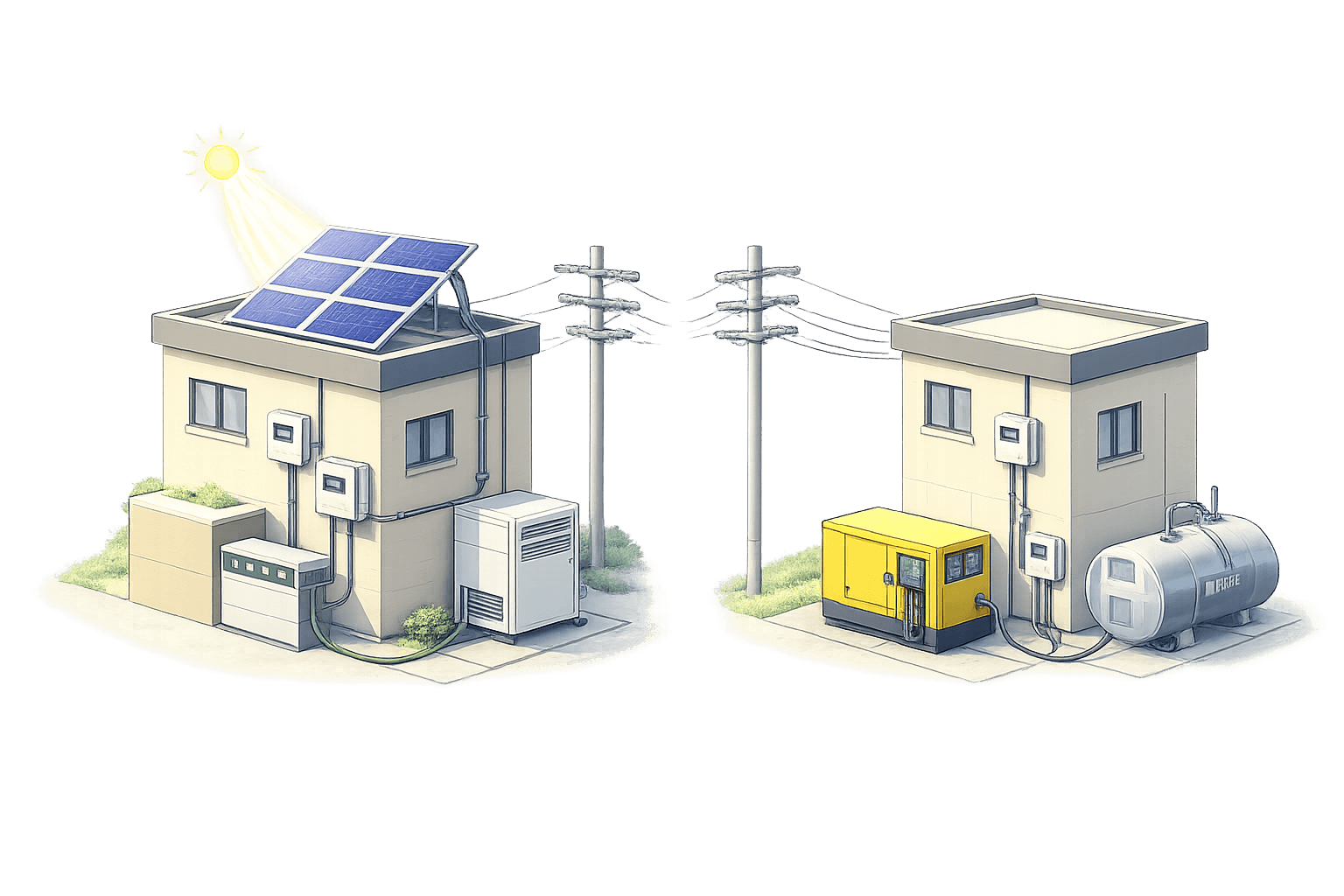
The government isn't just giving away subsidies; they are incentivizing you to become your own power plant. In Delhi, you can stack the central subsidy (up to ₹78,000) with the Delhi state capital subsidy (₹10,000 per kW, max ₹30,000). On top of that, the Delhi GBI (Generation-Based Incentive) pays you ₹3 per unit generated for the first 5 years if you stay under 3kW.
If you’re worried about the upfront cost, there are now excellent solar panel finance options. We work with partners like SBI, PNB, Canara Bank, ECOFY, and Aerem to provide low-interest EMI plans that often cost less than your current monthly electricity bill.
Why the Delhi Per Unit Electricity Rate Won't Go Down
Energy demand in Delhi is hitting record highs every year. The DISCOMs (BSES and Tata Power) have to buy expensive power from the spot market during peak hours. Those costs are passed to you via the PPAC surcharge.
While the base delhi bijli unit rate hasn't seen a massive change in the "headline" numbers since 2021, the surcharges are the back door for price increases. By the time you add the 8% Pension Surcharge and the 40% PPAC, the "cheap" power promised is nowhere to be found for the middle class consuming over 400 units.
If you are living in a builder floor in Delhi, you have a unique advantage. You can use your roof space to effectively "pre-pay" your electricity for the next 25 years at a fixed cost of roughly ₹2.50 per unit (amortized over the system life).
FAQ
What is the current delhi per unit electricity rate for residential users?
The base rate varies from ₹3 per unit for the first 200 units to ₹8 per unit for consumption above 1200 units. However, after including the latest PPAC surcharges (35-40%) and electricity tax, the effective top-slab rate is approximately ₹11.20 to ₹11.50 per unit.
How much can I save on my Delhi electricity bill with a 3kW solar system?
A 3kW system in Delhi generates roughly 360 units per month. At a blended rate of ₹7/unit, this saves you approximately ₹2,500 monthly. If this generation brings your net consumption below the 400 or 200-unit slab, your savings increase exponentially due to state subsidies and lower slab rates.
Will Delhi electricity bills rise due to approved surcharge increases in 2026?
Yes, DERC has approved a monthly adjustment of the Power Purchase Adjustment Cost (PPAC). For BSES Yamuna consumers, this surcharge is as high as 40.71%, which significantly increases the total bill amount even if your unit consumption remains unchanged.
Does the free 200 units scheme apply if I have solar?
Yes, the Delhi government's subsidy applies to your net consumption (Import minus Export). If your net units after solar generation are less than 200, you still receive a zero-energy-charge bill. Solar helps more residents stay within this "free" or "subsidized" (201-400 units) bracket.
What is the payback period for rooftop solar in Delhi?
For most residential users in Delhi, the payback period is between 3 to 4 years. This is due to the high effective unit rates and the generous combination of PM Surya Ghar central subsidy and Delhi state capital subsidy.
If you're tired of guessing what your next bill will look like, it's time to take control. You can get a free quote and a site survey from our engineering team to see exactly how many panels your roof can support. Raising your own power is no longer just for factories—it's the only way for a Delhi household to stay financially sane in 2026.
Every 1 kW of solar on your roof offsets 1.5 tonnes of CO₂ per year
That's 40 trees planted — every year, for 25 years.
A typical 5 kW home system offsets 187 tonnes of carbon over its lifetime. That's equivalent to taking 8 cars off the road.
See your impact →How much can you save with solar?
Enter your electricity bill → get system size, subsidy amount & payback period
Get StartedSee how much of this bill solar erases
Related Articles
What Is Captive Open Access Solar (100% Equity Model)
Learn how Captive Open Access Solar (100% Equity Model) helps Indian businesses cut electricity costs by 40% using off-site solar plants. Guide on rules, savings & ROI.
Read moreHow Rooftop Solar Can Eliminate Your Electricity Bill
Discover how Net Metering and PM Surya Ghar subsidies can reduce your monthly electricity bill to near-zero. Learn about system sizing, costs, and real-world savings.
Read moreSolar Subsidy in Uttar Pradesh 2026: ₹1,08,000 for Noida, Ghaziabad & Greater Noida
UP's stacked solar subsidy 2026: ₹78,000 central + ₹30,000 UPNEDA state top-up = ₹1.08L. Real PVVNL net-cost math for Noida, Greater Noida, Ghaziabad & Meerut.
Read moreRelated guides
Delhi Electricity Rate 2026
BSES & Tata Power per-unit rates, PPAC, subsidy — sourced from DERC.
ExploreDelhi Solar Policy 2026
Free rooftop solar up to 3 kW for homes under 400 units. Eligibility & apply.
ExploreSolar Panel Price in Delhi
Live 2026 rooftop prices in Delhi after ₹1.56L subsidy. 1,200+ installs.
ExploreSolar Company in Gurgaon
Gurgaon's rooftop solar installer — 800+ systems, ₹78K PM Surya Ghar subsidy.
ExploreSolar Company in Noida
Noida & Greater Noida rooftop solar — 500+ installs, ₹1.08L stacked subsidy.
ExploreSolar Panel Price in Faridabad
Live 2026 Faridabad prices after ₹78K PM Surya Ghar subsidy. 350+ homes.
Explore