
By Vansh Dahiya · Reviewed by Arshi Chadha, Founder
Net Metering in India: How to Sell Solar Power Back to the Grid
Quick answer
With net metering in India, surplus solar units exported to the grid offset your imported units one-for-one on the bill. Surplus is banked as credit and rolls month to month; at the annual settlement the leftover is paid at the utility APPC (average power purchase cost) rate, which is well below retail tariff — so the real money is in self-consumption and bill offset, not in selling power. Sizing the system to your own consumption is the correct strategy.
| Scenario | How it is settled |
|---|---|
| Import exceeds export | Billed on net units only |
| Export exceeds import (month) | Surplus banked as credit, rolls forward |
| Year-end surplus | Paid at APPC rate, below retail |
- •Primary Function: Offsets electricity bills by exporting excess solar energy to the grid.
- •Financial Impact: Can reduce the variable energy component of your bill by up to 90-100%.
- •Standard Payback: 3.5 to 5 years for most Indian residential systems.
- •Equipment Required: A Bi-directional (Net) Meter and an On-grid or Hybrid Inverter.
- •Central Subsidy: Up to ₹78,000 via [PM Surya Ghar Yojana](https://pmsuryaghar.gov.in).
If you are considering rooftop solar in India, you have likely heard the term "Net Metering." It is the single most important policy that makes solar financially viable for the average homeowner. Imagine your electricity meter running backward during a sunny afternoon—that isn’t a technical glitch; it is the power of net metering.
In the past, solar was largely for those who wanted to live "off-grid" with expensive, heavy batteries. Today, thanks to policies driven by the Ministry of New & Renewable Energy (MNRE), the grid itself acts as your battery. Whether you are a homeowner in South City Gurgaon dealing with high summer bills or a business owner in Noida Extension looking to hedge against rising tariffs, understanding how to net metering India sell solar power back to the grid is the first step toward energy independence.
What is Net Metering?
Net metering is a billing mechanism that allows rooftop solar owners to export excess electricity to the utility grid and receive credits on their electricity bill. When your solar panels produce more power than your home or business consumes—which typically happens between 10 AM and 4 PM—the surplus energy flows back through a bi-directional meter.
Unlike a standard meter that only records what you consume, a net meter records two things:
- Import: Electricity you take from the DISCOM (e.g., at night or on rainy days).
- Export: Solar electricity you send to the grid (when your panels outproduce your needs).
At the end of the billing cycle, your DISCOM (Utility company) subtracts the exported units from the imported units. You are only billed for the "Net" consumption.
The Step-by-Step Flow of Energy
- Generation: Your Topcon Mono PERC panels convert sunlight into DC electricity.
- Conversion: An on-grid inverter converts this DC into AC power for your appliances.
- Self-Consumption: Your lights, fans, and ACs use the solar power first.
- Export: Any "leftover" units automatically push through the bi-directional meter into the government grid.
- Night Mode: When the sun sets, your house draws power from the grid as usual.
- Billing: Your bill reflects: (Units Imported) - (Units Exported) = Net Payable Units.
Net Metering India: The Financial Benefits
Why is everyone talking about this? Because it changes solar from an "expense" to an "investment."
1. Eliminating the Need for Batteries
Batteries are the most expensive and least durable part of a solar system. With net metering, you don't need them to save money. The grid "stores" your excess daytime energy and gives it back to you at night for free (via credits).
2. High Return on Investment (ROI)
Since residential electricity rates in cities like Mumbai or Pune can reach ₹9–10 per unit, every unit you export is essentially "sold" back at that high retail rate. This leads to a very short payback period.
3. Protection Against Tariff Hikes
Electricity rates in India rise by approximately 3-5% annually. By installing solar with net metering, you "lock in" your electricity cost for the next 25 years.
State-wise Net Metering Policies (2025-2026)
In India, electricity is a "Concurrent List" subject, meaning both the Central and State governments make rules. Consequently, net metering regulations vary significantly by state.
| State | Capacity Limit | Settlement Period | Surplus Unit Rate (APPC) |
|---|---|---|---|
| Delhi | Up to Sanctioned Load | Annual (March 31) | ~₹3.50 - ₹4.00 |
| Haryana | Up to Sanctioned Load | Annual (June) | ~₹3.00 - ₹3.50 |
| Uttar Pradesh | Up to Sanctioned Load | Annual (March 31) | ~₹2.50 - ₹3.00 |
| Maharashtra | Up to 1 MW | Annual | ~₹3.50 |
| Karnataka | Up to 1 MW | Monthly/Annual | ~₹3.56 |
Delhi Net Metering Context
Delhi has one of the most progressive solar policies. Under the Delhi Solar Policy 2024, homeowners can also benefit from a Generation-Based Incentive (GBI). Residents can earn ₹3/unit for the first 3 kW and ₹2/unit for systems up to 10 kW for five years. This is in addition to the savings on your bill.
Settlement in Delhi happens annually on March 31. Any surplus units left in your "solar bank" at the end of the year are paid out to you at the Average Power Purchase Cost (APPC) rate.
Haryana & UP Context
In Gurugram and Faridabad, DHBVN allows net metering up to the sanctioned load of the building. In Uttar Pradesh (Noida/Ghaziabad), PVVNL follows a similar structure, though the surplus settlement rate is slightly lower than Delhi's.
Real-World Example 1: Residential Home in Delhi
Let’s look at a 3BHK house in Dwarka with a monthly electricity bill of ₹8,000.
- System Size: 5 kW Rooftop Solar
- Average Monthly Generation: 600 Units (Based on 120 units/kW/month)
- Current Electricity Rate: ~₹8.00 per unit (Top slab)
- Monthly Savings: 600 units x ₹8.00 = ₹4,800
- Delhi GBI Earnings: 600 units x ₹2.00 = ₹1,200
- Total Monthly Benefit: ₹6,000
- Net Electricity Bill: ₹8,000 - ₹6,000 = ₹2,000 (Remaining amount covers fixed charges and taxes)
In this scenario, the homeowner reduces their bill by 75% without changing their lifestyle.
Real-World Example 2: Small Business in Gurgaon
A small workshop in Manesar has a sanctioned load of 20 kW and a monthly bill of ₹25,000.
- System Size: 15 kW Rooftop Solar
- Monthly Generation: 1,800 Units
- Commercial Tariff: ₹7.50 per unit
- Direct Savings: 1,800 x ₹7.50 = ₹13,500
- Tax Benefit: 40% Accelerated Depreciation (AD) in Year 1.
- Payback Period: Less than 4 years.
For businesses, net metering acts as a massive operational cost reduction tool. You can see more details in our guide on solar for MSMEs.
Equipment Needed for Net Metering
You cannot just plug a solar panel into a wall socket and expect the meter to reverse. You need specific, DISCOM-approved hardware.
1. The Bi-Directional Meter
This is provided (or approved) by your DISCOM (like BSES, TPDDL, or DHBVN). It replaces your existing single-direction meter. It has separate registers for 'Import kWh', 'Export kWh', and 'Net kWh'.
Talk to a solar engineer — not a salesperson
Check whether we install in your area, then get your answer on WhatsApp. No forms, no call centre.
Translate your bill into a system size
Solar Depreciation & Tax Benefit Calculator
Based on Section 32 — 40% WDV + 20% additional depreciation (Year 1)
2. On-Grid Inverter
This inverter "syncs" with the grid's frequency. If the grid goes down (power cut), the inverter shuts off for safety (anti-islanding) unless you have a hybrid system with a battery.
3. Solar Generation Meter
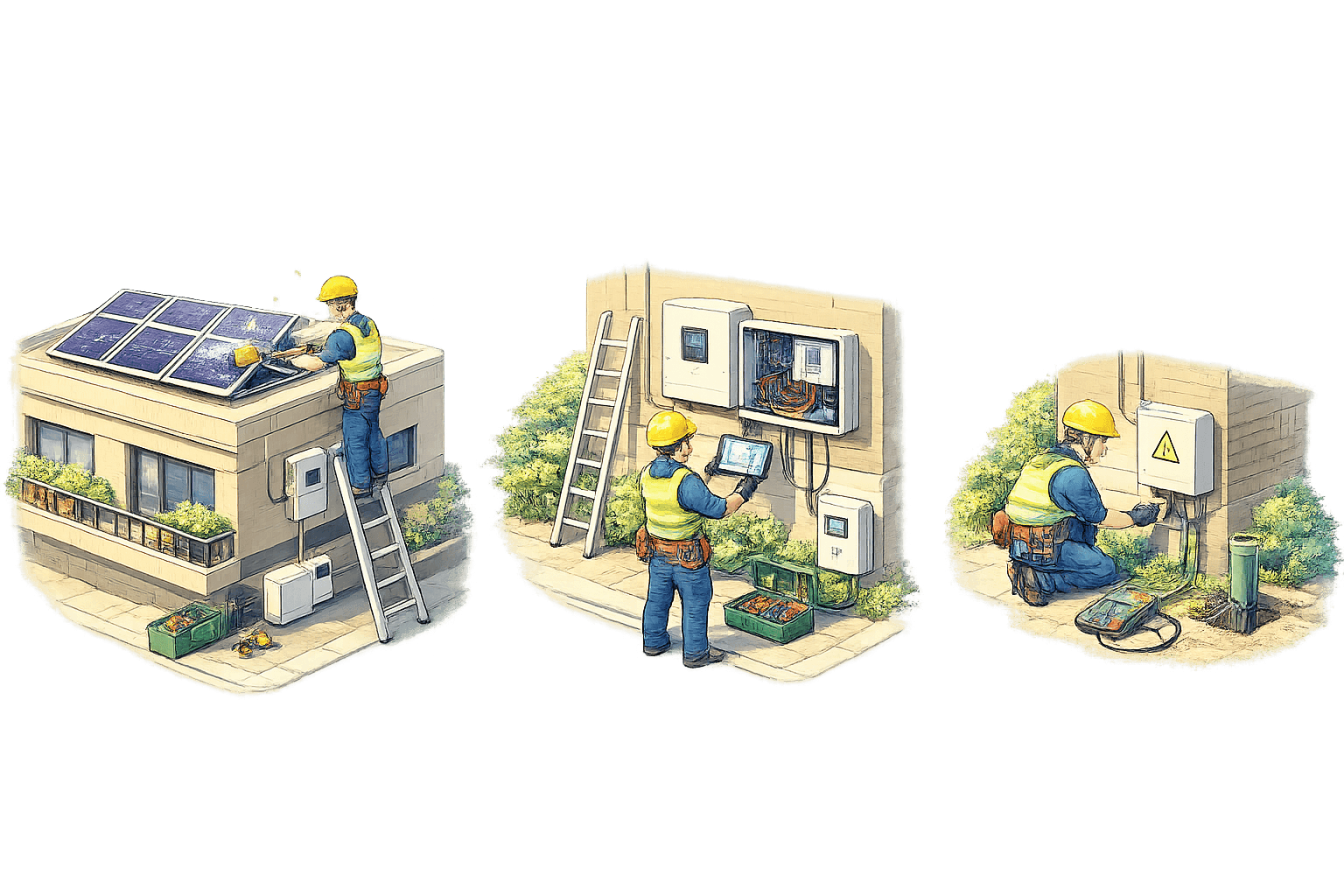
In states like Delhi, a second meter is installed specifically to record how much total electricity your panels produced, which is used to calculate your GBI incentives.
The Net Metering Application Process in India
While every state has a different portal, the general process for net metering India sell solar power follows these 7 steps:
- Feasibility Analysis: Check if your sanctioned load supports the solar capacity you want.
- Solar Installation: Bridgeway Power installs the system according to MNRE and DISCOM standards.
- Online Application: Submit documents (Electricity bill, Aadhaar, Site photos) to the DISCOM portal (e.g., BSES Solar Portal).
- Technical Inspection: A DISCOM junior engineer (JE) visits to verify the installation and earthing.
- Net Metering Agreement: A legal contract is signed between you and the DISCOM.
- Meter Procurement & Testing: You pay the meter fee; the DISCOM tests the meter for accuracy.
- Commissioning: The new meter is installed, and the system is officially "turned on."
Net Metering vs. Gross Metering vs. Net Billing
It is vital to distinguish these terms as they affect your wallet differently.
- Net Metering: You offset your consumption. 1 unit exported = 1 unit imported. This is the most profitable for residential users.
- Gross Metering: You sell all solar power to the grid at a fixed low rate (e.g., ₹3/unit) and buy all your consumption at the high retail rate (e.g., ₹8/unit). This is rarely beneficial for homes.
- Net Billing: Similar to net metering, but the export credit is calculated at a lower monetary value rather than a 1:1 unit swap.
Common Misconceptions About Net Metering
"My bill will be exactly Zero."
Even if you export more than you import, your bill will not be ₹0. You will still have to pay:
- Fixed Charges: Based on your sanctioned load (e.g., ₹125/kW in Delhi).
- Electricity Tax: Usually 5% of the total charges.
- Surcharges: Like the Pension Trust Surcharge in Delhi. However, the "Energy Charge" (which is usually 80-90% of the bill) can be wiped out.
"I can sell power and get a monthly check."
In most states, you don't get a "check" every month. Instead, you get "credits." If you export 100 units extra in October, they are carried forward to November. A cash settlement only happens once a year during the annual settlement month.
"If the power goes out, solar will keep my lights on."
Not with a standard on-grid net-metered system. For safety reasons, if the grid fails, the solar system shuts down to prevent electrocuting utility workers fixing the lines. If you want power during outages, you need a Hybrid Solar System.
How Bridgeway Power Simplifies Net Metering
With 35+ years of experience and over 5,000 installations, Bridgeway Power takes the headache out of the paperwork.
- Documentation: We handle the entire DISCOM application process.
- Compliance: We ensure your system meets the strict earthing and safety standards required for net meter approval.
- Speed: Our team coordinates with DISCOM officials to get your meter installed in the shortest possible time (typically 30-45 days).
- Financing: We help you secure solar loans from partners like SBI, PNB, or ECOFY to cover the upfront cost.
Summary Table: Solar System Cost & Net Metering Benefits
| System Size | Total Cost (GST Incl.) | Subsidy (PM Surya Ghar) | Net Cost (Approx.) | Annual Savings |
|---|---|---|---|---|
| 3 kW | ₹2,40,000 | ₹78,000 | ₹1,32,000* | ₹35,000 - ₹40,000 |
| 5 kW | ₹3,43,035 | ₹78,000 | ₹2,65,035 | ₹60,000 - ₹70,000 |
| 10 kW | ₹6,29,442 | ₹78,000 | ₹5,51,442 | ₹1,20,000+ |
*Additional state subsidies may apply in Delhi and UP.
FAQ
How long does the net metering process take?
In Delhi NCR, the process from application to meter installation typically takes 30 to 60 days. This includes the technical feasibility study, installation, inspection by the DISCOM, and the physical replacement of the meter. Bridgeway Power manages this entire timeline for you.
What happens to my excess solar units at the end of the year?
In most states, including Delhi and Haryana, any surplus units remaining in your "solar account" at the end of the financial year (March 31) are settled at a pre-defined APPC (Average Power Purchase Cost) rate. This is usually around ₹3.00 to ₹4.00 per unit, which is credited to your electricity bill.
Can I install a system larger than my sanctioned load?
No. DISCOMs generally restrict the solar system capacity to 100% of your sanctioned load. If you have a 3 kW connection, you can only install up to a 3 kW solar system. If you need more, you must first apply for a load enhancement with your utility provider.
Do I need to pay for the net meter?
Yes, there is usually a "meter testing and installation fee" payable to the DISCOM, which ranges from ₹500 to ₹2,500 depending on the state and whether the meter is single-phase or three-phase. Some DISCOMs allow you to purchase your own approved meter, while others provide it themselves.
Will net metering work with my existing inverter?
Only if you have an "On-Grid" or "Hybrid" inverter. Standard home UPS/Inverters used for power backups are not designed to sync with the grid and export power. You will need a solar-specific inverter that is on the DISCOM's approved list.
Is net metering available for apartments?
Yes, but it depends on the roof ownership. For individual floors with roof rights, you can get a net meter for your specific connection. For societies, Group Net Metering (GNM) or Virtual Net Metering (VNM) allows the society to install a large system and distribute credits among different flats.
Conclusion
Net metering is the engine that drives the ROI of rooftop solar in India. By turning the national grid into your personal energy bank, you can effectively "sell" solar power back to the grid and watch your monthly bills plummet. While the technical and bureaucratic hurdles can seem daunting, they are a one-time process for a 25-year benefit.
Ready to see how much you can save? Use our Solar Calculator to estimate your savings, or contact Bridgeway Power for a free site survey. With over 25 MW of solar installed, we are your trusted partner in navigating the future of energy in India.
Every 1 kW of solar on your roof offsets 1.5 tonnes of CO₂ per year
That's 40 trees planted — every year, for 25 years.
A typical 5 kW home system offsets 187 tonnes of carbon over its lifetime. That's equivalent to taking 8 cars off the road.
See your impact →How much can you save with solar?
Enter your electricity bill → get system size, subsidy amount & payback period
Get StartedTranslate your bill into a system size
Related Articles
What Is Captive Open Access Solar (100% Equity Model)
Learn how Captive Open Access Solar (100% Equity Model) helps Indian businesses cut electricity costs by 40% using off-site solar plants. Guide on rules, savings & ROI.
Read moreSolar Installation Cost in Delhi NCR 2026: 3 kW at ₹1.32L net
Updated 2026 guide to solar costs in Delhi NCR. Learn about PM Surya Ghar subsidies, system pricing from 1kW-10kW, and how to reach zero electricity bills.
Read moreHow Rooftop Solar Can Eliminate Your Electricity Bill
Discover how Net Metering and PM Surya Ghar subsidies can reduce your monthly electricity bill to near-zero. Learn about system sizing, costs, and real-world savings.
Read moreRelated guides
Delhi Electricity Rate 2026
BSES & Tata Power per-unit rates, PPAC, subsidy — sourced from DERC.
ExploreDelhi Solar Policy 2026
Free rooftop solar up to 3 kW for homes under 400 units. Eligibility & apply.
ExploreSolar Panel Price in Delhi
Live 2026 rooftop prices in Delhi after ₹1.56L subsidy. 1,200+ installs.
ExploreSolar Company in Gurgaon
Gurgaon's rooftop solar installer — 800+ systems, ₹78K PM Surya Ghar subsidy.
ExploreSolar Company in Noida
Noida & Greater Noida rooftop solar — 500+ installs, ₹1.08L stacked subsidy.
ExploreSolar Panel Price in Faridabad
Live 2026 Faridabad prices after ₹78K PM Surya Ghar subsidy. 350+ homes.
Explore