
By Sandeep Maurya · Reviewed by Arshi Chadha, Founder
Net Metering Explained: How You Actually Get Paid for Solar Power in India

Imagine standing in front of your electricity meter on a scorching Delhi afternoon. Your AC is humming, yet the digital numbers on the meter aren't climbing—they are actually moving backward. This isn't a glitch; it is the magic of net metering India explained.
For years, Indian homeowners viewed electricity as a one-way street: you buy power, and the DISCOM sends a bill. With the PM Surya Ghar Yojana, the script has flipped. Your roof is now a power plant, and the grid is your battery. But how do you actually get "paid"? Does the DISCOM send you a cheque every month? Is the export price the same as the import price?
Understanding the nuances of how net metering works India is the difference between a solar system that pays for itself in 3 years and one that takes 7. As Bridgeway Power, with 35+ years of electrical lineage, we have navigated thousands of net metering applications across BSES, TPDDL, DHBVN, and PVVNL. Here is everything you need to know about getting paid for your sunshine.
What is Net Metering? The "Running Backwards" Concept
Net metering is a billing mechanism that credits solar energy system owners for the electricity they add to the grid. During the day, most residential solar systems produce more energy than the home consumes. Under net metering rules India 2026, this excess electricity is exported to the utility grid.
When this happens, your bi-directional meter records the export. At the end of the month, the DISCOM subtracts the units you exported from the units you imported. You are only billed for the "net" consumption.
How Net Metering Math Works
To understand the financial impact, let’s look at a typical monthly cycle for a 5kW system in a city like Noida or Gurgaon.
| Scenario Component | Units (kWh) | Result |
|---|---|---|
| Solar Generation | 600 Units | Total produced by panels |
| Self-Consumption | 200 Units | Used directly by home during day |
| Export to Grid | 400 Units | Excess sent to DISCOM |
| Import from Grid | 350 Units | Used at night/rainy days |
| Net Billable Units | -50 Units | Carry forward credit to next month |
In this case, your "Energy Charges" for the month would be zero. You would only pay the fixed charges (like the BSES fixed charge of ₹125/kW) and applicable taxes.
Net Metering vs. Net Billing: Know the Difference
A common point of confusion in net metering India explained is the distinction between "Net Metering" and "Net Billing" (also known as Gross Metering or Feed-in Tariffs).
- Net Metering (Unit-for-Unit): You export 1 unit and it offsets 1 unit of import. If your tariff is ₹8/unit, your export is effectively worth ₹8. This is the gold standard for ROI.
- Net Billing/Gross Metering: You are billed for all imports at the retail rate (e.g., ₹8) but credited for exports at a lower "Average Power Purchase Cost" (APPC) rate, usually around ₹3.5 to ₹4.5.
Most states in India allow net metering for residential consumers up to 10kW or 500kW depending on the state policy, while commercial entities are often pushed toward net billing or Open Access Solar.
State-Wise Net Metering Policies (2025-2026)
Policy varies significantly across borders. While Delhi is highly aggressive in promoting solar, other states have different caps.
| State | Max Capacity Allowed | Settlement Period | Policy Highlight |
|---|---|---|---|
| Delhi | 100% of Sanctioned Load | April to March | Includes GBI incentive of ₹2-3/unit |
| Haryana | 100% of Sanctioned Load | April to March | Reliable DHBVN/UHBVN processing |
| Uttar Pradesh | Up to 100% (Residential) | April to March | Strong support in Noida/Ghaziabad |
| Maharashtra | Varies (Moving to Net Billing) | Monthly | Stricter rules for high-capacity systems |
| Rajasthan | 80-100% of Load | April to March | Zero state subsidy, but net metering is active |
For residents in Dwarka or Janakpuri, the Delhi Solar Policy 2024 is particularly lucrative because it allows you to eliminate your electricity bill even if you consume more than you generate, thanks to the stacked subsidies.
The Net Metering Timeline: From Application to Savings
One of the biggest hurdles customers face is the DISCOM net metering process. It requires technical feasibility checks and physical meter replacements. At Bridgeway Power, we handle this end-to-end to minimize delays.
| Phase | Timeline | Action Item |
|---|---|---|
| Step 1: Application | Day 1 | Submit documents via PM Surya Ghar portal |
| Step 2: Feasibility | 15–30 Days | DISCOM checks transformer capacity |
| Step 3: Installation | 1–3 Days | Panels and inverter mounted by Bridgeway |
| Step 4: Inspection | 15–30 Days | CEI or DISCOM inspector visits site |
| Step 5: Meter Swap | 7–15 Days | Old meter replaced with Bi-directional meter |
| Total Estimated Time | 45–90 Days | System officially begins grid export |
Note: Delays often occur if the DISCOM lacks meter stock. It is crucial to choose an EPC partner who knows the local sub-division offices.
Talk to a solar engineer — not a salesperson
Check whether we install in your area, then get your answer on WhatsApp. No forms, no call centre.
Translate your bill into a system size
Real-World Example: A 5kW System in Rohini
Let’s look at a 3BHK home in Rohini with a monthly bill of ₹8,000.
- System Size: 5kW TOPCon Mono PERC
- Monthly Generation: ~600 units
- Monthly Consumption: 700 units
- Pre-Solar Bill: ₹8,000 (approx. ₹11/unit including PPAC surcharges)
- Post-Solar Bill: The 600 solar units offset the first 600 units of the bill. The owner only pays for the remaining 100 units at the lowest slab rate.
- Monthly Savings: ~₹7,200
- Annual Savings: Over ₹85,000
With the current 5kW solar system price in India and a central subsidy of ₹78,000, the payback period for this home is just under 3.5 years.
The "Sweet Spot": Sizing Your System for ROI
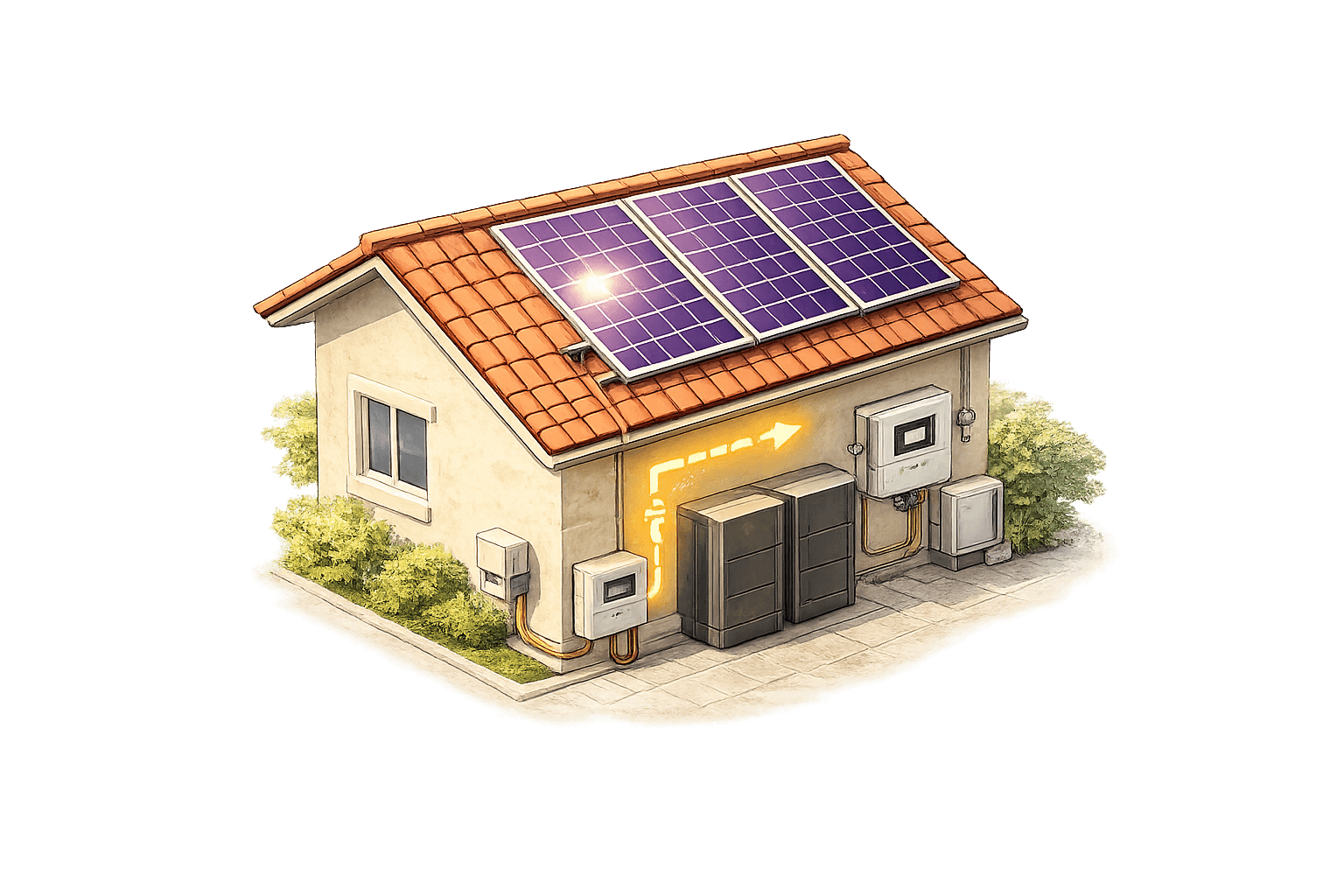
To truly sell solar power to grid India, you must size your system correctly.
- Under-sizing: If you install 2kW but need 5kW, you will still pay high-slab rates for the remaining power.
- Over-sizing: If you install 10kW but only need 3kW, the DISCOM will only pay you the APPC rate (approx. ₹4) for the massive surplus at the end of the year, which is lower than the ₹8 you save by not buying power.
We recommend sizing for 80-100% of your annual average consumption. Use our Solar Calculator to find your specific requirement.
2026 Update: Time of Day (ToD) Tariffs
The landscape is shifting. Some states are introducing Time of Day (ToD) tariffs, where electricity is cheaper during the day (when solar is abundant) and expensive at night.
- Why this matters: Your solar exports will happen during the "cheap" hours.
- The Solution: This makes Hybrid Solar Systems with lithium batteries more attractive, as you can store your solar power and use it during the expensive peak night hours.
Why ROI is 30-40% Higher with Net Metering
Without net metering, any power you don't use the moment it's generated is "wasted" (unless you have expensive batteries). Net metering allows the grid to act as a 100% efficient, free battery.
- Weekend Credits: In offices, Saturday/Sunday generation is fully exported and used to offset Monday-Friday consumption.
- Seasonal Banking: Excess power generated in the sunny months of March and April helps offset heavy AC usage in June and July.
Even if you choose a no-subsidy route to speed up installation, ensuring you have a net meter is the single most important factor for financial success.
Common Frustrations & How to Handle Them
The most common complaint is: "My solar panels are installed, but the DISCOM hasn't changed the meter!" During this period, if you turn your solar system on, a traditional meter might count your exports as consumption, actually increasing your bill. Pro Tip: Do not turn on your system until the bi-directional meter is installed and programmed. If delays exceed 30 days post-installation, you have the right to escalate via the DERC or HERC consumer forums.
FAQ
How much does a net meter cost in India?
A residential single-phase net meter typically costs between ₹2,500 and ₹5,000, while three-phase meters can range from ₹7,000 to ₹12,000. These charges are usually paid directly to the DISCOM or included in your EPC package.
Can I get net metering for my flat in an apartment?
Yes, through Virtual Net Metering (VNM) or Group Net Metering. This allows residents to install panels on a common roof and have the credits adjusted against their individual flat's electricity bill. This is very popular in Dwarka RWA societies.
Does net metering work during a power cut?
No. For safety reasons, on-grid solar inverters shut down during a power cut (anti-islanding) to prevent electrocuting linemen working on the grid. If you need power during outages, you must install a Hybrid Solar System.
What happens to my excess credits at the end of the year?
In most states, the "banking cycle" ends on March 31st. If you still have surplus units, the DISCOM will buy them at a pre-determined APPC rate (usually ₹3–4.5/unit) and credit the amount to your electricity account.
Is net metering mandatory for solar?
It is not mandatory to function, but it is mandatory if you want to receive credits for excess power sent to the grid. Without it, you can only save money through "behind-the-meter" self-consumption.
Conclusion
Net metering is the engine that drives the financial viability of rooftop solar in India. By turning the grid into a virtual battery, it allows you to capitalize on every ray of sunshine that hits your roof.
However, navigating DISCOM approvals and technical sizing requires expertise. With over 5,000+ installations and a legacy dating back to 1990, Bridgeway Power ensures your net metering journey is seamless.
Ready to see your meter run backwards? Contact Bridgeway Power for a free site audit and net metering feasibility report today. Let’s turn your roof into a revenue generator. ⚡
Every 1 kW of solar on your roof offsets 1.5 tonnes of CO₂ per year
That's 40 trees planted — every year, for 25 years.
A typical 5 kW home system offsets 187 tonnes of carbon over its lifetime. That's equivalent to taking 8 cars off the road.
See your impact →How much can you save with solar?
Enter your electricity bill → get system size, subsidy amount & payback period
Get StartedTranslate your bill into a system size
Related Articles
What Is Captive Open Access Solar (100% Equity Model)
Learn how Captive Open Access Solar (100% Equity Model) helps Indian businesses cut electricity costs by 40% using off-site solar plants. Guide on rules, savings & ROI.
Read moreHow Rooftop Solar Can Eliminate Your Electricity Bill
Discover how Net Metering and PM Surya Ghar subsidies can reduce your monthly electricity bill to near-zero. Learn about system sizing, costs, and real-world savings.
Read moreSolar Subsidy in Uttar Pradesh 2026: ₹1,08,000 for Noida, Ghaziabad & Greater Noida
UP's stacked solar subsidy 2026: ₹78,000 central + ₹30,000 UPNEDA state top-up = ₹1.08L. Real PVVNL net-cost math for Noida, Greater Noida, Ghaziabad & Meerut.
Read moreRelated guides
Delhi Electricity Rate 2026
BSES & Tata Power per-unit rates, PPAC, subsidy — sourced from DERC.
ExploreDelhi Solar Policy 2026
Free rooftop solar up to 3 kW for homes under 400 units. Eligibility & apply.
ExploreSolar Panel Price in Delhi
Live 2026 rooftop prices in Delhi after ₹1.56L subsidy. 1,200+ installs.
ExploreSolar Company in Gurgaon
Gurgaon's rooftop solar installer — 800+ systems, ₹78K PM Surya Ghar subsidy.
ExploreSolar Company in Noida
Noida & Greater Noida rooftop solar — 500+ installs, ₹1.08L stacked subsidy.
ExploreSolar Panel Price in Faridabad
Live 2026 Faridabad prices after ₹78K PM Surya Ghar subsidy. 350+ homes.
Explore