
By Vansh Dahiya · Reviewed by Arshi Chadha, Founder
Hybrid Solar System Components and Wiring: ACDB, DCDB, Changeover and Battery Setup (India 2026)
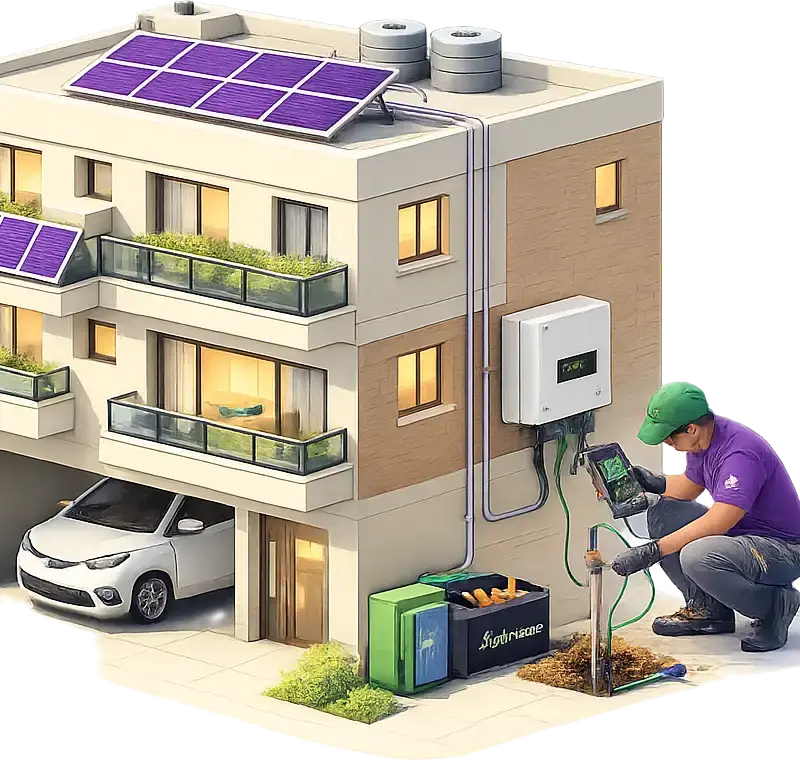
Installing a solar system in India is no longer just about putting "plates" on the roof. As we move into 2026, the shift toward hybrid solar system wiring has accelerated. Unlike simple on-grid systems that shut down during power cuts, or off-grid systems that can’t export surplus power to the grid, a hybrid system gives you the best of both worlds: bill savings via net metering and emergency backup via batteries.
However, the "magic" happens behind the scenes. If your installer doesn't prioritize the precision of the ACDB and DCDB or uses undersized cables, your expensive lithium battery and high-tech topcon modules are at risk. In this guide, we’ll dismantle the mystery of hybrid wiring, covering everything from surge protection to the critical role of the changeover switch.
1. The Anatomy of a Hybrid Solar System: Main Components
A hybrid system is more complex than its on-grid cousin because it handles three power sources: the Sun, the Grid, and the Battery. To manage this safely, a specific set of components is required.
Complete Component Checklist:
- Solar Panels: High-efficiency Topcon Mono PERC 600Wp modules are the gold standard for 2026.
- Hybrid Inverter: The "brain" that synchronizes grid power, solar power, and battery charging.
- DC Distribution Box (DCDB): Sits between the panels and the inverter.
- AC Distribution Box (ACDB): Sits between the inverter and your home’s electrical load.
- Battery Bank: Typically Lithium Ferro Phosphate (LFP) for 12+ years of life.
- Changeover Switch: Allows you to bypass the solar system if repairs are needed.
- Earthing & Lightning Protection: Discharges surges safely into the ground.
2. The DC Side: Understanding the DCDB
The DCDB (DC Distribution Box) is the first line of defense. Because solar panels generate Direct Current (DC), which is harder to extinguish than AC if a spark occurs, this box is non-negotiable.
What’s Inside the DCDB?
- DC MCB (Miniature Circuit Breaker): Allows you to manually cut power from the panels for maintenance.
- DC SPD (Surge Protection Device): This is the most critical part. It protects your inverter's sensitive MPPT trackers from lightning-induced voltage spikes.
- DC Fuses: Provides over-current protection for each string of panels.
Pro-Tip: Many budget installers skip the DCDB to save ₹3,000–₹5,000. In India’s dusty and lightning-prone environment, this is a recipe for a fried inverter. Always insist on a DCDB with a transparent cover for easy inspection.
3. The AC Side: The Role of the ACDB
The ACDB (AC Distribution Box) handles the power after the inverter has converted it into usable 230V AC. While the DCDB protects the equipment, the ACDB's primary goal is to protect people and the home's internal wiring.
Components of a Professional ACDB:
- AC MCB: Trips if there is a short circuit in your home appliances.
- AC SPD: Protects the inverter from surges coming from the grid (very common in India due to transformer fluctuations).
- Energy Meter (Optional): Some systems include a secondary meter here to verify the inverter’s display accuracy.
Hybrid Solar System Component Specs (India 2026)
| Component | Function | Typical Spec (for 5kW) | Recommended Brand |
|---|---|---|---|
| Solar Panels | Photovoltaic generation | 600Wp Topcon Mono PERC | Waaree / Vikram / Adani |
| Hybrid Inverter | Power conversion & charging | 5kW Single Phase | Deye / Solis / Sungrow |
| Battery Bank | Energy storage | 5kWh - 10kWh LFP | Li-Energy / Pylontech / Okaya |
| DCDB | DC circuit protection | 2-in 2-out, 1000V SPD | Hensel / Elmex |
| ACDB | AC circuit protection | 32A MCB + Type II SPD | Schneider / ABB / L&T |
| Changeover | Grid/Solar isolation | 40A 4-Pole (Manual/Auto) | Havells / HPL |
4. The Changeover Switch: Manual vs. Automatic
A solar changeover switch is essential for any hybrid setup. It acts as a bridge. If your solar system ever needs a software update or a component replacement, you don't want your house to be in the dark.
- Manual Changeover: A physical lever you flip. It’s reliable and cheap (approx. ₹1,500).
- Automatic Transfer Switch (ATS): Detects a fault and switches to the grid in milliseconds. This costs roughly ₹3,000–₹5,000 extra but is highly recommended for homes with sensitive electronics or home offices.
5. Master the Wiring: Batteries and Cables
The wiring is where 90% of DIY or local "electrician-installed" systems fail. Direct Current (DC) suffers significantly higher losses over distance compared to AC.
Cable Sizing Guide
Using the wrong gauge (thickness) of wire causes heat buildup and reduces your generation by 5–10%.
- Under 1kW: 4mm² DC Cable (Twin Core)
- 1kW to 3kW: 6mm² DC Cable
- 3kW to 5kW: 10mm² DC Cable (Essential for high-wattage 600Wp panels)
Talk to a solar engineer — not a salesperson
Enter your pincode and monthly bill. If we install in your area, an engineer answers on WhatsApp with your numbers.
What would solar save on YOUR bill?
Battery Setup & Wiring
In 2026, most hybrid systems in India use 48V or 96V battery banks.
- Series Wiring: Connect the positive of one battery to the negative of the next to increase voltage (e.g., 4 x 12V Lead Acid = 48V).
- Parallel Wiring: Connect positive to positive to increase capacity (Ah).
- The Golden Rule: Never mix an old battery with a new one. The old battery will "drag down" the performance of the new one, leading to premature failure.
6. Earthing: The Life-Saver
Grounding is non-negotiable. A hybrid solar system wiring India project requires a minimum of TWO separate earth pits:
- DC Earthing: For the solar panel frames and the lightning arrestor (LA).
- AC/Inverter Earthing: For the inverter body and the ACDB/DCDB enclosures.
Using a single earth pit for both is a safety violation. If lightning strikes the panels, a shared earth could potentially send that high-voltage surge back into your home through the inverter. Always use an 8ft copper-bonded rod with chemical earthing compound for the best results in India's varied soil conditions.
7. Real-Life Example: 5kW Hybrid System in Gurgaon
Consider a 3BHK villa in Sushant Lok, Gurgaon. The owner faced 2-hour daily power cuts during peak summer.
The Setup:
- Panels: 9 x 580Wp Mono PERC Modules
- Inverter: 5kVA Hybrid (Grid-Export Enabled)
- Battery: 5kWh Lithium (LFP)
- Wiring: 10mm² DC cables for minimal loss.
- Result: The owner’s bill dropped from ₹9,000 to ₹1,200, and they now have a 4-hour backup for 2 ACs, lights, and fans without ever hearing a "beep" from a traditional UPS.
Calculate your potential savings here
8. Common Mistakes to Avoid
- Skipping DCDB: As mentioned, 50% of unauthorized installers skip this. It voids your inverter warranty!
- Cramped Spacing: Always leave at least 1 foot of clearance around your ACDB, DCDB, and Inverter. These components generate heat; they need airflow to function efficiently.
- No Cable Trays: Leaving DC wires exposed to the sun and rain on the roof leads to insulation cracks within 3 years. Use UV-protected conduits or GI cable trays.
- Incorrect Polarity: Reversing the + and - wires in a DC circuit can cause an immediate fire or "pop" the inverter's internal fuses.
9. Financing and Support
Installing a hybrid system is a significant investment. Residents in Delhi can leverage the Delhi Solar Policy 2026 for GBI incentives, while homeowners across India can explore financing through:
- SBI PM Surya Ghar Loan
- PNB Solar Rooftop Scheme
- Canara Bank Solar Loan
- Digital-first partners like ECOFY and Aerem.
Frequently Asked Questions
Can I add batteries to my existing on-grid solar system?
Only if your inverter is "Hybrid-Ready." Most standard on-grid inverters (like Growatt or Sungrow string models) cannot accept a direct battery connection. You would need to replace the inverter or use an AC-coupled battery system.
Is a manual changeover switch safe for a hybrid system?
Yes, it is extremely safe and often preferred for its simplicity. However, you will experience a 1-2 second power flicker when you manually flip the switch. For uninterrupted power, an ATS is better.
Why does my hybrid inverter get hot during battery charging?
Charging a lithium battery at high current creates thermal energy. This is why the solar ACDB DCDB function includes maintaining safe distances. Ensure your inverter is mounted in a ventilated area, not a closed cupboard.
How much maintenance does the wiring need?
Very little, but you should have a professional check the terminal tightness once a year. India’s temperature swings cause wires to expand and contract, which can loosen screws over time. Loose wires cause sparking and energy loss.
Does PM Surya Ghar provide subsidy for hybrid systems?
The PM Surya Ghar Yojana provides subsidy based on the solar capacity (kW), not the inverter type. However, the cost of the battery is NOT covered by the subsidy. You pay for the battery out of pocket, but you still get the central subsidy for the solar components.
Conclusion
A hybrid solar system is the ultimate energy insurance policy for the modern Indian home. By ensuring your hybrid solar system wiring India follows IS standards—with dedicated ACDBs, DCDBs, and proper earthing—you protect your family and your 25-year investment.
Ready to switch to a worry-free hybrid setup? Bridgeway Power's team brings 35+ years of solar experience engineering high-performance systems. Contact us today for a free site audit and professional wiring diagram tailored to your roof.",excerpt:
Every 1 kW of solar on your roof offsets 1.5 tonnes of CO₂ per year
That's 40 trees planted — every year, for 25 years.
A typical 5 kW home system offsets 187 tonnes of carbon over its lifetime. That's equivalent to taking 8 cars off the road.
See your impact →How much can you save with solar?
Enter your electricity bill → get system size, subsidy amount & payback period
Get StartedLiked this article? Get a free solar quote
Tell us about your rooftop — we'll call with exact savings for your home.
Related Articles
What Is Captive Open Access Solar (100% Equity Model)
Learn how Captive Open Access Solar (100% Equity Model) helps Indian businesses cut electricity costs by 40% using off-site solar plants. Guide on rules, savings & ROI.
Read moreHow Rooftop Solar Can Eliminate Your Electricity Bill
Discover how Net Metering and PM Surya Ghar subsidies can reduce your monthly electricity bill to near-zero. Learn about system sizing, costs, and real-world savings.
Read moreSolar Subsidy in Uttar Pradesh 2026: ₹1,08,000 for Noida, Ghaziabad & Greater Noida
UP's stacked solar subsidy 2026: ₹78,000 central + ₹30,000 UPNEDA state top-up = ₹1.08L. Real PVVNL net-cost math for Noida, Greater Noida, Ghaziabad & Meerut.
Read moreRelated guides
Delhi Electricity Rate 2026
BSES & Tata Power per-unit rates, PPAC, subsidy — sourced from DERC.
ExploreDelhi Solar Policy 2026
Free rooftop solar up to 3 kW for homes under 400 units. Eligibility & apply.
ExploreSolar Panel Price in Delhi
Live 2026 rooftop prices in Delhi after ₹1.56L subsidy. 1,200+ installs.
ExploreSolar Company in Gurgaon
Gurgaon's rooftop solar installer — 800+ systems, ₹78K PM Surya Ghar subsidy.
ExploreSolar Company in Noida
Noida & Greater Noida rooftop solar — 500+ installs, ₹1.08L stacked subsidy.
ExploreSolar Panel Price in Faridabad
Live 2026 Faridabad prices after ₹78K PM Surya Ghar subsidy. 350+ homes.
Explore