
By Mahendra Singh · Reviewed by Arshi Chadha, Founder
Dwarka Society Solar: The 2026 RWA Guide to Community Solar, VNM and BSES Rajdhani
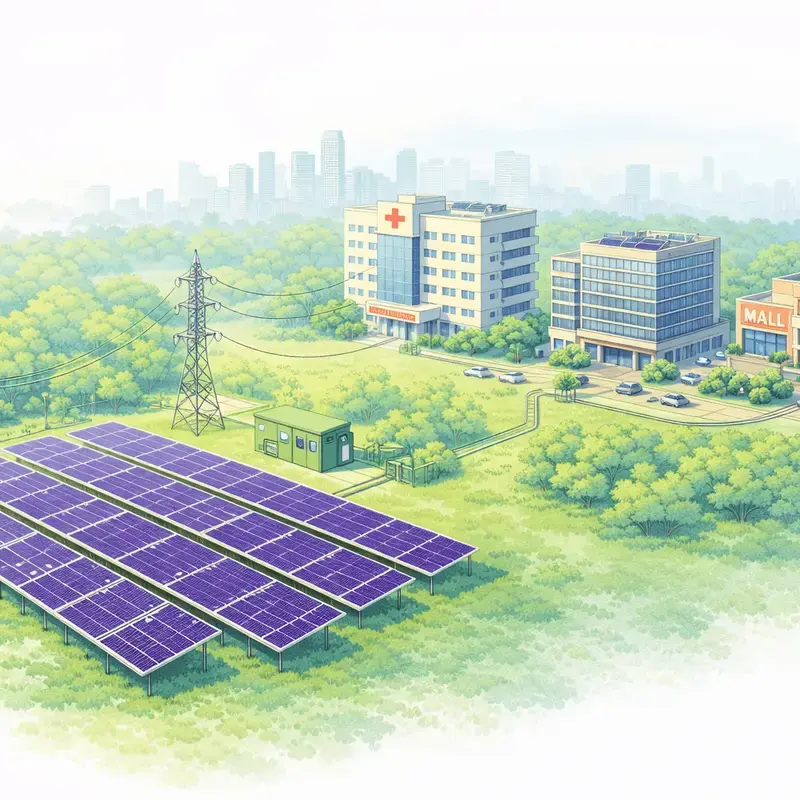
One GBM resolution. One BRPL application. Two independent balance sheets.
If your Dwarka society has been "thinking about solar" for two years and going nowhere, the problem is almost never the panels. It is the politics of who owns the roof, who pays, and who gets the credit on their BSES bill. Community solar — done through Virtual Net Metering — is the only structure that actually solves all three at once.
This is the playbook we use to take a Dwarka cooperative group housing society from a confused GBM agenda item to a commissioned solar plant. No fluff, no greenwashing, just the rules and the math.
1. Why Dwarka is the easiest place in Delhi to do society solar
Dwarka is unusual in Delhi for one reason: it was planned. The sub-city has roughly 350 registered cooperative group housing societies spread across thirty sectors, most built in the 1990s and 2000s with broadly similar towers, similar load profiles, and — critically — large shared rooftops that nobody can sell.
Three things make Dwarka the cleanest pilot ground for community solar:
- One DISCOM, one set of rules. Every pin code in Dwarka (110075, 110077, 110078) sits under BSES Rajdhani Power Limited. Unlike South or East Delhi where Tata Power DDL or BSES Yamuna can complicate cross-society projects, Dwarka is monolithic.
- Roof you can actually use. A 14-storey Dwarka tower with ~80 flats typically has 600–900 sqm of usable shadow-free roof. That fits a 60–90 kW plant — enough to offset roughly 70% of common-area load plus meaningful per-flat credit.
- The CGHS structure is VNM-friendly. Cooperative societies are already a registered legal entity that can apply for a single VNM connection on behalf of all members. RWA-only colonies elsewhere in Delhi often have to invent a Section 8 vehicle first.
We have 5,000+ installations across NCR and the question we get most often from Dwarka GBMs is the same one. Let's answer it directly.
2. The decision tree: can YOUR Dwarka society do community solar today?
Walk through these four questions in your next managing committee meeting:
(a) Is the building connected to BSES Rajdhani? If your meter says BRPL, yes. (It does — you are in Dwarka.)
(b) Is the sanctioned load of the society's common-area connection at least 11 kW? DERC's VNM regulations let you install up to the sanctioned load of the parent connection. Almost every Dwarka high-rise crosses this comfortably.
(c) Do you have a clear, shadow-free roof patch of at least 100 sqm? That gives you a ~10 kW starter plant. Most Dwarka towers have far more.
(d) Can you get a 75% GBM majority for a capital expense between ₹3 lakh and ₹50 lakh, OR are you open to a zero-investment OPEX model? If yes to either, you are ready.
If you said yes to all four, the only thing standing between your society and a commissioned plant is paperwork — which is what the rest of this guide is for.
3. How VNM actually works for a Dwarka high-rise
The model is simple once you stop thinking like an individual rooftop owner.
The society installs one solar plant on the common roof. That plant is connected via a single bi-directional meter to BSES Rajdhani's grid under the society's existing common-area connection. Every unit of solar exported gets logged.
At the end of each billing cycle, BRPL takes the total exported units and distributes them as credits across the individual flat meters in proportions the society defines in its VNM application — typically equal share per flat, or weighted by sanctioned load. Each flat owner sees the credit on their own BSES bill, automatically.
That is the magic of Virtual Net Metering: the panels are physically on one roof, but the financial benefit is virtually distributed to many meters. There is no need for separate inverters per flat, no rewiring inside individual homes, and no individual subsidy applications.
The legal basis is the DERC (Group Net Metering and Virtual Net Metering for Renewable Energy) Guidelines, 2019, read with the Net Metering Regulations of 2014. The application flow is documented on the BSES Rajdhani solar portal.
4. The Dwarka subsidy stack — common vs individual
Most society treasurers get this wrong because they treat solar as one bucket. It is two. Run them on separate balance sheets, or you will argue about money for six months.
Bucket A — Common-area plant (society pays, society benefits)
This plant powers lifts, water pumps, corridor lighting, STP — anything billed to the RWA's common-area connection. The RWA pays the capex, the RWA pockets the savings.
- Capital subsidy: ₹29,000 per installed kW — ₹18,000 central + ₹11,000 Delhi state (DCR panels)
- GBI: none on society common-area plants
- Who funds it: society maintenance corpus or a one-time per-flat levy
- Who benefits: the RWA's monthly common-area bill drops
Bucket B — Individual flat VNM (each owner pays for their own kW)
Under VNM, each flat owner sponsors their share of kW on the shared rooftop and receives credit on their own BSES bill — same as if the panels were on their own balcony.
- Installed cost: ~₹50,000 per kW (residential rate)
- Subsidy stack for 3 kW: ₹1,56,000 total = ₹78,000 PM Surya Ghar central + ₹78,000 Delhi state
- GBI: ₹3 per unit generated for systems under 3 kW, paid for 5 years
- Who funds it: each participating flat owner individually
- Who benefits: that flat's monthly residential bill drops
Talk to a solar engineer — not a salesperson
Enter your pincode and monthly bill. If we install in your area, an engineer answers on WhatsApp with your numbers.
What would solar save on YOUR bill?
What this looks like for an 80-flat Dwarka tower
A realistic split is 30 kW common-area + 50 flats × 2 kW VNM = 130 kW on the same rooftop. The RWA approves both in one GBM resolution and BRPL processes them under a single society-level application — but the money flows are kept separate from day one.
- Common-area 30 kW plant: ~₹15 lakh gross, minus ₹8.7 lakh subsidy (₹5.4 lakh central + ₹3.3 lakh Delhi) = ₹6.3 lakh net to the society
- Each VNM flat (2 kW):
₹1 lakh gross, minus ₹78,000 stacked subsidy = **₹22,000 net** to the flat owner
That is why community solar in Dwarka works: the RWA only writes the cheque for the common plant, and 50 flat owners each write a ₹22,000 cheque for their own VNM share. Nobody is subsidising anyone.
5. The application flow — what your committee actually has to do
Here is the seven-step path from GBM to commissioned plant. Most Dwarka societies complete this in 75 to 110 days.
- Site feasibility — shadow analysis, structural load check, roof area measurement. (We do this free for any Dwarka CGHS that asks.)
- GBM resolution — society members approve the project, the financing model, and the credit-sharing rule (equal vs weighted).
- VNM application to BRPL — submitted via the BSES Rajdhani portal with the resolution, electrical SLD, and the credit-share matrix.
- Technical feasibility study — BRPL inspects the parent connection and load.
- Subsidy registration — concurrent application on the National Portal for Rooftop Solar.
- Installation and commissioning — typically 15–25 working days for a 60 kW plant.
- Net meter installation by BRPL — the only step the society does not control. Plan for 20–30 days here.
6. Frequently asked questions from Dwarka RWAs
How does VNM work for a Dwarka society? The society installs one solar plant on its shared roof under its common-area BRPL connection. Generated units are credited proportionally to individual flat meters every billing cycle, based on a credit-share rule the society files with BRPL.
Which DISCOM handles Dwarka? BSES Rajdhani Power Limited (BRPL) covers every Dwarka sector, from Sector 1 through Sector 30, including the new sub-city extensions.
Can a CGHS apply for group net metering instead of VNM? Yes, if all participating meters are physically on the same premises (which a CGHS satisfies). GNM is often simpler than VNM administratively. We help societies choose based on their meter topology.
What is the minimum society size that makes community solar worthwhile? Anything above 40 flats with a common-area sanctioned load over 11 kW is financially worth it. Below that, individual rooftop on duplex/penthouse units often makes more sense.
Do all flat owners have to pay equally? No. The society GBM decides. Most Dwarka societies we work with split the capex via the sinking fund or a one-time society levy, then distribute credits equally per flat. Others weight it by carpet area or sanctioned load. Both are legal.
7. Where this fits in our broader work
This guide is the Dwarka-specific application of three deeper resources we maintain:
- How Community Solar Works in India: VNM, GNM & Savings Explained
- Virtual Net Metering in India: How Apartments and Societies Can Go Solar
- Group Net Metering in India: A Guide for Commercial & Institutional Groups
If you sit on the managing committee of a Dwarka CGHS and want a verified feasibility study for your tower, get a quote or message us on WhatsApp. We will walk your committee through the GBM presentation, the BRPL application, and the subsidy math — for free.
The roof above your head is already producing about ₹7 lakh worth of electricity every year. You just have not collected it yet.
FAQ
Which DISCOM handles solar applications for Dwarka societies?
Every pin code in Dwarka (110075, 110077, 110078) falls under BSES Rajdhani Power Limited (BRPL). All Virtual Net Metering applications, feasibility approvals and CEIG clearances route through BRPL, which keeps the paperwork consistent across sectors 1–30.
What subsidy does a Dwarka RWA get on a community solar plant?
RWAs and Group Housing Societies get ₹29,000 per kW on the common-area plant: ₹18,000 central under PM Surya Ghar plus an additional ₹11,000 per kW from the Delhi government. Both need DCR panels. There is no GBI on society plants. Individual flat owners still claim their own residential subsidy on their own meters.
How does Virtual Net Metering (VNM) actually credit each flat?
Under DERC's Group / Virtual Net Metering Regulations, a single society-owned solar plant exports units to the grid and BRPL credits pre-declared share percentages to each participating flat's electricity bill every billing cycle. The society files one application; members sign a beneficiary allocation sheet.
What size plant makes sense for a typical Dwarka tower?
A 14-storey Dwarka tower with 80 flats has 600–900 sqm of usable shadow-free roof, which fits a 60–90 kW plant. That typically offsets about 70% of common-area load and still leaves meaningful per-flat credit.
What is the payback period for a Dwarka society solar project?
4–5 years for a 50–100 kW plant after applying the RWA subsidy, with the plant running for 25 years under a 25-year performance warranty on panels. Common-area DG dependence during outages also falls sharply, which is the second-order saving societies usually forget to count.
Every 1 kW of solar on your roof offsets 1.5 tonnes of CO₂ per year
That's 40 trees planted — every year, for 25 years.
A typical 5 kW home system offsets 187 tonnes of carbon over its lifetime. That's equivalent to taking 8 cars off the road.
See your impact →How much can you save with solar?
Enter your electricity bill → get system size, subsidy amount & payback period
Get StartedLiked this article? Get a free solar quote
Tell us about your rooftop — we'll call with exact savings for your home.
Related Articles
Lock In a Fixed Electricity Rate for Your School — Before Delhi Tariffs Rise Again
Lock in your school's electricity rate before Delhi tariffs hit ₹16/unit. Learn how Community Solar offers zero-capex savings of ₹10L+ annually.
Read moreWhat Delhi's Solar Policy Means for Apartment Owners and Non-Rooftop Residents
Discover how Delhi's 2026 solar policy enables apartment owners to save 40% on bills using Virtual Net Metering. No roof access or RWA NOC required.
Read moreVirtual Net Metering (VNM) in India: How It Enables Community Solar for Homeowners
Learn how Virtual Net Metering (VNM) enables community solar in India. Discover how DERC and RERC policies allow flat owners to share solar credits without individual rooftops.
Read moreRelated guides
Delhi Electricity Rate 2026
BSES & Tata Power per-unit rates, PPAC, subsidy — sourced from DERC.
ExploreDelhi Solar Policy 2026
Free rooftop solar up to 3 kW for homes under 400 units. Eligibility & apply.
ExploreSolar Panel Price in Delhi
Live 2026 rooftop prices in Delhi after ₹1.56L subsidy. 1,200+ installs.
ExploreSolar Company in Gurgaon
Gurgaon's rooftop solar installer — 800+ systems, ₹78K PM Surya Ghar subsidy.
ExploreSolar Company in Noida
Noida & Greater Noida rooftop solar — 500+ installs, ₹1.08L stacked subsidy.
ExploreSolar Panel Price in Faridabad
Live 2026 Faridabad prices after ₹78K PM Surya Ghar subsidy. 350+ homes.
Explore