
By Bhawna Thakur · Reviewed by Arshi Chadha, Founder
Hidden Costs in Solar Quotations: What Installers Don't Say
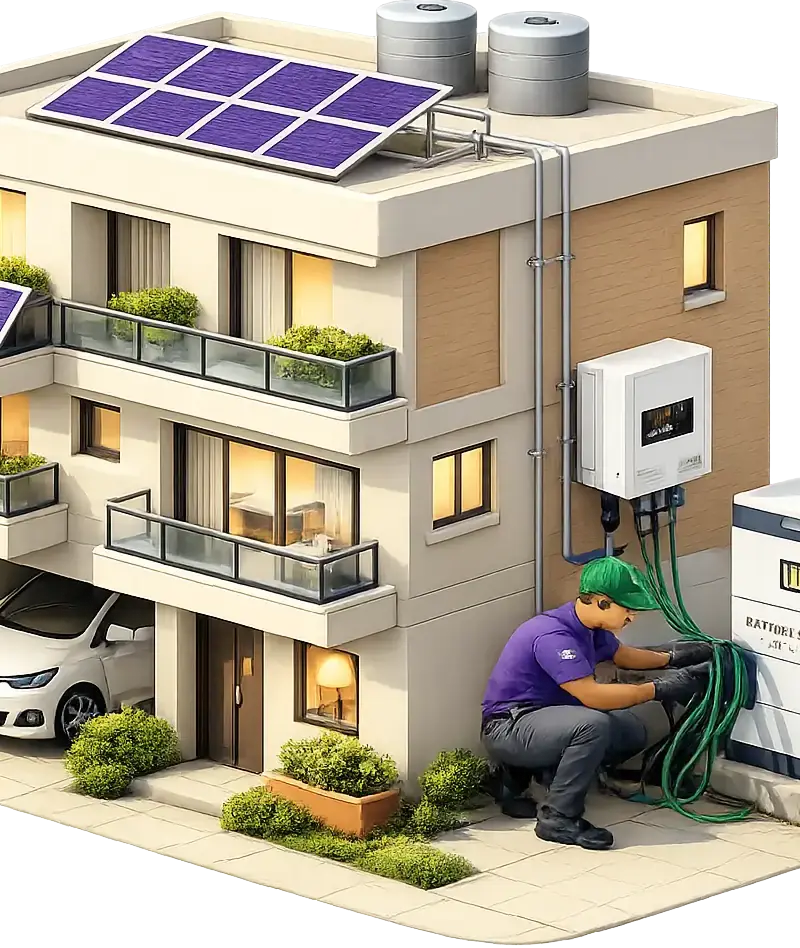
- •Primary Concern: Most solar quotes omit 15–25% of the final bill in 'site-specific' add-ons.
- •Critical Missing Items: Elevated structures, extra wiring, and net metering liaisoning fees.
- •Financial Impact: A ₹2.4L quote can easily hit ₹2.9L once the team arrives on-site.
- •Best Practice: Demand a fixed-price contract after a physical site survey.
The first thing you need to know about a solar quote in India is that the "lowest price" is usually a trap. We’ve seen it thousands of times in Delhi NCR: a homeowner gets a quote for a 5kW system at a rock-bottom price, only to be slapped with a bill for "extra wiring," "elevated structure premiums," and "government liaisoning fees" the moment the truck arrives.
At Bridgeway Power, having spent 35+ years in the electrical and solar industry, we’ve learned that transparency is rarer than a clear sky in November. A cheap quote isn't a bargain if it leaves out the components required to keep your roof from leaking or your panels from flying off during a dust storm.
Here is the truth about the hidden costs in solar installation quotation that most sales reps won't mention until you’ve already paid the booking amount.
The Structure Trap: Standard vs. Site-Specific Engineering
Most installers quote a "standard structure." In the solar world, "standard" usually means a low-tilt frame that sits 1–2 feet off the ground. But if you live in a builder floor in Rohini or a bungalow in Sushant Lok, you likely want to use your roof for walking, gardening, or drying clothes.
To do that, you need an elevated structure. This isn't just a few extra pipes; it requires heavy-duty galvanised iron (GI) or MS structures, specialized civil work (pedestals), and potentially wind-loading reinforcement.
Mounting Structure Cost Add-ons
If your roof has a high parapet wall or you want 7–10 feet of clearance, the mounting structure cost will jump significantly.
- Standard GI Structure: Included in the base price (usually ~₹1,500/kW value).
- High-Rise/Elevated GI: Often adds ₹3,000 to ₹5,000 per kW.
- Pergola or Aesthetic Structures: Can add up to ₹15,000 per kW.
If an installer hasn't climbed your roof with a measuring tape, their quote for the structure is just a guess. Don't be surprised when they ask for an extra ₹20,000 for "additional MS bracing" because your area is prone to high wind speeds. You can check the best structure for solar panels to see which one fits your specific roof type.
Wiring: The "Kit" vs. The Reality
A standard solar kit usually includes 15–20 meters of DC and AC cable. For a small house, that might suffice. But for a 3-story building where the panels are on the top roof and the net meter is at the ground floor gate, 20 meters won't even get you halfway.
These solar installation extra charges for cabling are the most common "gotcha" in the industry.
- DC Cable: Connects panels to the inverter.
- AC Cable: Connects the inverter to your main distribution board.
- Earthing Wire: Crucial for safety.
We’ve seen sites where the customer was charged ₹250 per meter for extra 6sqmm DC cable because the installer "forgot" to account for the height of the building. Always ask: “How many meters of wiring are included, and what is the per-meter rate for extras?”
Before you sign, use a Solar Calculator to estimate your system size correctly so you don't end up needing more panels (and more wiring) than originally planned.
Net Metering: The Paperwork Nobody Wants to Mention
In Delhi, BSES Rajdhani and Tata Power have specific protocols for solar integration. In Haryana, DHBVN has a completely different portal. Most quotes list "Net Metering" as an inclusion, but they omit the net metering hidden fees associated with:
- Liaisoning: The cost of a technician visiting the DISCOM office multiple times.
- Application Fees: Government portal charges.
- Meter Testing: The cost of getting your new bi-directional meter certified.
- Sanctioned Load Increase: If your 5kW solar system exceeds your current 3kW sanctioned load, the DISCOM will charge you for a load upgrade.
Many installers will give you the equipment but tell you to "handle the DISCOM yourself." Trust us—you don't want to do that. It involves navigating the PM Surya Ghar Yojana portal and coordinating with inspectors. Ensure your quote explicitly covers the liaisoning service, or you’ll be stuck with a system that's installed but not allowed to turn on.
Inclusion Checklist: Standard vs. Add-ons
Use this table to audit any quote you receive. If an item in the "Common Add-ons" column is necessary for your roof but missing from your quote, you are looking at a hidden cost.
| Component | Usually Included (Standard) | Common Add-on Costs (Hidden) |
|---|---|---|
| Structure | Low-tilt GI (1-2 ft height) | Elevated structures (>6 ft), MS structures, Pergolas |
| Cabling | 15–20 meters of AC/DC cable | Extra length for multi-story buildings, conduit pipes |
| Net Metering | Application filing | Load increase charges, meter testing fees, liaisoning |
| Safety | Basic Earthing | Lightning Arrester (LA) for high-rise buildings |
| Monitoring | Wi-Fi Inverter capability | Wi-Fi range extenders or data SIM cards |
| Civil Work | Standard anchor bolts | Concrete pedestals, waterproofing, tiling repair |
| Maintenance | 1st year basic support | Professional cleaning (AMC), pigeon proofing |
Talk to a solar engineer — not a salesperson
Enter your pincode and monthly bill. If we install in your area, an engineer answers on WhatsApp with your numbers.
What would solar save on YOUR bill?
Solar Depreciation & Tax Benefit Calculator
Based on Section 32 — 40% WDV + 20% additional depreciation (Year 1)
The Post-Install Hangover: AMC and Cleaning
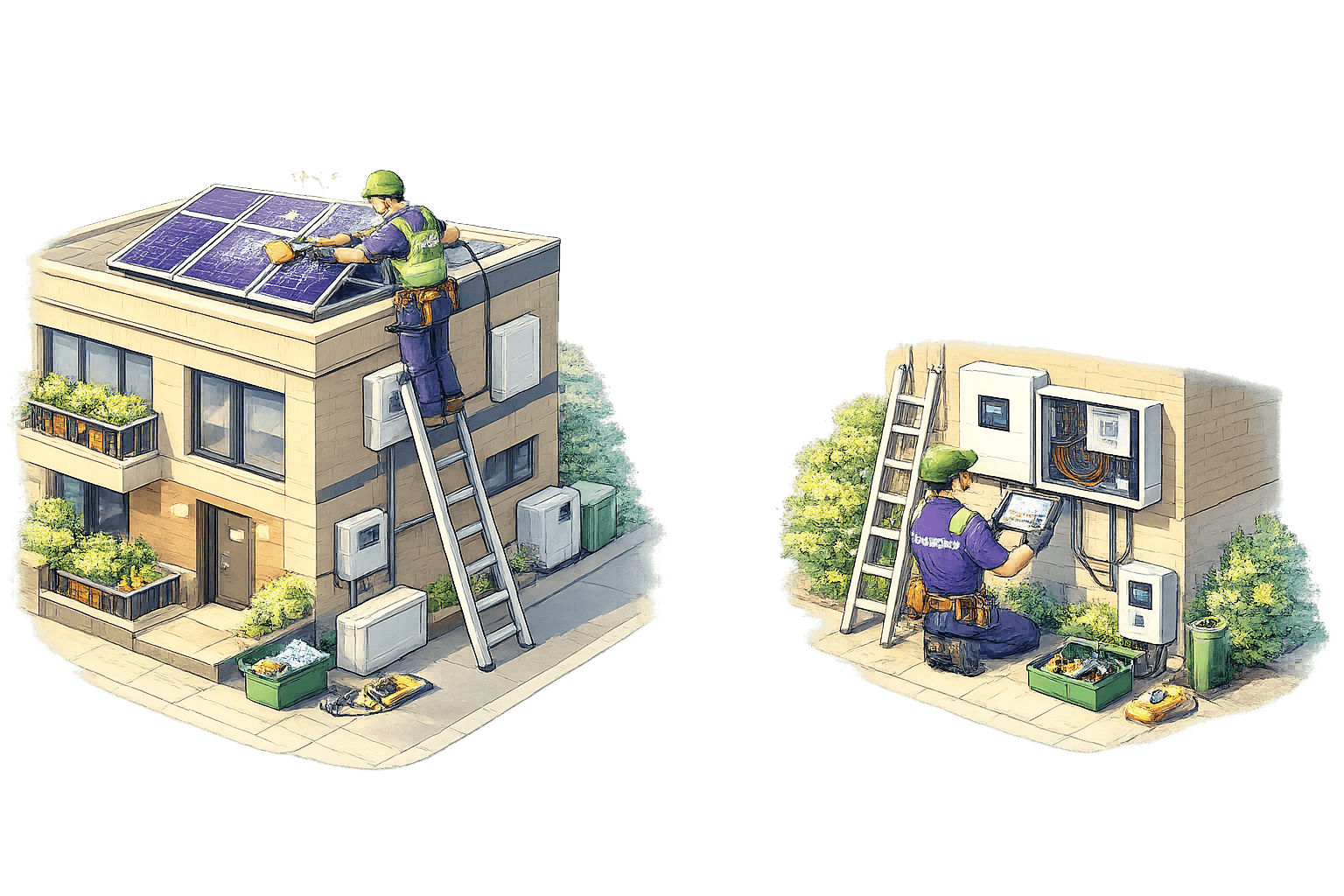
Solar is "low maintenance," but it isn't "no maintenance." In a city like Noida or Ghaziabad, dust and bird droppings can reduce your generation by 20–30% in just two weeks.
Most installers provide "Year 1 Free Service," which usually means they’ll send someone to wash the panels twice. But what happens in Year 2? If you don't have a plan for solar panel cleaning, your ROI will tank.
We recommend looking at AMC plans early. A professional service includes checking the DC connections (which can loosen due to thermal expansion) and ensuring the inverter is actually communicating with the grid. If your installer doesn't offer a long-term service contract, they are planning to "install and vanish."
Real Example: The "₹2.5 Lakh" 5kW System
A homeowner in Janakpuri recently showed us a quote from a competitor for a 5kW system priced at ₹2,50,000. It looked like a steal. However, after a site visit, the following "unforeseen" costs were added:
- Elevated Structure: The roof had a 4ft parapet; panels needed to be raised to avoid shadows. Cost: ₹25,000.
- Extra Wiring: The inverter was in the basement, panels on the 3rd floor. Cost: ₹12,000.
- Net Metering Liaisoning: The installer claimed this was "extra service." Cost: ₹10,000.
- Sanctioned Load Increase: The house was on 4kW; needed 5kW. Cost: ₹8,000.
The "₹2.5 Lakh bargain" became a ₹3.05 Lakh reality. This is why we insist on a free site survey before giving a final number.
From our installs
We recently completed an installation for a bungalow in Gurugram. The initial estimate based on the bill was for a 10kW system. However, during the site survey, we noticed the customer had a large 2000L water tank that would cast a significant shadow during winter months.
- System Size: 10kW
- Locality: A bungalow in Gurugram
- Result: We recommended an elevated GI structure to clear the shadow zone. While this increased the upfront cost by ₹30,000, the system now generates 4.2 units/kW/day consistently.
- Caveat: Even with the best structure, if the customer doesn't clean the panels every 15 days in the dusty Gurgaon environment, generation drops to 3.2 units almost immediately.
FAQ
Why is there a price difference between DCR and Non-DCR panels?
DCR (Domestic Content Requirement) panels are made in India (cells and modules) and are mandatory if you want to claim the government subsidy. Non-DCR panels are usually slightly cheaper—by about ₹10,000 per kW—but they disqualify you from the ₹78,000 central subsidy. Always check which one is quoted.
Does the solar quote include GST?
In 2026, the blended GST for residential solar is roughly 8.9%. Some installers quote "Excluding GST" to make the price look lower. Always verify if the total includes all taxes and GST on solar.
Will I be charged extra for earthing?
A safe system needs three separate earthing pits: DC, AC, and Lightning Arrester. Some budget installers only do one or two to save money. If your quote doesn't specify three pits, you’ll likely be asked for an extra ₹5,000–₹8,000 per pit during installation.
Is the net meter provided by the installer or the DISCOM?
The meter itself is usually provided by the DISCOM (like BSES or DHBVN) after you pay a security deposit, but the installer should handle the procurement and testing process. Make sure the "Liaisoning" fee is clearly defined in your hidden costs in solar installation quotation checklist.
Do I need to pay for a site survey?
Most reputable companies like Bridgeway Power offer a free site survey. If an installer asks for money just to look at your roof, it’s a sign they might be looking for every opportunity to add "extra charges" later.
The best way to avoid these headaches is to look for a partner with a long track record—not just a sales office. We’ve been through the iterations of the Delhi Solar Policy and seen every trick in the book. If you want a quote that actually stays the same from day one to the day you switch on the lights, get a free quote from our engineering team.
Reviewed by: Gurubaksh Singh, Senior Solar Advisor, Bridgeway Power",excerpt:
Every 1 kW of solar on your roof offsets 1.5 tonnes of CO₂ per year
That's 40 trees planted — every year, for 25 years.
A typical 5 kW home system offsets 187 tonnes of carbon over its lifetime. That's equivalent to taking 8 cars off the road.
See your impact →How much can you save with solar?
Enter your electricity bill → get system size, subsidy amount & payback period
Get StartedLiked this article? Get a free solar quote
Tell us about your rooftop — we'll call with exact savings for your home.
Related Articles
What Is Captive Open Access Solar (100% Equity Model)
Learn how Captive Open Access Solar (100% Equity Model) helps Indian businesses cut electricity costs by 40% using off-site solar plants. Guide on rules, savings & ROI.
Read moreHow Rooftop Solar Can Eliminate Your Electricity Bill
Discover how Net Metering and PM Surya Ghar subsidies can reduce your monthly electricity bill to near-zero. Learn about system sizing, costs, and real-world savings.
Read moreSolar Subsidy in Uttar Pradesh 2026: ₹1,08,000 for Noida, Ghaziabad & Greater Noida
UP's stacked solar subsidy 2026: ₹78,000 central + ₹30,000 UPNEDA state top-up = ₹1.08L. Real PVVNL net-cost math for Noida, Greater Noida, Ghaziabad & Meerut.
Read moreRelated guides
Delhi Electricity Rate 2026
BSES & Tata Power per-unit rates, PPAC, subsidy — sourced from DERC.
ExploreDelhi Solar Policy 2026
Free rooftop solar up to 3 kW for homes under 400 units. Eligibility & apply.
ExploreSolar Panel Price in Delhi
Live 2026 rooftop prices in Delhi after ₹1.56L subsidy. 1,200+ installs.
ExploreSolar Company in Gurgaon
Gurgaon's rooftop solar installer — 800+ systems, ₹78K PM Surya Ghar subsidy.
ExploreSolar Company in Noida
Noida & Greater Noida rooftop solar — 500+ installs, ₹1.08L stacked subsidy.
ExploreSolar Panel Price in Faridabad
Live 2026 Faridabad prices after ₹78K PM Surya Ghar subsidy. 350+ homes.
Explore