
By Sandeep Maurya · Reviewed by Arshi Chadha, Founder
DCR vs Non-DCR Solar Panels: Which One Keeps Your ₹78,000 Subsidy?
Don't lose ₹78,000 over the wrong panel
Send us the quotation you have. We'll tell you if those modules are ALMM List-II DCR — before the DISCOM inspection decides for you.
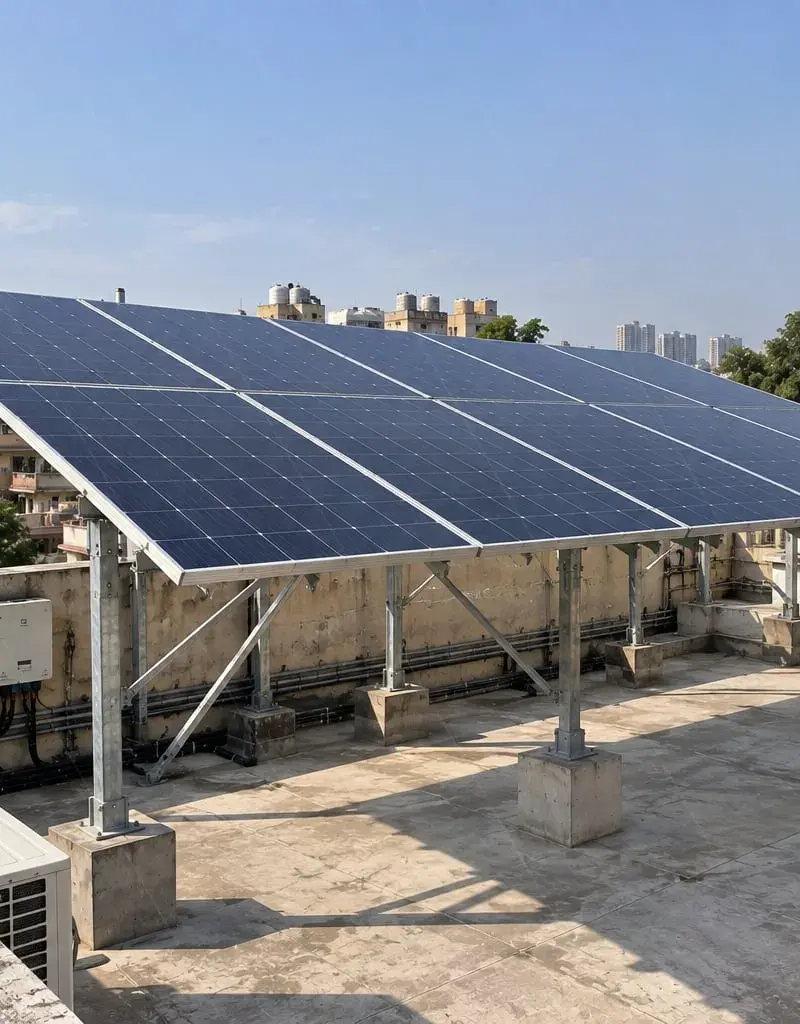
Short answer: If you want the PM Surya Ghar subsidy, you must install DCR panels — panels whose cells and modules are made in India and listed under ALMM List-II. Non-DCR panels (imported cells) are roughly ₹10,000 per kW cheaper, but choosing them means you forfeit the entire central subsidy of up to ₹78,000, and in Delhi the stacked central + state subsidy of ₹1,56,000. On a 3 kW home system the discount never covers the loss.
What DCR actually means
DCR stands for Domestic Content Requirement. Under the Ministry of New and Renewable Energy rules that govern PM Surya Ghar Muft Bijli Yojana, a subsidised rooftop system must use modules where both stages are made in India:
- The solar cell is manufactured in India.
- The module (the finished panel) is assembled in India from those cells.
Only modules meeting both conditions appear on ALMM List-II (the Approved List of Models and Manufacturers for solar PV cells). A panel can be assembled in a factory outside Delhi and still be non-DCR if the cell inside it was imported — which is the case for a large share of what is sold in the NCR market.
Non-DCR simply means the module does not meet that rule. It is not illegal, not unsafe, and not lower quality by definition. Plenty of Tier-1 imported modules outperform Indian DCR modules on efficiency. The only thing non-DCR loses you is government money.
The money, side by side
Take a standard 3 kW residential system — the most common size in Delhi NCR homes.
| DCR panels | Non-DCR panels | |
|---|---|---|
| Hardware cost difference | baseline | about ₹30,000 less (₹10,000/kW × 3) |
| PM Surya Ghar central subsidy | ₹78,000 | ₹0 |
| Delhi state capital subsidy | ₹78,000 | ₹0 |
| Net position (Delhi) | — | ₹1,26,000 worse off |
| Net position (Uttar Pradesh) | — | ₹78,000 worse off |
| Net position (Haryana) | — | ₹48,000 worse off |
The central subsidy ladder is fixed: ₹30,000 up to 2 kW, ₹60,000 up to 3 kW, and ₹78,000 at 3 kW and above. It does not scale beyond ₹78,000 no matter how big the system is.
State stacking is where the gap widens sharply:
- Delhi: following the Delhi Solar Energy Policy amendment approved on 2 September 2026, the state capital subsidy is ₹78,000, stacking with the central amount to ₹1,56,000. Domestic consumers averaging up to 400 units a month can get a system up to 3 kW at effectively zero cost, with the government covering the gap between the stacked subsidy and the tendered plant cost. The free rooftop solar scheme for Delhi homes breaks down exactly who qualifies for that zero-cost route.
- Uttar Pradesh: a flat ₹30,000 state top-up, stacking to ₹1,08,000.
- Haryana: no state capital subsidy in 2026. The central ₹78,000 is the whole amount.
So when does non-DCR make sense?
There is a real answer here, and it is not "never".
Non-DCR is the right choice when you are not eligible for the subsidy in the first place. That covers:
- Commercial and industrial rooftops. PM Surya Ghar is a residential scheme. A factory in Faridabad or an office in Noida gets no central subsidy regardless of panel origin, so paying a DCR premium buys nothing. Non-DCR is straightforwardly cheaper.
- Housing societies and RWA common-area plants that sit outside the residential subsidy route.
- Systems above the subsidy ceiling. If you are installing 10 kW, only the first slice attracts the ₹78,000 cap. The panels beyond that carry no subsidy value, though most installers keep the whole array on one module type for warranty simplicity.
- Off-grid and backup-only systems that are never connected for net metering.
DCR is the right choice for essentially every subsidised residential rooftop. The arithmetic is not close.
Talk to a solar engineer — not a salesperson
Enter your pincode and monthly bill. If we install in your area, an engineer answers on WhatsApp with your numbers.
See your exact subsidy after state stacking
How to verify a panel is genuinely DCR before you pay
This is where homeowners get caught. Verbal assurance is worthless — check the paperwork.
- Ask for the exact make and model number, not just the brand. DCR status is per-model, not per-manufacturer. The same company sells both.
- Match it against ALMM List-II published by MNRE. List-I covers modules; List-II covers cells and is the one that determines DCR eligibility.
- Check the module serial numbers and the RFID tag. Every DCR module carries a traceable serial that is uploaded during subsidy processing.
- Insist the model is written into the quotation and the work order, not just discussed. If the delivered model differs from the quoted one, you have written grounds to reject it.
- Confirm before the DISCOM inspection. Once BRPL, BYPL, TPDDL, DHBVN or PVVNL flags a non-DCR module during inspection, your subsidy claim is rejected and re-doing the array is entirely at your cost.
The December 2026 deadline
MNRE's current DCR framework and the ALMM List-II enforcement timeline run to the end of December 2026. Policy may be extended, tightened, or restructured after that. What that means practically: if you are planning a subsidised residential installation in Delhi NCR, the rules you can rely on today are the rules that exist today. Commissioning and subsidy claim both need to complete under the current framework — not just the booking.
What we do at Bridgeway
We quote DCR modules by default on every residential rooftop in Delhi NCR, because on a subsidised home system it is the only rational choice. We put the exact model number on the quotation, run the PM Surya Ghar and state subsidy filing ourselves, and handle the DISCOM inspection. On commercial rooftops, where no subsidy exists, we quote non-DCR where it saves you money and say so plainly.
If you have a quotation in hand from another installer and you are not sure whether the panels on it are DCR, send it to us. We will tell you what the model number actually is and whether it will survive the subsidy inspection.
FAQ
Can I get the PM Surya Ghar subsidy with non-DCR solar panels?
No. The subsidy requires modules that meet the Domestic Content Requirement — Indian-made cells in Indian-made modules, listed under ALMM List-II. A non-DCR module makes the entire claim ineligible, not partially reduced.
How much cheaper are non-DCR panels in India?
Roughly ₹10,000 per kW at Bridgeway's 2026 price band. On a 3 kW system that is about ₹30,000 — against ₹78,000 to ₹1,56,000 of subsidy you would be giving up.
Are DCR panels lower quality than imported panels?
Not necessarily, though imported Tier-1 modules often carry a small efficiency edge. For a typical Delhi NCR home roof the generation difference over a year is marginal compared to the subsidy difference, which is immediate and large.
How do I check whether the panel my installer quoted is DCR?
Get the exact model number in writing and match it against MNRE's ALMM List-II. Brand alone is not enough — most manufacturers sell both DCR and non-DCR variants of similar-looking modules.
Does DCR matter for a commercial or factory rooftop?
No. PM Surya Ghar is a residential scheme, so a commercial plant gets no central subsidy either way. On those projects non-DCR is usually the cheaper and sensible choice.
What happens if a non-DCR panel is found during the DISCOM inspection?
The subsidy claim is rejected. Replacing the array afterwards is at your own cost, and the subsidy application has to be refiled from the start. This is why the model number belongs on the work order before installation begins.
Every 1 kW of solar on your roof offsets 1.5 tonnes of CO₂ per year
That's 40 trees planted — every year, for 25 years.
A typical 5 kW home system offsets 187 tonnes of carbon over its lifetime. That's equivalent to taking 8 cars off the road.
See your impact →How much can you save with solar?
Enter your electricity bill → get system size, subsidy amount & payback period
Get StartedSee your exact subsidy after state stacking
Related Articles
What Is Captive Open Access Solar (100% Equity Model)
Learn how Captive Open Access Solar (100% Equity Model) helps Indian businesses cut electricity costs by 40% using off-site solar plants. Guide on rules, savings & ROI.
Read moreHow Rooftop Solar Can Eliminate Your Electricity Bill
Discover how Net Metering and PM Surya Ghar subsidies can reduce your monthly electricity bill to near-zero. Learn about system sizing, costs, and real-world savings.
Read moreSolar Subsidy in Uttar Pradesh 2026: ₹1,08,000 for Noida, Ghaziabad & Greater Noida
UP's stacked solar subsidy 2026: ₹78,000 central + ₹30,000 UPNEDA state top-up = ₹1.08L. Real PVVNL net-cost math for Noida, Greater Noida, Ghaziabad & Meerut.
Read moreRelated guides
10 kW Solar Generation: Units per Day in Delhi NCR
40–54 units/day, 15,000/year. Net cost ₹4.42L (Noida) to ₹4.72L (DHBVN). 3.9-yr payback.
ExploreFree 3 kW Rooftop Solar in Delhi
Under 400 units/month? Zero upfront cost — ₹1.56L subsidy plus a government gap top-up.
ExploreDelhi Solar Subsidy Above 400 Units
Over 400 units/month? You still get the full ₹1.56L subsidy on 3 kW. Net ₹84,000.
ExplorePM Surya Ghar Subsidy Amount (2026)
Exact ₹78,000 central subsidy by system size — and when it lands after commissioning.
ExploreSBI Solar Loan for PM Surya Ghar
Surya Ghar loan rate, EMI and zero-down options to finance a rooftop system.
ExploreSolar Installation in Gurugram: Cost & Subsidy
DHBVN net metering + PM Surya Ghar ₹78,000. Real cost for DLF, Sushant Lok, Sector 57 — no fake Haryana stacking.
Explore