
By Vansh Dahiya · Reviewed by Arshi Chadha, Founder
Solar Panel Cleaning in India: Why Dirty Panels Lose 20–30% Power
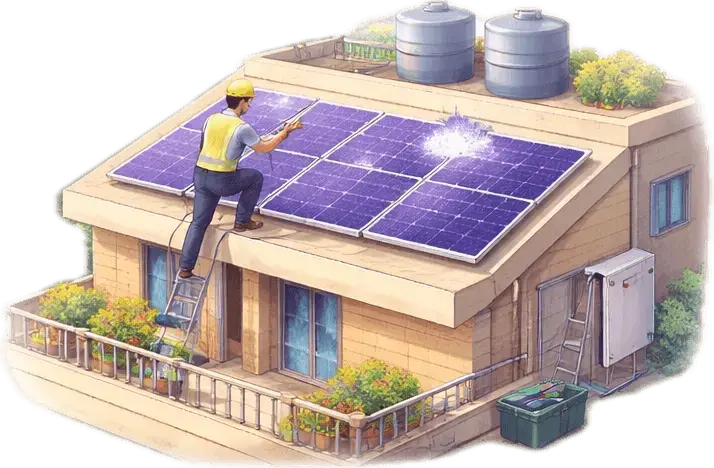
- •Efficiency Loss: Uncleaned panels lose 20–30% of their power generation capacity within a month in typical Indian conditions.
- •Main Culprits: Fine dust (PM2.5/PM10), bird droppings, and pollen.
- •Ideal Frequency: Once every 7–14 days depending on your location.
- •Economic Impact: For a 10kW system, poor cleaning can lead to a monthly loss of ₹2,500–₹4,000 in savings.
- •Solution: Professional AMC services ensure maximum ROI and panel longevity.
India is currently witnessing a solar revolution. From the rooftops of Kerala to the industrial hubs of Gujarat, solar panels are becoming a common sight. However, there is a silent "energy thief" lurking on millions of Indian rooftops: dust.
If you have installed a solar system, you likely did it to slash your electricity bills and contribute to a greener planet. But here is a hard truth: if you aren't prioritizing solar panel cleaning in India, you are literally throwing money away. In the Indian context—characterized by high particulate matter, construction dust, and long dry spells—a solar panel is only as good as its transparency.
In this comprehensive guide, we will dive deep into why dirty panels lose 20–30% of their power, the science of "soiling losses," and how a professional Annual Maintenance Contract (AMC) can save your investment from degrading prematurely.
The Science of Soiling: Why "Dirty" Means "Dead" Energy
In technical terms, the accumulation of dust, dirt, and other organic matter on solar modules is known as soiling. In a country like India, which faces high levels of air pollution and dust storms (especially in Northern and Western regions), soiling is the single biggest controllable factor affecting energy yield.
Solar panels work by allowing photons from sunlight to strike silicon cells, creating an electric current. When a layer of dust sits on the glass, it acts as a physical barrier. It reflects and absorbs the light before it ever reaches the solar cells.
Power Loss From Dust Accumulation
The rate of power loss in India is significantly higher than in European or North American countries due to our tropical climate and high suspended particulate matter (SPM).
| Duration Without Cleaning | Estimated Power Yield Loss | Financial Impact (Estimated) |
|---|---|---|
| 1 Week | 10% Loss | Minimal but noticeable |
| 2 Weeks | 15% - 18% Loss | Significant drop in daily units |
| 1 Month | 20% - 30% Loss | Substantial monetary loss |
| 3 Months+ | 40% - 50% Loss | System fails to meet ROI targets |
As the table shows, solar panel cleaning in India isn't a luxury; it’s a core maintenance requirement. A 10kW system meant to generate 40 units a day might only produce 28 units if left uncleaned for a month. Over a year, that’s thousands of units lost.
The Main Culprits Behind Power Loss in India
1. Fine Dust (PM2.5 and PM10)
India has some of the world’s highest dust levels. Construction activity, unpaved roads, and agricultural residue all contribute to a fine layer of silt that sticks to the panels. This dust is often "cementitious," meaning it hardens when it comes into contact with morning dew, making it harder to remove with just a light breeze.
2. Bird Droppings (The "Hotspot" Creator)
Bird droppings are more than just an eyesore; they are a technical hazard. Bird droppings are opaque and acidic. They create "hotspots" where the covered cell cannot generate electricity but continue to receive it from neighboring cells. This causes the cell to overheat, which can lead to permanent damage, glass cracking, or even fire hazards.
3. Industrial Pollutants and Soot
If your home or factory is near an industrial zone or a busy highway, oily soot and carbon particles will settle on your panels. Water alone often fails to remove these greasy layers, requiring specialized professional cleaning agents.
Why the Indian Monsoon Is Not a "Self-Cleaning" Solution
A common myth among Indian solar owners is that the monsoon will take care of cleaning. This is only partially true. While a heavy downpour can wash away loose dust, light rain often does more harm than good.
Light rain mixes with existing dust to create a muddy sludge that settles in the corners of the panel frame. When the sun comes out, this mud bakes into a hard crust. Furthermore, rain does nothing to remove sticky bird droppings or oily industrial residues. Relying solely on rain for solar panel cleaning in India leads to "shading" at the edges of the cells, which triggers the bypass diodes and reduces the entire string's efficiency.
Proper Cleaning Techniques: What to Do and What to Avoid
Many homeowners make the mistake of using harsh chemicals or abrasive tools, thinking they are doing a "thorough job." This can void your warranty and permanently scratch the anti-reflective coating (ARC) on the glass.
The "Dough and Don'ts" of Solar Cleaning:
- NO Abrasives: Never use steel wool, abrasive sponges, or scouring pads.
- NO Harsh Chemicals: Avoid bleach, strong detergents, or ammonia-based cleaners. These can degrade the frame and the glass.
- Water Temperature: Never pour cold liquid water on a hot panel (like at 2 PM in May). The thermal shock can shatter the glass. Clean early in the morning or late in the evening.
- Wipedown: Use a soft squeegee or a microfiber cloth attached to a telescopic pole.
Mandatory Cleaning Frequency in India
Depending on your geographic location in India, your cleaning schedule should vary:
| Location Type | Environment Factors | Recommended Cleaning Frequency |
|---|---|---|
| High Dust Zones | Rajasthan, Delhi NCR, near construction sites | Weekly (Every 7 days) |
| Coastal Areas | Kerala, Mumbai, Chennai (Salt accumulation) | Bi-Weekly (Every 14 days) |
| Greener/Rural Areas | Parts of Karnataka, Himachal (Pollen/Sap) | Bi-Weekly (Every 14 days) |
| Industrial Zones | MIDC areas, Gujarat industrial belts | Weekly (Due to soot/chemicals) |
Real-Life Example: The Cost of Neglect
Consider a 5kW rooftop system in a residential colony in Gurugram.
- Expected Generation: ~600 units (kWh) per month.
- Electricity Tariff: ₹8 per unit.
- Potential Revenue: ₹4,800 per month.
The owner neglected solar panel cleaning in India for two months during the dry summer season. Due to a 30% soiling loss, the system only produced 420 units.
- Actual Revenue: ₹3,360.
- Monthly Loss: ₹1,440.
- Annual Loss: Over ₹17,000.
In this scenario, a professional AMC would have cost less than the amount lost in generation, while also ensuring the system's mechanical safety.
Talk to a solar engineer — not a salesperson
Check whether we install in your area, then get your answer on WhatsApp. No forms, no call centre.
What would solar save on YOUR bill?
DIY Cleaning vs. Professional AMC: Which is Better?
While some homeowners prefer a Do-It-Yourself approach, there are significant risks involved, including falls from heights and electrical shocks.
| Feature | DIY Cleaning | Professional AMC (Bridgeway Power) |
|---|---|---|
| Equipment | Garden hose, basic cloth | De-mineralized water, soft solar brushes, safety harnesses |
| Power Check | Not possible | Inverter log analysis & string testing |
| Safety | High risk of slips/falls | Certified professionals with safety gear |
| System Health | Surface level only | Deep inspection of MC4 connectors, earthing, and structures |
| Cost | Low (Time cost high) | Economical when considering ROI & Longevity |
A professional AMC service from Bridgeway Power doesn’t just involve a bucket and a mop. It includes:
- Module Cleaning: Using pressurized water and specialized brushes.
- Electrical Inspection: Checking for loose wires or burnt connectors.
- Inverter Health Check: Ensuring the firmware is updated and the cooling fans are working.
- Performance Monitoring: Comparing actual yield against theoretical yield to spot hidden issues.
Interactive Demo: See the Difference
Curious how much power your specific city's dust levels are stealing? Check out Bridgeway's interactive panel cleaning demo [here] (Search "Bridgeway Solar Cleaning Demo") to see a side-by-side comparison of clean vs. soiled panels in real Indian weather conditions.
Why 35+ Years of Experience Matters
At Bridgeway Power, we have seen the evolution of solar technology in India. We understand that a panel installed in the humid climate of Kochi requires different maintenance than one in the dusty plains of Punjab. Our AMC packages are designed to maximize your uptime and ensure your 25-year warranty remains valid.
Frequently Asked Questions
Is it okay to use tap water for solar panel cleaning in India?
If your tap water is "hard" (high TDS), it can leave white calcium deposits on the glass over time, which are extremely difficult to remove. It is always better to use soft water or filtered water for the final rinse.
Can I stand on the solar panels to reach the middle?
Absolutely not. Walking on solar panels creates micro-cracks in the silicon cells that are invisible to the naked eye. These cracks will eventually lead to "snail trails" and complete panel failure. Always use telescopic tools.
Do I need to clean my solar panels in the winter?
Yes. In fact, winter in many Indian cities (especially North India) is associated with high smog and fog levels. Smog particles are very greasy and can significantly reduce generation, making regular cleaning even more crucial.
Why does Bridgeway Power recommend cleaning only in the morning or evening?
During peak sunlight, the surface temperature of a solar panel can reach 60°C–70°C. If you splash water at 25°C on it, the glass can experience "thermal shock" and shatter. Morning (before 9 AM) and evening (after 5 PM) are THE safest times.
Does bird poop really damage the panels permanently?
Yes, it can. Bird droppings create a 100% shade on a small spot. This forces the cell to dissipate energy as heat (hotspot). If left for months, this heat can burn through the backsheet of the panel, rendering it useless.
Conclusion
Your solar power plant is a financial asset. Just as you wouldn't run a luxury car for years without a service, you shouldn't let your solar panels sit unmaintained. With solar panel cleaning in India impacting your efficiency by up to 30%, the math is simple: a clean panel pays for itself.
Don't let dust dictate your savings. Ensure your system operates at peak performance with a professional touch.
Ready to boost your solar output? Contact Bridgeway Power today for a free rooftop health check and AMC consultation. we bring 35+ years of engineering excellence to your doorstep.
Every 1 kW of solar on your roof offsets 1.5 tonnes of CO₂ per year
That's 40 trees planted — every year, for 25 years.
A typical 5 kW home system offsets 187 tonnes of carbon over its lifetime. That's equivalent to taking 8 cars off the road.
See your impact →Protect your existing solar system
Annual maintenance plans — panel cleaning, remote monitoring & emergency support
Get StartedProtect your solar investment
Panel cleaning, inverter checks, and generation monitoring — all year, all covered.
Or get a free solar quote
Tell us about your rooftop — we'll call with exact savings for your home.
Related Articles
Annual Solar Maintenance Cost in India: DIY vs AMC vs One-Time Service
Learn the real annual solar maintenance cost in India for 2026. Compare DIY, one-time service, and AMC plans to maximize your rooftop solar savings.
Read moreHow to Correctly Read Your Solar Net Meter Display
Master how to read solar net meter displays (Secure/Genus), understand Export vs. Import codes, and verify your DISCOM bill accuracy in Delhi NCR.
Read moreNPCL Solar Net Metering in Greater Noida: Process & Documents
Learn the exact NPCL solar net metering process in Greater Noida. Get the document checklist, application steps, and timeline for rooftop solar approval in 2026.
Read moreRelated guides
Delhi Electricity Rate 2026
BSES & Tata Power per-unit rates, PPAC, subsidy — sourced from DERC.
ExploreDelhi Solar Policy 2026
Free rooftop solar up to 3 kW for homes under 400 units. Eligibility & apply.
ExploreSolar Panel Price in Delhi
Live 2026 rooftop prices in Delhi after ₹1.56L subsidy. 1,200+ installs.
ExploreSolar Company in Gurgaon
Gurgaon's rooftop solar installer — 800+ systems, ₹78K PM Surya Ghar subsidy.
ExploreSolar Company in Noida
Noida & Greater Noida rooftop solar — 500+ installs, ₹1.08L stacked subsidy.
ExploreSolar Panel Price in Faridabad
Live 2026 Faridabad prices after ₹78K PM Surya Ghar subsidy. 350+ homes.
Explore