
By Vansh Dahiya · Reviewed by Arshi Chadha, Founder
GST and HSN Codes for Solar Power Plant Equipment
If you’re sitting across from a solar installer in India today, the conversation usually revolves around subsidies and unit generation. But the moment the pro-forma invoice hits your desk, things get confusing. You’ll see terms like "Mixed Supply," "Composite Supply," and a string of numbers known as HSN codes.
At Bridgeway Power, we’ve handled over 5,000 installations across 35+ years. We’ve seen the tax laws evolve from a flat 5% GST to the current complex split-rate system. Getting the solar power generating system hsn code right isn't just a matter of compliance for us—it’s about ensuring you don't overpay due to lazy billing practices.
Identifying HSN Codes for Solar Components
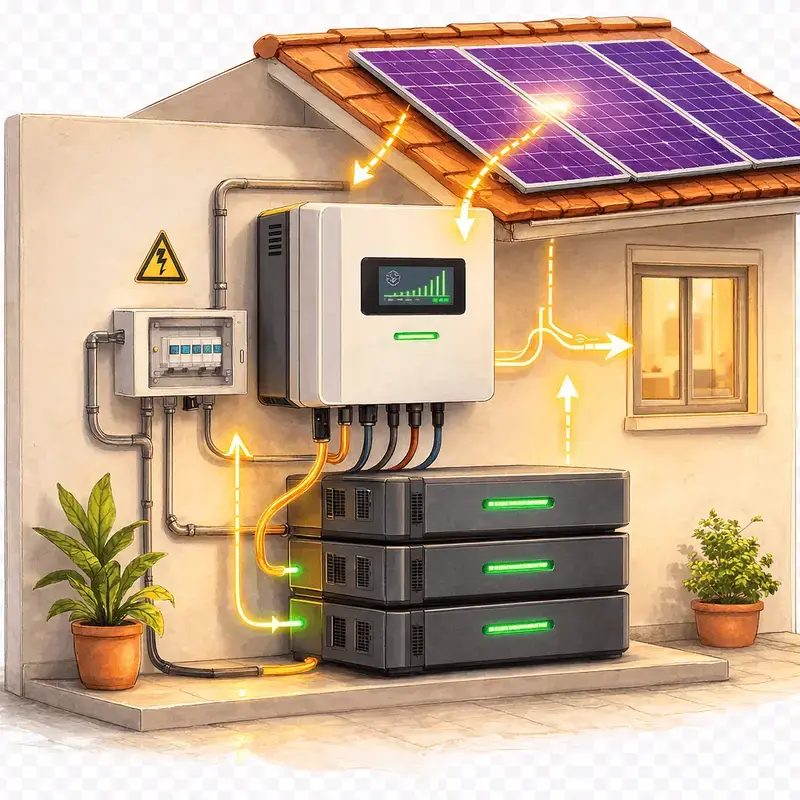
The Harmonized System of Nomenclature (HSN) is how the government categorizes goods for taxation. For a solar plant, you aren't just buying one "item." You’re buying a system comprised of modules, inverters, cables, and structures. Each has a specific code, but when sold as a "Solar Power Generating System," the primary code governs the transaction.
HSN Codes for Solar Components
Here is the breakdown of the codes we use for the primary components in our BOM (Bill of Materials):
| Component | HSN Code | Description |
|---|---|---|
| Solar PV Modules | 85414300 | Photovoltaic cells assembled in modules or made up into panels |
| Solar Inverters | 850440 | Static converters (String/Micro/Hybrid) |
| Solar Battery (LFP) | 85076000 | Lithium-ion accumulators |
| Mounting Structures | 73089090 | Galvanized Iron (GI) or Aluminum structures |
| DC/AC Cables | 8544 | Insulated electric conductors |
| DCDB / ACDB Boxes | 8537 | Boards, panels, consoles for electric control |
If you are a commercial buyer in Noida or Delhi, checking these codes on your vendor's quote is the first step in auditing your project cost. Using an incorrect solar inverter hsn code or structure code can lead to GST input tax credit (ITC) rejections later.
The "70:30 Rule": Mixed Supply GST Explained
This is where most homeowners get tripped up. You might hear that the solar panel gst rate is 12%. Then you see an invoice where the total tax looks closer to 9%.
The Ministry of Finance clarified that a solar installation is a "Composite Supply." Since the panels (goods) and the installation (service) are bundled, the government mandates a specific split for tax calculation.
- 70% of the total contract value is treated as the value of "Goods" (taxed at 12% GST).
- 30% of the total contract value is treated as the value of "Services" (taxed at 18% GST).
When you blend these, the effective tax rate comes out to 8.9%.
Effective GST Rate for Integrated Solar Projects
| Category | Value Split | GST Rate | Effective Combined Rate |
|---|---|---|---|
| Goods (Modules/BOS) | 70% | 12% | 8.4% |
| Services (Installation) | 30% | 18% | 5.4% (on the 30% portion) |
| Total Project | 100% | N/A | ~8.9% (Blended) |
We apply this blended GST rate to all our residential projects in Gurgaon and Faridabad. If an installer tries to bill you 18% on the entire project, they are either uninformed or pocketing a margin they shouldn't have. Conversely, if they bill the whole thing at 12%, they are creating a future tax liability for you.
How HSN Codes Impact Your Final Invoice
The solar power generating system hsn code (typically 8541) acts as an umbrella. When we provide an EPC (Engineering, Procurement, and Construction) quote, we break down the epc billing components to show the transparency of this 70:30 split.
For a customer using our Solar Calculator to plan a 5kW system, the HSN code ensures they qualify for the PM Surya Ghar Yojana benefits. The national portal requires specific documentation where the HSN codes must match the MNRE-approved list of components.
Talk to a solar engineer — not a salesperson
Enter your pincode and monthly bill. If we install in your area, an engineer answers on WhatsApp with your numbers.
What would solar save on YOUR bill?
Solar Depreciation & Tax Benefit Calculator
Based on Section 32 — 40% WDV + 20% additional depreciation (Year 1)
Real Example: Billing a 5kW System in Delhi
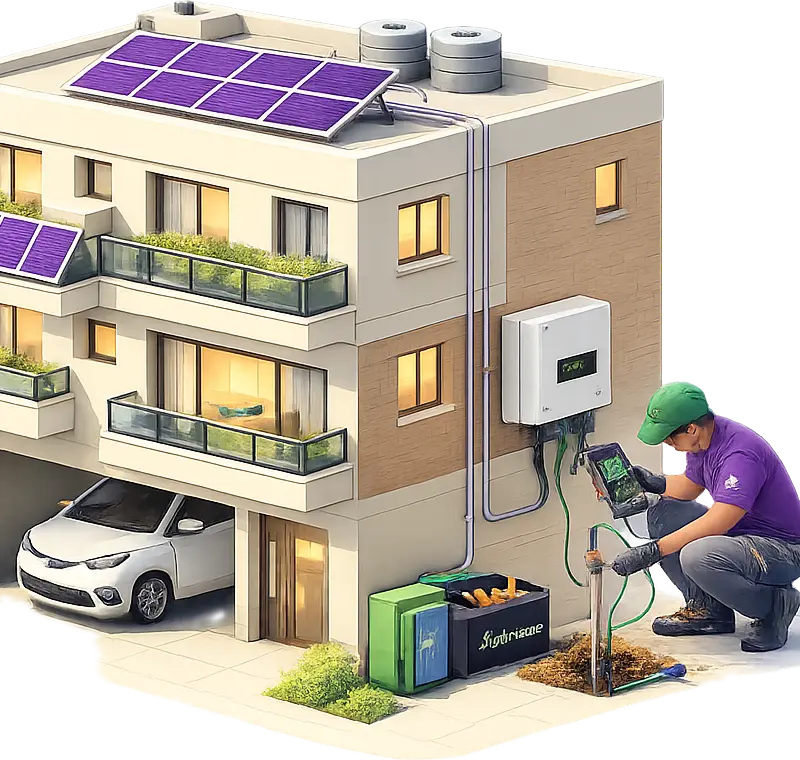
A homeowner in Pitampura installs a 5kW system with Bridgeway Power.
- Gross Cost: ₹3,43,035 (Inclusive of 8.9% GST).
- Tax Breakdown:
- Goods Value (70%): ₹2,40,124 @ 12% GST
- Service Value (30%): ₹1,02,911 @ 18% GST
- HSN Codes Used: 85414300 for the system bundle.
By using the correct codes and the 70:30 split, the customer remains eligible for the ₹78,000 Central Subsidy and the ₹30,000 Delhi State Subsidy.
Documentation Requirements for Correct Tax Application
To ensure you aren't hit with a tax notice or a rejected subsidy claim, your documentation must be airtight. We provide our clients with a complete docket that includes:
- Detailed Invoice: Clearly showing the 70% goods and 30% solar installation service tax breakdown.
- Component Data Sheets: Proving the HSN 85414300 classification for modules.
- Commissioning Report: Required by DISCOMs like BSES Rajdhani or PVVNL Noida to prove the system is operational under the cited HSN.
For businesses, the HSN code is even more critical. Under Section 32 of the Income Tax Act, you can claim 40% Accelerated Depreciation on solar assets. To do this, your CA will need an invoice that correctly identifies the solar plant equipment under the appropriate HSN codes to distinguish them from standard office equipment (which carries a much lower depreciation rate).
Financing and Taxes
When you opt for Solar Panel Financing, banks like SBI or PNB look at the GST-inclusive invoice. Since the GST is part of the total project cost, it is covered under the loan amount. Our partners—including ECOFY and Aerem—process these loans based on the standardized 8.9% GST model, making the EMI calculation straightforward for the user.
FAQ
What is the HSN code for a complete solar power plant?
The most commonly used code for a solar power generating system is 85414300. This covers the modules and the associated equipment when sold as a single functional unit.
Is the GST rate on solar panels 5% or 12%?
The GST rate was increased from 5% to 12% for solar modules and most renewable energy equipment effective from October 2021. When combined with installation services, the effective rate is approximately 8.9%.
Can I claim GST Input Tax Credit (ITC) on residential solar?
No, residential consumers cannot claim GST ITC. However, registered businesses and MSMEs can claim the full GST paid as an input credit, effectively reducing their project cost by the tax amount.
Does the solar inverter have a separate GST rate?
If purchased separately, a solar inverter hsn code 8504 may attract 18% GST. However, when provided as part of a "Solar Power Generating System" contract, it is bundled into the 70:30 split, benefiting from the lower effective rate.
Why do some installers charge 18% GST?
If the installer is providing only the service (labor) and you are providing the panels, they must charge 18% solar installation service tax. The 8.9% blended rate only applies to "Composite Supplies" where the vendor provides both material and labor.
If you're planning to go solar in Delhi NCR, don't let tax jargon stall your project. You can get a free quote from our engineers today to see a transparent breakdown of HSN codes, GST, and subsidies specific to your roof.
The most important thing to remember is that the "70:30 rule" is the law of the land for solar projects. Any deviation from this usually signals a vendor who isn't keeping up with MNRE and Finance Ministry circulars—and that’s a red flag for the long-term health of your solar maintenance and warranty.
Every 1 kW of solar on your roof offsets 1.5 tonnes of CO₂ per year
That's 40 trees planted — every year, for 25 years.
A typical 5 kW home system offsets 187 tonnes of carbon over its lifetime. That's equivalent to taking 8 cars off the road.
See your impact →How much can you save with solar?
Enter your electricity bill → get system size, subsidy amount & payback period
Get StartedLiked this article? Get a free solar quote
Tell us about your rooftop — we'll call with exact savings for your home.
Related Articles
What Is Captive Open Access Solar (100% Equity Model)
Learn how Captive Open Access Solar (100% Equity Model) helps Indian businesses cut electricity costs by 40% using off-site solar plants. Guide on rules, savings & ROI.
Read moreHow Rooftop Solar Can Eliminate Your Electricity Bill
Discover how Net Metering and PM Surya Ghar subsidies can reduce your monthly electricity bill to near-zero. Learn about system sizing, costs, and real-world savings.
Read moreSolar Subsidy in Uttar Pradesh 2026: ₹1,08,000 for Noida, Ghaziabad & Greater Noida
UP's stacked solar subsidy 2026: ₹78,000 central + ₹30,000 UPNEDA state top-up = ₹1.08L. Real PVVNL net-cost math for Noida, Greater Noida, Ghaziabad & Meerut.
Read moreRelated guides
Delhi Electricity Rate 2026
BSES & Tata Power per-unit rates, PPAC, subsidy — sourced from DERC.
ExploreDelhi Solar Policy 2026
Free rooftop solar up to 3 kW for homes under 400 units. Eligibility & apply.
ExploreSolar Panel Price in Delhi
Live 2026 rooftop prices in Delhi after ₹1.56L subsidy. 1,200+ installs.
ExploreSolar Company in Gurgaon
Gurgaon's rooftop solar installer — 800+ systems, ₹78K PM Surya Ghar subsidy.
ExploreSolar Company in Noida
Noida & Greater Noida rooftop solar — 500+ installs, ₹1.08L stacked subsidy.
ExploreSolar Panel Price in Faridabad
Live 2026 Faridabad prices after ₹78K PM Surya Ghar subsidy. 350+ homes.
Explore