
By Vansh Dahiya · Reviewed by Arshi Chadha, Founder
Solar Subsidy Documents List: Everything You Need

- •Primary Requirement: Electricity bill and Aadhaar must have matching names/addresses.
- •Maximum Subsidy: ₹78,000 (Central) + ₹78,000 (Delhi State, if applicable).
- •Verification Time: 30–45 days after net meter installation.
- •Key Document: Cancelled cheque with the applicant's name clearly printed.
We’ve seen hundreds of solar subsidy applications get stuck in the PM Surya Ghar Yojana portal for one simple reason: a mismatched name on a document. Most people think "applying for subsidy" happens after the panels are up. In reality, the paperwork starts the day you decide to go solar. If your electricity bill is in your late father’s name or your Aadhaar address still shows your hometown while you’re living in solar in Rohini, your subsidy claim will hit a wall.
At Bridgeway Power, with 35+ years of experience, we’ve learned that the government doesn't just want to see that you installed solar; they want an airtight paper trail. Here is the definitive solar subsidy documents required list you need to clear the portal without queries.
The Foundation: Identity and Address Proof
The most common mistake is using a mobile-linked Aadhaar that has an old address. The PM Surya Ghar Muft Bijli Yojana portal uses automated verification. If the address on your Aadhaar doesn't substantially match the installation address on your electricity bill, the DISCOM (Distribution Company) will reject the feasibility report.
Aadhaar Card
Your Aadhaar must be linked to your current mobile number. You will receive multiple OTPs during the registration and the final subsidy claim (Annexure-II submission).
PAN Card
While not always mandatory for the initial feasibility, it is required for the solar panel financing process if you are taking a loan from partners like SBI, PNB, or Canara Bank.
Electricity Bill Criteria: The "Name Match" Rule
This is the single biggest "gotcha" in the process. To satisfy the rooftop solar subsidy eligibility, the name on the electricity bill MUST be the one applying for the subsidy.
- Sanctioned Load: Your solar system size cannot exceed your sanctioned load. If you have a 2kW load but want a 5kW system, you must first apply for a load increase. In Delhi, this involves navigating BSES load increase charges.
- Address Accuracy: The "Installation Address" on the bill is where the panels will go. If you are a builder floor owner, ensure your CA (Consumer Account) number corresponds to your specific floor. We’ve covered this extensively in our guide for solar for builder floors in Delhi.
Technical Specifications from the EPC
You cannot just buy panels from a local hardware store and claim a subsidy. The government requires DCR (Domestic Content Requirement) modules for residential subsidies. This means the solar cells and the modules must be manufactured in India.
When we finish an installation, we provide a "Project Completion Report." This includes:
- Solar Module Serial Numbers: A list of every single panel's unique ID.
- Inverter Serial Number: To verify it meets MNRE standards.
- Site Photos: Geo-tagged photos of the system, the inverter, and the applicant standing with the plant.
Categorized Document Checklist: Personal vs Technical
| Document Category | Document Name | Purpose |
|---|---|---|
| Personal | Aadhaar Card | Identity & Address verification (OTP linked) |
| Personal | Latest Electricity Bill | Verifies Sanctioned Load & Consumer Account (CA) |
| Personal | Cancelled Cheque | For DBT (Direct Benefit Transfer) of subsidy |
| Personal | Property Tax Receipt | Often required by DISCOMs to prove roof ownership |
| Technical | DCR Certificate | Proves panels are made in India (Mandatory for subsidy) |
| Technical | Module & Inverter Datasheets | Verifies technical compliance with MNRE |
| Technical | System Test Report | Signed by the EPC (Bridgeway) and the Consumer |
| Technical | Net Metering Agreement | Signed contract with DISCOM (e.g., BSES/DHBVN) |
Bank Account Verification: The Final Step
Once the net metering is installed and the system is syncing with the grid, you have to upload your bank details. The subsidy doesn't come to the installer; it goes directly to you.
- Cancelled Cheque: It must have your name printed on it. A "blank" cancelled cheque without a name is often rejected.
- Account Type: Must be a savings account. Business or Current accounts sometimes face hurdles in the DBT process for residential schemes.
Net Metering Documents: State-Specific Requirements
Depending on whether you are in Delhi, Gurgaon, or Noida, the DISCOM requirements vary. For example, net metering documents Delhi (BSES/TPDDL) often require an indemnity bond on non-judicial stamp paper.
- In Delhi: You need the BSES net metering application form, a copy of the sanctioned load proof, and the solar system's single-line diagram (SLD).
- In Haryana: For DHBVN net metering, you might need a "No Dues Certificate" ensuring you don't have pending electricity bills.
Talk to a solar engineer — not a salesperson
Enter your pincode and monthly bill. If we install in your area, an engineer answers on WhatsApp with your numbers.
See your exact subsidy after state stacking
The "Annexure" Paperwork
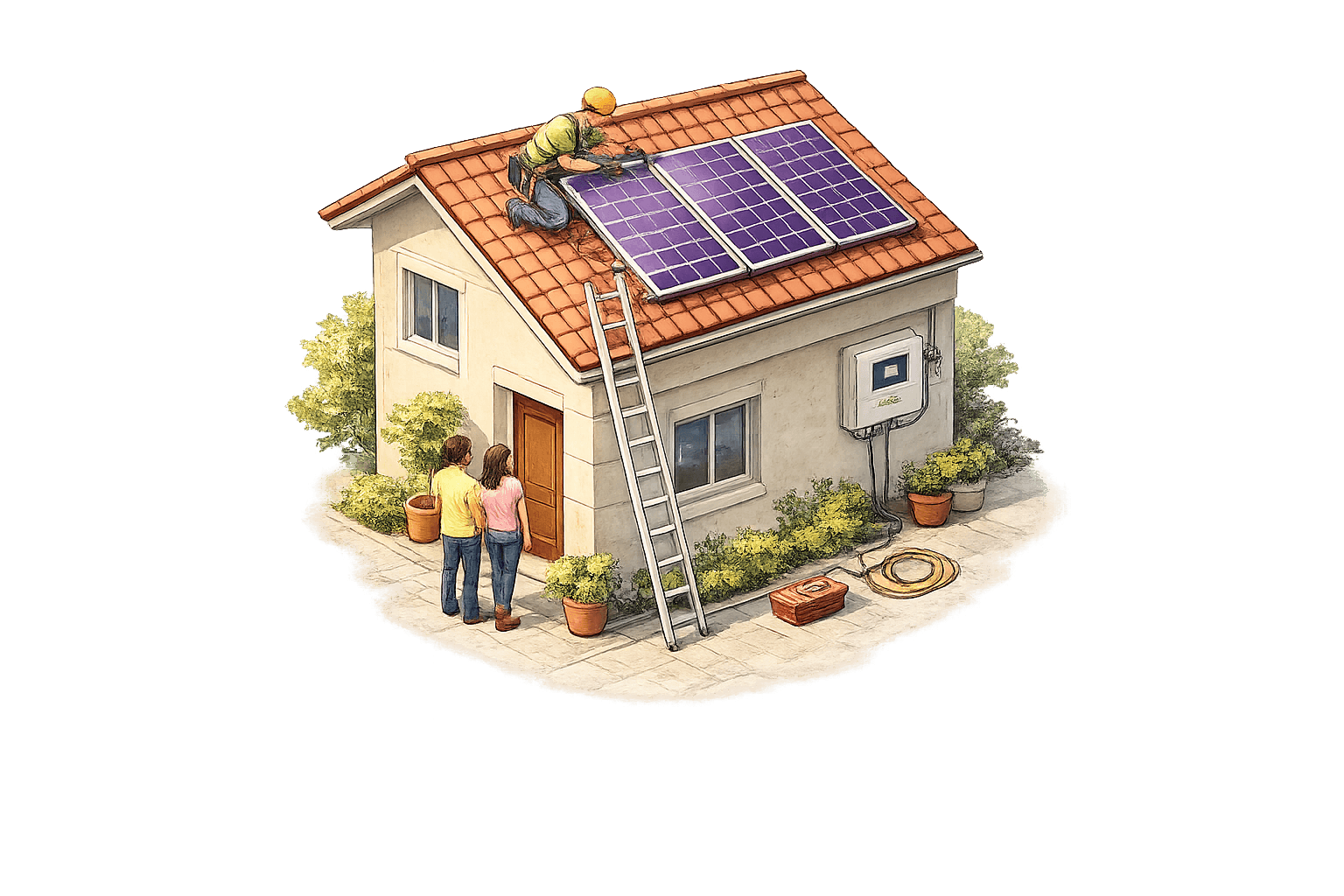
During the process, you will encounter various "Annexures." These are standard forms defined by the Ministry of New & Renewable Energy.
- Annexure for solar subsidy (Project Completion): This is a joint declaration signed by you and us (the installer) confirming the system is installed as per standards.
- Maintenance Agreement: A 5-year mandatory maintenance contract proof between the consumer and the EPC.
Real Example: A 3kW Install in Dwarka
A homeowner in solar in Dwarka with a monthly bill of ₹4,500 decided to install a 3kW system.
- The Problem: The electricity bill was in his wife's name, but the Aadhaar he used for portal registration was his own.
- The Fix: We had to stop the application, update the portal with the wife's Aadhaar (which was OTP linked), and ensure the cancelled cheque also belonged to her.
- The Result: Because the documents finally matched, the ₹78,000 central subsidy was credited 28 days after the net meter was commissioned. If they had used our Solar Calculator earlier, they would have seen the exact sizing needed to stay within the PM Surya Ghar subsidy caps.
From our installs
We recently completed a 5kW installation for a villa in solar in Gurugram. The client had all documents ready, but the DISCOM (DHBVN) rejected the initial feasibility because the "Sanctioned Load" on the bill was only 4kW.
- System Size: 5kW
- Locality: A residential villa in Sector 57, Gurugram.
- Result: After a load extension to 6kW, the system now generates an average of 20-22 units per day, reducing the bill by roughly 85%.
- Honest Caveat: Load extension can take 7–15 days and involves a small security deposit to the DISCOM, which people often forget to budget for.
FAQ
What if my electricity bill name is different from my Aadhaar name?
You must get the name changed on either the electricity bill or use the document of the person whose name is on the bill. The portal will not process subsidies if the applicant's name and the consumer name on the bill differ.
Are photos of the installation required for solar subsidy?
Yes. You need to upload geo-tagged photos of the installed solar modules, the inverter, and a photo of yourself standing next to the solar plant. Your EPC company should handle the geo-tagging for you.
Do I need a separate bank account for the solar subsidy?
No, any active savings bank account in the applicant's name works. However, you must provide a cancelled cheque or a passbook copy where the name, IFSC, and account number are clearly legible.
Is a DCR certificate mandatory for all solar panels?
Only if you want the government subsidy. DCR (Domestic Content Requirement) panels are built in India. If you install imported (Non-DCR) panels, you can still go solar, but you forfeit the ₹78,000 subsidy. We usually offer a Non-DCR price reduction if you choose that route.
How long does it take for the subsidy to hit my account?
In our experience with solar in Delhi, it takes approximately 30 to 45 days after the "Subsidy Claim" is submitted on the portal. This submission happens only after the net meter is installed and the first "solar-adjusted" bill is generated.
The document process is the "final exam" of your solar journey. If you get the paperwork right at the start, the rest is just engineering. If you’re unsure if your documents qualify, Get a free quote and our team will perform a pre-audit of your bills and IDs before you spend a single rupee.
Reviewed by: Gurubaksh Singh, Senior Solar Advisor, Bridgeway Power
Every 1 kW of solar on your roof offsets 1.5 tonnes of CO₂ per year
That's 40 trees planted — every year, for 25 years.
A typical 5 kW home system offsets 187 tonnes of carbon over its lifetime. That's equivalent to taking 8 cars off the road.
See your impact →How much can you save with solar?
Enter your electricity bill → get system size, subsidy amount & payback period
Get StartedSee your exact subsidy after state stacking
Related Articles
What Is Captive Open Access Solar (100% Equity Model)
Learn how Captive Open Access Solar (100% Equity Model) helps Indian businesses cut electricity costs by 40% using off-site solar plants. Guide on rules, savings & ROI.
Read moreHow Rooftop Solar Can Eliminate Your Electricity Bill
Discover how Net Metering and PM Surya Ghar subsidies can reduce your monthly electricity bill to near-zero. Learn about system sizing, costs, and real-world savings.
Read moreSolar Subsidy in Uttar Pradesh 2026: ₹1,08,000 for Noida, Ghaziabad & Greater Noida
UP's stacked solar subsidy 2026: ₹78,000 central + ₹30,000 UPNEDA state top-up = ₹1.08L. Real PVVNL net-cost math for Noida, Greater Noida, Ghaziabad & Meerut.
Read moreRelated guides
Delhi Electricity Rate 2026
BSES & Tata Power per-unit rates, PPAC, subsidy — sourced from DERC.
ExploreDelhi Solar Policy 2026
Free rooftop solar up to 3 kW for homes under 400 units. Eligibility & apply.
ExploreSolar Panel Price in Delhi
Live 2026 rooftop prices in Delhi after ₹1.56L subsidy. 1,200+ installs.
ExploreSolar Company in Gurgaon
Gurgaon's rooftop solar installer — 800+ systems, ₹78K PM Surya Ghar subsidy.
ExploreSolar Company in Noida
Noida & Greater Noida rooftop solar — 500+ installs, ₹1.08L stacked subsidy.
ExploreSolar Panel Price in Faridabad
Live 2026 Faridabad prices after ₹78K PM Surya Ghar subsidy. 350+ homes.
Explore