
By Arshi Chadha, Founder · Bridgeway Power
10 kW Solar System Generation: How Many Units per Day in Delhi NCR (2026)
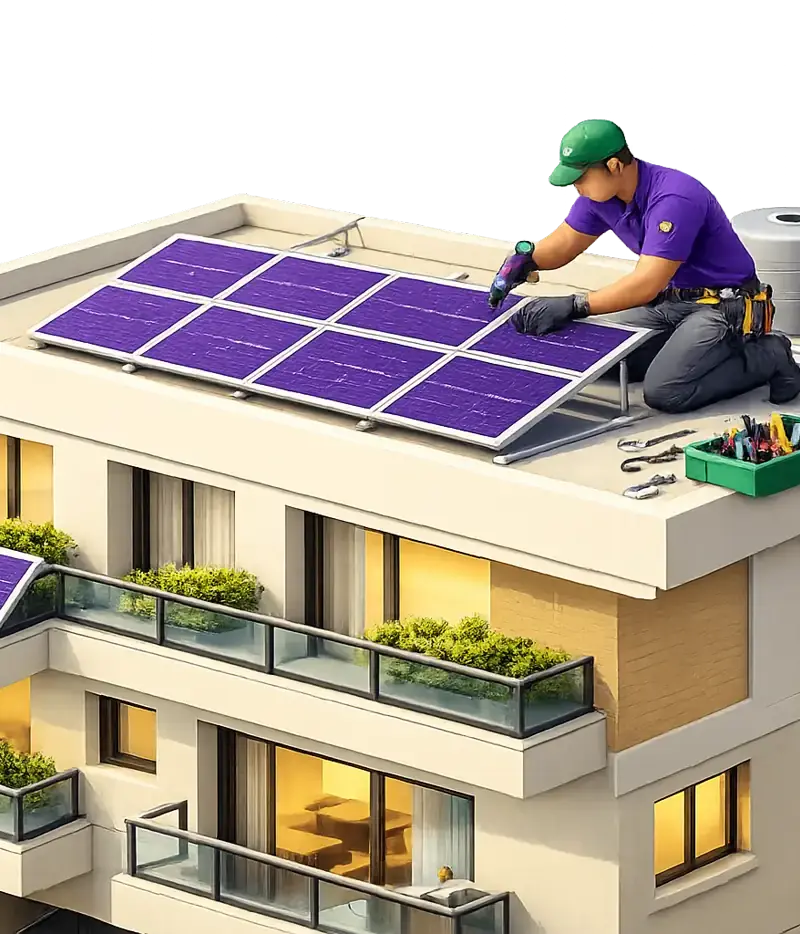
- •Daily generation: 40–54 units (varies by season)
- •Annual generation: ~15,000 units
- •Monthly bill offset (at ₹8/unit): up to ₹12,000
- •Roof area needed: ~600 sq ft of unshaded south-facing space
- •Panels needed: 17–18 panels of 580–620 Wp each
A 10 kW rooftop solar system is the typical sizing for a large villa, a 4-BHK independent floor with two A/Cs running through summer, or a small commercial premises in Delhi NCR. The question every serious buyer asks at quote time: how many units will it actually generate in a day?
This page answers that question with month-by-month numbers from Delhi NCR irradiance data, plus what the 10 kW size means for net metering, subsidy, and payback.
Daily Generation by Season (Delhi NCR)
Using Delhi''s field-corrected per-kW yield (see our per-kW generation guide):
| Season | Per-kW Daily | 10 kW System Daily | Monthly (10 kW) |
|---|---|---|---|
| Peak summer (May) | 5.4 units | 54 units/day | ~1,670 units |
| Pre-monsoon (April) | 5.3 units | 53 units/day | ~1,590 units |
| Monsoon (Jul–Aug) | 4.0 units | 40 units/day | ~1,240 units |
| Post-monsoon (Oct) | 4.4 units | 44 units/day | ~1,360 units |
| Winter (Dec–Jan) | 3.0 units | 30 units/day | ~930 units |
| Annual average | 4.2 units | ~42 units/day | ~1,250 units |
| Annual total | — | — | ~15,000 units |
A 10 kW system in Delhi NCR generates roughly 15,000 units per year. That''s enough to cover the entire annual consumption of a household drawing 1,200 units/month on average, with the seasonal surplus banked via net metering.
What 10 kW Actually Costs (Delhi NCR)
| City | Gross Cost (₹) | Subsidy | Net Cost (₹) | Per-kW |
|---|---|---|---|---|
| Delhi (BSES/TPDDL) | 5,50,000 | 78,000 + Delhi GBI | 4,72,000 | ₹47,200/kW |
| Gurugram (DHBVN) | 5,50,000 | 78,000 only | 4,72,000 | ₹47,200/kW |
| Faridabad (DHBVN) | 5,50,000 | 78,000 only | 4,72,000 | ₹47,200/kW |
| Noida (PVVNL) | 5,50,000 | 1,08,000 | 4,42,000 | ₹44,200/kW |
The subsidy is capped at 3 kW — a 10 kW system still receives only the 3 kW subsidy amount. Anyone quoting you a "10 kW subsidy" north of ₹78,000 (or ₹1,08,000 in UP) is wrong.
For full city-by-city pricing breakdowns, see Delhi NCR pricing, Gurugram pricing, Faridabad pricing, and Noida pricing.
Payback Math for a 10 kW System
At an average DHBVN/BSES upper-slab tariff of ₹8/unit:
- Annual generation: 15,000 units
- Annual savings: ₹1,20,000
- Net cost (DHBVN): ₹4,72,000
- Payback: 3.9 years
Noida''s lower net cost (₹4,42,000) pulls payback to 3.7 years.
After payback you''re looking at 21+ years of ~₹1.2L/year electricity offset — a lifetime saving of ₹25L+ at today''s tariff (and substantially more as tariffs escalate at ~5%/year, which is the actual historical Delhi NCR trend).
Talk to a solar engineer — not a salesperson
Check whether we install in your area, then get your answer on WhatsApp. No forms, no call centre.
What would solar save on YOUR bill?
Roof Area and Panel Count
A 10 kW system at 600 Wp/panel needs 17 panels (16.7 → round up to 17). Each panel is roughly 2.4 m × 1.13 m ≈ 2.7 m². With walking space and tilt:
- Minimum roof area: ~600 sq ft of contiguous, unshaded, south-facing space
- Recommended: 700–800 sq ft for service access and a future battery cabinet
Most independent floors in Delhi NCR Sectors 14–57 (Gurugram), Sectors 50–75 (Noida), Sectors 14–46 (Faridabad), and Dwarka/Vasant Kunj/Rohini blocks have the area on the top terrace. Apartment-block roofs can host 10 kW only as an RWA-level community installation — see our Dwarka RWA community solar guide.
For the 10 kW microinverter alternative (worth considering when you have multiple shading sources), read our 10 kWp Enphase IQ8 case study from a Gurgaon bungalow — real module-level yield data from a 2.5-year-old install.
Net Metering for a 10 kW System
10 kW is the upper limit for residential net metering in most NCR utility territories without crossing into commercial-category billing:
- BSES Rajdhani / BSES Yamuna (Delhi): Up to 10 kW residential, quarterly settlement
- TPDDL (Delhi): Up to 10 kW residential, annual settlement
- DHBVN (Gurugram, Faridabad): Up to 10 kW residential, monthly netting
- PVVNL (Noida, Greater Noida): Up to 10 kW residential
Crossing 10 kW often re-categorises you to commercial tariffs (₹10+/unit fixed charge, three-phase connection mandatory). For most homes, 10 kW is the sweet spot — the largest you can install before the tariff math changes.
FAQ
How many units does a 10 kW solar system generate per day in Delhi? 40–54 units depending on season. Peak summer (May) hits ~54 units/day; winter (December–January) drops to ~30 units/day; annual average is ~42 units/day.
How many units in a year? About 15,000 units annually for a properly-installed 10 kW system in Delhi NCR with quarterly cleaning.
Is a 10 kW system overkill for a home? For a 1,200+ units/month consumer (typical of large villas with 4+ A/Cs, EV charging, or pool pumps) it''s correctly sized. For a 600 units/month household, a 5 kW is the better number — see 3 kW vs 5 kW for Indian homes.
Does the PM Surya Ghar subsidy increase for a 10 kW system? No. Subsidy is capped at the 3 kW slab — ₹78,000 central, plus state top-up where applicable (Delhi ₹30,000; UP ₹30,000; Haryana ₹0). A 10 kW system gets the same subsidy as a 3 kW system.
How much roof do I need for 10 kW? About 600 sq ft of unshaded, south-facing roof minimum. 700–800 sq ft is more comfortable. See our solar on 1000 sq ft roof guide for a full sizing walkthrough.
Can I run a 10 kW system on a single-phase connection? Technically up to 7–8 kW; for 10 kW you''ll typically need a three-phase service connection from your utility. DHBVN, BSES, and PVVNL all require three-phase for residential 10 kW installations.
Get a 10 kW Quote
Our installations engineer will measure your roof, check shading, verify your single-vs-three-phase connection, and give you a binding quote with month-by-month generation forecast. Free, no obligation, MNRE-empanelled — and we file the PM Surya Ghar paperwork ourselves.
Every 1 kW of solar on your roof offsets 1.5 tonnes of CO₂ per year
That's 40 trees planted — every year, for 25 years.
A typical 5 kW home system offsets 187 tonnes of carbon over its lifetime. That's equivalent to taking 8 cars off the road.
See your impact →How much can you save with solar?
Enter your electricity bill → get system size, subsidy amount & payback period
Get StartedLiked this article? Get a free solar quote
Tell us about your rooftop — we'll call with exact savings for your home.
Related Articles
Net Metering in India: How to Sell Solar Power Back to the Grid
Learn how net metering in India allows you to sell solar power back to the grid. Discover state policies, savings examples, and how to reduce your bill by 90%.
Read moreWhat Is Captive Open Access Solar (100% Equity Model)
Learn how Captive Open Access Solar (100% Equity Model) helps Indian businesses cut electricity costs by 40% using off-site solar plants. Guide on rules, savings & ROI.
Read moreSolar Installation Cost in Delhi NCR 2026: 3 kW at ₹1.32L net
Updated 2026 guide to solar costs in Delhi NCR. Learn about PM Surya Ghar subsidies, system pricing from 1kW-10kW, and how to reach zero electricity bills.
Read moreRelated guides
Free 3 kW Rooftop Solar in Delhi
Under 400 units/month? Zero upfront cost — ₹1.56L subsidy plus a government gap top-up.
ExploreDelhi Solar Subsidy Above 400 Units
Over 400 units/month? You still get the full ₹1.56L subsidy on 3 kW. Net ₹84,000.
ExploreSolar Subsidy in Delhi 2026
₹1.56L stacked (central + state) + Delhi GBI earnings for 5 years. The real math.
ExploreDCR vs Non-DCR Solar Panels
Non-DCR panels are cheaper — and forfeit your entire ₹78,000 subsidy.
ExplorePM Surya Ghar Subsidy Amount (2026)
Exact ₹78,000 central subsidy by system size — and when it lands after commissioning.
ExploreSubsidy Stuck at the DISCOM?
The five stages of a PM Surya Ghar claim, and how to clear the one you're parked at.
Explore