
By Kajal Rajpoot · Reviewed by Arshi Chadha, Founder
Inverter vs UPS vs Solar: Which Backup Is Right for You?
- •Best for Data Safety: UPS (Computer/Electronics only)
- •Best for Base Backup: Home Inverter (4–8 hours for lights/fans)
- •Best for ROI: Solar Hybrid System (Unlimited daytime power + full night backup)
- •Payback Period: Solar pays for itself in 4–5 years; UPS/Inverter are permanent expenses.
- •10-Year Cost: Solar ends up being cheaper due to zero electricity bills and 12-year battery life.
The sweltering heat of a Delhi summer is manageable until the power cuts hit. Whether you are a professional working from home in Dwarka, running a small shop in Indirapuram, or managing a household in Sushant Lok, the search for the best power backup India offers usually leads to three words: UPS, Inverter, or Solar.
Most Indian households have lived on the "Inverter-Battery Treadmill" for decades—buying a lead-acid battery, watching it die in three years, and spending thousands to replace it, all while paying rising electricity bills. But in 2026, the tech landscape has shifted. If your monthly electricity bill exceeds ₹2,000, the "backup" question shouldn't just be about surviving a power cut—it should be about eliminating the bill itself.
In this guide, we break down the inverter vs UPS vs solar India debate to help you decide which system fits your lifestyle and your wallet.
1. The UPS: A Specialist for Your Digital Life
A UPS (Uninterruptible Power Supply) is often the first thing people think of when they want to protect their work. However, there is a major UPS vs inverter difference that many overlook: transition time.
A UPS switches to battery power in milliseconds—so fast that your computer doesn't even "blink" or restart. However, this precision comes at a cost of capacity.
- Purpose: Protecting desktop computers, servers, and sensitive medical equipment.
- Limitation: It is NOT a home solution. You cannot run a ceiling fan or a refrigerator on a standard 600VA UPS.
- The Reality: It gives you just enough time (20–30 minutes) to save your work and shut down.
2. The Home Inverter: The Basic Indian Backup
The standard home inverter (Non-Solar) has been the backbone of Indian homes. It’s affordable upfront, but it is a "passive" device. It sits on your wall, consumes grid electricity to stay charged, and waits for a power cut.
The biggest issue? The "Inverter-Battery Treadmill." Lead-acid batteries used in these systems are sensitive to heat and deep discharge. In the North Indian climate, these batteries rarely last beyond 36–48 months. Over 10 years, you will likely buy three sets of batteries.
Solar panels don't fail, but systems do when the maintenance is ignored. With a traditional inverter, you aren't saving money; you are simply paying for the luxury of having lights on during a blackout.
3. Solar Hybrid: The Backup That Pays You Back
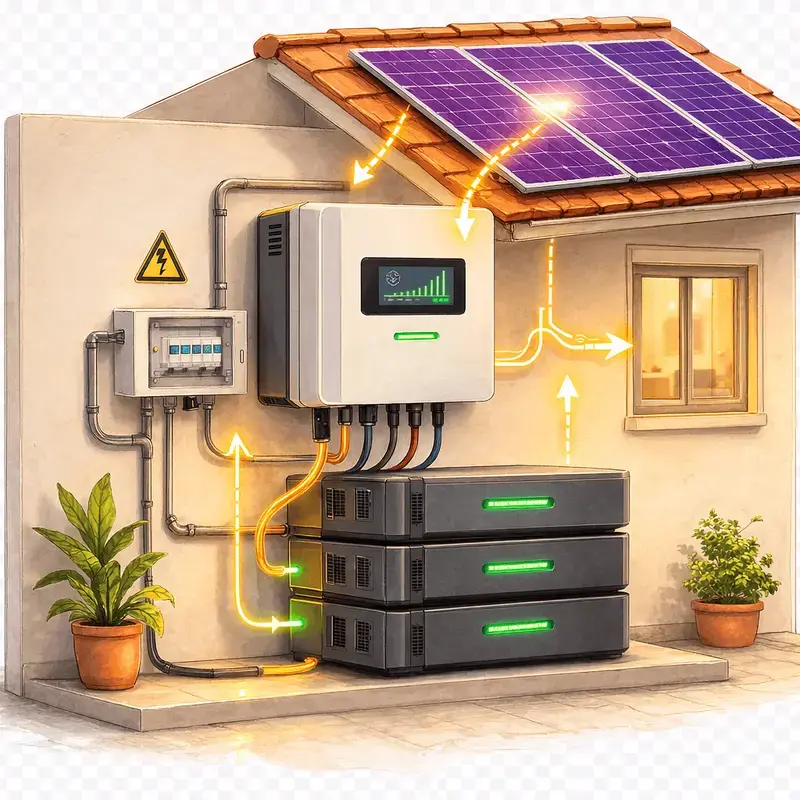
A home solar battery system in India (Hybrid) is a game-changer. Unlike a UPS or a standard inverter, a solar hybrid system does two things simultaneously:
- It provides high-capacity backup (including ACs and Fridges).
- It generates free electricity, which slashes your monthly DISCOM bill.
While it has a higher upfront cost, it is the only backup solution with a "Return on Investment." Instead of spending ₹10,000 every 3 years on batteries, you invest once in Lithium-lon (LFP) technology that lasts 12+ years.
Comparison Table: Inverter vs UPS vs Solar India (2026)
| Feature | UPS (Uninterruptible Power Supply) | Home Inverter (Non-Solar) | Solar Hybrid System |
|---|---|---|---|
| Typical Capacity | 600VA - 1kVA | 1kVA - 2kVA | 3kW - 5kW |
| Upfront Cost | ₹3,000 – ₹5,000 | ₹8,000 – ₹15,000 | ₹3.5L – ₹5.5L |
| Backup Duration | 20–30 Minutes | 4–8 Hours | Unlimited (Day) / 6–10 Hrs (Night) |
| What can it run? | PC, Monitor, Router | 3 Fans, 4 Lights, TV | Entire Home (incl. AC/Fridge) |
| Bill Savings | None (Increases bill) | None (Increases bill) | Reduces bill by 90–100% |
4. The Hidden Costs: A 5-Year Financial Reality Check
When comparing solar vs inverter battery costs, most people only look at the sticker price. This is a mistake. A system that costs ₹10,000 today but requires ₹15,000 in maintenance every 3 years is more expensive than it looks.
5-Year Total Cost of Ownership (TCO)
| Expense Type | UPS (Electronic) | Home Inverter (Lead-Acid) | Solar Hybrid (LFP Battery) |
|---|---|---|---|
| Initial Purchase | ₹4,000 | ₹12,000 | ₹5,00,000 (5kW Hybrid) |
| Battery Replacements | ₹3,000 (1 Cycle) | ₹24,000 (2 Cycles) | ₹0 (LFP lasts 12 years) |
| Electricity Consumed | ₹1,500 | ₹6,000 | -₹4,50,000 (Savings generated) |
| Total 5-Year Cost | ₹8,500 | ₹42,000 | ₹50,000 (Net after savings) |
Note: For the Solar Hybrid, the "cost" is drastically reduced because the system has almost paid for itself through electricity bill savings within those 5 years.
Battery Replacement Cycle & Maintenance
| System | Battery Type | Life Expectancy | Replacement Cost |
|---|---|---|---|
| UPS | Small VRLA | 2–3 Years | ₹2,000 – ₹4,000 |
| Home Inverter | Lead-Acid / Tubular | 3–4 Years | ₹8,000 – ₹15,000 |
| Solar Hybrid | Lithium Ferro Phosphate (LFP) | 10–15 Years | Included in System |
With Bridgeway Power's 35+ years of experience, we have seen thousands of customers get frustrated with lead-acid batteries. This is why we specialize in high-efficiency Lithium-based hybrid solar system pricing, offering 6,000+ cycles and 85% Depth of Discharge (DoD).
5. Why Solar Reframes the Entire Question
Most people ask: "How much does a backup system cost?" The better question is: "How can my backup system pay for my electricity?"
The Inverter Battery Treadmill
Most Indian homes spend ₹40,000–₹60,000 over 10 years on inverter maintenance and batteries. At the end of those 10 years, they have zero savings and still have to pay ₹4.5/unit to ₹8/unit to their DISCOM (like BSES Rajdhani or PVVNL).
The Solar Advantage
A solar hybrid system turns your roof into a power plant.
- Daytime: The panels power your home and charge the battery.
- Nighttime: The battery provides backup.
- Surplus: Excess energy goes back to the grid via net metering.
Talk to a solar engineer — not a salesperson
Enter your pincode and monthly bill. If we install in your area, an engineer answers on WhatsApp with your numbers.
What would solar save on YOUR bill?
6. Real-World Example: A 3BHK Home in Gurgaon
Let’s look at a family living in Sushant Lok, Gurgaon with a monthly electricity bill of ₹8,000.
- Choice A: Traditional Inverter. They spend ₹20,000 on a high-end inverter + 2 batteries. They still pay ₹8,000/month to DHBVN. Over 5 years, they pay ₹4.8 Lakhs in bills + ₹30k in battery maintenance.
- Choice B: 5kW Solar Hybrid System. They invest ₹5.5 Lakhs. Their electricity bill drops to nearly zero (or just the fixed charges). By year 5, they have saved ₹4.5 Lakhs in electricity costs. Their "net" investment for a premium backup system is now only ₹1 Lakh.
If you are spending more than ₹3,000 per month, solar vs inverter battery isn't even a contest—solar wins on every financial metric. You can even check your specific savings using our Solar Calculator.
7. Financing Your Backup
At Bridgeway Power, we ensure that the transition to solar is as smooth as possible. We work with leading financing partners to offer affordable EMI plans:
- SBI Solar Loan: Competitive rates for residential solar.
- PNB Solar Rooftop Scheme: Ideal for homeowners looking for long-tenure loans.
- Canara Bank Solar Loan: Transparent processing and quick approvals.
- Aerem Solar Finance: Specialized fintech for solar installations.
- ECOFY Solar Financing: Zero-cost and low-EMI options for a digital-first experience.
8. Can I Use PM Surya Ghar Subsidy for Hybrid?
Yes and No. The PM Surya Ghar Yojana provides a subsidy of up to ₹78,000 for systems up to 3kW. However, the subsidy calculation is based on the solar panels and on-grid inverter. While you can add batteries to create a hybrid system, the government's subsidy generally only covers the solar portion.
Even so, the subsidy makes the solar part so affordable that adding a battery becomes significantly cheaper than buying an independent power backup system. For a full breakdown, see our guide on Exactly How Much Subsidy Will You Get.
9. Which One Should You Choose?
Choose a UPS if:
- You only care about your Desktop PC not restarting.
- You have a stable grid and 24/7 power backup in your society (like many apartments in Noida Extension).
- Your budget is under ₹5,000.
Choose an Inverter if:
- You are a tenant and cannot install anything on the roof.
- You only need backup for 2-3 lights and fans.
- Your monthly bill is very low (under ₹1,500).
Choose Solar Hybrid if:
- You are a homeowner in Delhi NCR.
- Your monthly bill is ₹3,000 or more.
- You want to run heavy loads like Air Conditioners on Solar.
- You are tired of the "Inverter-Battery Treadmill" and want a 10-15 year permanent solution.
Frequently Asked Questions
Is a UPS the same as an Inverter?
No. The primary UPS vs inverter difference is the switching time. A UPS switches in <10ms, which is required for computers. An inverter takes 20-50ms, which might cause a computer to reboot but is perfectly fine for lights, fans, and TVs.
Can I convert my existing inverter into a solar inverter?
Yes, using a Solar Charge Controller. However, this is often inefficient. If you want real savings and a long-lasting home backup system India comparison shows that a dedicated hybrid inverter is 20-30% more efficient at charging and power management.
How much weight does a solar system add to my roof?
A common myth is that solar is too heavy. In reality, a solar panel weighs about 22-28kg. Even with structures, the load is much less than a standard 1000L water tank. Read more in our Solar Panel Weight Guide.
Do solar batteries need distilled water like normal inverters?
Only if you use lead-acid batteries. If you opt for the modern Solar Hybrid systems installed by Bridgeway Power, we use Lithium(LFP) batteries which are maintenance-free, require no water topping, and do not emit toxic fumes.
What is the lifespan of a solar hybrid system?
The solar panels are warrantied for 25 years. The hybrid inverter usually lasts 8-10 years, and the Lithium battery lasts 12-15 years. This far outlasts any traditional UPS or Inverter system.
Conclusion: Stop Buying Backup, Start Investing in Energy
The era of the "dumb" backup is over. Whether you live in Janakpuri or Faridabad, continuing to pay for lead-acid battery replacements every few years is a drain on your finances.
A Solar Hybrid system reframes the conversation from a recurring expense to a wealth-generating asset. With Bridgeway Power's 35 years of engineering expertise and 5,000+ successful installations, we can help you design a system that makes the "inverter vs UPS vs solar" debate easy: Solar is the only one that pays you back.
Ready to stop paying for backup and start saving? Contact Bridgeway Power today for a free site audit and custom solar design.
Every 1 kW of solar on your roof offsets 1.5 tonnes of CO₂ per year
That's 40 trees planted — every year, for 25 years.
A typical 5 kW home system offsets 187 tonnes of carbon over its lifetime. That's equivalent to taking 8 cars off the road.
See your impact →How much can you save with solar?
Enter your electricity bill → get system size, subsidy amount & payback period
Get StartedLiked this article? Get a free solar quote
Tell us about your rooftop — we'll call with exact savings for your home.
Related Articles
What Is Captive Open Access Solar (100% Equity Model)
Learn how Captive Open Access Solar (100% Equity Model) helps Indian businesses cut electricity costs by 40% using off-site solar plants. Guide on rules, savings & ROI.
Read moreHow Rooftop Solar Can Eliminate Your Electricity Bill
Discover how Net Metering and PM Surya Ghar subsidies can reduce your monthly electricity bill to near-zero. Learn about system sizing, costs, and real-world savings.
Read moreSolar Subsidy in Uttar Pradesh 2026: ₹1,08,000 for Noida, Ghaziabad & Greater Noida
UP's stacked solar subsidy 2026: ₹78,000 central + ₹30,000 UPNEDA state top-up = ₹1.08L. Real PVVNL net-cost math for Noida, Greater Noida, Ghaziabad & Meerut.
Read moreRelated guides
Delhi Electricity Rate 2026
BSES & Tata Power per-unit rates, PPAC, subsidy — sourced from DERC.
ExploreDelhi Solar Policy 2026
Free rooftop solar up to 3 kW for homes under 400 units. Eligibility & apply.
ExploreSolar Panel Price in Delhi
Live 2026 rooftop prices in Delhi after ₹1.56L subsidy. 1,200+ installs.
ExploreSolar Company in Gurgaon
Gurgaon's rooftop solar installer — 800+ systems, ₹78K PM Surya Ghar subsidy.
ExploreSolar Company in Noida
Noida & Greater Noida rooftop solar — 500+ installs, ₹1.08L stacked subsidy.
ExploreSolar Panel Price in Faridabad
Live 2026 Faridabad prices after ₹78K PM Surya Ghar subsidy. 350+ homes.
Explore