
By Arshi Chadha, Founder · Bridgeway Power
Solar Panel Installation in Noida: Cost, PVVNL Net Metering & ₹1.08L Subsidy
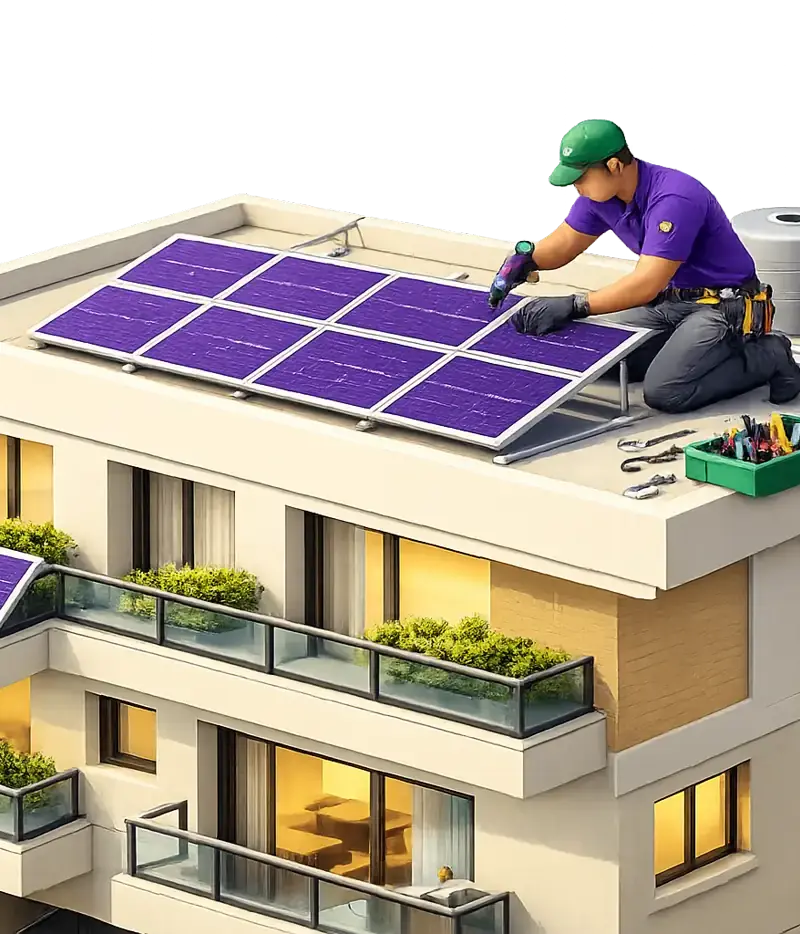
- •System size: 3 kW to 10 kW (Typical Residential)
- •Cost after subsidy: ₹93,000 – ₹4.62 Lakh
- •Monthly savings: ₹3,000 – ₹10,500 (at PVVNL ₹7/unit)
- •Payback period: 3.5 – 4.5 years
- •Stacked subsidy (3 kW): ₹78,000 central + ₹30,000 UP = ₹1,08,000
Noida sits in one of the most aggressive solar geographies in India: PVVNL distribution, soaring summer load, and — uniquely — a state government that stacks ₹30,000 on top of the central PM Surya Ghar subsidy. That makes Noida and Greater Noida the single best ROI postcodes in the entire NCR for a 3 kW residential system.
This guide walks through the exact 2026 cost, the stacked subsidy math, and how PVVNL net metering works for a Sector 50 villa or a Jaypee Greens flat.
Why Noida Beats Gurugram on Solar Economics
Two reasons.
One, Uttar Pradesh runs a state-level top-up subsidy of ₹30,000 for residential rooftop systems. Haryana does not. A 3 kW system in Noida nets ₹1,08,000 in combined incentives; the same 3 kW in Gurugram nets ₹78,000 — a flat ₹30,000 gap before you've even compared tariffs.
Two, PVVNL residential slabs cross ₹7/unit on the upper tiers — which is exactly where AC-heavy Noida households spend their consumption. Every unit your solar plant offsets is offsetting a near-peak-tier unit, not a subsidised lifeline-tier unit. The math compounds.
If you're comparing Noida against Gurugram solar pricing, this is the structural reason the same rooftop saves more money east of the Yamuna.
Solar Installation Cost in Noida (2026)
We price every Noida installation off the same N-Type TOPCon module catalogue we use across Delhi NCR — 580 Wp to 620 Wp Tier-1 panels, IEC-certified inverters, and DCR-compliant structures that pass PVVNL inspection on the first visit.
| System Size | Best For | Gross Cost (₹) | Subsidy (Central + UP) | Net Cost (₹) |
|---|---|---|---|---|
| 2 kW | 1–2 BHK, ~250 units/mo | 1,34,000 | 60,000 + 20,000 | 54,000 |
| 3 kW | 2–3 BHK, ~400 units/mo | 2,01,000 | 78,000 + 30,000 | 93,000 |
| 5 kW | 3 BHK villa, ~600 units/mo | 3,35,000 | 78,000 + 30,000 | 2,27,000 |
| 10 kW | Large villa / small commercial | 5,50,000 | 78,000 + 30,000 | 4,42,000 |
Costs use the live Bridgeway tier card: ₹67,000/kW for systems up to 5 kW, dropping to ₹55,000/kW above 5 kW.
PVVNL Net Metering: What Actually Happens
Net metering in Noida runs through PVVNL (Paschimanchal Vidyut Vitran Nigam Limited). The process — once paperwork is filed — typically takes 30 to 45 working days from application to meter installation. The steps:
- Empanelled vendor only. PM Surya Ghar requires the installation to be done by a MNRE-empanelled vendor. Bridgeway is empanelled; verify any quote you receive.
- Online application through the PM Surya Ghar portal — this triggers both the central subsidy claim and the PVVNL net meter request in one filing.
- Site feasibility by PVVNL engineer (typically within 10 days).
- Installation + commissioning — 2 to 4 days of on-site work.
- Net meter installation by PVVNL after inspection.
- Subsidy disbursal to your bank account within 30 days of commissioning.
If your installer asks you to "manage the portal yourself" — that's the moment to walk away. Subsidy filing is the install company's job.
The ₹1.08 Lakh Subsidy Stack, Decoded
People conflate central and state subsidies all the time. Here's the clean breakdown for a 3 kW system in Noida:
- Central (PM Surya Ghar): ₹30,000 for the first kW + ₹30,000 for the second kW + ₹18,000 for the third kW = ₹78,000
- Uttar Pradesh state top-up: flat ₹30,000 for residential systems
- Total: ₹1,08,000
That's the number to write on your back-of-envelope. Anyone quoting "up to ₹1.5 Lakh" or "₹2 Lakh subsidy" for a 3 kW system is either including a system above the residential cap or misrepresenting GBI (which Noida does not have — that's a Delhi-only programme).
Talk to a solar engineer — not a salesperson
Check whether we install in your area, then get your answer on WhatsApp. No forms, no call centre.
See your exact subsidy after state stacking
Payback Math for a Noida Household
Take the 3 kW case at ₹93,000 net cost.
A 3 kW system in Noida's irradiance band generates roughly 4,500 units a year. At PVVNL's ₹7/unit effective tariff for households crossing the 300-unit slab, that's ₹31,500 of annual electricity offset.
Payback: ₹93,000 ÷ ₹31,500 ≈ 3 years.
After payback, you're looking at 22 more years of essentially free generation on the same equipment. The panels carry a 25-year linear performance warranty; the inverter is replaced once around year 10–12.
If you want the exact numbers for your bill and your roof orientation, run our calculator — it pulls live PVVNL tariffs and the same subsidy table used in this article.
Best Localities for Solar in Noida
Not every Noida flat is a candidate. Independent floors and villas in Sectors 50, 52, 92, 100, 128, 137, and the Jaypee Greens belt typically have the unshaded rooftop area for a 3–10 kW system. Apartment-resident? You'll need RWA approval — and an RWA-level community installation is often a better path. We've documented that route in our RESCO vs Community Solar guide.
For Greater Noida specifically — Sectors Alpha, Beta, Gamma and the Pari Chowk belt — the same PVVNL stack applies. The only difference is plot sizes are typically larger, so 5 kW becomes the modal install rather than 3 kW.
What Could Go Wrong
A short, honest list:
- Subsidy delay. Disbursal is in theory 30 days from commissioning. In practice we've seen 45–75 days during portal congestion. Don't pay your vendor the full amount expecting subsidy will arrive on time.
- Net meter delay. PVVNL is faster than BSES in Delhi but slower than DHBVN in Gurugram. Plan for 30–45 working days.
- Cheap module substitution. "₹50,000/kW" quotes are almost always Mono PERC, not the N-Type TOPCon required by current PM Surya Ghar specs for DCR compliance. The cheap quote becomes a non-disbursing subsidy. Verify module brand and certification before signing.
- Roof orientation losses. A perfectly south-facing roof generates ~5% more than east-west. Most Noida row villas are oriented east-west — factor this into your kWh expectation.
FAQ
Is solar worth it in Noida if my bill is under ₹3,000/month? At under ₹3,000/month you're consuming around 350 units, which puts you near the slab boundary. A 2 kW system at ₹54,000 net cost will offset roughly 90% of that bill — payback of about 18–24 months. Yes, it's worth it.
Does Noida get the same subsidy as Lucknow? Yes. The ₹30,000 UP state top-up is uniform across the state. The only city-specific variable is your tariff slab and irradiance — both of which favour western UP cities like Noida.
Can I install solar in a Noida Authority flat without RWA approval? For private rooftop space (top-floor flats with terrace rights), no. For shared society terraces, you need RWA approval and typically a community-scale install. We handle both pathways.
What about Noida Extension and Greater Noida West? Same PVVNL grid, same subsidy stack, same Bridgeway pricing. We've installed across Gaur City, Cherry County, and the Sector 1–16 corridor.
Get a Site-Specific Quote
The numbers in this article are real and verified — but your roof, your shading, and your actual bill structure determine what you'll save. Drop your details and we'll come measure your rooftop. Free, no obligation, MNRE-empanelled.
Every 1 kW of solar on your roof offsets 1.5 tonnes of CO₂ per year
That's 40 trees planted — every year, for 25 years.
A typical 5 kW home system offsets 187 tonnes of carbon over its lifetime. That's equivalent to taking 8 cars off the road.
See your impact →How much can you save with solar?
Enter your electricity bill → get system size, subsidy amount & payback period
Get StartedLiked this article? Get a free solar quote
Tell us about your rooftop — we'll call with exact savings for your home.
Related Articles
Net Metering in India: How to Sell Solar Power Back to the Grid
Learn how net metering in India allows you to sell solar power back to the grid. Discover state policies, savings examples, and how to reduce your bill by 90%.
Read moreWhat Is Captive Open Access Solar (100% Equity Model)
Learn how Captive Open Access Solar (100% Equity Model) helps Indian businesses cut electricity costs by 40% using off-site solar plants. Guide on rules, savings & ROI.
Read moreSolar Installation Cost in Delhi NCR 2026: 3 kW at ₹1.32L net
Updated 2026 guide to solar costs in Delhi NCR. Learn about PM Surya Ghar subsidies, system pricing from 1kW-10kW, and how to reach zero electricity bills.
Read moreRelated guides
Delhi Electricity Rate 2026
BSES & Tata Power per-unit rates, PPAC, subsidy — sourced from DERC.
ExploreDelhi Solar Policy 2026
Free rooftop solar up to 3 kW for homes under 400 units. Eligibility & apply.
ExploreSolar Panel Price in Delhi
Live 2026 rooftop prices in Delhi after ₹1.56L subsidy. 1,200+ installs.
ExploreSolar Company in Gurgaon
Gurgaon's rooftop solar installer — 800+ systems, ₹78K PM Surya Ghar subsidy.
ExploreSolar Company in Noida
Noida & Greater Noida rooftop solar — 500+ installs, ₹1.08L stacked subsidy.
ExploreSolar Panel Price in Faridabad
Live 2026 Faridabad prices after ₹78K PM Surya Ghar subsidy. 350+ homes.
Explore