
By Mahendra Singh · Reviewed by Arshi Chadha, Founder
Home Solar Battery System in India (2026 Guide): Hybrid Solar + Backup for Power Cuts
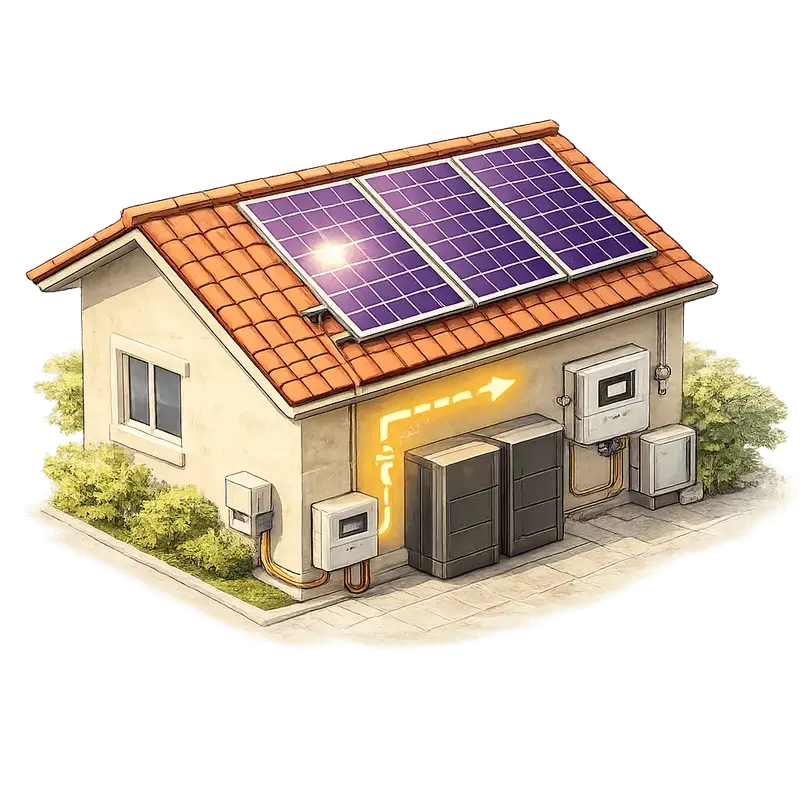
- •System Type: Hybrid Solar (On-grid + Battery Backup)
- •Primary Benefit: 24/7 Power + Savings on electricity bills
- •Battery Capacity: 5kWh to 15kWh common for Indian homes
- •Total Cost (5kW Hybrid): ₹5,20,000 – ₹6,50,000 (after subsidies)
- •Payback Period: 5–7 years due to battery life and cycle efficiency
Imagine it is a sweltering July afternoon in Gurgaon. The temperature is touching 46°C, and suddenly, the grid fails. This is a common reality for millions in Delhi-NCR, Bangalore, and Tier-2 cities across India. While traditional on-grid solar systems are excellent for saving money, they have one major flaw: they shut down during a power cut for safety reasons.
As we move into 2026, Indian homeowners are no longer satisfied with just "cheaper" electricity; they want "reliable" electricity. This shift has led to a massive surge in demand for the home solar battery India market. With falling lithium-ion prices and the evolution of the PM Surya Ghar Muft Bijli Yojana, hybrid solar systems—which combine solar panels with advanced battery storage—have become the gold standard for modern Indian households.
In this comprehensive 2026 guide, Bridgeway Power breaks down everything you need to know about lithium-backed hybrid solar systems, from costs and backup durations to the latest technology.
1. What is a Hybrid Solar System?
A hybrid solar system is the "best of both worlds." It combines the cost-saving benefits of a grid-tied system with the security of an off-grid system. Unlike a standard inverter, a hybrid setup uses a specialized Hybrid Inverter and a Lithium Battery Bank.
How it works:
- Daytime: Solar panels power your home directly. Excess energy first charges your battery, and any remaining surplus is exported to the grid via net metering India.
- Power Cut: The system automatically disconnects from the grid and uses the energy stored in your batteries to keep your lights, ACs, and fans running.
- Nighttime: Your home runs on stored battery energy until it reaches a safe discharge limit, then switches to the grid.
2. Why the Demand for Home Solar Battery in India is Skyrocketing
Several factors have aligned in 2026 to make home solar battery systems the preferred choice for Indian residents:
- Grid Instability in Tech Hubs: Despite infrastructure growth, cities like Noida and Bangalore still face localized outages. A solar battery ensures your home office and Wi-Fi never go dark.
- Falling Lithium Prices: Between 2023 and 2026, the cost of lithium iron phosphate (LFP) batteries has dropped by nearly 35%, making high-capacity storage affordable for middle-class families.
- Net Metering Uncertainty: Some states are moving toward "Net Billing" or "Gross Metering," which reduces the credit you get for exporting power. Storing your own power is now more profitable than selling it back to the Discom.
- The PM Surya Ghar Impact: While the central subsidy focuses on the solar components, the overall push for solar has matured the supply chain, making PM Surya Ghar Yojana beneficiaries look at hybrid upgrades as a long-term investment.
3. How Much Backup Does a Solar Battery Provide?
When choosing a home solar battery India solution, the most common question is: "How many hours will it last?" This depends on your "Critical Load"—the essential appliances you need during a blackout.
Table 1: Battery Backup Guide by Size (2026 Standards)
| Battery Capacity (kWh) | Typical Backup Duration | What it Can Run |
|---|---|---|
| 5 kWh | 6–8 Hours | Lights, 4 Fans, Wi-Fi, Laptop, TV, Fridge |
| 10 kWh | 12–15 Hours | All above + 1 Inverter AC (1.5 Ton) for 4-5 hours |
| 15 kWh | 20+ Hours (Full Backup) | Entire 3-4 BHK load, multiple ACs, Water Pump |
Note: Lithium batteries (LFP) are recommended over Lead-acid due to their 90% Depth of Discharge (DoD) and 10+ year lifespan.
4. Cost of Home Solar Battery System in India (2026 Pricing)
A hybrid system is an investment in both energy and peace of mind. While the upfront cost is higher than a simple on-grid system, the lifetime value is significantly higher.
Table 2: 5kW Hybrid Solar System Cost Breakdown (2026)
| Component | Estimated Price (₹) |
|---|---|
| 5kW Solar Panels (Mono PERC/Bifacial) | ₹2,20,000 - ₹2,50,000 |
| 5kW Hybrid Inverter (Smart Sync) | ₹70,000 - ₹1,00,000 |
| 5kWh Lithium Battery Pack (LFP) | ₹1,50,000 - ₹2,00,000 |
| Structure, Wiring, & Installation | ₹60,000 - ₹80,000 |
| Total Gross Cost | ₹5,00,000 - ₹6,30,000 |
| Estimated Subsidy (PM Surya Ghar) | ₹78,000 |
| Net Investment | ₹4,22,000 - ₹5,52,000 |
To get an exact quote based on your rooftop area, use our Solar Calculator.
5. Is a Solar Battery System Worth it for You?
To decide if you should choose a hybrid system over a standard on-grid one, use this simple decision framework:
Choose a Hybrid System (With Battery) if:
- You experience more than 2-3 hours of power cuts weekly.
- You work from home and cannot afford any downtime.
- You live in a state with high peak-hour electricity tariffs (Time-of-Day pricing).
- You want to maximize your self-consumption of solar energy.
Talk to a solar engineer — not a salesperson
Check whether we install in your area, then get your answer on WhatsApp. No forms, no call centre.
Size solar for your home in 30 seconds
Choose an On-Grid System (No Battery) if:
- Your grid is 99% stable.
- Your primary goal is ROI (Return on Investment) in the shortest time (3-4 years).
- You have a limited initial budget. Check out solar panel price Delhi for more on budget-friendly options.
6. The Best Hybrid Setup for Indian Homes
Based on Bridgeway Power’s 35+ years of experience, the "Sweet Spot" for a typical Indian family is a 5kW Solar System paired with a 5.12kWh or 10kWh Lithium battery.
Key Specifications to Look For:
- LFP Technology: Lithium Iron Phosphate is safer for Indian climates and offers 3,000–6,000 charging cycles.
- Bifacial Modules: These panels generate power from both sides, increasing yield by up to 15% in the same footprint.
- App Monitoring: Ensure your inverter allows you to monitor battery health and solar generation on your smartphone.
7. Real Example: The Sharma Residence in Noida
Pre-Solar Condition: 3BHK home, monthly bill of ₹9,500. Frequent 2-hour power cuts in the evenings meant running a noisy, expensive petrol generator.
The Solution:
- System Installed: 5kW Hybrid Solar System.
- Storage: 10kWh Lithium Battery.
- Investment: ₹5.8 Lakhs (including all taxes and installation).
- Outcome:
- Monthly bill dropped to ₹1,200 (fixed charges + minimal usage).
- The expensive generator was sold; the house now has seamless backup.
- The AC runs during afternoon power cuts without extra cost.
- Projected Payback: 5.5 years.
8. The Future: EV Charging and Policy Evolution
By 2027-2028, we expect the emergence of V2H (Vehicle-to-Home) technology in India. Your Electric Vehicle could potentially serve as an additional battery for your home. Furthermore, as Discoms move toward "Time of Day" (ToD) tariffs, having a home solar battery India will allow you to avoid high charges during 7 PM – 11 PM by using your stored solar energy instead of the grid.
Frequently Asked Questions
1. Does PM Surya Ghar Yojana provide a subsidy on batteries?
No, the central government subsidy is currently calculated based on the solar panel capacity (kW). However, the solar components of your hybrid system are still eligible for the subsidy (up to ₹78,000 for a 3kW+ system).
2. How long do lithium solar batteries last in India?
Modern LFP batteries used in 2026 systems typically last 10 to 15 years, depending on the depth of discharge and temperature management. Most reputable brands offer a 5-10 year replacement warranty.
3. Can I run my 1.5-ton AC on a solar battery?
Yes, but you need a hybrid inverter with a high enough "surge rating" (at least 5kW) and a battery bank of 10kWh or more to sustain the load for several hours.
4. Is maintenance high for hybrid solar systems?
Lithium batteries are virtually maintenance-free. Unlike lead-acid batteries, they do not require water topping. You only need to clean your solar panels every 15 days to ensure maximum generation.
5. Can I add a battery to my existing on-grid solar system?
Yes, this is called "AC Coupling." You can add a battery-tied inverter to your existing system, although a dedicated hybrid inverter is more efficient for new installations.
Conclusion
A home solar battery system is no longer a luxury—it is a strategic upgrade for the modern Indian home. With the 2026 landscape offering lower battery costs and more efficient hybrid inverters, there has never been a better time to switch. At Bridgeway Power, we bring over three decades of engineering excellence to help you design the perfect solar plus backup solution.
Ready to say goodbye to power cuts and high bills? Contact Bridgeway Power today for a FREE site survey and customized hybrid solar quote.
Every 1 kW of solar on your roof offsets 1.5 tonnes of CO₂ per year
That's 40 trees planted — every year, for 25 years.
A typical 5 kW home system offsets 187 tonnes of carbon over its lifetime. That's equivalent to taking 8 cars off the road.
See your impact →Get your exact solar cost — free in 30 seconds
Enter your electricity bill → see system size, govt subsidy & payback period
Get StartedLiked this article? Get a free solar quote
Tell us about your rooftop — we'll call with exact savings for your home.
Related Articles
Net Metering in India: How to Sell Solar Power Back to the Grid
Learn how net metering in India allows you to sell solar power back to the grid. Discover state policies, savings examples, and how to reduce your bill by 90%.
Read moreWhat Is Captive Open Access Solar (100% Equity Model)
Learn how Captive Open Access Solar (100% Equity Model) helps Indian businesses cut electricity costs by 40% using off-site solar plants. Guide on rules, savings & ROI.
Read moreSolar Installation Cost in Delhi NCR 2026: 3 kW at ₹1.32L net
Updated 2026 guide to solar costs in Delhi NCR. Learn about PM Surya Ghar subsidies, system pricing from 1kW-10kW, and how to reach zero electricity bills.
Read moreRelated guides
Delhi Electricity Rate 2026
BSES & Tata Power per-unit rates, PPAC, subsidy — sourced from DERC.
ExploreDelhi Solar Policy 2026
Free rooftop solar up to 3 kW for homes under 400 units. Eligibility & apply.
ExploreSolar Panel Price in Delhi
Live 2026 rooftop prices in Delhi after ₹1.56L subsidy. 1,200+ installs.
ExploreSolar Company in Gurgaon
Gurgaon's rooftop solar installer — 800+ systems, ₹78K PM Surya Ghar subsidy.
ExploreSolar Company in Noida
Noida & Greater Noida rooftop solar — 500+ installs, ₹1.08L stacked subsidy.
ExploreSolar Panel Price in Faridabad
Live 2026 Faridabad prices after ₹78K PM Surya Ghar subsidy. 350+ homes.
Explore