
By Mahendra Singh · Reviewed by Arshi Chadha, Founder
Summer Electricity Bill Shock? How Solar Eliminates Your AC Cost
- •Average AC Bill Spike: ₹3,500–₹8,000 per month
- •Recommended System: 3 kW to 5 kW for typical homes
- •Delhi Net Cost: ₹0 (Free) to ₹84,000 after stacked subsidies
- •NCR Payback Period: 3–4 years
- •Lifespan: 25–30 years
You're checking the rate — now see how much of your bill solar erases
If your May electricity bill just landed and it’s 3x higher than your February statement, you aren’t alone. In Delhi NCR, summer temperatures hitting 48°C force air conditioners to run 12–18 hours a day, pushing most households into the highest tariff slabs of ₹8 per unit. Between the base energy charge, the Delhi PPAC surcharge (which recently spiked to over 35% for some DISCOMs), and the 5% electricity tax, a single 1.5-ton 5-star AC can add ₹4,000 to your monthly expense.
We’ve spent 35 years at Bridgeway Power watching this cycle repeat. Every June, our phones ring off the hook with homeowners in Dwarka and Gurgaon who are tired of "electricity bill anxiety." Solar isn't just a "green" choice anymore; it’s a financial hedge against the rising cost of staying cool.
The Math of Summer: Why Your Bill Explodes
Most people think their bill doubles because they use the AC twice as much. The reality is worse. Indian utility companies use "slab-based pricing."
In Delhi, once you cross 800 units, you pay ₹8/unit. In Haryana (DHBVN), the top slab hits ₹7.10/unit. When you turn on the AC, you don't just use more units; you push every single unit you consume into a more expensive category.
What a 1.5 Ton AC Actually Costs You (Delhi NCR)
| Metric | 3-Star AC (Non-Inverter) | 5-Star AC (Inverter) |
|---|---|---|
| Hourly Consumption | 1.6 Units | 1.1 Units |
| Daily Usage (10 Hours) | 16 Units | 11 Units |
| Monthly Units | 480 Units | 330 Units |
| Monthly Cost (@₹8/unit + PPAC) | ₹5,200+ | ₹3,600+ |
Note: This excludes fixed charges and taxes. Real-world costs are often 20% higher due to surcharges.
How Solar Wipes Out the AC Burden
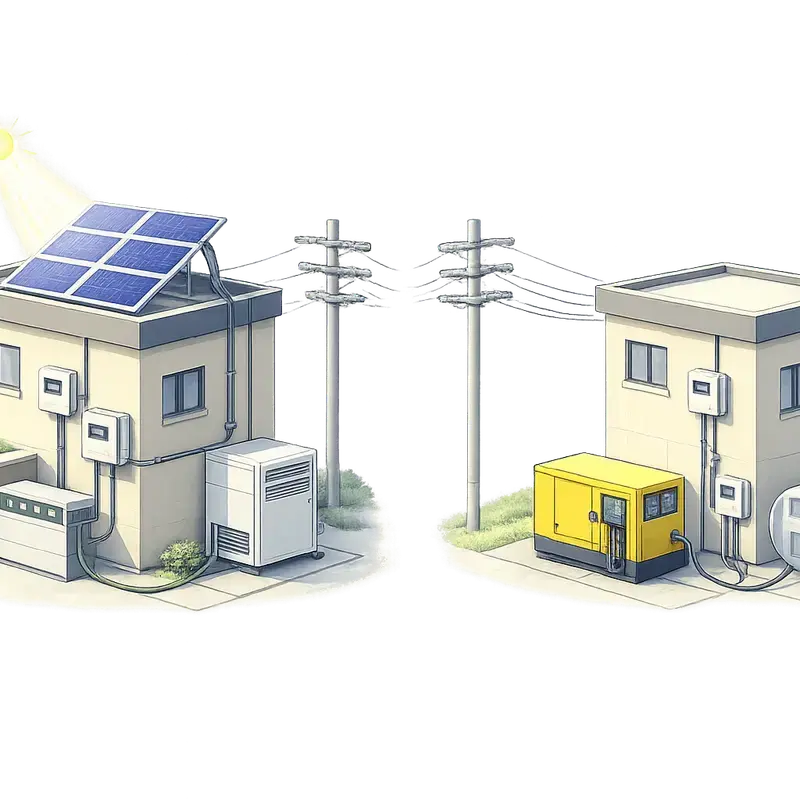
A rooftop solar system doesn't "run" your AC directly in the way a generator does. It works through net metering. During the day, when the sun is brutal, your panels produce peak power. This power first runs your home, and the excess is sent to the grid.
In the evening, when you blast the AC, you draw power back from the grid. At the end of the month, the DISCOM subtracts what you gave them from what you took. If you've sized your system correctly using a Solar Calculator, your net bill for energy charges can literally be zero.
Recommended System Sizing for Summer Comfort
| Home Type | Typical AC Count | Recommended Solar Size | Monthly Generation |
|---|---|---|---|
| 2BHK | 1 AC | 3 kW | ~360 Units |
| 3BHK | 2 ACs | 5 kW | ~600 Units |
| 4BHK / Villa | 3-4 ACs | 10 kW | ~1,200 Units |
The "Free Solar" Reality in Delhi (2026 Update)
If you are a resident in Delhi, the Delhi Solar Policy 2023 (2nd Amendment) has changed the game. For households consuming up to 400 units/month, a 3 kW system is now effectively zero-cost under the tendered route. The Delhi government tops up the difference between the PM Surya Ghar Yojana subsidy and the installation cost.
Even if you consume more than 400 units, the savings are massive. You can stack the Central subsidy of ₹78,000 with the Delhi State subsidy of ₹78,000.
2026 Pricing Table: Rooftop Solar in India
Prices include GST and standard structure. Subsidy figures based on PM Surya Ghar Muft Bijli Yojana.
| System Size | Total Cost (Gross) | Central Subsidy | Net Cost (Approx) |
|---|---|---|---|
| 3 kW | ₹2,40,000 | ₹78,000 | ₹1,62,000* |
| 5 kW | ₹3,43,035 | ₹78,000 | ₹2,65,035 |
| 10 kW | ₹6,29,442 | ₹78,000 | ₹5,51,442 |
*In Delhi, this net cost drops further to ₹84,000 for high-consumers or ₹0 for eligible households.
Real Example: The ₹10,000 Bill Fix
Last year, we visited a family in Palam Vihar, Gurgaon. Their summer bills were averaging ₹11,500 per month. They had two 1.5-ton ACs and a 1-ton AC in the kid's room.
We installed a 7 kW system.
- Previous Bill: ₹11,500/month
- Current Bill: ~₹1,200/month (Fixed charges + minimal units)
- Annual Savings: Over ₹90,000
- Payback: They are on track to recover their investment in just under 3.5 years.
You can see a similar transformation in this video case study:
Talk to a solar engineer — not a salesperson
Enter your pincode and monthly bill. If we install in your area, an engineer answers on WhatsApp with your numbers.
See how much of this bill solar erases
Financing: Don't Let the Upfront Cost Stop You

You don't need ₹3 lakh sitting in your bank to stop paying ₹10,000 to the DISCOM. Several banks and NBFCs now offer specialized solar loans that are often cheaper than personal loans.
We work with all major partners to ensure you get the best fit:
- SBI Solar Loan: Known for the lowest interest rates for PM Surya Ghar applicants.
- PNB Solar Rooftop Scheme: A solid option for residential users with quick processing.
- ECOFY Solar Financing: Great for those looking for tech-enabled, fast approvals and flexible EMIs.
- Aerem: Specializes in rooftop financing with end-to-end support.
- Canara Bank Solar Loan: Offers competitive tenures up to 10 years.
In many cases, your monthly EMI is actually lower than the amount you save on your electricity bill. It’s effectively a self-paying asset.
Beyond the Panels: Structure and Maintenance
A high summer electricity bill solar India solution is only as good as its uptime. We see a lot of "cheap" installations in Noida where the structure starts rusting after two monsoons or the generation drops by 40% because of dust.
- Structure Matters: In North India, we deal with high wind speeds and monkeys. We recommend galvanized iron (GI) or aluminum structures. Don't settle for flimsy MS (Mild Steel) painted frames. Check out our guide on solar structure costs.
- The Cleaning Crisis: Dust in cities like Ghaziabad and Faridabad is the silent killer of ROI. A layer of dust can reduce output by 25%. We include 2 professional cleanings in the first year, but for long-term health, consider an AMC Plan.
- Heat Degradation: High temperatures actually make solar panels less efficient. This sounds counterintuitive, but it's true. We use TOPCon Mono PERC panels with better temperature coefficients to ensure that when it's 45°C outside, your system is still pumping out maximum power for your AC.
Why Bridgeway Power?
We aren't just a sales company. We have an electrical lineage dating back to 1997 and a dedicated PV practice since 2019. With 5,000+ installations and 45+ MW installed, we've seen every type of roof—from builder floors in Delhi to massive industrial sheds.
We don't just bolt panels to your roof. We handle the BSES net metering or DHBVN approvals, provide 1-year installation insurance, and give you a 5-year workmanship warranty.
FAQ
Does a solar system work during a power cut?
If you have a standard on-grid system, it will shut down during a power cut for safety (anti-islanding). If you need power during outages to run your AC, you should opt for a Hybrid Solar System with a lithium battery bank.
How much area do I need for a 5 kW solar system?
A 5 kW system typically requires about 400 to 500 square feet of shadow-free rooftop area. This fits comfortably on the roof of most 3BHK homes or independent floors.
Will the weight of the panels damage my roof?
Not at all. A solar panel weighs about 22-28 kg, and the structure adds another 4-6 kg per panel. This is significantly less than the weight of a standard 1000L water tank. Most RCC roofs in India are designed to handle much higher loads.
Can I run a 1.5-ton AC on a 3 kW solar system?
Yes, a 3 kW system generates about 12-15 units a day. A 5-star 1.5-ton AC uses about 1-1.2 units per hour. So, your daily solar generation can easily cover 8-10 hours of AC usage, provided your other base loads (fridge, lights, fans) are moderate.
How long does it take to get the subsidy?
Under the PM Surya Ghar scheme, the subsidy is usually credited to your bank account within 30 to 60 days after the DISCOM installs the net meter and inspects the system. We assist all our customers with the documentation to ensure there are no delays.
If you are ready to stop fearing the summer heat and start generating your own power, get a free quote today. We’ll perform a site survey and show you exactly how much your roof can save you.
Every 1 kW of solar on your roof offsets 1.5 tonnes of CO₂ per year
That's 40 trees planted — every year, for 25 years.
A typical 5 kW home system offsets 187 tonnes of carbon over its lifetime. That's equivalent to taking 8 cars off the road.
See your impact →How much can you save with solar?
Enter your electricity bill → get system size, subsidy amount & payback period
Get StartedSee how much of this bill solar erases
Related Articles
What Is Captive Open Access Solar (100% Equity Model)
Learn how Captive Open Access Solar (100% Equity Model) helps Indian businesses cut electricity costs by 40% using off-site solar plants. Guide on rules, savings & ROI.
Read moreHow Rooftop Solar Can Eliminate Your Electricity Bill
Discover how Net Metering and PM Surya Ghar subsidies can reduce your monthly electricity bill to near-zero. Learn about system sizing, costs, and real-world savings.
Read moreSolar Subsidy in Uttar Pradesh 2026: ₹1,08,000 for Noida, Ghaziabad & Greater Noida
UP's stacked solar subsidy 2026: ₹78,000 central + ₹30,000 UPNEDA state top-up = ₹1.08L. Real PVVNL net-cost math for Noida, Greater Noida, Ghaziabad & Meerut.
Read moreRelated guides
Delhi Electricity Rate 2026
BSES & Tata Power per-unit rates, PPAC, subsidy — sourced from DERC.
ExploreDelhi Solar Policy 2026
Free rooftop solar up to 3 kW for homes under 400 units. Eligibility & apply.
ExploreSolar Panel Price in Delhi
Live 2026 rooftop prices in Delhi after ₹1.56L subsidy. 1,200+ installs.
ExploreSolar Company in Gurgaon
Gurgaon's rooftop solar installer — 800+ systems, ₹78K PM Surya Ghar subsidy.
ExploreSolar Company in Noida
Noida & Greater Noida rooftop solar — 500+ installs, ₹1.08L stacked subsidy.
ExploreSolar Panel Price in Faridabad
Live 2026 Faridabad prices after ₹78K PM Surya Ghar subsidy. 350+ homes.
Explore