
By Arshi Chadha, Founder · Bridgeway Power
Choosing Between On-Grid and Hybrid Solar with Battery
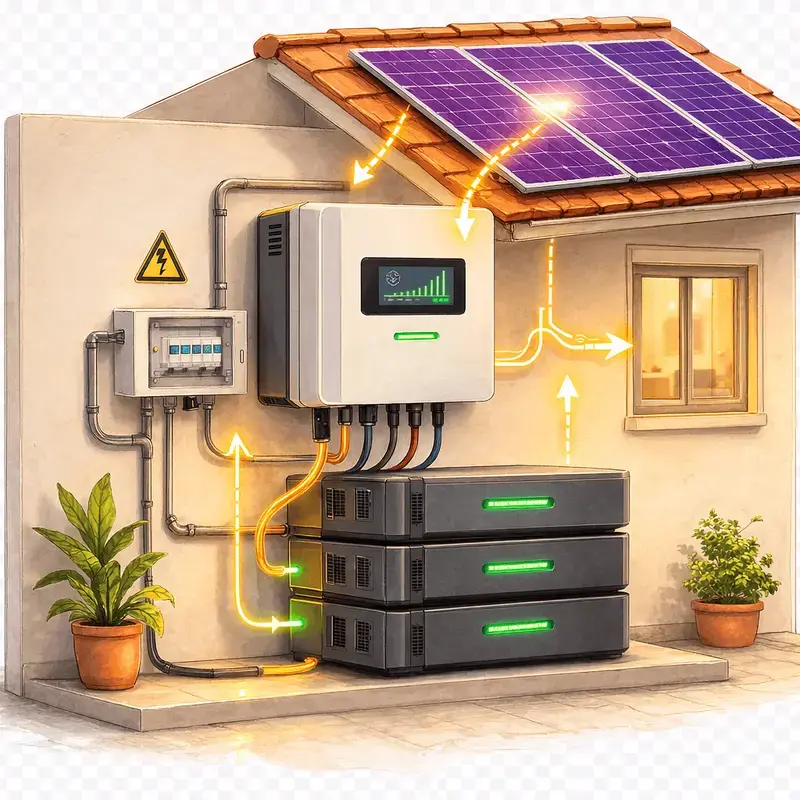
- •On-Grid: Best for bill reduction; lowest cost; no backup during power cuts.
- •Hybrid (Solar with Battery): Best for unreliable grids; provides backup + bill savings.
- •Battery ROI: Typically adds 3–5 years to the system payback period.
- •Technology: Lithium (LFP) is now the standard over Lead-Acid for 10+ year life.
I’ve spent 35 years looking at Indian roofs, from the early days of simple off-grid lighting to today’s high-tech bifacial arrays. The most common question I get in my office today isn't about the panels—it's about the storage. Specifically, "Do I need a solar with battery setup, or should I just stick to the grid?"
In places like solar in Delhi, where the grid is remarkably stable but Delhi electricity rates are climbing, the answer is usually different than it is for a farmhouse in the outskirts of Gurgaon where power cuts are a daily reality. This isn't just about "going green"; it’s about engineering a system that doesn't leave you in the dark or with a hole in your wallet.
How Battery Storage Changes the Economics of Solar ROI
When you install a standard on-grid system, your "battery" is the DISCOM’s grid. You pump excess power into it during the day via net metering, and you take it back at night. It’s efficient and cheap.
However, adding a solar power backup for home changes the math. A battery is an additional capital expenditure (CAPEX) that doesn't generate electricity—it only stores it. This means your ROI period stretches.
While a 5kW on-grid system in Delhi might pay for itself in 3.5 to 4 years, adding a 10kWh lithium ion battery for solar can push that payback to 7 or 8 years. You’re paying a premium for "energy security." We tell our customers: if your area has less than 2 hours of power cuts a week, a battery is a luxury. If you face 4+ hours of cuts, it’s a necessity for productivity.
Lead-Acid vs. Lithium-based Solar Storage
If you're still considering lead-acid batteries for a modern solar plant, you're likely making a mistake. In the Indian heat, lead-acid batteries degrade rapidly if they aren't maintained with distilled water, and they only give you about 3-4 years of life.
We exclusively recommend lithium ion battery for solar (specifically LFP - Lithium Iron Phosphate) for hybrid installs now. Here is the field reality:
| Feature | Lead-Acid (C10) | Lithium (LFP) |
|---|---|---|
| Lifespan | 1,200 Cycles (3-4 years) | 6,000 Cycles (10-12 years) |
| Depth of Discharge (DoD) | 50% (Don't drain it fully!) | 85-90% (Use almost all capacity) |
| Maintenance | High (Water topping) | Zero (Plug and play) |
| Space Required | Large, heavy rack | Compact wall-mount |
| Efficiency | ~75-80% | ~95% |
For a 5kW hybrid solar system, we typically install 5kWh to 10kWh of Lithium storage. It’s cleaner, safer, and over 10 years, it actually costs less per unit of energy stored.
Calculating the Number of Batteries Needed for Night-Time Load
We don't just guess how many batteries you need. We look at your "critical load"—the things that MUST run when the grid fails.
To calculate your requirement, list your appliances, their wattage, and how many hours you need them to run. Use our Solar Calculator to get a sense of your total generation, then apply the storage math: Wattage × Hours = Watt-hours (Wh).
Battery Capacity vs Backup Hours for Common Appliances
Assumes a 5kWh Lithium battery bank at 85% usable capacity (4.25kWh).
| Appliance Load | Total Watts | Estimated Backup Hours |
|---|---|---|
| Basic: 5 LEDs, 3 Fans, 1 TV, 1 Router | 350W | ~12 Hours |
| Work From Home: Laptop, Monitor, Lights, Fans, AC (Inverter type, 1.5T) | 1,200W | ~3.5 Hours |
| Full Comfort: 2 Fans, 5 LEDs, 1.5T AC (Running at 24°C) | 1,000W | ~4.2 Hours |
| Heavy Load: Fridge, Microwave (intermittent), Lights, Fans | 1,800W | ~2.3 Hours |
Note: Running an AC on a solar with battery setup requires a high-discharge lithium bank and a hybrid inverter rated for the starting surge of the compressor.
Talk to a solar engineer — not a salesperson
Check whether we install in your area, then get your answer on WhatsApp. No forms, no call centre.
What would solar save on YOUR bill?
Off-Grid Solar vs Hybrid: What’s the Difference?
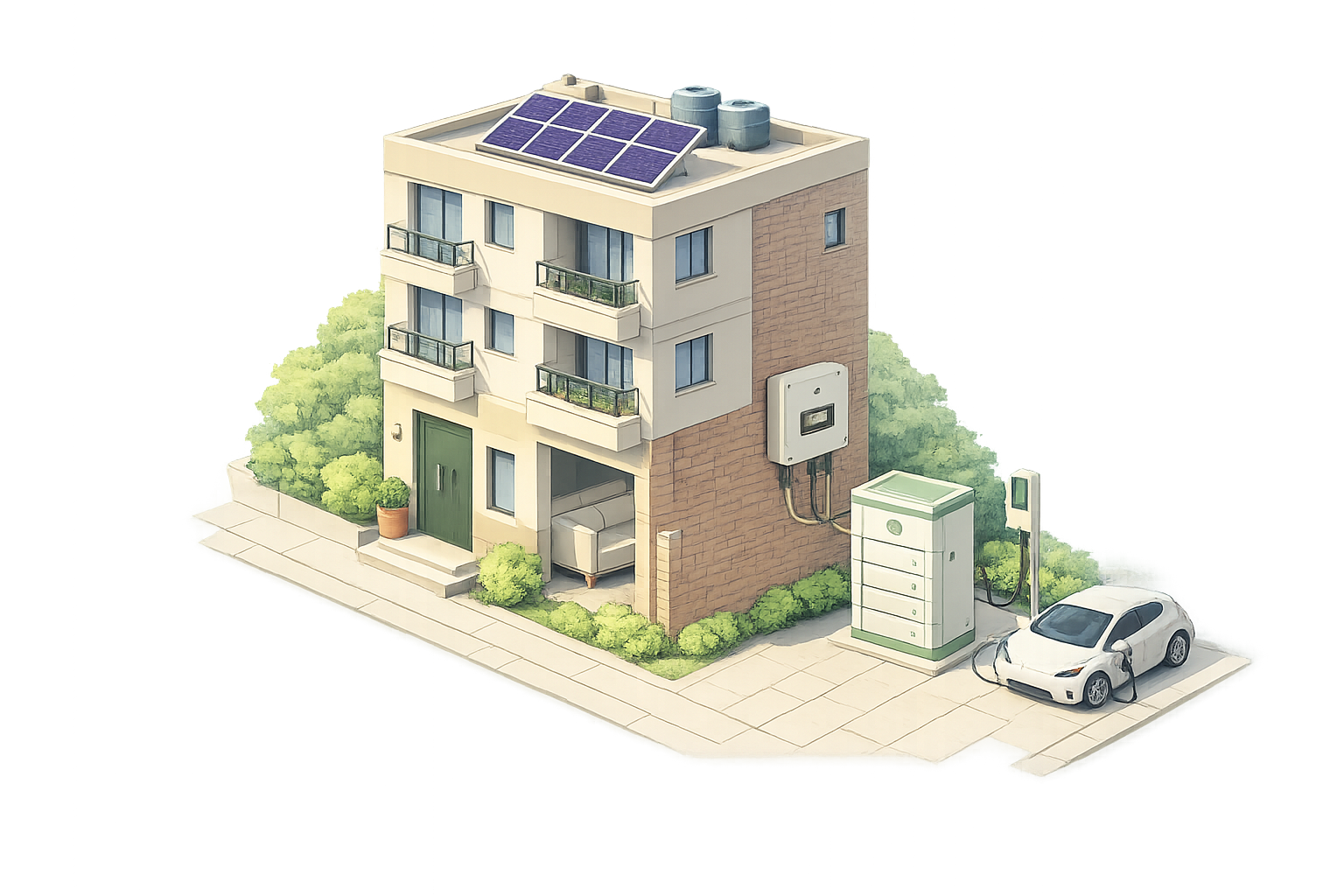
Many people confuse these two.
- Off-Grid Solar: Not connected to the DISCOM at all. If your batteries are full and the sun is shining, your panels simply stop producing. You "waste" energy.
- Hybrid Solar: Connected to the grid AND batteries. It uses solar to run the house first, charges the battery second, and exports the leftover to the grid (earning you credits).
In urban areas like solar in Gurgaon, a pure off-grid system is almost never a good idea. You want the hybrid ability to sell excess power back to DHBVN when your batteries are topped up.
Limitations of Hybrid Systems in Net Metering Scenarios
There is a catch. Not every state makes hybrid net metering easy. In some DISCOM territories, the process for getting a hybrid inverter approved for export is more paperwork-heavy than a standard on-grid system.
Also, solar with battery systems are slightly less efficient at exporting. Because the power has to pass through more conversion stages (DC to Battery to AC), you might see a 2-3% drop in total units exported compared to a lean string-inverter on-grid setup. We usually offset this by using high-efficiency TOPCon panels which offer 22% efficiency.
Real Example: A Dwarka Residency
A 3BHK homeowner in Dwarka had a monthly bill of ₹8,000. They faced 1-hour power cuts every evening—just enough to be annoying. We installed a 5kW hybrid system with a 5kWh lithium battery.
- Daytime: Solar runs the AC and fridge, and charges the battery.
- Evening: When the grid tripped, the transition was so fast the WiFi didn't even reset.
- Bill Impact: The bill dropped to near zero (fixed charges only), and they stopped using their old, noisy lead-acid inverter.
For a similar setup, you can get a free quote tailored to your specific roof space and load profile.
FAQ
Can I add a battery to my existing on-grid solar system?
Yes, but it usually requires an "AC-coupled" battery system or replacing your existing string inverter with a hybrid one. It's often more expensive to retrofit than to install a hybrid system from the start.
Does PM Surya Ghar subsidy apply to batteries?
The PM Surya Ghar Muft Bijli Yojana subsidy is calculated based on the solar plant capacity (kW), not the battery storage. While you can install a hybrid system, the government only subsidizes the solar portion, usually up to ₹78,000 for a 3kW+ system.
How long does a lithium ion battery for solar last?
Tier-1 LFP batteries like the ones we use are rated for 6,000 cycles. If you discharge it once a day, that’s roughly 16 years. Realistically, considering Indian ambient temperatures, we tell customers to expect 10-12 years of peak performance.
Is hybrid solar better than a diesel generator?
Absolutely. A diesel generator costs roughly ₹25 per unit to run when you factor in fuel and maintenance. Solar with battery storage costs significantly less over its lifetime and operates silently with zero emissions.
Can I run my 1.5 Ton AC on solar with battery at night?
Yes, but you need a large enough battery bank. A typical 1.5T inverter AC consumes about 0.8 to 1.2 units per hour. A 10kWh battery could potentially run an AC for 8-10 hours if no other heavy loads are active.
Don't buy a battery just because it sounds high-tech. If your grid is 99% reliable, go on-grid and save the money. But if you're running a home office or have critical medical equipment, the peace of mind a hybrid system provides is worth every rupee. Get a professional site survey to see which structure fits your roof best by checking our guide on solar structures.
Every 1 kW of solar on your roof offsets 1.5 tonnes of CO₂ per year
That's 40 trees planted — every year, for 25 years.
A typical 5 kW home system offsets 187 tonnes of carbon over its lifetime. That's equivalent to taking 8 cars off the road.
See your impact →How much can you save with solar?
Enter your electricity bill → get system size, subsidy amount & payback period
Get StartedLiked this article? Get a free solar quote
Tell us about your rooftop — we'll call with exact savings for your home.
Related Articles
Net Metering in India: How to Sell Solar Power Back to the Grid
Learn how net metering in India allows you to sell solar power back to the grid. Discover state policies, savings examples, and how to reduce your bill by 90%.
Read moreWhat Is Captive Open Access Solar (100% Equity Model)
Learn how Captive Open Access Solar (100% Equity Model) helps Indian businesses cut electricity costs by 40% using off-site solar plants. Guide on rules, savings & ROI.
Read moreSolar Installation Cost in Delhi NCR 2026: 3 kW at ₹1.32L net
Updated 2026 guide to solar costs in Delhi NCR. Learn about PM Surya Ghar subsidies, system pricing from 1kW-10kW, and how to reach zero electricity bills.
Read moreRelated guides
Delhi Electricity Rate 2026
BSES & Tata Power per-unit rates, PPAC, subsidy — sourced from DERC.
ExploreDelhi Solar Policy 2026
Free rooftop solar up to 3 kW for homes under 400 units. Eligibility & apply.
ExploreSolar Panel Price in Delhi
Live 2026 rooftop prices in Delhi after ₹1.56L subsidy. 1,200+ installs.
ExploreSolar Company in Gurgaon
Gurgaon's rooftop solar installer — 800+ systems, ₹78K PM Surya Ghar subsidy.
ExploreSolar Company in Noida
Noida & Greater Noida rooftop solar — 500+ installs, ₹1.08L stacked subsidy.
ExploreSolar Panel Price in Faridabad
Live 2026 Faridabad prices after ₹78K PM Surya Ghar subsidy. 350+ homes.
Explore