
By Sandeep Maurya · Reviewed by Arshi Chadha, Founder
Solar ROI Calculation & Payback Period in India (2026)
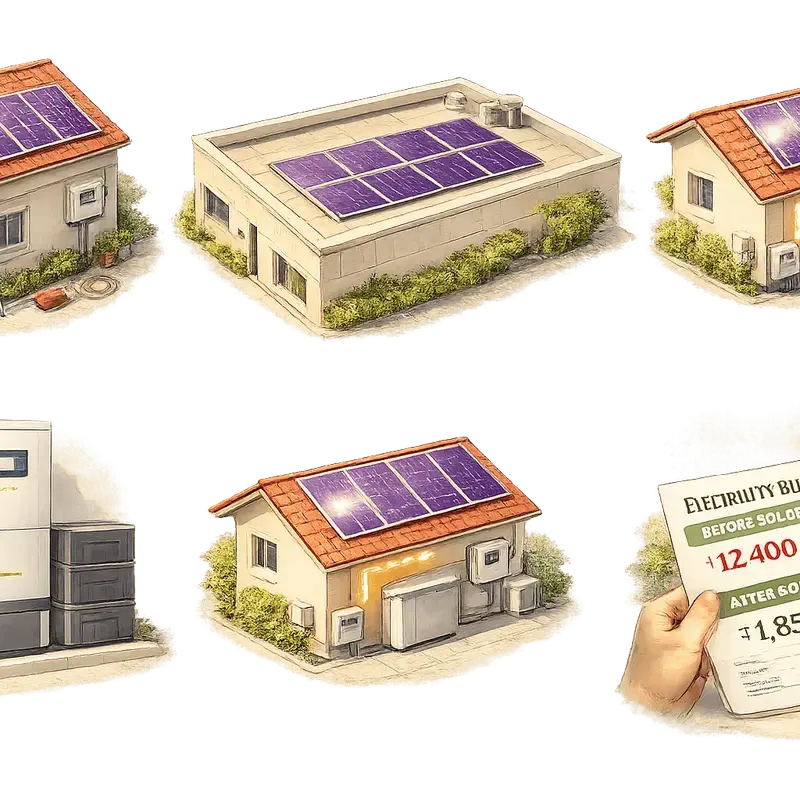
- •Average Cost per kW: ₹67,000 (Installed)
- •Payback Period: 3.5 to 5.5 years (with subsidy)
- •ROI (Return on Investment): 25% – 35% annually
- •25-Year Savings: ₹15 Lakh to ₹60 Lakh+ (depending on system size)
- •Government Subsidy: Up to ₹78,000 under PM Surya Ghar Yojana
Is solar a "good" investment? In 2026, with residential electricity tariffs in cities like Mumbai touching ₹10/unit and Delhi hovering around ₹8/unit, this is no longer just an environmental question—it is a core financial one. Most Indian households see their electricity bills rise by 5-7% every year due to fuel adjustment costs and slab changes.
When you perform a solar ROI calculation India, you quickly realize that rooftop solar isn't just about saving the planet; it’s about securing a fixed, low-cost energy rate for the next 25 years. Whether you are in Dwarka or Noida Extension, understanding the mathematics behind your investment is the first step toward energy independence.
How to Calculate Solar ROI Step by Step
To determine your solar investment return, you need to look beyond the initial invoice. Solar ROI calculation India involves four primary variables:
1. Total Installed Cost (Capital Outlay)
This is the upfront cost of panels, inverters, mounting structures, and installation. In 2026, the average cost for a high-quality rooftop system is approximately ₹67,000 per kW.
2. Annual Energy Generation
In the Delhi NCR region, a well-maintained solar plant generates an average of 120 units (kWh) per month per kW of installed capacity. A 5kW system, therefore, produces roughly 600 units monthly or 7,200 units annually. You can use our Solar Calculator to get specific estimates for your roof.
3. Avoided Cost (The Value of a Unit)
This is where most people make mistakes. You don't just calculate based on the base tariff. You must include:
- Base energy charges
- PPAC Surcharge (especially in Delhi)
- Electricity Duty (ED)
- Fixed charges saved by downsizing your sanctioned load (in some states)
4. Applied Subsidies
The PM Surya Ghar Yojana has revolutionized the solar panel payback period India. For a residential system, the central subsidy is ₹30,000 per kW for the first 2kW and ₹18,000 for the 3rd kW, capping at ₹78,000.
The Formula:
ROI Calculation Example: 3kW, 5kW, and 10kW Systems (2026)
Here is a breakdown of what the returns look like for different residential system sizes in 2026. This table assumes an average tariff of ₹8/unit (typical for Delhi/NCR mid-to-high slabs).
| System Size | Total Cost (Inc. GST) | Central Subsidy | Net Investment | Annual Generation (Units) | Annual Savings (₹8/unit) | Annual ROI (%) |
|---|---|---|---|---|---|---|
| 3kW | ₹2,01,000 | ₹78,000 | ₹1,23,000 | 4,320 | ₹34,560 | 28.1% |
| 5kW | ₹3,35,000 | ₹78,000 | ₹2,57,000 | 7,200 | ₹57,600 | 22.4% |
| 10kW | ₹5,50,000 | ₹78,000* | ₹4,72,000 | 14,400 | ₹1,15,200 | 24.4% |
*Note: Subsidy is capped at 3kW for residential consumers. For systems larger than 10kW, the cost per kW drops significantly due to economies of scale.
Payback Period with and Without Subsidy
The solar panel payback period India refers to the time it takes for the cumulative electricity savings to equal the initial net investment. Once you hit the "break-even" point, your electricity is essentially free for the remainder of the system's life.
| System Size | Payback (Without Subsidy) | Payback (With Subsidy) |
|---|---|---|
| 3kW System | 5.8 Years | 3.5 Years |
| 5kW System | 5.8 Years | 4.4 Years |
| 10kW System | 4.7 Years | 4.1 Years |
As shown, the PM Surya Ghar Yojana 2026 guide highlights how the subsidy can slash nearly two years off your payback period. In Delhi specifically, the Delhi State Solar Subsidy and the Generation Based Incentive (GBI) of ₹3/unit can further accelerate this to under 3 years.
Is Solar Worth It in India 2026?
The short answer is: Yes, more than ever.
When asking is solar worth it India 2026, consider that a Fixed Deposit (FD) gives you 7-8% return, and the Stock Market averages 12-15% over the long term. A rooftop solar system provides a tax-free return of 25% to 35%.
Furthermore, solar provides a hedge against inflation. While BSES bill increases are likely to continue, your solar panel generation cost is locked at zero for 25 years.
Talk to a solar engineer — not a salesperson
Enter your pincode and monthly bill. If we install in your area, an engineer answers on WhatsApp with your numbers.
What would solar save on YOUR bill?
Solar Depreciation & Tax Benefit Calculator
Based on Section 32 — 40% WDV + 20% additional depreciation (Year 1)
Real Example: A 3BHK Home in Gurgaon
A family in Sushant Lok, Gurgaon, had a monthly electricity bill of ₹9,000 (approx. 1,100 units/month).
- Solution: 8kW On-Grid Solar System.
- Net Investment: ₹4,40,000 (after 3kW subsidy cap).
- Monthly Generation: ~960 units.
- New Bill: Reduced to almost zero (only fixed charges and minimal night consumption).
- Monthly Savings: ₹8,500.
- Annual Savings: ₹1,02,000.
- Payback Period: ~4.3 Years.
- 25-Year Profit: Over ₹45 Lakhs (accounting for 5% annual tariff hike).
25-Year Savings Projection
Solar panels come with a performance warranty of 25 years. This means your solar investment return continues long after the system has paid for itself.
| Year Range | Cumulative Savings (No Hike) | Cumulative Savings (5% Tariff Hike) |
|---|---|---|
| Years 1-5 | ₹2.8 Lakh | ₹3.1 Lakh |
| Years 6-15 | ₹8.6 Lakh | ₹11.4 Lakh |
| Years 16-25 | ₹14.4 Lakh | ₹26.8 Lakh |
| Total 25-Year Benefit | ₹14.4 Lakh | ₹41.3 Lakh |
Table based on a 5kW system with initial ₹8/unit tariff.
Factors That Impact Your Solar ROI
While the numbers above are standard, your specific ROI can shift based on these factors:
1. Panel Cleaning & Maintenance
Dirty panels in dusty areas like Raj Nagar Extension can lose 25% of their output. We recommend regular solar panel cleaning to maintain a sub-4-year payback.
2. Shading Issues
Even a small shadow from a water tank or a neighbor's building can drop generation significantly. Proper site assessment is critical.
3. Financing Costs
If you take a loan from SBI PM Surya Ghar Loan at 7% interest, your payback period might extend by 6-8 months, but your out-of-pocket "upfront" cost becomes nearly zero. Bridgeway Power partners with Aerem Solar Finance, Canara Bank, ECOFY, PNB, and SBI to offer flexible options.
Frequently Asked Questions
Which system size has the best ROI in India?
Usually, a 3kW system has the highest ROI percentage because it maximizes the Government Solar Subsidy relative to its cost. However, larger systems (10kW+) have better "per kW" pricing, which makes them more attractive for bungalows and commercial shops.
Does the ROI change if I use a battery?
Yes. Adding a hybrid solar battery system increases the upfront cost by 60-100%, which extends the payback period to 7-9 years. However, it provides invaluable backup during power cuts and protection against future "Time of Day" (ToD) tariff hikes.
How do I calculate ROI if I have net metering?
With Net Metering, you export excess power to the grid during the day and "withdraw" it at night. Your ROI is calculated based on the total units generated multiplied by your current slab rate, as the grid acts as a free "virtual battery."
Will my ROI decrease as the panels age?
Solar panels degrade by about 0.5% to 0.7% per year. However, electricity tariffs usually rise by 5% per year. The tariff hike significantly outweighs the panel degradation, meaning your savings actually increase as the system gets older.
Is the ROI different for commercial buildings?
Commercial ROI is often even better than residential. While businesses don't get the PM Surya Ghar subsidy, they can claim 40% Accelerated Depreciation and a lower GST rate (in some cases), significantly reducing their taxable income. Read more about solar for MSMEs.
Conclusion: Start Your Savings Journey Today
The math is clear: a solar ROI calculation India proves that rooftop solar outperforms almost every other traditional investment available to homeowners in 2026. With a payback period of under 5 years and a lifespan of 25 years, you are essentially buying 20 years of free electricity.
At Bridgeway Power, we help you maximize your solar investment return through premium components, expert engineering, and seamless subsidy processing. Whether you're in NIT Faridabad or Pitampura, our team is ready to design a system that fits your roof and your budget.
Ready to see your personalized ROI? Get a Free Consultation & Quote Today or use our Solar Calculator to estimate your savings.
Every 1 kW of solar on your roof offsets 1.5 tonnes of CO₂ per year
That's 40 trees planted — every year, for 25 years.
A typical 5 kW home system offsets 187 tonnes of carbon over its lifetime. That's equivalent to taking 8 cars off the road.
See your impact →How much can you save with solar?
Enter your electricity bill → get system size, subsidy amount & payback period
Get StartedLiked this article? Get a free solar quote
Tell us about your rooftop — we'll call with exact savings for your home.
Related Articles
What Is Captive Open Access Solar (100% Equity Model)
Learn how Captive Open Access Solar (100% Equity Model) helps Indian businesses cut electricity costs by 40% using off-site solar plants. Guide on rules, savings & ROI.
Read moreHow Rooftop Solar Can Eliminate Your Electricity Bill
Discover how Net Metering and PM Surya Ghar subsidies can reduce your monthly electricity bill to near-zero. Learn about system sizing, costs, and real-world savings.
Read moreSolar Subsidy in Uttar Pradesh 2026: ₹1,08,000 for Noida, Ghaziabad & Greater Noida
UP's stacked solar subsidy 2026: ₹78,000 central + ₹30,000 UPNEDA state top-up = ₹1.08L. Real PVVNL net-cost math for Noida, Greater Noida, Ghaziabad & Meerut.
Read moreRelated guides
Delhi Electricity Rate 2026
BSES & Tata Power per-unit rates, PPAC, subsidy — sourced from DERC.
ExploreDelhi Solar Policy 2026
Free rooftop solar up to 3 kW for homes under 400 units. Eligibility & apply.
ExploreSolar Panel Price in Delhi
Live 2026 rooftop prices in Delhi after ₹1.56L subsidy. 1,200+ installs.
ExploreSolar Company in Gurgaon
Gurgaon's rooftop solar installer — 800+ systems, ₹78K PM Surya Ghar subsidy.
ExploreSolar Company in Noida
Noida & Greater Noida rooftop solar — 500+ installs, ₹1.08L stacked subsidy.
ExploreSolar Panel Price in Faridabad
Live 2026 Faridabad prices after ₹78K PM Surya Ghar subsidy. 350+ homes.
Explore