
By Bhawna Thakur · Reviewed by Arshi Chadha, Founder
Solar for MSMEs in India (2026): No Subsidy Needed — Tax Benefits, Financing & ROI Explained
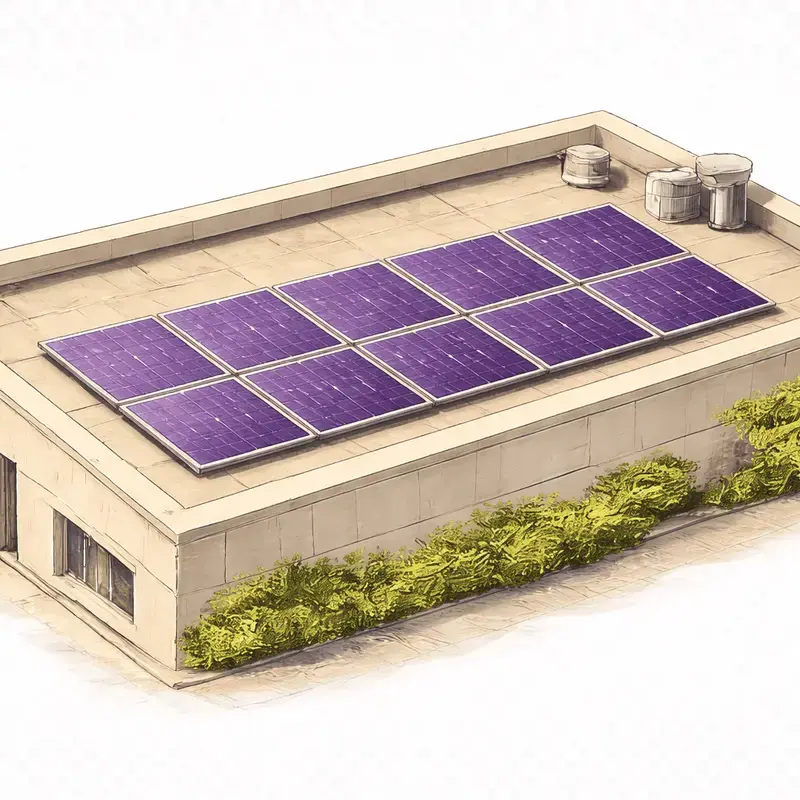
- •Primary Benefit: 60% Tax Depreciation + 5% GST Input Tax Credit (ITC)
- •Average System Cost: ₹45,000–₹50,000 per kW (for systems >20kW)
- •Payback Period: 3 to 4 years (factoring in tax shield)
- •Key Financing: SIDBI 4E Scheme (7–8% interest rates)
- •Annual ROI: 25% to 35% depending on state electricity tariffs
For years, the conversation around solar energy in India has been dominated by residential subsidies like the PM Surya Ghar Yojana. However, if you are a business owner operating an MSME (Micro, Small, and Medium Enterprise), you might feel left behind. You’ve likely asked, "Where is my subsidy?"
The hard truth for 2026 is this: There is no central government subsidy for MSME solar. But here is the secret that India’s most profitable factory owners already know—you don't need one.
While residential users get a flat cash handout, MSMEs have access to "industrial-grade" financial boosters: Accelerated Depreciation, GST Input Tax Credits, and specialized low-interest green financing from institutions like SIDBI. When you combine these, the "effective cost" of your solar plant drops by nearly 30-40% in the very first year.
In this guide, we will break down why solar for MSME business India is the highest-return investment you can make in 2026, even without a direct subsidy check.
1. The Myth of the MSME Subsidy: Setting the Record Straight
There is a lot of misinformation circulating in industrial hubs like Noida Extension and Faridabad. Let’s clarify the current policy landscape administered by the Ministry of New & Renewable Energy (MNRE):
- Residential (PM Surya Ghar): Direct subsidy available (up to ₹78,000). MSMEs do not qualify.
- Agriculture (PM KUSUM): Subsidies for solar pumps and feeders. MSMEs do not qualify.
- MSME/Industrial: No direct central capital subsidy.
Important Policy Update: While Niti Aayog has proposed a "PM Suryaghar-like" scheme specifically for MSMEs to encourage green transition, it is NOT yet approved or available. As of 2026, any company promising you a "government subsidy" for a factory solar plant is likely misrepresenting the facts.
However, the lack of a "subsidy" is offset by massive commercial solar tax benefits that residential users cannot claim.
2. The Power of "Tax Shields": 60% Depreciation & GST ITC
For a registered MSME, the government "pays" for a large chunk of your solar system through tax savings. This is where the ROI for solar for MSME business India truly outperforms any other capital expenditure.
Accelerated Depreciation (AD)
Under Section 32 of the Income Tax Act, solar energy equipment qualifies for a Written Down Value (WDV) depreciation of 40%. But for MSMEs involved in manufacturing, there is an additional 20% benefit under Section 32(1)(iia).
| Tax Benefit Component | Percentage | Impact on Cash Flow |
|---|---|---|
| Normal Depreciation (WDV) | 40% | Reduces taxable income significantly in Year 1 |
| Additional Depreciation | 20% | Exclusive to manufacturing MSMEs in Year 1 |
| Total Year 1 Benefit | 60% | Massive tax shield on the total project cost |
| GST Input Tax Credit | 5% | Full refund of GST paid on modules/inverters |
How GST ITC Works
When you install a solar plant, the GST on solar components is currently 12% (effective rate on a composite contract is often lower or around 5% for specific items). Because your MSME likely pays GST on its finished products or services, you can claim the 5% GST paid on the solar system as an Input Tax Credit (ITC). This is essentially a 5% cash discount on the system price.
3. Financing Solar for MSME Business India: Low-Interest Loans
If you don't want to lock up your working capital, specialized "Green Loans" are available. These are far cheaper than standard business loans or LAP (Loan Against Property).
SIDBI 4E (End to End Energy Efficiency)
The SIDBI Solar Loan for MSMEs is the gold standard for industrial solar financing. It targets energy efficiency and solar adoption with aggressive rates and high funding limits.
Comparison of MSME Solar Financing Options (2026)
| Loan Provider | Interest Rate | Max Loan Amount | Tenure | Key Feature |
|---|---|---|---|---|
| SIDBI 4E Scheme | 7.0% – 8.0% | Up to ₹7.5 Crore | 3 - 7 Years | 100% project funding available |
| SBI Surya Shakti | 7.0% onwards | Case-to-Case | Up to 15 Years | Longest tenure for low EMI |
| IREDA | 8.25% – 9.75% | Min ₹1 Crore | Up to 10 Years | Best for large-scale C&I projects |
| PNB Solar | PNB Rates | Case-to-Case | Up to 10 Years | Available for smaller 10kW+ units |
Note: For smaller MSMEs, ECOFY Solar Financing or Aerem Solar Finance offer faster, tech-enabled processing with minimal paperwork.
4. Real Example: ROI for a 30kW System in a Delhi NCR Factory
Let’s look at a real-world scenario for a small plastic molding unit in Bhiwadi or Okhla.
- Current Monthly Bill: ₹80,000 (Avg. ₹8.5/unit)
- System Size Required: 30kW
- Project Cost: ₹15,00,000 (Approx ₹50,000/kW)
- Annual Generation: ~43,200 units (based on 120 units/kW/month)
The Savings Breakdown:
- Yearly Electricity Savings: 43,200 units × ₹8.5 = ₹3,67,200
- GST ITC (5%): ₹75,000 (Immediate recovery)
- Tax Shield (Year 1): 60% of ₹15L = ₹9,00,000 reduction in taxable income. At a 25% tax bracket, this is ₹2,25,000 in cash saved.
- Total Year 1 Financial Gain: ₹3,67,200 (Savings) + ₹75,000 (GST) + ₹2,25,000 (Tax) = ₹6,67,200
Simple Payback Period: ~35-40 Months (Under 3.5 years). After this point, your electricity is essentially free for the next 21 years of the solar panel lifespan.
Talk to a solar engineer — not a salesperson
Enter your pincode and monthly bill. If we install in your area, an engineer answers on WhatsApp with your numbers.
See your EMI for a real bill
Solar Depreciation & Tax Benefit Calculator
Based on Section 32 — 40% WDV + 20% additional depreciation (Year 1)
5. State-Specific Incentives: Beyond Delhi NCR
While the central government doesn't offer a subsidy, some state-level policies provide additional "sweeteners" for MSMEs:
- Gujarat: Historically one of the best states for MSME solar with capital subsidies and excellent banking support. Check the latest GERC HT Tariff updates.
- Uttar Pradesh: Offers exemptions on electricity duty for a certain period for new solar installations.
- Delhi: While there is no capital subsidy for commercial users, the Delhi Solar Policy 2024 offers a Generation Based Incentive (GBI) of ₹1/unit for commercial properties, though this is capped and subject to annual budget releases.
For businesses in Gurgaon or Noida, the main driver remains the high commercial tariff (often ₹7–₹9 per unit), which makes solar a math-driven "no-brainer."
6. Technical Considerations for MSME Solar
When adopting solar for MSME business India, industrial roofs require more care than residential ones.
Rooftop Structure
Most Indian MSMEs operate out of shed-type structures with tin/metal roofs. You must choose the right mounting structure to ensure no leakages occur. Aluminum "short rails" or "long rails" are standard.
Net Metering vs. Captive Consumption
- Captive Consumption: Using solar directly to run your machinery. This is the most efficient because it avoids PPAC surcharges and taxes.
- Net Metering: Exporting excess power on Sundays or holidays back to the grid. This requires an application with your DISCOM (BSES, TPDDL, PVVNL, or DHBVN).
Maintenance (AMC)
Industrial areas are prone to high dust and pollution. A dirty solar panel can lose 25% of its output. For MSMEs, we highly recommend a Solar AMC Plan to ensure regular cleaning and electrical health checks. Read our case study on how a Delhi site recovered 6x generation through professional maintenance.
7. How to Start Your Solar Journey with Bridgeway Power
At Bridgeway Power, we have assisted over 5,000+ clients in their transition to renewable energy. Our process for MSMEs is designed to be "zero-friction":
- Feasibility Audit: We analyze your last 12 months of electricity bills and roof strength.
- Custom Proposal: A detailed ROI report including commercial solar tax benefits.
- Financing Assistance: We help prepare your technical dossier for SIDBI solar loan MSME or SBI PM Surya Ghar Loan applications.
- Execution: Tier-1 components (Tata, Adani, or Waaree) with a 25-year performance warranty.
- Dossier for CA: We provide all technical certificates and invoices required for your CA to claim solar depreciation for business.
Frequently Asked Questions
Is there a subsidy for MSME solar in 2026?
No, there is currently no central capital subsidy for MSMEs under the PM Surya Ghar Yojana. MSMEs are expected to utilize the benefits of 60% accelerated depreciation and GST Input Tax Credits to drive their ROI.
Can an MSME claim depreciation on solar?
Yes. Under Section 32 of the Income Tax Act, solar plants qualify for 40% WDV depreciation. Manufacturing MSMEs can often claim an additional 20% depreciation in the first year, totaling 60%.
What is the payback for commercial solar in India?
For most MSMEs with a tariff above ₹7 per unit, the payback period is between 3 to 4 years. If your business is in a high-tax bracket, the tax savings can bring the payback down to even 2.5 years.
What is the SIDBI 4E scheme for solar?
The SIDBI 4E (End to End Energy Efficiency) scheme provides low-interest loans (7–8%) for MSMEs to install solar plants or energy-efficient machinery. It covers up to 100% of the project cost with a limit of ₹7.5 Crore.
Is solar worth it for a rented factory?
If you have a long-term lease (5+ years), solar is still highly viable. Alternatively, you can explore Virtual Net Metering (VNM) or Community Solar options if your state policy allows it.
Conclusion: Stop Waiting for a Subsidy, Start Saving Today
In the MSME world, waiting for a government subsidy is often a "lost opportunity" cost. For every month you delay, you are paying a high electricity bill that could have been zero. With commercial solar tax benefits offering a 60% depreciation shield and SIDBI offering interest rates as low as 7%, the financial environment for solar for MSME business India has never been better.
Ready to see how much your factory can save? Use our Commercial Solar Calculator or contact Bridgeway Power for a free technical site audit today.
Every 1 kW of solar on your roof offsets 1.5 tonnes of CO₂ per year
That's 40 trees planted — every year, for 25 years.
A typical 5 kW home system offsets 187 tonnes of carbon over its lifetime. That's equivalent to taking 8 cars off the road.
See your impact →How much can you save with solar?
Enter your electricity bill → get system size, subsidy amount & payback period
Get StartedGo solar without owning a rooftop
Community Solar gives commercial & institutional consumers the same savings — zero capex, zero roof needed.
Or get a free solar quote
Tell us about your rooftop — we'll call with exact savings for your home.
Related Articles
Lock In a Fixed Electricity Rate for Your School — Before Delhi Tariffs Rise Again
Lock in your school's electricity rate before Delhi tariffs hit ₹16/unit. Learn how Community Solar offers zero-capex savings of ₹10L+ annually.
Read moreWhat Delhi's Solar Policy Means for Apartment Owners and Non-Rooftop Residents
Discover how Delhi's 2026 solar policy enables apartment owners to save 40% on bills using Virtual Net Metering. No roof access or RWA NOC required.
Read moreVirtual Net Metering (VNM) in India: How It Enables Community Solar for Homeowners
Learn how Virtual Net Metering (VNM) enables community solar in India. Discover how DERC and RERC policies allow flat owners to share solar credits without individual rooftops.
Read moreRelated guides
Delhi Electricity Rate 2026
BSES & Tata Power per-unit rates, PPAC, subsidy — sourced from DERC.
ExploreDelhi Solar Policy 2026
Free rooftop solar up to 3 kW for homes under 400 units. Eligibility & apply.
ExploreSolar Panel Price in Delhi
Live 2026 rooftop prices in Delhi after ₹1.56L subsidy. 1,200+ installs.
ExploreSolar Company in Gurgaon
Gurgaon's rooftop solar installer — 800+ systems, ₹78K PM Surya Ghar subsidy.
ExploreSolar Company in Noida
Noida & Greater Noida rooftop solar — 500+ installs, ₹1.08L stacked subsidy.
ExploreSolar Panel Price in Faridabad
Live 2026 Faridabad prices after ₹78K PM Surya Ghar subsidy. 350+ homes.
Explore