
By Vansh Dahiya · Reviewed by Arshi Chadha, Founder
Solar for Apartments in Delhi: Feasibility, Cost & Rules (2026)
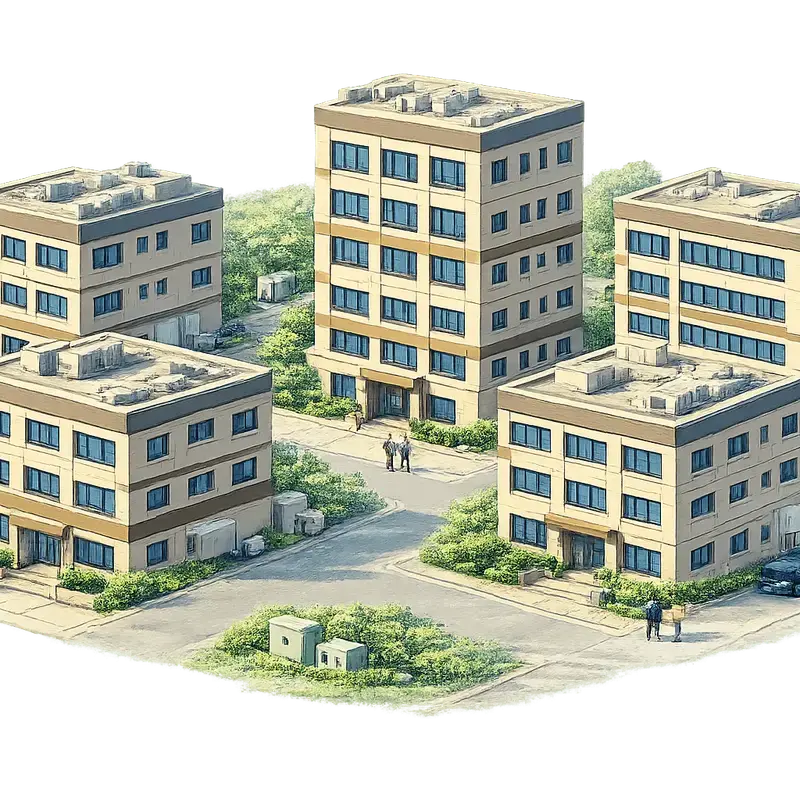
- •Feasibility: High for top-floor owners; Requires RWA/Society consensus for shared roofs.
- •Cost (Individual): ₹67,000 per kW (before subsidy).
- •Subsidy: Up to ₹78,000 (Central) + ~₹30,000 (Delhi State).
- •Best Option: Virtual Net Metering (VNM) for societies without direct roof access.
- •Payback Period: 3–4 years for residential apartments in Delhi.
Solar for Apartments in Delhi: Feasibility, Cost & Rules (2026)
Living in an apartment in Delhi—whether it’s a high-rise in Dwarka or a builder floor in Janakpuri—often comes with a unique set of challenges when it comes to renewable energy. While the Delhi Solar Policy 2024-2027 has made it easier than ever to adopt green power, many residents still ask: "Can I actually install solar if I don't own the whole roof?"
As electricity tariffs in Delhi continue to rise and BSES bills increase, the shift toward solar for apartments Delhi is no longer just an environmental choice—it’s a financial necessity. With over 35 years of experience at Bridgeway Power, we’ve helped thousands of residents navigate the complex rules of Group Housing Societies (GHS) and Resident Welfare Associations (RWA) to unlock massive savings.
In this guide, we will break down the feasibility, costs, and the latest 2026 rules for solar installations in Delhi apartments.
Can Apartments Install Solar? Ownership and Rooftop Access Rules
The short answer is: Yes. However, the "how" depends entirely on your legal rights to the terrace.
In Delhi, apartment solar generally falls into three categories:
- Independent Floors/Builder Floors: Usually, the top-floor owner has roof rights, making it easy to install a private system.
- Group Housing Societies (GHS): The roof is "common area." Installation requires RWA approval and usually benefits the common facilities (lifts, water pumps, lighting).
- Individual Owners in High-rises: If you live on the 2nd floor of a 10-story building, you likely don't have roof rights. In this case, you need to explore Community Solar or Virtual Net Metering.
The 2026 Legal Landscape
The Delhi Government currently mandates that any new building with a plot area of 500 sqm or more must install rooftop solar. For existing buildings, the Delhi Solar Policy provides Group Based Incentives (GBI) of ₹2/unit for RWAs, making it highly lucrative for societies to go solar.
Apartment Solar Feasibility Checklist
Before you call an installer, use this checklist to see if your apartment is ready for a solar panel for apartment building.
| Feature | Requirement for Feasibility | Why It Matters |
|---|---|---|
| Roof Ownership | Registered roof rights or RWA NOC | Legal requirement for DISCOM net metering. |
| Shadow-Free Area | ~100 sq. ft. per 1 kW | Water tanks or taller adjacent buildings can block sun. |
| Sanctioned Load | System size $\le$ Sanctioned Load | You cannot install 5kW if your meter load is only 3kW. |
| Structural Integrity | RCC roof (concrete) preferred | Most Delhi apartments are RCC; old blocks may need a survey. |
| Inverter Location | Within 10-15 meters of panels | Longer distances lead to DC power loss. |
| DISCOM Approval | TPDDL, BRPL, or BYPL | Net metering must be supported by your specific DISCOM. |
Individual vs. Society-Level Installation
There are two primary ways to approach society solar installation Delhi. You can either do it for your personal meter or the society can do it for common areas.
1. Individual Rooftop Solar
If you own the roof (common in solar for builder floors in Delhi), you can install a system and connect it directly to your apartment's meter. You get the full benefit of the PM Surya Ghar Yojana subsidy, which can be as high as ₹78,000.
2. Society/RWA Common Area Solar
The RWA installs a large plant (e.g., 50kW or 100kW) on the shared rooftop. This power is used to run elevators, streetlights, and water pumps. This significantly reduces the "Maintenance Charges" paid by every resident.
Comparison: Individual vs. Society Solar
| Feature | Individual Apartment Solar | Society (Common Area) Solar |
|---|---|---|
| Typical System Size | 3kW - 7kW | 20kW - 100kW+ |
| Avg. Cost (Pre-subsidy) | ₹2 Lakh - ₹4.5 Lakh | ₹10 Lakh - ₹50 Lakh |
| Central Subsidy | Available (up to ₹78,000) | Available for residential GHS |
| Primary Benefit | Reaches ₹0 individual bill | Reduces monthly maintenance fees |
| RWA Approval | Needed for roof usage | Simple majority vote by RWA |
| Payback Period | 3.5 Years | 4 Years |
Net Metering Rules for Multi-Unit Buildings in Delhi
Net metering is the backbone of solar savings in India. It allows you to "export" excess solar energy produced during the day to the grid and "import" it back at night for free.
For apartments, Delhi offers three specific models:
- Standard Net Metering: Best for individual owners with roof access.
- Virtual Net Metering (VNM): This is a game-changer. It allows a solar plant at one location (the roof) to be credited against multiple electricity meters (different apartments). This is the best way for shared rooftop solar India to work.
- Group Net Metering (GNM): Ideal for entities with multiple buildings (like a large society with 5 blocks) to offset all bills from one large solar plant.
Learn more about how these work in our Virtual Net Metering in India guide.
Community Solar: The Alternative for No-Roof Access
What if you live on the ground floor and the top-floor owner refuses to let you use the roof? Or what if your building is too old to support panels?
This is where community solar apartments come in. Under the Delhi Solar Policy, residents can subscribe to a portion of a large solar farm located elsewhere. The energy generated by "your" portion of that farm is deducted from your BSES or TPDDL bill. While this doesn't involve installing panels on your roof, it provides similar savings.
Check out our Community Solar India Guide to see if you qualify.
The RWA Solar Approval Process
Getting an RWA solar approval process started is often the hardest part of the journey. Here is the step-by-step roadmap we recommend:
Step 1: Technical Survey
Invite a professional EPC company like Bridgeway Power to assess the roof. We provide a shadow analysis and a generation report.
Talk to a solar engineer — not a salesperson
Check whether we install in your area, then get your answer on WhatsApp. No forms, no call centre.
What would solar save on YOUR bill?
Step 2: The Proposal
Present the findings to the RWA committee. Focus on the ROI. For example, a 50kW system can save a society nearly ₹6-7 Lakhs annually in electricity bills.
Step 3: General Body Meeting (GBM)
Most society bylaws require a GBM to approve major capital expenditures or the use of common roof space.
Step 4: Documentation
- Ownership proof of the building.
- Latest electricity bills of the common area meter.
- NOC from the RWA (if an individual is installing).
Step 5: DISCOM Application
Apply for net metering via the PM Surya Ghar portal. The DISCOM (BSES Rajdhani/Yamuna or TPDDL) will conduct a feasibility check of the local transformer.
Real Example: A 10-Floor Apartment in Rohini
A housing society in Rohini was paying ₹1.2 Lakh per month for common area utilities (lifts, motors, and park lights).
The Solution:
- System Size: 40kW Rooftop Solar.
- Total Cost: ₹20,00,000 (approx. ₹50,000/kW for bulk).
- Subsidy: ₹78,000 (Central).
- Generation: ~4,800 units per month.
- Savings: At ₹8/unit, they saved ₹38,400 monthly.
- Result: The society reduced its maintenance demand from residents by ₹400 per household.
For individual 3BHK flats, you can check our dedicated guide: How many solar panels for a 3BHK?.
Cost Sharing Models for Housing Societies
Finance is often the biggest hurdle for society solar installation Delhi. Here are three models being used in 2026:
1. CAPEX Model (Self-Funded)
The society pays the full cost upfront using its sinking fund. This offers the highest ROI, as 100% of the savings belong to the society.
- Payback: 3-4 years.
2. RESCO / OPEX Model
A third-party investor installs the panels on your roof for free. You simply agree to buy the solar power from them at a rate lower than the DISCOM (e.g., ₹5/unit instead of ₹8/unit).
- Payback: Immediate savings, zero investment.
3. EMI/Loan Model
Many banks like SBI and PNB now offer "Solar Loans" for RWAs. The monthly EMI is often covered by the savings generated by the solar panels themselves.
Why Maintenance is Critical for Delhi Apartments
Delhi’s pollution is a major enemy of solar efficiency. Dust and smog can cause a 25% power loss if panels are not cleaned regularly. For apartments, where panels are often high up and hard to reach, we recommend an AMC.
Read our guide on solar panel cleaning in India to understand why rainfall isn't enough to keep your panels working.
Frequently Asked Questions
Can I install solar on my balcony in a Delhi apartment?
While "plug-and-play" balcony kits exist, they are generally not approved for net metering by Delhi DISCOMs. For a legal, subsidy-eligible system, rooftop installation is mandatory. Read more about balcony solar in India.
What is the GBI benefit for Delhi RWAs?
Under the current Delhi Solar Policy, RWA and group-housing plants get no Generation Based Incentive (GBI). Instead the society gets ₹29,000 per kW of capital subsidy: ₹18,000 central under PM Surya Ghar plus ₹11,000 from the Delhi government, both on DCR panels.
Do I need permission from all neighbors to install solar on the roof?
If you have registered roof rights (common in builder floors), you generally do not need neighbor permission, though an NOC from the RWA is usually required by the DISCOM for the net meter installation.
How much space is needed for a 5kW system in an apartment?
A 5kW system requires approximately 500 square feet of clear, shadow-free roof space. In modern apartments using high-efficiency mono-perc bifacial panels, this can be reduced to about 350-400 sq. ft.
What happens if the RWA refuses my solar request?
The Delhi Solar Policy encourages solar adoption. If you are being unfairly blocked from using your designated area or common area for solar, you can escalate the matter to the Delhi Electricity Regulatory Commission (DERC).
Conclusion
Going solar in a Delhi apartment is no longer a complicated dream—it is a streamlined process thanks to Virtual Net Metering and aggressive state subsidies. Whether you are an individual owner looking to eliminate your bill or an RWA aiming to slash maintenance costs, the time to act is now.
With electricity rates expected to touch ₹9-10 per unit by 2027, every month you wait is money lost.
Ready to see if your apartment is solar-ready? Contact Bridgeway Power for a free technical roof survey and RWA consultation today. Our experts will handle everything from RWA approval process to DISCOM net-metering.
Visit our Solar Calculator to estimate your savings in under 30 seconds!
Every 1 kW of solar on your roof offsets 1.5 tonnes of CO₂ per year
That's 40 trees planted — every year, for 25 years.
A typical 5 kW home system offsets 187 tonnes of carbon over its lifetime. That's equivalent to taking 8 cars off the road.
See your impact →How much can you save with solar?
Enter your electricity bill → get system size, subsidy amount & payback period
Get StartedStart with a balcony solar kit
No rooftop access? Our plug-and-play balcony kits start saving from Day 1 — 3.7 year payback.
Or get a free solar quote
Tell us about your rooftop — we'll call with exact savings for your home.
Related Articles
Net Metering in India: How to Sell Solar Power Back to the Grid
Learn how net metering in India allows you to sell solar power back to the grid. Discover state policies, savings examples, and how to reduce your bill by 90%.
Read moreWhat Is Captive Open Access Solar (100% Equity Model)
Learn how Captive Open Access Solar (100% Equity Model) helps Indian businesses cut electricity costs by 40% using off-site solar plants. Guide on rules, savings & ROI.
Read moreSolar Installation Cost in Delhi NCR 2026: 3 kW at ₹1.32L net
Updated 2026 guide to solar costs in Delhi NCR. Learn about PM Surya Ghar subsidies, system pricing from 1kW-10kW, and how to reach zero electricity bills.
Read moreRelated guides
Delhi Electricity Rate 2026
BSES & Tata Power per-unit rates, PPAC, subsidy — sourced from DERC.
ExploreDelhi Solar Policy 2026
Free rooftop solar up to 3 kW for homes under 400 units. Eligibility & apply.
ExploreSolar Panel Price in Delhi
Live 2026 rooftop prices in Delhi after ₹1.56L subsidy. 1,200+ installs.
ExploreSolar Company in Gurgaon
Gurgaon's rooftop solar installer — 800+ systems, ₹78K PM Surya Ghar subsidy.
ExploreSolar Company in Noida
Noida & Greater Noida rooftop solar — 500+ installs, ₹1.08L stacked subsidy.
ExploreSolar Panel Price in Faridabad
Live 2026 Faridabad prices after ₹78K PM Surya Ghar subsidy. 350+ homes.
Explore