
By Kajal Rajpoot · Reviewed by Arshi Chadha, Founder
Solar Panels for 2BHK & 3BHK Homes in India 2026: Count, Cost, Subsidy
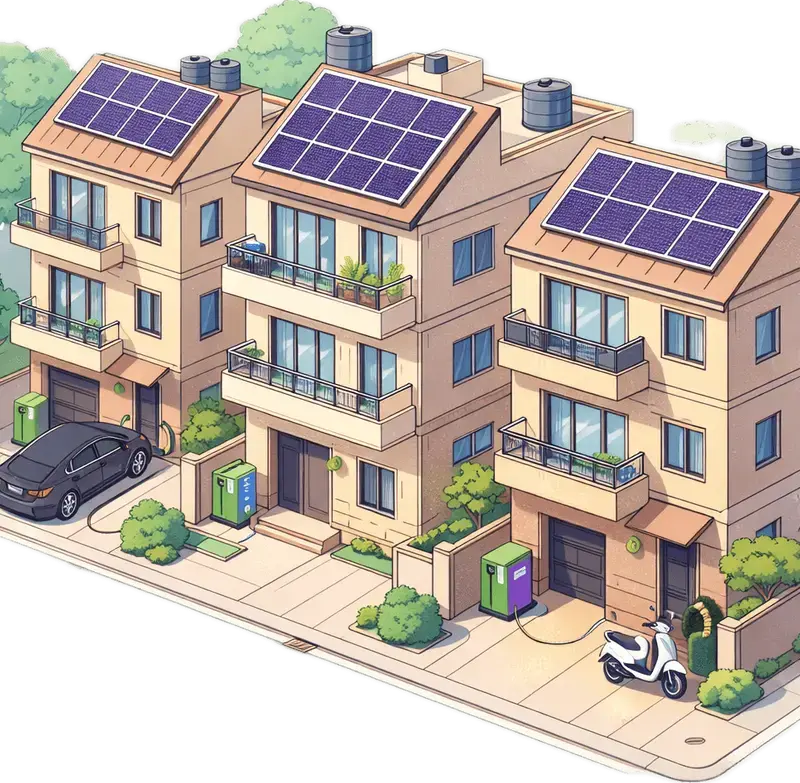
As electricity tariffs across Indian states like Maharashtra, Gujarat, and Karnataka continue to climb, homeowners are no longer asking if they should go solar, but how much solar they actually need. If you are living in a standard 2BHK or 3BHK apartment or independent house, you’ve likely noticed your summer electricity bills doubling due to air conditioning.
At Bridgeway Power, with over 35 years of experience in the Indian energy sector, we’ve found that many homeowners mistakenly believe that the physical square footage of their home determines their solar system size. In reality, your solar journey begins with your electricity bill, not your floor plan. This guide will break down exactly how many solar panels you need for a 2BHK or 3BHK in India, updated for 2025-2026 standards.
The Golden Rule: Consumption vs. Square Footage
Before we dive into the numbers, it is vital to understand that a 2BHK with two people living in it will have vastly different energy needs than a 2BHK housing a family of five. Similarly, a 3BHK where one room is used as a home office with a 1.5-ton AC running 8 hours a day will require a much larger system than a 3BHK without heavy appliances.
When calculating solar panels for 2BHK 3BHK India, we look at "Units" (kWh) consumed per month. One kilowatt (1kW) of solar typically produces 4 units of electricity per day in India, or roughly 120 units per month.
House Size vs. Recommended Solar System Capacity
| House Type | Typical Monthly Consumption | Recommended System Size | Roof Space Required |
|---|---|---|---|
| 2BHK | 150 – 250 Units | 2kW to 3kW | 160 – 240 sq. ft. |
| 3BHK | 300 – 500 Units | 3kW to 5kW | 240 – 400 sq. ft. |
| 4BHK / Villas | 600+ Units | 5kW to 8kW+ | 400 – 650+ sq. ft. |
Why Appliance Usage Dictates Your Panel Count
The primary driver of high electricity bills in Indian urban homes is the Air Conditioner (AC). While fans, LED bulbs, and TVs contribute to a baseline consumption, the surge during March–July is what solar systems are primarily designed to offset.
Appliance-wise Power Consumption Breakdown
To understand how many solar panels you need for a 2BHK or 3BHK, you must first audit your appliances.
| Appliance | Rated Power (Watts) | Avg. Usage (Hours/Day) | Daily Units (kWh) |
|---|---|---|---|
| 1.5 Ton AC (Inverter) | 1,500W | 6 - 8 hours | 7.0 - 9.0 Units |
| Refrigerator (250L) | 200W | 24 hours (Compressor cycles) | 1.5 - 2.0 Units |
| Ceiling Fan (BLDC) | 35W | 12 hours | 0.4 Units |
| LED Lights (x5) | 45W (total) | 6 hours | 0.27 Units |
| Washing Machine | 500W | 1 hour | 0.5 Units |
| Microwave/Geyser | 2,000W | 0.5 hours | 1.0 Unit |
If your 3BHK has three ACs running simultaneously, a 3kW system will not be enough. You would likely need to scale up to a 5kW or 7kW system to achieve a "Net Zero" bill. You can calculate your exact requirements using our Solar Quote Calculator.
How Many Solar Panels Do You Need? (By Configuration)
In 2025, the standard for residential solar has shifted toward high-efficiency Mono-PERC or TopCon Half-cut modules, typically ranging from 540Wp to 580Wp. Gone are the days of small 250W panels that took up the entire roof.
Number of Panels Needed for 2BHK & 3BHK
| System Size | Total Monthly Generation | No. of Panels (540Wp Modules) | No. of Panels (400Wp Modules) |
|---|---|---|---|
| 2kW System | ~240 Units | 4 Panels | 5 Panels |
| 3kW System | ~360 Units | 6 Panels | 8 Panels |
| 4kW System | ~480 Units | 8 Panels | 10 Panels |
| 5kW System | ~600 Units | 10 Panels | 13 Panels |
The 2BHK Scenario (2kW to 3kW)
For a typical 2BHK in a city like Pune or Bangalore, a 2kW system is usually sufficient if you use one AC moderately. If you have two ACs and run them frequently, a 3kW system is the safer bet. This ensures that even on cloudy days, you generate enough to keep your bill near zero.
The 3BHK Scenario (3kW to 5kW)
A 3BHK is the "sweet spot" for residential solar in India. With the PM Surya Ghar: Muft Bijli Yojana, a 3kW system receives a significant central subsidy (up to ₹78,000). For 3BHK owners with heavy appliance usage (Geysers, Induction cooktops, 2+ ACs), we strongly recommend a 5kW system to future-proof your home, especially if you plan to buy an Electric Vehicle (EV) in the next 2-3 years.
Real Example: A 3BHK Home in Hyderabad
Let’s look at a real-world case study from one of Bridgeway Power’s recent installations.
The Client: Mr. Reddy, living in a 3BHK independent floor. The Problem: Monthly electricity bills averaging ₹7,500 due to two 1.5-ton ACs and an EV scooter. The Solution: We installed a 5kW On-Grid Solar System using 9 TopCon Bifacial modules (550Wp each).
The Results:
- Monthly Generation: ~600 Units
- Old Bill: ₹7,500
- New Bill: ₹450 (Fixed connection charges only)
- Total Savings: ~₹7,000 per month
- Estimated Payback: 3.5 years (post-subsidy)
By choosing the right solar panels for 2BHK 3BHK India, Mr. Reddy effectively shielded his family from future utility price hikes for the next 25 years.
Talk to a solar engineer — not a salesperson
Enter your pincode and monthly bill. If we install in your area, an engineer answers on WhatsApp with your numbers.
Size solar for your home in 30 seconds
Factors That Influence Panel Count
While the tables above provide a standard guideline, several technical factors can increase or decrease the number of panels you need:
1. Panel Efficiency (Wattage)
Using higher-wattage panels (like 550W+) reduces the physical number of panels on your roof. This is crucial for 2BHK/3BHK owners with limited terrace space or those who want to leave room for a terrace garden.
2. Roof Orientation and Shadows
In India, panels must face South to capture maximum sunlight. If your roof has shadows from neighboring buildings or water tanks, you may need more panels or higher-efficiency "Bifacial" panels to compensate for the lost generation.
3. On-Grid vs. Off-Grid
If you are installing an On-Grid system (with Net Metering), you can rely on the grid at night. However, if you are in an area with frequent power cuts and want an Off-Grid system with batteries, you might need extra panels to charge the batteries while simultaneously powering the house during the day.
The PM Surya Ghar Subsidy Factor
The Indian government has made it incredibly affordable for 2BHK and 3BHK owners to go solar. As of 2025, the subsidy structure is:
- 1kW to 2kW: ₹30,000 to ₹60,000
- 3kW and above: Fixed at ₹78,000
This means a 3kW system, which is ideal for a 3BHK, offers the maximum "value for money" in terms of subsidy ROI.
Frequently Asked Questions
Is 3kW enough for a 3BHK in India?
Yes, for a standard 3BHK with 1-2 ACs used during the night, a 3kW system producing ~360 units a month is usually sufficient. However, if you use ACs during the day or have an EV, a 5kW system is recommended.
How much space do I need for solar panels on a 2BHK?
A 2kW system (ideal for a 2BHK) requires approximately 160 to 200 square feet of shadow-free rooftop area.
Can I run a 1.5 Ton AC on solar panels?
A 1.5 Ton inverter AC consumes about 1.5 units per hour. A 3kW solar system can easily power an AC during the day while still running other household appliances.
What is the cost of solar panels for a 3BHK?
A 3kW system typically costs between ₹1.8 Lakh to ₹2.2 Lakh before subsidy. After the ₹78,000 subsidy, the effective cost drops significantly, making it a highly viable investment.
Do I need more panels if my roof is not south-facing?
Ideally, yes. If your roof faces East or West, the generation may drop by 10-15%. You might need to add 1-2 extra panels to achieve the same energy output as a South-facing system.
Conclusion: Start Your Hybrid Journey with Bridgeway Power
Determining how many solar panels for 2BHK 3BHK India you need is the first step toward energy independence. While the general rule is 2-3kW for a 2BHK and 3-5kW for a 3BHK, every home is unique. A professional site survey can identify shadow issues and structural integrity that a simple online calculation cannot.
With 35+ years of expertise, Bridgeway Power helps you navigate the entire process—from choosing the right panel wattage to securing your government subsidy. Stop letting rising electricity rates dictate your lifestyle.
Ready to wipe out your electricity bill? Contact Bridgeway Power today for a Free Site Survey and Custom Solar Layout!
A 3BHK usually lands on a 5 kW system; here is the current 5kW solar system price with subsidy applied.
Every 1 kW of solar on your roof offsets 1.5 tonnes of CO₂ per year
That's 40 trees planted — every year, for 25 years.
A typical 5 kW home system offsets 187 tonnes of carbon over its lifetime. That's equivalent to taking 8 cars off the road.
See your impact →How much can you save with solar?
Enter your electricity bill → get system size, subsidy amount & payback period
Get StartedStart with a balcony solar kit
No rooftop access? Our plug-and-play balcony kits start saving from Day 1 — 3.7 year payback.
Or get a free solar quote
Tell us about your rooftop — we'll call with exact savings for your home.
Related Articles
What Is Captive Open Access Solar (100% Equity Model)
Learn how Captive Open Access Solar (100% Equity Model) helps Indian businesses cut electricity costs by 40% using off-site solar plants. Guide on rules, savings & ROI.
Read moreHow Rooftop Solar Can Eliminate Your Electricity Bill
Discover how Net Metering and PM Surya Ghar subsidies can reduce your monthly electricity bill to near-zero. Learn about system sizing, costs, and real-world savings.
Read moreSolar Subsidy in Uttar Pradesh 2026: ₹1,08,000 for Noida, Ghaziabad & Greater Noida
UP's stacked solar subsidy 2026: ₹78,000 central + ₹30,000 UPNEDA state top-up = ₹1.08L. Real PVVNL net-cost math for Noida, Greater Noida, Ghaziabad & Meerut.
Read moreRelated guides
Delhi Electricity Rate 2026
BSES & Tata Power per-unit rates, PPAC, subsidy — sourced from DERC.
ExploreDelhi Solar Policy 2026
Free rooftop solar up to 3 kW for homes under 400 units. Eligibility & apply.
ExploreSolar Panel Price in Delhi
Live 2026 rooftop prices in Delhi after ₹1.56L subsidy. 1,200+ installs.
ExploreSolar Company in Gurgaon
Gurgaon's rooftop solar installer — 800+ systems, ₹78K PM Surya Ghar subsidy.
ExploreSolar Company in Noida
Noida & Greater Noida rooftop solar — 500+ installs, ₹1.08L stacked subsidy.
ExploreSolar Panel Price in Faridabad
Live 2026 Faridabad prices after ₹78K PM Surya Ghar subsidy. 350+ homes.
Explore