
By Vansh Dahiya · Reviewed by Arshi Chadha, Founder
RESCO vs Community Solar in Delhi: Which Zero-Capex Model Actually Works?
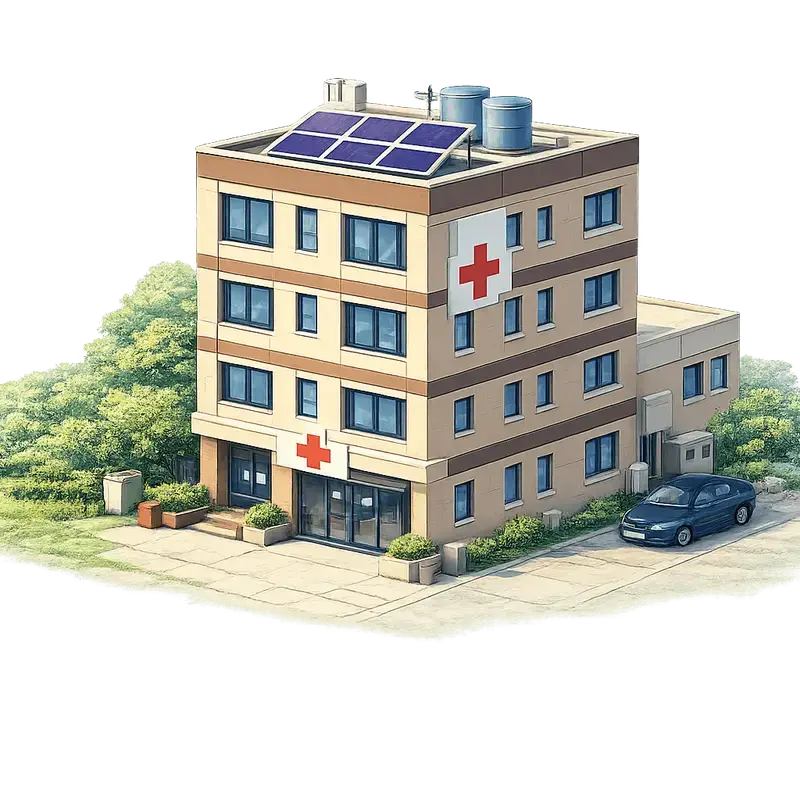
- •Initial Investment: ₹0 (Zero Capex for both models)
- •RESCO PPA Rate: ₹4.00 – ₹6.00 per unit
- •Community Solar Savings: ~10-20% reduction in total bill
- •Lock-in Period: 15–25 Years (RESCO) vs. Flexible/Monthly (Community Solar)
- •Best For: Large industrial roofs (RESCO) vs. Apartments & Rented Offices (Community Solar)
Imagine you are the owner of a thriving hospital in Rajouri Garden or a boutique hotel in South Delhi. Your monthly electricity bill is touching ₹2,00,000, and you know solar is the answer. However, there are two major hurdles: you don’t want to block ₹50 lakhs in capital right now, or perhaps your roof is already occupied by heavy HVAC machinery and a water tank.
In the Indian solar market, specifically within the Delhi NCR landscape, two "Zero-Capex" models have emerged to solve these problems. On one side, we have the established RESCO model solar India (Renewable Energy Service Company), and on the other, the revolutionary Community Solar model. Both promise to slash your bills without you spending a single rupee upfront, but they are fundamentally different in how they operate, where the panels are located, and how long you are tied to the contract.
This guide deep-dives into the RESCO vs community solar Delhi debate to help you decide which zero-investment path actually fits your operational reality in 2026.
1. What is the RESCO Model? (Solar On Your Roof)
The RESCO model, often called the OPEX model, is a third-party ownership arrangement. In this setup, a developer (like a specialized solar EPC or investment firm) bears the entire cost of the solar installation. They install the panels on your roof, maintain them for 25 years, and sell the generated electricity to you at a pre-decided Power Purchase Agreement (PPA) rate.
How RESCO Works in Delhi
If your current BSES Rajdhani or TPDDL commercial tariff is ₹9.50 per unit, a RESCO developer might offer you solar power at ₹5.50 per unit. You save ₹4.00 on every unit the solar system produces.
The catch? The developer owns your roof for the next two decades. If you decide to renovate, add an extra floor, or sell the building, moving those panels is a legal and financial nightmare. This is why the RESCO model solar India is typically reserved for large-scale institutional buildings or factories with massive, clear rooftops.
2. What is Community Solar? (Solar On Our Farm)
Community Solar is the newer, more flexible sibling in the zero-capex family. Here, the panels are not on your roof. Instead, you "subscribe" to a share of a large, off-site solar farm. The energy generated by your share is fed into the grid, and thanks to Virtual Net Metering (VNM) in India, the DISCOM credits your electricity bill directly.
How Community Solar Works in Delhi
For an apartment dweller in Dwarka or a business in a heritage building with no roof access, community solar vs RESCO is an easy choice because the latter isn't even an option. You pay a monthly subscription fee, and in return, you see a "Solar Credit" on your BSES or TPDDL bill that lowers your total payable amount.
Comparison: RESCO vs Community Solar Features
| Feature | RESCO (Rooftop PPA) | Community Solar (Subscription) |
|---|---|---|
| Panel Location | Your Building's Roof | Remote Solar Farm |
| Ownership | Developer Owned | Developer Owned |
| Typical Rate | ₹4.00 – ₹6.00 per unit | Effective ₹8.00 – ₹10.00 per unit* |
| Term Length | 15 – 25 Years | Flexible / Monthly / Rolling |
| Roof Requirement | High (Structural Stability Needed) | Zero Roof Space Needed |
| Maintenance | Developer's Responsibility | Developer's Responsibility |
| Ideal For | Large Factories, Schools, Hospitals | Apartments, Rented Offices, Shops |
*Note: In community solar, you are essentially buying credits that offset higher-tier DISCOM rates.
3. The Structural Barrier: Why Your Roof Matters
One of the biggest differences in third-party PPA solar Delhi (RESCO) compared to community solar is the physical requirement.
To qualify for a RESCO project, your roof must pass a rigorous structural assessment. A single 600Wp Topcon solar panel weighs around 28kg, and once you add the mounting structures and ballast, the load adds up.
If your building in Janakpuri is 30 years old, a RESCO developer might reject the site because they cannot risk their 25-year investment on a weak structure. Community solar bypasses this entirely. Since the panels are located on a professionally managed solar farm, your building's age or structural integrity is irrelevant.
4. Commitment vs. Flexibility: The 25-Year Question
When performing an OPEX solar model comparison India, the "lock-in" is usually the dealbreaker.
The RESCO Commitment
Under a PPA, you sign a contract that usually lasts 15 to 25 years. If you want to exit early, you usually have to "buy out" the system at a depreciated value, which can cost several lakhs. This makes RESCO perfect for institutions that own their property and have long-term stability—like a hospital in Delhi or a manufacturing plant in Manesar.
The Community Solar Flexibility
Community solar is built for the modern, mobile business or resident. If you are a tenant in a Cyber City office or an apartment in Gurgaon, you might move in 3 years. Community solar allows you to "take your subscription with you" as long as you stay within the same DISCOM boundary, or simply cancel the subscription with a short notice period.
5. Economic Breakdown: Which Saves More?
While both models require zero capital expenditure (Capex), the "cost of power" differs significantly.
Table: Decision Matrix for Delhi NCR Consumers
| If your situation is... | Suggested Model | Why? |
|---|---|---|
| Own Roof + Massive Empty Space + 15yr Plan | RESCO (OPEX) | Lowest per-unit cost; panels on-site. |
| No Roof / Shaded Roof / Rented Space | Community Solar | Only way to access solar credits. |
| Heritage Building / Structural Constraints | Community Solar | No physical load on the structure. |
| Residential Apartment (High Rise) | Community Solar | Avoids RWA disputes over common roof usage. |
| High Credit Score + High Electricity Bill | RESCO or Solar Loan | Maximize ROI via Solar Loans. |
Talk to a solar engineer — not a salesperson
Check whether we install in your area, then get your answer on WhatsApp. No forms, no call centre.
What would solar save on YOUR bill?
Solar Depreciation & Tax Benefit Calculator
Based on Section 32 — 40% WDV + 20% additional depreciation (Year 1)
Real-World Example: The Lajpat Nagar Boutique
A high-end clothing boutique in Lajpat Nagar pays ₹45,000/month in electricity. They occupy the ground and first floor, but the roof belongs to the second-floor resident.
- RESCO Attempt: Rejected. They don't own the roof.
- Community Solar Solution: They subscribed to a 10kW share of a community solar project.
- Result: Monthly bill reduced by 15% (approx ₹6,500/month) with zero panels on their building and zero technical maintenance.
6. Why Businesses are Choosing Community Solar Over RESCO Now
Historically, RESCO vs community solar Delhi was a one-sided fight because community solar didn't exist in a regulated format. However, with the rise of Virtual Net Metering in India, the tide is shifting for several reasons:
- Multiple Tenants: A commercial building with 10 different shops cannot effectively use RESCO. Who gets the power? Community solar allows each shop to have its own independent subscription.
- No "Solar Eyesore": Some premium residential properties in Vasant Kunj or Greater Kailash prefer not to have visible panels on their aesthetic rooftops.
- No Maintenance Headaches: While RESCO developers maintain the plants, the presence of technicians on your roof every month can be a security concern for some. With community solar, all maintenance happens kilometers away.
7. The Regulatory Landscape in Delhi (2025-2026)
Delhi remains one of the most progressive states for solar. The Delhi Electricity Regulatory Commission (DERC) has enabled both models, but with caveats:
- RESCO is highly encouraged for the commercial and industrial (C&I) segment.
- Community Solar is being championed as the bridge for the "missing middle"—the millions of apartment dwellers and small businesses who were previously locked out of the solar revolution.
For those looking for home systems with ownership, the PM Surya Ghar Yojana provides massive subsidies, but it requires you to own the system. If you want zero-capex, you must look at RESCO or Community Solar.
8. Financial Partner Synergy
Whether you choose to go with a RESCO developer or explore Solar on EMI, financing is the engine of the industry. Bridgeway Power works with a wide range of partners to facilitate different financial needs. Our partners include Aerem Solar Finance, Canara Bank Solar, ECOFY Solar Financing, PNB Solar Rooftop Scheme, and SBI PM Surya Ghar Loan.
For larger commercial entities, a Commercial Solar Loan often offers better long-term ROI than RESCO, because you eventually own the asset.
9. Conclusion: Which Model Should You Pick?
The RESCO vs community solar Delhi debate doesn't have a single winner—it has a "best fit."
- Pick RESCO if you are a stable business with a massive, strong roof, and you want the absolute lowest per-unit cost of energy for the next 20 years.
- Pick Community Solar if you are a tenant, live in an apartment, have a small or shaded roof, or value flexibility over the absolute lowest price.
At Bridgeway Power, we have 35+ years of experience and have installed over 25 MW of solar. We don't just sell panels; we design energy strategies. If you’re unsure which zero-capex model fits your building, Contact Bridgeway Power for a Free Consultation. We’ll analyze your solar generation logs and DISCOM bills to show you exactly how much you can save.
Frequently Asked Questions
Does RESCO require any security deposit?
In the RESCO model solar India, developers often ask for a "Payment Security Mechanism," which could be a bank guarantee or a few months of estimated bills as a security deposit. This protects the developer if the client stops paying for the solar power generated on their own roof.
Can I switch from RESCO to Community Solar?
Switching is difficult. A RESCO agreement is a long-term legal contract. However, if your business expands and you run out of roof space for your RESCO plant, you can supplement your remaining energy needs by subscribing to community solar vs RESCO for the additional units.
Is community solar available for residential homes in Delhi?
Yes! Through Virtual Net Metering, residential consumers in Delhi can subscribe to a community solar project. This is particularly popular in areas like Pitampura and Rohini where high-rise living is common.
What happens if the community solar farm stops producing?
The subscription agreements are usually "output-linked." If the solar farm produces less due to weather or maintenance, you are only charged for what was actually credited to your bill. Most professional managers also provide generation guarantees to protect subscribers.
Which model is better for tax benefits?
If you choose third-party PPA solar Delhi (RESCO), the developer claims the 40% accelerated depreciation. If you want to claim tax benefits yourself, you must own the system—either through Capex or a solar loan. Community solar is a service subscription and does not offer depreciation benefits to the subscriber.
Every 1 kW of solar on your roof offsets 1.5 tonnes of CO₂ per year
That's 40 trees planted — every year, for 25 years.
A typical 5 kW home system offsets 187 tonnes of carbon over its lifetime. That's equivalent to taking 8 cars off the road.
See your impact →How much can you save with solar?
Enter your electricity bill → get system size, subsidy amount & payback period
Get StartedGo solar without owning a rooftop
Community Solar gives commercial & institutional consumers the same savings — zero capex, zero roof needed.
Or get a free solar quote
Tell us about your rooftop — we'll call with exact savings for your home.
Related Articles
Lock In a Fixed Electricity Rate for Your School — Before Delhi Tariffs Rise Again
Lock in your school's electricity rate before Delhi tariffs hit ₹16/unit. Learn how Community Solar offers zero-capex savings of ₹10L+ annually.
Read moreWhat Delhi's Solar Policy Means for Apartment Owners and Non-Rooftop Residents
Discover how Delhi's 2026 solar policy enables apartment owners to save 40% on bills using Virtual Net Metering. No roof access or RWA NOC required.
Read moreVirtual Net Metering (VNM) in India: How It Enables Community Solar for Homeowners
Learn how Virtual Net Metering (VNM) enables community solar in India. Discover how DERC and RERC policies allow flat owners to share solar credits without individual rooftops.
Read moreRelated guides
Delhi Electricity Rate 2026
BSES & Tata Power per-unit rates, PPAC, subsidy — sourced from DERC.
ExploreDelhi Solar Policy 2026
Free rooftop solar up to 3 kW for homes under 400 units. Eligibility & apply.
ExploreSolar Panel Price in Delhi
Live 2026 rooftop prices in Delhi after ₹1.56L subsidy. 1,200+ installs.
ExploreSolar Company in Gurgaon
Gurgaon's rooftop solar installer — 800+ systems, ₹78K PM Surya Ghar subsidy.
ExploreSolar Company in Noida
Noida & Greater Noida rooftop solar — 500+ installs, ₹1.08L stacked subsidy.
ExploreSolar Panel Price in Faridabad
Live 2026 Faridabad prices after ₹78K PM Surya Ghar subsidy. 350+ homes.
Explore