
By Arshi Chadha, Founder · Bridgeway Power
How Hospitals in Delhi Can Cut Their ₹1L+ Electricity Bill by 30–40%
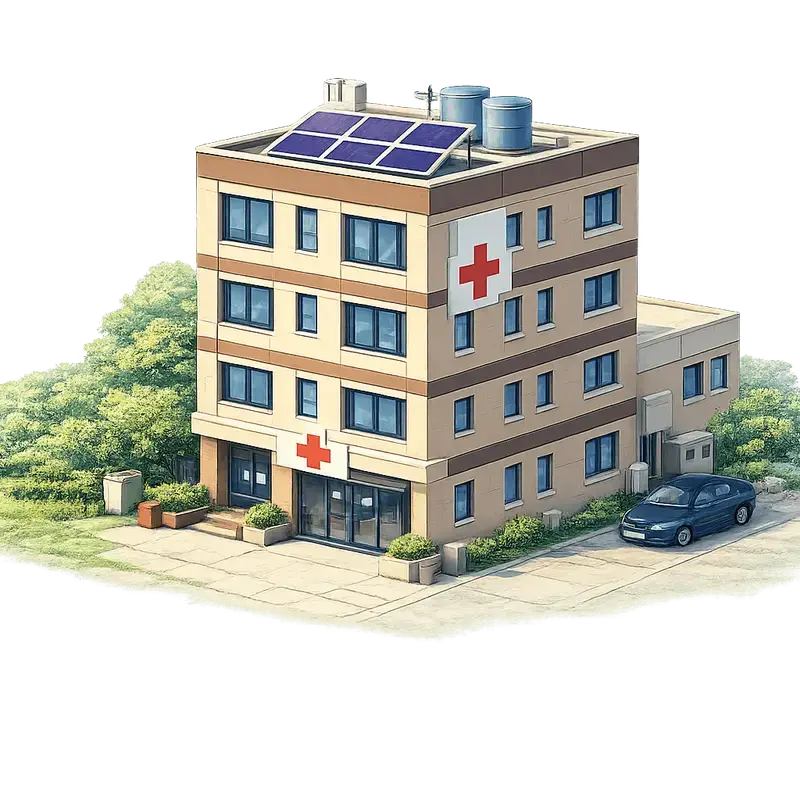
- •Ideal for: Hospitals, clinics, and diagnostic centers with ₹1L+ monthly bills.
- •Potential Savings: 30–40% reduction in monthly electricity costs.
- •Investment: ₹0 Capex (with community solar/PPA models).
- •System Requirement: No rooftop space or structural changes needed.
- •Implementation Time: Savings reflect within 2–3 billing cycles.
You're checking the rate — now see how much of your bill solar erases
Running a healthcare facility in Delhi is a high-stakes balancing act. Between maintaining life-saving equipment 24/7, powering central air conditioning, and ensuring high-end diagnostic tools like MRIs and CT scans are always operational, the energy demand is relentless. For a 50 to 200-bed hospital in areas like South Delhi or Rohini, the monthly electricity bill is often the second-highest operational expense after staff salaries.
With modern C&I electricity tariffs in Delhi reaching as high as ₹16 per unit, hospital administrators are frequently stuck between rising costs and the need to keep healthcare affordable. While rooftop solar has long been the gold standard for green energy, many hospitals in Delhi face a unique dilemma: they either lack the structural strength for heavy panels, have heritage building restrictions, or their rooftops are already packed with HVAC chillers and cooling towers.
This is where Community Solar and Virtual Net Metering change the game. This guide explains how you can reduce hospital electricity bill Delhi by 30–40% without spending a single rupee on hardware or losing a square foot of rooftop space.
The Crisis of Rising Hospital Electricity Costs in Delhi
Hospitals operate under the Commercial & Industrial (C&I) category. Unlike residential users who enjoy subsidized slabs, hospitals are hit with "Time of Day" (ToD) tariffs and high fixed demand charges. During peak summer months in Delhi, a mid-sized hospital’s bill can easily cross ₹5 Lakhs, while smaller nursing homes struggle with ₹1 Lakh+ bills.
Understanding Delhi’s C&I Tariff Breakdown (2025-26)
To understand how to save, we must first look at what you are currently paying. Delhi’s DISCOMs—BSES Rajdhani (BRPL), BSES Yamuna (BYPL), and Tata Power (TPDDL)—have some of the highest commercial rates in the country.
| Charge Component | Rate Range (Estimated 2025-26) |
|---|---|
| Energy Charge (Base) | ₹8.50 – ₹9.50 per unit |
| Fixed Demand Charges | ₹250 – ₹300 per kW/month |
| PPAC (Surcharge) | 25% – 35% on energy charges |
| Electricity Duty / Taxes | 5% – 8% |
| Effective Landing Cost | ₹12 – ₹16 per unit |
For a hospital consuming 10,000 units a month, a ₹14/unit landing cost results in a ₹1.4 Lakh bill. Over a decade, that is ₹1.68 Crores spent just on power.
Why Rooftop Solar Isn't Always the Answer for Healthcare
While we at Bridgeway Power have installed hundreds of rooftop systems, we recognize that hospitals face specific challenges:
- Space Constraints: Roofs are often occupied by OT AHUs (Air Handling Units), water tanks, and laundry areas.
- Structural Integrity: Older hospital buildings may not support the dead load of solar structures.
- Shadowing: Multi-story additions or nearby high-rises often cast shadows, reducing efficiency.
- Capital Allocation: Large hospitals prefer investing ₹50 Lakhs into a new ICU setup or diagnostic equipment rather than a solar plant with a 4-year payback.
Comparison: Rooftop Solar vs. Community Solar
If you want to reduce hospital electricity bill Delhi but cannot or do not want to install panels on your roof, here is how the two models compare:
| Feature | Rooftop Solar (Capex Model) | Community Solar (Virtual Net Metering) |
|---|---|---|
| Upfront Investment | ₹50L – ₹1Cr (for mid-size hospital) | ₹0 Zero Capex |
| Physical Space | Requires 100 sq. ft. per kW | No roof space required |
| Maintenance | Hospital’s responsibility (AMC needed) | Provider’s responsibility |
| Savings Start | After 3-4 years (post-payback) | Month 1 of activation |
| Scalability | Limited by roof size | Scalable as per your consumption |
| Implementation | 3–6 months | 4–8 weeks |
How Community Solar Works: The Virtual Net Metering Revolution
Community Solar allows hospitals to benefit from solar energy generated at a remote location. Through Virtual Net Metering (VNM), a large solar farm (built by a provider like Bridgeway Power) generates electricity and feeds it into the Delhi grid.
The DISCOM (BSES or Tata Power) tracks this generation and credits your hospital’s monthly bill. You don't need a single panel on your premises. You simply sign a long-term Power Purchase Agreement (PPA) at a rate significantly lower than the DISCOM’s ₹14-16/unit.
Real-Life Savings Example: A Nursing Home in Delhi NCR
Consider a 50-bed nursing home in Dwarka with a monthly bill of ₹1,00,000.
| Metric | Without Solar | With Community Solar (PPA) |
|---|---|---|
| Monthly Consumption | ~7,150 Units | ~7,150 Units |
| DISCOM Rate (effective) | ₹14 / unit | Integrated Credit Model |
| Solar PPA Rate | N/A | ₹8.50 / unit |
| Monthly Bill Total | ₹1,00,100 | ₹60,775 |
| Monthly Savings | ₹0 | ₹39,325 (approx. 39%) |
| Annual Savings | ₹0 | ₹4.71 Lakhs |
Note: Savings vary based on contracted demand and consumption patterns.
Talk to a solar engineer — not a salesperson
Check whether we install in your area, then get your answer on WhatsApp. No forms, no call centre.
See how much of this bill solar erases
Solar Depreciation & Tax Benefit Calculator
Based on Section 32 — 40% WDV + 20% additional depreciation (Year 1)
Strategic Advantages of Solar for Hospitals in India
1. Operational Budget Predictability
Electricity tariffs in Delhi have historically risen by 3–5% annually. By locking in a solar rate through a community solar PPA, a hospital can freeze a significant portion of its utility costs for the next 15–20 years. This makes financial planning for healthcare groups much more stable.
2. Zero Operational Hassle
A hospital’s primary focus should be patient care, not cleaning solar panels or monitoring inverters. In a community solar model, the maintenance of the solar farm is handled by the developer. If a panel breaks or gets dusty in a remote farm, it doesn’t affect your hospital operations; you simply receive the credits on your bill. For those who do choose rooftop systems, we always recommend a professional Solar Panel AMC to ensure performance doesn't drop due to Delhi's high pollution levels.
3. Aggregated Billing for Hospital Chains
If you operate a chain of diagnostic centers across Janakpuri, Vasant Kunj, and Noida, you can aggregate your total consumption. This "Group Net Metering" approach allows you to subscribe to a larger share of a community solar project, fetching even better per-unit rates.
4. Meeting ESG and NABH Standards
Modern accreditation standards like NABH often look favorably upon "Green Hospital" initiatives. Transitioning to renewable energy significantly reduces your facility's carbon footprint, which can be a key highlight in your hospital's annual sustainability report.
Step-by-Step Process to Reduce Hospital Electricity Bill Delhi
If your hospital or clinic is ready to slash its overheads, here is how the transition usually works with Bridgeway Power:
- Bill Audit: We analyze your last 12 months of DISCOM bills to identify your peak demand and average consumption.
- Eligibility Check: We verify your Sanctioned Load and DISCOM category (C&I).
- PPA Signing: You sign a Power Purchase Agreement. There is NO upfront cost for the hospital.
- VNM Registration: We handle the paperwork with the Delhi Electricity Regulatory Commission (DERC) and your DISCOM for Virtual Net Metering.
- Credit Activation: Once the solar capacity is allocated, you will see a "Solar Export Credit" line item on your BSES or Tata Power bill, reducing your total amount due by 30–40%.
Is Solar Worth It in India in 2026? Absolutely, especially for high-tariff commercial entities like hospitals.
Frequently Asked Questions
Will my hospital face power cuts during the transition?
No. Community solar is a billing arrangement. Your physical connection to the DISCOM grid remains unchanged. You will continue to receive power even if the sun isn't shining; the credit system simply reduces the cost of the units you consume.
My hospital has an existing diesel generator (DG). Can I still use community solar?
Yes. Community solar manages your grid electricity bill. It does not interfere with your DG set or internal backup systems. However, by reducing your grid bill, you free up capital that can be used for more efficient backup solutions like Hybrid Solar Battery Systems.
Is there a minimum bill amount to qualify for community solar?
For commercial healthcare facilities, we typically look for a minimum monthly bill of ₹50,000 to ₹1 Lakh to make the administrative transition feasible and provide significant ROI.
Can I get a government subsidy for hospital solar?
The PM Surya Ghar Muft Bijli Yojana is primarily for residential consumers. However, hospitals can benefit from Accelerated Depreciation (AD) benefits if they choose the Capex (ownership) model for rooftop solar, which can provide significant tax savings.
What happens if the hospital expands and needs more power?
The beauty of community solar is scalability. If you add a new wing or install more equipment, we can simply increase your allocated share in the solar farm (subject to load approvals), unlike a rooftop system which might be limited by roof area.
Conclusion: Take the First Step Toward a "Green Hospital"
Electricity should be a tool that helps you save lives, not a financial burden that limits your hospital's growth. By leveraging Delhi’s progressive policies on Virtual Net Metering, healthcare facilities can finally escape the trap of high C&I tariffs.
Whether you want a 3kW vs 5kW system for a small clinic or a multi-megawatt community solar share for a corporate hospital group, Bridgeway Power has the expertise to guide you. With 35+ years of experience in the Delhi NCR energy landscape, we handle everything from the initial audit to the final DISCOM approval.
Ready to see a 40% drop in your next bill? Contact Bridgeway Power for a free Hospital Energy Audit today.
Every 1 kW of solar on your roof offsets 1.5 tonnes of CO₂ per year
That's 40 trees planted — every year, for 25 years.
A typical 5 kW home system offsets 187 tonnes of carbon over its lifetime. That's equivalent to taking 8 cars off the road.
See your impact →How much can you save with solar?
Enter your electricity bill → get system size, subsidy amount & payback period
Get StartedGo solar without owning a rooftop
Community Solar gives commercial & institutional consumers the same savings — zero capex, zero roof needed.
Or get a free solar quote
Tell us about your rooftop — we'll call with exact savings for your home.
Related Articles
Lock In a Fixed Electricity Rate for Your School — Before Delhi Tariffs Rise Again
Lock in your school's electricity rate before Delhi tariffs hit ₹16/unit. Learn how Community Solar offers zero-capex savings of ₹10L+ annually.
Read moreWhat Delhi's Solar Policy Means for Apartment Owners and Non-Rooftop Residents
Discover how Delhi's 2026 solar policy enables apartment owners to save 40% on bills using Virtual Net Metering. No roof access or RWA NOC required.
Read moreVirtual Net Metering (VNM) in India: How It Enables Community Solar for Homeowners
Learn how Virtual Net Metering (VNM) enables community solar in India. Discover how DERC and RERC policies allow flat owners to share solar credits without individual rooftops.
Read moreRelated guides
Delhi Electricity Rate 2026
BSES & Tata Power per-unit rates, PPAC, subsidy — sourced from DERC.
ExploreDelhi Solar Policy 2026
Free rooftop solar up to 3 kW for homes under 400 units. Eligibility & apply.
ExploreSolar Panel Price in Delhi
Live 2026 rooftop prices in Delhi after ₹1.56L subsidy. 1,200+ installs.
ExploreSolar Company in Gurgaon
Gurgaon's rooftop solar installer — 800+ systems, ₹78K PM Surya Ghar subsidy.
ExploreSolar Company in Noida
Noida & Greater Noida rooftop solar — 500+ installs, ₹1.08L stacked subsidy.
ExploreSolar Panel Price in Faridabad
Live 2026 Faridabad prices after ₹78K PM Surya Ghar subsidy. 350+ homes.
Explore