
By Vansh Dahiya · Reviewed by Arshi Chadha, Founder
Solar on EMI in India: Zero Down Payment Options 2026
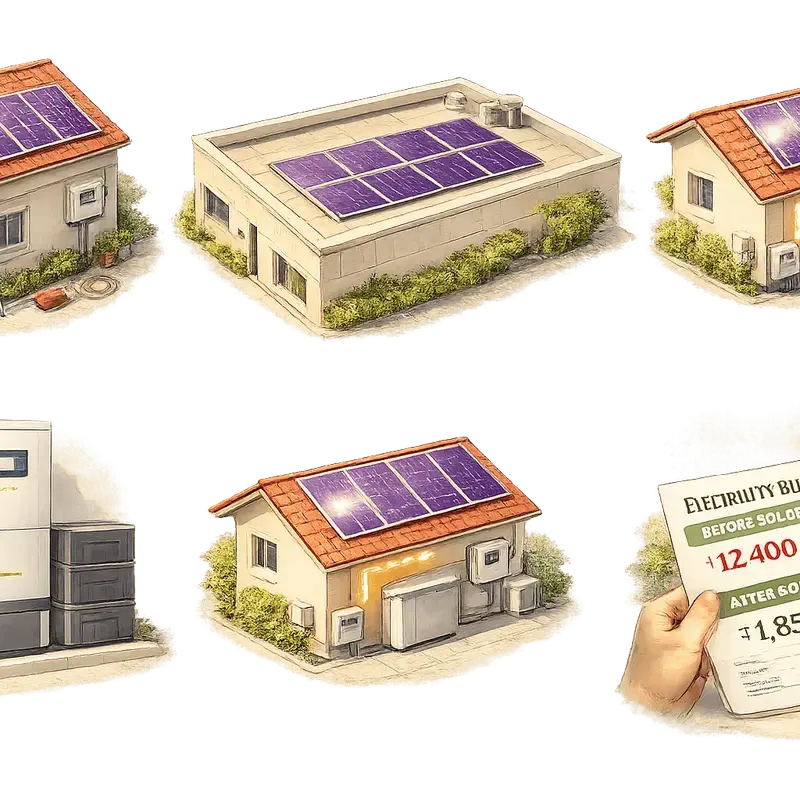
- •System size: 5 kW (Standard 3-4 BHK)
- •Investment: ₹3,43,035 (5 kW, GST-incl; facts_registry.system_price_table, verified 2026-06-21)
- •Net after ₹78k central subsidy: ₹2,65,035
- •Net after ₹78k central + ₹30k Delhi state stack (₹1.08 L total): ₹2,35,035
- •Monthly EMI: ₹5,000 – ₹5,500
- •Monthly Savings: ₹5,400 – ₹6,000 (Delhi/NCR Rates)
- •Effective Out-of-Pocket Cost: Near Zero (Savings often cover the EMI)
Imagine if your local DISCOM (BSES, PVVNL, or DHBVN) sent you a letter saying, "If you pay your current bill for just 5 more years, your electricity will be free for the 20 years after that." You would sign up in a heartbeat.
In 2026, solar EMI India options have made this hypothetical scenario a reality. For most homeowners in Delhi, Gurgaon, and Noida, the biggest barrier to going solar isn't the technology—it's the upfront "sticker shock." While a 5kW system is an incredible investment, not everyone has ₹3.43 lakh lying around. This is where zero down payment solar India schemes come into play.
With the launch of the PM Surya Ghar Yojana, the Indian government and financial institutions have aligned to make solar financing as easy as buying a smartphone on EMI. In this guide, we will break down how you can transition to clean energy with zero upfront investment and let your sun-generated savings pay off your loan.
The Paradigm Shift: Your EMI Replaces Your Bill
The most important insight for any Indian homeowner in 2026 is this: You are already paying for a solar system; you just don't own it yet.
Every time you pay a ₹6,000 monthly electricity bill, that money is gone forever. If you redirect that same ₹6,000 toward a solar loan India 2026 EMI, you are essentially buying an asset that will produce free power for 25 years.
By choosing solar financing India options, you aren't adding a new expense to your monthly budget; you are simply changing the recipient of your payment from the power utility to a bank. Once the loan is cleared in 3 to 5 years, your "bill" drops to near zero, while your neighbors are likely facing 5-7% annual tariff hikes.
Solar Financing Options in India (2026)
There is no one-size-fits-all when it comes to solar EMI India. Depending on your credit score, urgency, and documentation, you can choose from four primary routes:
Table 1: Comparative Solar Financing Options
| Feature | Bank Solar Loan (PSU) | NBFC Financing | Installer/Fintech EMI | Credit Card EMI |
|---|---|---|---|---|
| Interest Rate | 10% – 12% (p.a.) | 12% – 16% (p.a.) | 0% – 8% (Subsidized) | 15% – 18% (p.a.) |
| Tenure | 5 – 7 Years | 3 – 5 Years | 1 – 3 Years | 6 – 18 Months |
| Approval Speed | Slow (15–30 days) | Fast (24–72 hours) | Instant | Instant |
| Processing Fee | Low (0.5% - 1%) | Moderate (2% - 3%) | Nil to Moderate | High |
| Collateral | Usually None (for PM Surya Ghar) | None | None | None |
1. Bank Solar Loans (The Low-Cost Path)
Leading public sector banks like SBI and PNB have launched dedicated schemes under the PM Surya Ghar initiative. The SBI PM Surya Ghar Loan and the PNB Solar Rooftop Scheme offer some of the lowest interest rates in the market.
- Pros: Lowest long-term cost of borrowing.
- Cons: Involves significant paperwork, physical branch visits, and a stringent "technical feasibility" check.
2. NBFCs (The Convenient Path)
Non-Banking Financial Companies (NBFCs) have revolutionized solar panel EMI options India. Partners like ECOFY Solar Financing and Aerem Solar Finance offer digital-first journeys. You can often get an "In-Principal Sanction" in under 10 minutes using just your PAN and Aadhaar.
3. Installer-Led 0% EMI
Many top-tier EPC companies (including Bridgeway Power) partner with fintechs to offer short-term, low-interest or zero-interest EMIs. These are ideal if you can afford to pay off the system within 12-24 months.
The "Zero Down Payment" Strategy: Using Subsidies as Capital
Is zero down payment solar India actually possible? Yes, if you use the "Subsidy-Back" strategy.
Under the PM Surya Ghar Yojana 2026 guide, the central government provides a fixed subsidy of ₹78,000 for systems 3kW and above. For residents of Uttar Pradesh, there is an additional ₹30,000 state subsidy.
How to execute a zero-upfront-cost install:
- Finance the Full Amount: Apply for a loan covering 100% of the project cost.
- Install & Commission: Bridgeway Power completes the installation and net-metering.
- Receive Subsidy: The ₹78,000 (Central) + ₹30,000 (UP State, if applicable) is credited to your bank account within 30-60 days.
- Bullet Pre-payment: Use this ₹1.08 lakh to make a part-payment on your loan principal. This immediately reduces your EMI or tenure, effectively making your "initial investment" zero out of your own pocket.
Real-World Math: 5kW System EMI vs. Savings
Let’s look at the numbers for a typical home in Noida or Ghaziabad. A 5kW system using Topcon Mono PERC 600Wp panels generates an average of 600 units (kWh) per month.
Table 2: The EMI vs. Savings Math (5kW System)
| Component | Calculation / Value |
|---|---|
| Total Project Cost (Installed) | ₹3,43,035 |
| Loan Amount (100% Finance) | ₹3,43,035 |
| Tenure & Interest Rate | 5 Years @ 10.5% |
| Monthly EMI | ₹7,200 |
| Monthly Units Generated | 600 Units |
| Electricity Price (Avg ₹9/unit) | ₹5,400 Savings |
| PM Surya Ghar Subsidy Amount | ₹78,000 (Credited post-install) |
| Revised Loan after Subsidy Payout | ₹2,57,000 |
| New Monthly EMI (Approx) | ₹5,500 |
| Net Monthly Cashflow | -₹100 (EMI ₹5500 - Savings ₹5400) |
The Result: For just ₹100 extra per month (the price of a cup of coffee), you own a ₹3.3 lakh asset. After 5 years, the EMI stops, but the ₹5,400+ savings continue for two more decades. Read more about is solar worth it in India 2026 to see the long-term ROI.
Top Players for Zero Down Payment Solar in 2026
In the current market, "Zero Down Payment" usually means 100% LTV (Loan to Value) financing. While banks usually ask for 10-20% margin money, certain NBFCs and fintech partners offer true zero-upfront options for customers with a CIBIL score above 750.
Table 3: Reliable Zero Down Payment Financing Partners
| Partner | Eligibility | Speciality |
|---|---|---|
| ECOFY | CIBIL 700+ | 100% Digital process, specifically for rooftop solar. |
| Aerem | CIBIL 720+ | Offers "Solar Finance" as a specialized product; fast tenure. |
| SBI (PM Surya Ghar) | Property Ownership | Lowest rates, but requires a 10% down payment (Margin). |
| Credit Fair | CIBIL 650+ | Flexible options for smaller 2kW - 3kW systems. |
| Bridgeway Direct | Project Specific | Seasonal 0%-interest tie-ups with manufacturing partners. |
Talk to a solar engineer — not a salesperson
Check whether we install in your area, then get your answer on WhatsApp. No forms, no call centre.
Solar Depreciation & Tax Benefit Calculator
Based on Section 32 — 40% WDV + 20% additional depreciation (Year 1)
5 Things to Check Before Signing a Solar Loan
While solar financing India is a boon, you must read the fine print to ensure your savings aren't eaten up by hidden costs:
- Processing Fees: Most banks charge 0.5% to 1%. NBFCs might charge up to 3%. Ensure this is disclosed upfront.
- Pre-payment Charges: Since you will get a large subsidy check from the government, you must ensure your loan allows "Part Pre-payment" without heavy penalties. This is crucial for the "Zero Down Payment" strategy.
- Insurance Requirement: Many lenders require you to insure the solar plant. At Bridgeway Power, we help coordinate these policies to protect your investment from storms or accidental damage.
- Generation Guarantee: Does your installer provide an AMC? If your panels are dirty, generation can drop by 25%. If generation drops, your savings won't cover your EMI. Check our Solar AMC Guide.
- Technical Approval: Public sector banks like Canara Bank only lend if the installer is MNRE-approved and uses ALMM-listed modules.
The Real Example: 3BHK Home in Gurgaon
Mr. Sharma lives in South City, Gurgaon. His monthly bill in the summer peaks at ₹12,000. He installed a 7kW system with Bridgeway Power.
- System Cost: ₹4,20,000
- Financing: 5-year loan via an NBFC partner.
- EMI: ₹9,100
- Monthly Savings: ₹8,500 (average across the year)
- Net Out-of-Pocket: ₹600 per month during the loan period.
- Outcome: Mr. Sharma treated the ₹600 as a "subscription fee" for future free energy. He used his ₹78,000 subsidy to pay off a chunk of the loan early, reducing his tenure to just 4 years. By 2030, he will have zero electricity bills and zero loan.
Financing for Commercial & MSME Users
If you are a business owner in Faridabad or Manesar, solar EMI India options are even more lucrative. Businesses can claim 40% Accelerated Depreciation in the first year and offset 5% GST.
For commercial users, we recommend exploring Commercial Solar Loans through SIDBI or specialized lenders like Tata Capital. The ROI for businesses is often under 3 years because the commercial tariff (₹8.5 - ₹11) is much higher than residential rates.
Frequently Asked Questions
Can I get a solar loan if I live in a rented house?
Generally, no. Solar loan India 2026 eligibility requires you to be the owner of the property where the panels are installed. If you are a tenant, you might consider Community Solar or Balcony Solar which are more portable or don't require structural changes.
Does the EMI include maintenance?
Standard bank and NBFC EMIs only cover the hardware and installation cost. However, Bridgeway Power offers integrated packages where a 5-year Solar AMC is bundled into the project cost, effectively financing your maintenance as well.
What happens if I want to sell my house before the EMI ends?
You can either pay off the remaining loan balance (using the sale proceeds) or, in some cases, transfer the loan to the new homeowner along with the property. Solar panels typically increase property value by 3-5%, making the sale easier.
Is the ₹78,000 subsidy guaranteed?
Yes, provided you install through an empanelled vendor and use ALMM-approved components. The process is now streamlined through the National Solar Portal. You can track your application status online. Check out our PM Surya Ghar subsidy guide for details.
What is the minimum CIBIL score required for solar EMI?
For PSU banks (SBI/PNB), a score of 700+ is usually required. For fintech partners like ECOFY or Aerem, they can sometimes look at scores as low as 650 if your electricity bill payment history is consistent.
Conclusion: Stop Paying Bills, Start Clearing Equity
The year 2026 marks the end of the "solar is expensive" era. With solar EMI India options, the sun is essentially paying for your equipment. By opting for zero down payment solar India plans, you protect yourself from inflation and contribute to a greener planet without touching your savings.
Ready to see which financing plan fits your roof? Solar EMI calculator — India to estimate your savings, or contact Bridgeway Power today for a free site visit and financing consultation. We pride ourselves on being one of the best solar companies in Delhi NCR, with over 5,000 successful installations and a 4.6★ rating.
Don't let another high electricity bill land in your mailbox. Go solar on EMI today!},excerpt:
Related: see our full guide to rooftop solar installation in India for pricing, sizing, and the end-to-end process.

To size the EMI correctly, start from the actual 5kW solar system price after subsidy rather than the sticker cost.
FAQ
What interest rate will I actually get on a solar loan?
PSU banks (SBI, PNB, Canara, Union) quote 7.0%–9.5% under the PM Surya Ghar / Jan Samarth scheme, tied to credit score bands (typically ≥750 CIBIL gets the floor rate). NBFCs like credit-fair, ecofy, and mufin quote 10.5%–13.5% but sanction in 24–48 hours.
Loans up to how much are collateral-free?
Under PM Surya Ghar, loans up to ₹2 lakh (systems up to 3 kW) are collateral-free at PSU banks. Beyond that, banks typically ask for hypothecation of the solar equipment itself, not property.
What tenure should I choose?
5 years is the sweet spot — EMI stays within monthly savings, total interest stays under ₹40,000 on a ₹2 lakh loan. 10-year tenures cut EMI further but almost double total interest.
Can I close the loan early if the subsidy comes in?
Yes. Most PSU banks allow foreclosure on the ₹78,000 DBT credit without prepayment penalty. Confirm at sanction — some NBFCs charge 2% of outstanding for early closure.
Every 1 kW of solar on your roof offsets 1.5 tonnes of CO₂ per year
That's 40 trees planted — every year, for 25 years.
A typical 5 kW home system offsets 187 tonnes of carbon over its lifetime. That's equivalent to taking 8 cars off the road.
See your impact →How much can you save with solar?
Enter your electricity bill → get system size, subsidy amount & payback period
Get StartedGet your solar EMI for a real bill
Two inputs, instant number on this page. No phone number needed to see it.
Related Articles
Net Metering in India: How to Sell Solar Power Back to the Grid
Learn how net metering in India allows you to sell solar power back to the grid. Discover state policies, savings examples, and how to reduce your bill by 90%.
Read moreWhat Is Captive Open Access Solar (100% Equity Model)
Learn how Captive Open Access Solar (100% Equity Model) helps Indian businesses cut electricity costs by 40% using off-site solar plants. Guide on rules, savings & ROI.
Read moreSolar Installation Cost in Delhi NCR 2026: 3 kW at ₹1.32L net
Updated 2026 guide to solar costs in Delhi NCR. Learn about PM Surya Ghar subsidies, system pricing from 1kW-10kW, and how to reach zero electricity bills.
Read moreRelated guides
Delhi Electricity Rate 2026
BSES & Tata Power per-unit rates, PPAC, subsidy — sourced from DERC.
ExploreDelhi Solar Policy 2026
Free rooftop solar up to 3 kW for homes under 400 units. Eligibility & apply.
ExploreSolar Panel Price in Delhi
Live 2026 rooftop prices in Delhi after ₹1.56L subsidy. 1,200+ installs.
ExploreSolar Company in Gurgaon
Gurgaon's rooftop solar installer — 800+ systems, ₹78K PM Surya Ghar subsidy.
ExploreSolar Company in Noida
Noida & Greater Noida rooftop solar — 500+ installs, ₹1.08L stacked subsidy.
ExploreSolar Panel Price in Faridabad
Live 2026 Faridabad prices after ₹78K PM Surya Ghar subsidy. 350+ homes.
Explore