
By Vansh Dahiya · Reviewed by Arshi Chadha, Founder
Solar Panel Tax Benefits in India (2026): 5% GST, 40% Depreciation & HSN Codes Explained
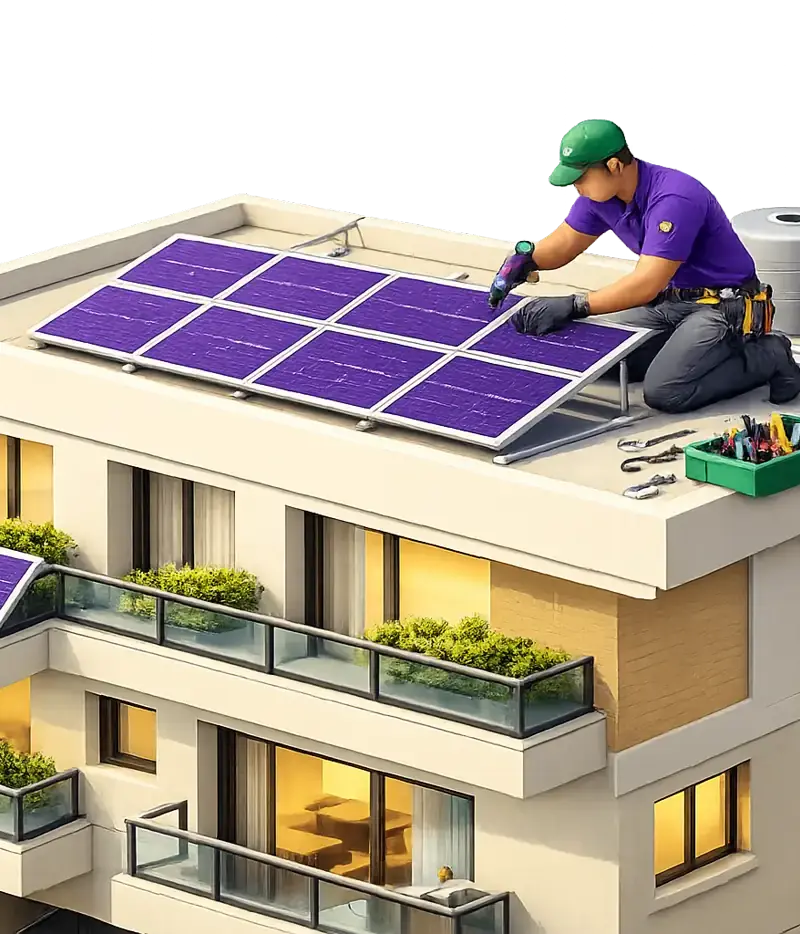
Running a business in India means constantly battling rising operational costs. From the soaring electricity tariffs in cities like Mumbai (₹10/unit) or Pune (₹9/unit) to the PPAC surcharges in Delhi, the grid is becoming an expensive partner. However, for Indian entrepreneurs and MSMEs, rooftop solar isn't just an "eco-friendly" choice—it is a sophisticated tax-planning tool.
With the launch of the PM Surya Ghar Yojana and evolving GST council norms, the financial landscape for solar has shifted in 2026. While homeowners focus on subsidies, businesses are leveraging solar panel tax benefits in India to achieve a payback period of under 3.5 years. By combining lower GST rates, Input Tax Credit (ITC), and accelerated depreciation, the government is essentially subsidizing nearly 30-40% of your project cost through tax savings.
In this comprehensive guide, we break down the HSN codes, the 40% depreciation rule, and how your business can claim these massive savings.
1. GST on Solar Panels and Components (2026 Update)
One of the most frequent questions we get at Bridgeway Power is: "What is the GST on solar panels in 2026?"
As of the latest GST Council updates effective from late 2025, the tax structure remains specialized for renewable energy. Currently, the GST on solar panels and inverters is pegged at 5%. This is a significant concession compared to the standard 18% or 28% slabs applicable to other electrical machinery.
However, a solar plant is not just panels. It is an assembly of various components, each governed by different HSN (Harmonized System of Nomenclature) codes.
HSN Code for Solar Panel India & Component-wise GST
| Component | HSN Code | GST Rate |
|---|---|---|
| Solar Cells/Modules | 85414011 | 5% |
| Solar Inverters | 8504 | 5% |
| Solar Power Generating Systems | 85 | 5% |
| Solar Water Heaters | 8419 12 | 5% |
| Mounting Structures | 7308 | 18% |
| DC Cables | 8544 | 18% |
| Solar Controllers (Non-Solar) | 8504 | 18% |
| EPC Composite Supply | 9954/9983/9987 | ~8.9% (Effective) |
The "70:30" Composite Supply Rule
If you buy panels separately, you pay 5%. If you buy cables, you pay 18%. But most businesses opt for a "Turnkey" or EPC (Engineering, Procurement, and Construction) contract.
Under the EPC composite supply rule, the GST Council treats the contract as a mix of goods and services. For taxation purposes:
- 70% of the contract value is treated as "Goods" (taxed at 5%).
- 30% of the contract value is treated as "Services" (taxed at 18%).
The Math: (0.70 x 5%) + (0.30 x 18%) = 8.9% Effective GST Rate.
This clarity in the solar panel GST rate 2026 helps businesses plan their cash flows accurately without worrying about tax disputes during audits.
2. Accelerated Depreciation: The 40% Tax Shield
For any profit-making business, "Depreciation" is a non-cash expense that reduces taxable income. While standard office furniture might depreciate at 10%, solar energy assets qualify for accelerated depreciation.
Under Section 32 of the Income Tax Act, solar power systems are eligible for a 40% depreciation rate on a Written Down Value (WDV) basis. This was reduced from the historical 80% limit in 2017, but at 40%, it remains one of the highest depreciation rates allowed for industrial assets.
Additional Depreciation (The Year 1 Bonus)
Under Section 32(1)(iia) of the Income Tax Act, businesses engaged in the manufacture of an article or the generation of power are eligible for an additional depreciation of 20% in the first year.
- Condition: The solar plant must be new (not second-hand).
- The "180 Day" Rule: If the plant is commissioned and used for more than 180 days in the financial year (i.e., before Oct 3rd), you get the full 60% (40% + 20%) deduction. If used for less than 180 days, you get half (30%).
3. Worked Example: Tax Savings on a ₹50 Lakh System
Let’s look at a real-world scenario. A manufacturing unit in Okhla, Delhi installs a 100kW rooftop solar system at a project cost of ₹50,00,000 (excluding GST). The company falls in the 30% corporate tax bracket.
Depreciation Table: ₹50L Solar System
| Year | Opening WDV | Depreciation Rate | Depreciation Amount | Tax Savings (30% Bracket) |
|---|---|---|---|---|
| Year 1 | ₹50,00,000 | 60%* | ₹30,00,000 | ₹9,00,000 |
| Year 2 | ₹20,00,000 | 40% | ₹8,00,000 | ₹2,40,000 |
| Year 3 | ₹12,00,000 | 40% | ₹4,80,000 | ₹1,44,000 |
| Year 4 | ₹7,20,000 | 40% | ₹2,88,000 | ₹86,400 |
| Year 5 | ₹4,32,000 | 40% | ₹1,72,800 | ₹51,840 |
| Total | ₹47,40,800 | ₹14,22,240 |
*Year 1 includes 40% base + 20% additional depreciation.
The Result: By installing solar, the business has saved ₹14.22 Lakhs in income tax over 5 years. When you add this to the annual electricity bill savings (approx. ₹12–15 Lakhs for a 100kW system), the system pays for itself in roughly 3 years.
4. Input Tax Credit (ITC) for Businesses
Beyond depreciation, the solar panel tax benefits India offers include the Input Tax Credit.
If your business is GST-registered and provides taxable outward supplies (e.g., you manufacture garments or provide IT services), you can claim the GST paid on your solar system as a credit.
- Standard Purchase: You pay ~8.9% GST to the solar installer.
- The Claim: You can deduct this entire amount from the GST you owe the government on your sales.
- Net Cost: For a GST-registered business, the "Tax" part of the solar invoice is effectively zeroed out, further reducing the net project cost.
Note: For individuals or residential societies, ITC is generally not available, making the PM Surya Ghar subsidy the primary financial driver.
Talk to a solar engineer — not a salesperson
Enter your pincode and monthly bill. If we install in your area, an engineer answers on WhatsApp with your numbers.
What would solar save on YOUR bill?
Solar Depreciation & Tax Benefit Calculator
Based on Section 32 — 40% WDV + 20% additional depreciation (Year 1)
5. Who Can Claim Solar Tax Benefits?
While the future of rooftop solar in India looks bright for everyone, tax benefits are not "one size fits all."
Businesses & Professionals
Eligible categories include:
- Private Limited & Public Limited Companies.
- LLPs and Partnership firms.
- Sole Proprietorships (must show the system is used for business).
- Professionals (Doctors with clinics, Architects with offices, etc.) under the old tax regime or as part of their business balance sheet.
Salaried Individuals
Unfortunately, salaried individuals cannot claim accelerated depreciation solar benefits. For residents in apartments or bungalows, the path to savings is through:
- Direct Subsidies: Up to ₹78,000 under Central schemes.
- Net Metering: Selling excess power back to the grid. Use our solar calculator to see these savings.
- State-specific incentives: Like the Delhi GBI (Generation-Based Incentive) of ₹3/unit.
6. Practical Real-World Example: NCR MSME
A small printing press in Noida Extension had a monthly electricity bill of ₹65,000. They installed a 40kW system costing ₹20 Lakhs.
- GST Benefit: They claimed ₹1.78L in Input Tax Credit (8.9% of total).
- Tax Benefit: In Year 1, they showed ₹12L as depreciation, saving ₹3.6L in Income Tax (30% bracket).
- Bill Reduction: Their monthly bill dropped to ₹5,000 (a ₹60,000 monthly saving).
- ROI: Between tax savings and bill reductions, they recovered their total investment in just 26 months.
7. Mandatory Documentation for Tax Claims
To successfully claim solar tax benefit for business, you must maintain a clean paper trail. The Income Tax department or GST auditors may require:
- Tax Invoice: Must clearly mention the HSN code solar panel India (85414011) and the correct GST breakdown.
- Proof of Commissioning: A letter from your DISCOM (like BSES or TPDDL) or the MNRE empanelled vendor confirming the system is operational.
- Net Metering Approval: Essential to prove the system is "Put to Use."
- Form 10CCB: If you are claiming specific deductions under the Income Tax Act, your Chartered Accountant will need to certify this form.
8. Financing Your Solar Journey
If the upfront cost is a barrier, several banks offer specialized credit lines that match the tax-saving timeline.
- SBI PM Surya Ghar Loan: Ideal for smaller commercial setups and homes.
- PNB Solar Rooftop Scheme: Offers competitive rates for MSMEs.
- Canara Bank Solar Loan: Known for quick processing for commercial projects.
- Fintechs like Aerem and Ecofy provide collateral-free financing for businesses.
For more details, check our guide on PNB Solar Loans.
Frequently Asked Questions
What is the GST rate on solar panels in 2026?
The GST on solar panels (modules) and solar inverters is 5%. However, if you are opting for a complete installation (EPC), the effective rate is approximately 8.9% due to the 70:30 rule between goods (5%) and services (18%).
Can I claim 80% depreciation on solar in India?
No. The accelerated depreciation rate for solar power systems was reduced from 80% to 40% effective April 1, 2017. However, you can still claim an additional 20% depreciation in the first year under Section 32(1)(iia), totaling 60%.
Is GST Input Tax Credit (ITC) available for rooftop solar?
Yes, for GST-registered businesses, ITC is available as long as the solar power generated is used for the "furtherance of business." It cannot be claimed for personal residential use.
What is the HSN code for solar modules in India?
The primary HSN code for solar cells and modules is 85414011. Solar inverters fall under 8504, and mounting structures usually fall under 7308.
Does a salaried person get tax benefits for solar?
Salaried individuals under the New Tax Regime or Old Tax Regime do not get income tax deductions for installing solar panels. Their benefits are limited to the PM Surya Ghar government subsidy and long-term savings on electricity bills.
Conclusion
Understanding solar panel tax benefits in India is the difference between a good investment and a great one. While the 40% accelerated depreciation solar rule is the star of the show, the ability to claim Input Tax Credit and utilize the composite GST slab significantly lowers the entry barrier for Indian businesses.
At Bridgeway Power, we don't just install panels; we help you navigate the complex world of DISCOM approvals, net metering, and tax-ready documentation. With 35+ years of experience and over 5,000 installations, we ensure your solar transition is financially seamless.
Ready to wipe out your electricity bill and slash your tax liability? Contact Bridgeway Power for a Free Site Survey & Tax Analysis or use our Solar Calculator to estimate your 25-year savings today. Give us a call at +91 11 4301 2282.
Every 1 kW of solar on your roof offsets 1.5 tonnes of CO₂ per year
That's 40 trees planted — every year, for 25 years.
A typical 5 kW home system offsets 187 tonnes of carbon over its lifetime. That's equivalent to taking 8 cars off the road.
See your impact →Get your exact solar cost — free in 30 seconds
Enter your electricity bill → see system size, govt subsidy & payback period
Get StartedLiked this article? Get a free solar quote
Tell us about your rooftop — we'll call with exact savings for your home.
Related Articles
What Is Captive Open Access Solar (100% Equity Model)
Learn how Captive Open Access Solar (100% Equity Model) helps Indian businesses cut electricity costs by 40% using off-site solar plants. Guide on rules, savings & ROI.
Read moreHow Rooftop Solar Can Eliminate Your Electricity Bill
Discover how Net Metering and PM Surya Ghar subsidies can reduce your monthly electricity bill to near-zero. Learn about system sizing, costs, and real-world savings.
Read moreSolar Subsidy in Uttar Pradesh 2026: ₹1,08,000 for Noida, Ghaziabad & Greater Noida
UP's stacked solar subsidy 2026: ₹78,000 central + ₹30,000 UPNEDA state top-up = ₹1.08L. Real PVVNL net-cost math for Noida, Greater Noida, Ghaziabad & Meerut.
Read moreRelated guides
Delhi Electricity Rate 2026
BSES & Tata Power per-unit rates, PPAC, subsidy — sourced from DERC.
ExploreDelhi Solar Policy 2026
Free rooftop solar up to 3 kW for homes under 400 units. Eligibility & apply.
ExploreSolar Panel Price in Delhi
Live 2026 rooftop prices in Delhi after ₹1.56L subsidy. 1,200+ installs.
ExploreSolar Company in Gurgaon
Gurgaon's rooftop solar installer — 800+ systems, ₹78K PM Surya Ghar subsidy.
ExploreSolar Company in Noida
Noida & Greater Noida rooftop solar — 500+ installs, ₹1.08L stacked subsidy.
ExploreSolar Panel Price in Faridabad
Live 2026 Faridabad prices after ₹78K PM Surya Ghar subsidy. 350+ homes.
Explore