
By Sandeep Maurya · Reviewed by Arshi Chadha, Founder
PM Surya Ghar Muft Bijli Yojana Eligibility and Benefits

If you’re reading this, you’re likely tired of seeing your DISCOM bill climb every summer. The PM Surya Ghar Muft Bijli Yojana isn't just another government brochure; it’s a ₹75,021 crore mission to put solar on 1 crore Indian roofs. In my 35 years of engineering rooftop systems at Bridgeway Power, I’ve seen dozens of schemes come and go, but this one is the most aggressive push for residential energy independence I’ve ever seen.
Here is the ground reality of the pm surya ghar scheme details, what you actually get, and how to avoid the common paperwork traps that delay subsidies.
Detailed Breakdown of PM Surya Ghar Subsidy Levels
The subsidy isn't a flat rate. It is heavily front-loaded to help smaller homes get started. The Ministry of New & Renewable Energy (MNRE) has designed the slabs to cover nearly 60% of the cost for a 2kW system.
Official PM Surya Ghar Subsidy Chart (Residential)
| System Capacity | Central Subsidy (CFA) | Who is it for? |
|---|---|---|
| 1 kW | ₹30,000 | Small 1BHK / Basic Load |
| 2 kW | ₹60,000 | 2BHK with 1 AC |
| 3 kW to 10 kW | ₹78,000 (Fixed Cap) | 3BHK+ with multiple ACs |
Note: While you can install up to 10kW (or more depending on your sanctioned load), the central government subsidy caps out at ₹78,000 for any system 3kW and above.
The "Stacking" Benefit in Delhi
If you are looking for Solar in Delhi, you get an extra win. The Delhi Solar Policy 2024 allows you to stack the state subsidy on top of the central one.
- Central Subsidy: Up to ₹78,000
- State Subsidy: ₹10,000 per kW (capped at ₹30,000)
- Generation Based Incentive (GBI): ₹3/unit for the first 3kW.
This means for a pm surya ghar yojana 3kw price analysis, your net cost drops significantly. A standard 3kW system that costs ₹2,40,000 gross can come down to a net cost of ₹1,32,000 after both subsidies are credited. You can use our Solar Calculator to see the exact breakdown for your specific bill.
Step-by-Step Registration Guide
I’ve seen many homeowners get stuck because they entered their consumer number incorrectly or uploaded a blurry bill. Here is the exact process we follow for our clients at Bridgeway Power:
- Portal Registration: Visit the National Portal. You’ll need your mobile number, email, and your latest electricity bill. You must select your DISCOM correctly (e.g., BSES Rajdhani, BSES Yamuna, or DHBVN for Gurgaon).
- Feasibility Approval: Once you apply, your DISCOM will check if your local transformer can handle the extra solar load. In places like Dwarka or Janakpuri, this is usually quick, but in older congested colonies, it might take a few extra days.
- Choose a Vendor: You must select an empaneled vendor. If you go with a non-empaneled local fabricator, you will NOT get the subsidy. Bridgeway Power is a registered vendor with 35+ years of lineage—we handle the technical upload for you.
- Installation & Net Metering: After installation, we apply for the net meter. The DISCOM inspector will visit, verify the equipment (which must be ALMM approved), and swap your meter.
- Subsidy Claim: Once the net meter is installed and a commissioning certificate is generated, you upload a cancelled cheque and a photo of the system on the portal.
Real Example: The 5kW ROI in Gurgaon
A homeowner in South City Gurgaon with a monthly bill of ₹8,500 installed a 5kW system last year.
- Gross Cost: ₹3,43,035 (Standard structure, Topcon panels)
- Central Subsidy: ₹78,000
- Net Investment: ₹2,65,035
- Generation: ~600 units/month (Average)
- Monthly Savings: ~₹4,500 (based on DHBVN tariffs)
- Payback: Approx 4.8 years.
If they had used an SBI Solar Loan, their EMI would have been almost offset by their bill savings, making it a "cash-flow neutral" project from day one.
Talk to a solar engineer — not a salesperson
Enter your pincode and monthly bill. If we install in your area, an engineer answers on WhatsApp with your numbers.
See your exact subsidy after state stacking
Solar Depreciation & Tax Benefit Calculator
Based on Section 32 — 40% WDV + 20% additional depreciation (Year 1)
Timeline Expectations: When does the money hit?
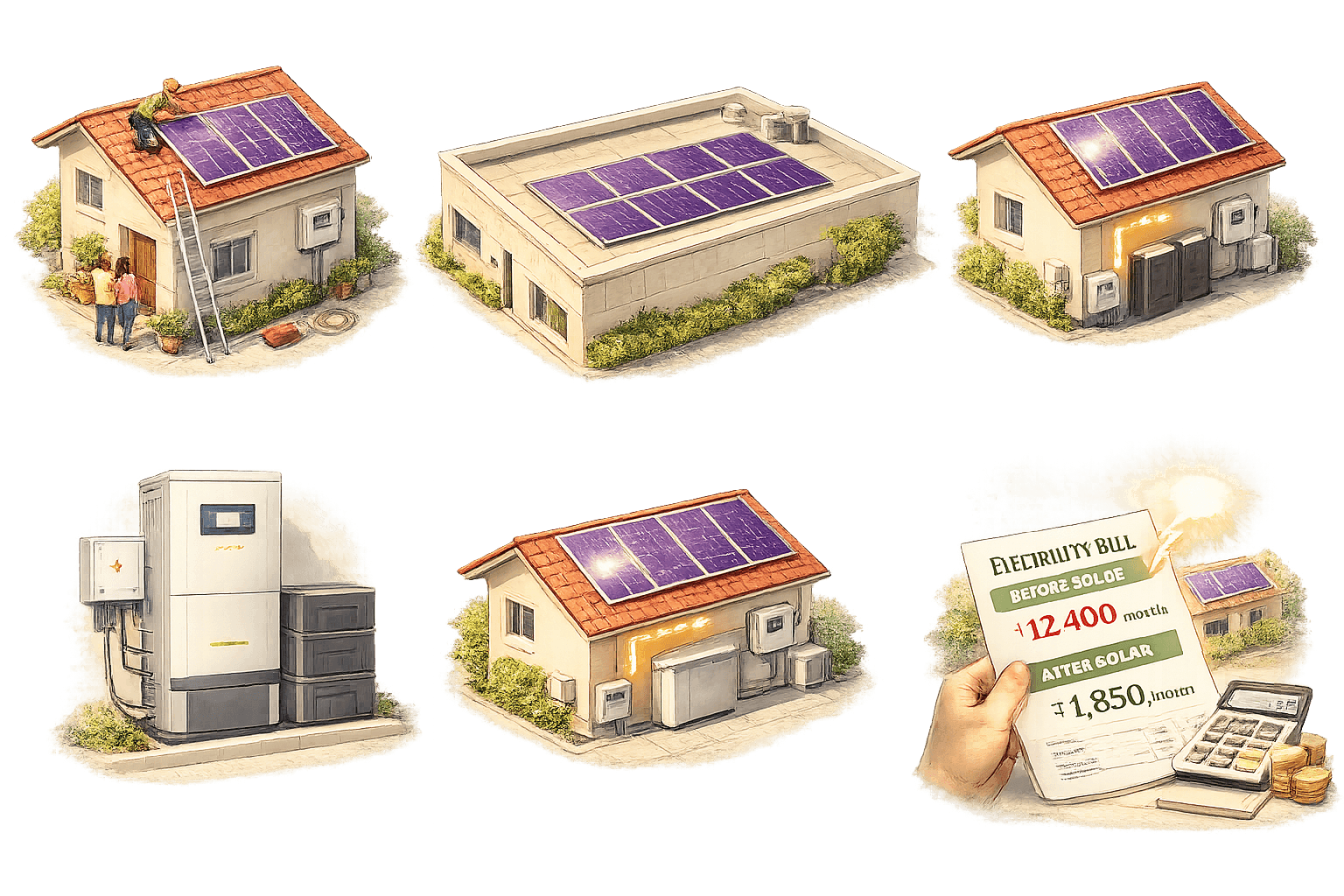
Don't expect the subsidy the day the panels are bolted down. From our experience across 5,000+ installations, here is the realistic timeline for pm surya ghar scheme details payouts:
- Site Survey to Installation: 7–10 days.
- Net Metering Process: 15–30 days (depends heavily on DISCOM stock of meters).
- Subsidy Disbursal: 30–60 days after the commissioning certificate is approved on the portal.
The money is transferred directly to the consumer's bank account via DBT (Direct Benefit Transfer). The government has become quite efficient, but if your bank account name doesn't match your electricity bill name exactly, it will trigger a manual audit and delay your payment by months.
Documents Required for Delhi and Haryana
To ensure you don't face rejection, keep these high-resolution scans ready:
- Electricity Bill: Must be in the name of the applicant.
- Aadhar Card: Linked to the mobile number used for registration.
- Address Proof: (If different from Aadhar).
- Cancelled Cheque: Must show the applicant's name clearly.
- Property Tax Receipt: Often required in Noida and parts of Haryana to prove roof ownership.
Why 3kW is the "Sweet Spot"
When people ask for the pm surya ghar yojana subsidy chart, they notice the subsidy stops increasing after 3kW. For a typical Indian household, 3kW covers 2 ACs and the rest of the home load during the day. Because you get the maximum possible subsidy (₹78,000) at this stage, the ROI is fastest here.
However, if you have an EV, you should look at 5kW or more. Charging a car adds about 150–200 units to your monthly consumption. You can check our guide on Solar + EV charging to see why sizing up now saves you from DISCOM tariff hikes later.
Once you are eligible, the next question is money: see the exact PM Surya Ghar 3kW price and subsidy slab table.
FAQ
Who is eligible for the PM Surya Ghar Muft Bijli Yojana?
Any Indian resident with a valid electricity connection and a concrete roof (or a roof capable of holding the weight) can apply. The scheme is specifically for residential consumers. Commercial and industrial sites do not get this subsidy, though they benefit from 40% accelerated depreciation.
Can I apply for the subsidy if I already have a solar system?
Generally, the subsidy is for new installations. However, if you are expanding an existing system and have not claimed subsidy before, you might be eligible for the additional capacity, provided the total doesn't exceed the sanctioned load. Read more in our guide: Can I get solar subsidy again?
What is the PM Surya Ghar calculator?
The pm surya ghar calculator is an online tool on the official portal that estimates your system size based on your monthly bill. While it’s a good starting point, it doesn't account for local shading or roof orientation. We recommend using a more detailed Solar Calculator for accurate financial planning.
Is the subsidy available for off-grid systems?
No. The PM Surya Ghar Muft Bijli Yojana is strictly for on-grid (grid-connected) rooftop solar systems. The goal is to reduce the load on the national grid and use Net Metering to balance energy production.
What happens if I sell my house after installing solar?
The solar system is considered a part of the property. The net metering agreement and the benefits of the solar plant will typically transfer to the new owner after a name-change process with the DISCOM. It usually increases the property value because the new owner inherits a near-zero electricity bill.
If you’re in the NCR region—whether it’s Noida, Gurgaon, or Faridabad—we can help you navigate this paperwork. Get a free quote and a site survey to see if your roof is ready for the PM Surya Ghar revolution. Residential solar isn't just about saving money anymore; it's about hedging against the 5-8% annual tariff hikes we see every year.
Don't wait for the next heatwave to realize your bill has doubled. The best time to install was last year; the second best time is today.
Every 1 kW of solar on your roof offsets 1.5 tonnes of CO₂ per year
That's 40 trees planted — every year, for 25 years.
A typical 5 kW home system offsets 187 tonnes of carbon over its lifetime. That's equivalent to taking 8 cars off the road.
See your impact →How much can you save with solar?
Enter your electricity bill → get system size, subsidy amount & payback period
Get StartedSee your exact subsidy after state stacking
Related Articles
What Is Captive Open Access Solar (100% Equity Model)
Learn how Captive Open Access Solar (100% Equity Model) helps Indian businesses cut electricity costs by 40% using off-site solar plants. Guide on rules, savings & ROI.
Read moreHow Rooftop Solar Can Eliminate Your Electricity Bill
Discover how Net Metering and PM Surya Ghar subsidies can reduce your monthly electricity bill to near-zero. Learn about system sizing, costs, and real-world savings.
Read moreSolar Subsidy in Uttar Pradesh 2026: ₹1,08,000 for Noida, Ghaziabad & Greater Noida
UP's stacked solar subsidy 2026: ₹78,000 central + ₹30,000 UPNEDA state top-up = ₹1.08L. Real PVVNL net-cost math for Noida, Greater Noida, Ghaziabad & Meerut.
Read moreRelated guides
Delhi Electricity Rate 2026
BSES & Tata Power per-unit rates, PPAC, subsidy — sourced from DERC.
ExploreDelhi Solar Policy 2026
Free rooftop solar up to 3 kW for homes under 400 units. Eligibility & apply.
ExploreSolar Panel Price in Delhi
Live 2026 rooftop prices in Delhi after ₹1.56L subsidy. 1,200+ installs.
ExploreSolar Company in Gurgaon
Gurgaon's rooftop solar installer — 800+ systems, ₹78K PM Surya Ghar subsidy.
ExploreSolar Company in Noida
Noida & Greater Noida rooftop solar — 500+ installs, ₹1.08L stacked subsidy.
ExploreSolar Panel Price in Faridabad
Live 2026 Faridabad prices after ₹78K PM Surya Ghar subsidy. 350+ homes.
Explore