
By Arshi Chadha, Founder · Bridgeway Power
Open Access vs Rooftop vs Community Solar: Decision Framework for Indian Buyers
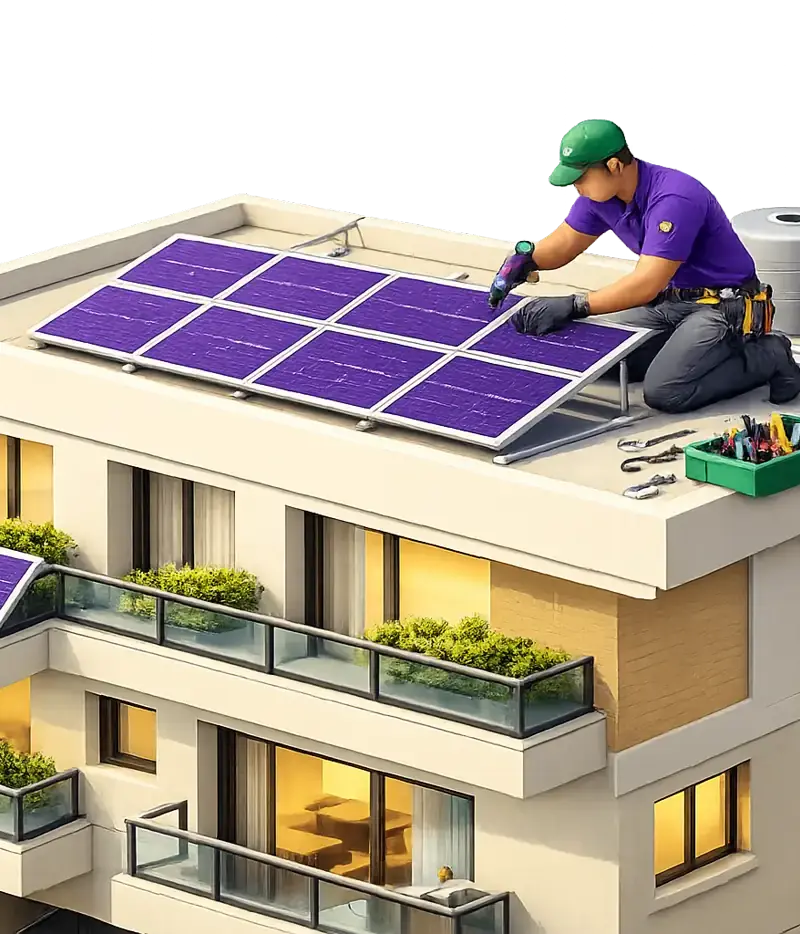
- •Best for Homeowners: Rooftop Solar (Highest ROI with subsidies)
- •Best for Tenants/Apartments: Community Solar (No roof required)
- •Best for Large Industries: Open Access Solar (Scale and flexibility)
- •Average Payback: 3–5 years for Rooftop; 4–6 years for Open Access
- •Key Benefit: Up to 100% bill reduction for Rooftop; 20–40% for Open Access
Deciding how to go solar in India used to be simple: you either put panels on your roof or you didn’t. But as 2026 approaches, the Indian energy landscape has shifted drastically. Today, a factory owner in Manesar, a high-rise apartment resident in Dwarka, and a bungalow owner in Sushant Lok all have different paths to clean energy.
The dilemma often boils down to a technical tug-of-war: open access vs rooftop solar, or perhaps the newer, more flexible community solar model. With electricity tariffs rising—reaching as high as ₹8–10/unit for commercial consumers in Delhi and Mumbai—choosing the wrong model can mean leaving lakhs of rupees on the table.
At Bridgeway Power, with 35+ years of experience and 25+ MW installed, we’ve built this framework to help you stop guessing and start saving.
The Three Main Contenders: A High-Level Overview
Before diving into the numbers, let’s define the players.
1. Rooftop Solar (The Capex King)
This is the most common model. You own the roof, you buy the panels, and the energy generated is used directly behind your meter. Any excess is sent to the grid via net metering.
2. Open Access Solar (The Industrial Scale)
Open Access allows large consumers (typically those with a sanctioned load >100kW or 1MW depending on state policy) to buy solar power from a massive off-site solar park. The power is "wheeled" through the state grid to your facility.
3. Community Solar & Virtual Net Metering (The Urban Solution)
This is the "Netflix of Solar." You don't need a roof. You subscribe to a share of a remote solar plant, and the credits are adjusted in your electricity bill through Virtual Net Metering (VNM).
Decision Framework: Open Access vs Rooftop vs Community Solar
Choosing between these models isn't just about "what's cheaper." It’s about your available space, your sanctioned load, and your long-term financial goals.
Comparison Matrix: Key Features at a Glance
| Feature | Rooftop Solar | Open Access Solar | Community Solar |
|---|---|---|---|
| Location | On your own roof | Off-site solar park | Off-site solar park |
| Ownership | Self-owned (Capex) | Third-party or Joint | Subscription or Ownership |
| Best For | Independent homes, MSMEs | Large factories, Hospitals | Apartment owners, Tenants |
| Max Savings | Up to 100% of bill | 20–40% per unit | 15–30% of bill |
| Net Metering | Available (Physical) | Not applicable | Virtual Net Metering (VNM) |
| Maintenance | Owner's responsibility | Managed by developer | Managed by provider |
1. When to Choose Rooftop Solar
If you have clear title to your roof and a monthly bill above ₹2,000, rooftop solar is almost always the winner for ROI. Thanks to the PM Surya Ghar Yojana, residential buyers now get massive subsidies.
The Economics of Rooftop Solar (2026 Rates): The average installed cost is currently ₹67,000 per kW. However, the price drops significantly as the system size increases.
| System Capacity | Avg. Cost (Pre-Subsidy) | Central Subsidy (PM Surya Ghar) | Effective Cost |
|---|---|---|---|
| 1 kW | ₹67,000 | ₹30,000 | ₹37,000 |
| 2 kW | ₹1,34,000 | ₹60,000 | ₹74,000 |
| 3 kW | ₹2,01,000 | ₹78,000 | ₹1,23,000 |
| 5 kW | ₹3,35,000 | ₹78,000 | ₹2,57,000 |
| 10 kW | ₹5,50,000 | ₹78,000 | ₹4,72,000 |
Note: In Delhi, residents can get an additional state subsidy of ₹10,000/kW (up to ₹30,000) and Generation Based Incentives.
2. When to Choose Open Access Solar
If you are an industrial giant or a large commercial entity (like a shopping mall or large hospital) and your roof only covers 10% of your energy needs, Open Access is your primary tool. It allows you to procure 100% of your energy from solar without needing 10 acres of rooftop.
However, Open Access comes with "hidden" costs like Cross-Subsidy Surcharge (CSS) and Banking Charges.
Typical Commercial/Industrial (C&I) Pricing: For MSMEs looking at rooftop or onsite plants, the pricing is even more competitive.
| Capacity Tier | Rate (₹/Wp) | Typical Project Cost (Excl. GST) |
|---|---|---|
| Up to 25 kW | ₹48 | ₹12,00,000 |
| 50 kW | ₹44 | ₹22,00,000 |
| 100 kW | ₹42 | ₹42,00,000 |
| 500 kW | ₹38 | ₹1,90,00,000 |
| 1 MW+ | ₹36 | ₹3,60,00,000 |
3. When to Choose Community Solar
Community solar is the breakthrough of 2026. It is ideal for residents in high-rise societies in Noida Extension or Janakpuri who do not have individual roof rights.
- Pros: No installation on your roof, easy to "move" your solar benefits if you change houses within the same DISCOM (like BSES Rajdhani).
- Cons: Lower ROI than rooftop solar because you don't get the 78,000 central subsidy.
Real-World Example: The Commercial Dilemma
Let’s look at a manufacturing unit in Faridabad with a monthly bill of ₹5,00,000 and a sanctioned load of 250kW.
Option A: Rooftop Solar (100kW System)
- Space Required: ~10,000 sq. ft.
- Investment: ₹42,00,000.
- Generation: ~12,000 units/month.
- Savings: At ₹7.5/unit (DHBVN tariff), that's ₹90,000 monthly.
Talk to a solar engineer — not a salesperson
Check whether we install in your area, then get your answer on WhatsApp. No forms, no call centre.
What would solar save on YOUR bill?
Solar Depreciation & Tax Benefit Calculator
Based on Section 32 — 40% WDV + 20% additional depreciation (Year 1)
- Payback: ~4 years.
- Constraint: Limited by roof size. It only covers 20% of their total bill.
Option B: Open Access (Full Procurement)
- Investment: High Capex (if owning) or Zero Capex (if PPA model).
- Savings: They buy power at ₹5.5/unit (including wheeling charges) instead of ₹7.5/unit.
- Total Savings: ₹2/unit on their entire consumption (say 60,000 units) = ₹1,20,000 monthly.
- Constraint: Requires regulatory approvals and payment of CSS/Additional Surcharges.
The Verdict: Most smart businesses in Delhi NCR today use a Hybrid Approach. They fill their roof to the max for the highest ROI, and cover the remaining deficit via Open Access or Group Net Metering.
Financing Your Decision
Whether you choose open access vs rooftop solar, the initial cost doesn't have to be a barrier. India’s banking sector has gone "all-in" on solar.
For residential buyers, SBI Solar Loans and PNB Solar Rooftop Schemes offer attractive rates.
For businesses, we recommend checking these equal-value partners:
- Aerem Solar Finance: Specialized in MSME loans with fast processing.
- Canara Bank Solar Loan: Great for mid-sized commercial projects.
- ECOFY Solar Financing: Excellent zero-cost EMI options for residential consumers.
- SIDBI 4E Solar Loan: Specifically for MSMEs, offering ₹10L–₹10Cr at 8.5–10% interest.
Critical Factors: Maintenance & Generation
No matter which model you choose, your units generated depend on maintenance. In dusty cities like Delhi or Ghaziabad, panel soiling can cause a 25% drop in output.
If you own a rooftop plant, you need a solid AMC plan. For Open Access or Community Solar, the developer handles this, but you must audit their generation logs to ensure you are getting your promised units. Use our guide on how to audit solar generation to stay on top of it.
Average Yield Expectations in NCR
| Month | Expected Units/kW/Month |
|---|---|
| Summer (April–June) | 130–150 units |
| Monsoon (July–Sept) | 90–110 units |
| Winter (Oct–March) | 110–120 units |
Frequently Asked Questions
Which is better: Open Access or Rooftop Solar?
Rooftop solar is better for ROI because you avoid grid charges (wheeling, banking, CSS). Open access is better for scale when your electricity demand exceeds your available roof space. Most large C&I consumers use rooftop solar for their primary load and open access for the remainder.
Can I get a subsidy for Open Access solar?
No. Central government subsidies like PM Surya Ghar Yojana are only available for residential rooftop solar (up to 10kW). Commercial and Open Access projects rely on tax benefits like 40% accelerated depreciation and lower cost of power.
What is Virtual Net Metering?
Virtual Net Metering (VNM) allows a consumer to receive credits from a solar plant located somewhere else. In Delhi, this is the backbone of Community Solar, allowing apartment owners to see solar savings on their monthly BSES or Tata Power bills.
How much weight can my roof take for solar?
A standard residential RCC roof has a live load capacity of ~150 kg/sqm. A solar panel + structure weighs roughly 30–35 kg per unit (spread over 30 sq. ft.), which is significantly less than a full 1000L water tank.
Can I use solar if I live in a rented apartment?
Yes, either through Balcony Solar (limited generation) or by subscribing to a Community Solar project. You can also talk to your landlord about installing Solar for Builder Floors.
Conclusion: Making Your Choice
The battle of open access vs rooftop solar isn't about finding a "winner." It's about finding the right fit for your property and energy goals.
- If you have a roof: Install rooftop solar. It is the most profitable financial instrument in India today.
- If you are an industry with huge land: Build an on-site captive plant.
- If you have high demand but no space: Go for Open Access or Captive Open Access.
- If you live in a flat: Sign up for Solar Subscription or Community Solar.
Bridgeway Power has been navigating the future of rooftop solar in India since 1990. Whether you need a 3kW system for your home or a 1MW Open Access solution for your factory, our team is ready to help.
Ready to see which model saves you the most? Calculate your savings now or contact us for a free technical site survey.
Every 1 kW of solar on your roof offsets 1.5 tonnes of CO₂ per year
That's 40 trees planted — every year, for 25 years.
A typical 5 kW home system offsets 187 tonnes of carbon over its lifetime. That's equivalent to taking 8 cars off the road.
See your impact →How much can you save with solar?
Enter your electricity bill → get system size, subsidy amount & payback period
Get StartedGo solar without owning a rooftop
Community Solar gives commercial & institutional consumers the same savings — zero capex, zero roof needed.
Or get a free solar quote
Tell us about your rooftop — we'll call with exact savings for your home.
Related Articles
Net Metering in India: How to Sell Solar Power Back to the Grid
Learn how net metering in India allows you to sell solar power back to the grid. Discover state policies, savings examples, and how to reduce your bill by 90%.
Read moreWhat Is Captive Open Access Solar (100% Equity Model)
Learn how Captive Open Access Solar (100% Equity Model) helps Indian businesses cut electricity costs by 40% using off-site solar plants. Guide on rules, savings & ROI.
Read moreSolar Installation Cost in Delhi NCR 2026: 3 kW at ₹1.32L net
Updated 2026 guide to solar costs in Delhi NCR. Learn about PM Surya Ghar subsidies, system pricing from 1kW-10kW, and how to reach zero electricity bills.
Read moreRelated guides
Delhi Electricity Rate 2026
BSES & Tata Power per-unit rates, PPAC, subsidy — sourced from DERC.
ExploreDelhi Solar Policy 2026
Free rooftop solar up to 3 kW for homes under 400 units. Eligibility & apply.
ExploreSolar Panel Price in Delhi
Live 2026 rooftop prices in Delhi after ₹1.56L subsidy. 1,200+ installs.
ExploreSolar Company in Gurgaon
Gurgaon's rooftop solar installer — 800+ systems, ₹78K PM Surya Ghar subsidy.
ExploreSolar Company in Noida
Noida & Greater Noida rooftop solar — 500+ installs, ₹1.08L stacked subsidy.
ExploreSolar Panel Price in Faridabad
Live 2026 Faridabad prices after ₹78K PM Surya Ghar subsidy. 350+ homes.
Explore