
By Vansh Dahiya · Reviewed by Arshi Chadha, Founder
Haryana Solar Policy and New Energy Schemes 2024-2026
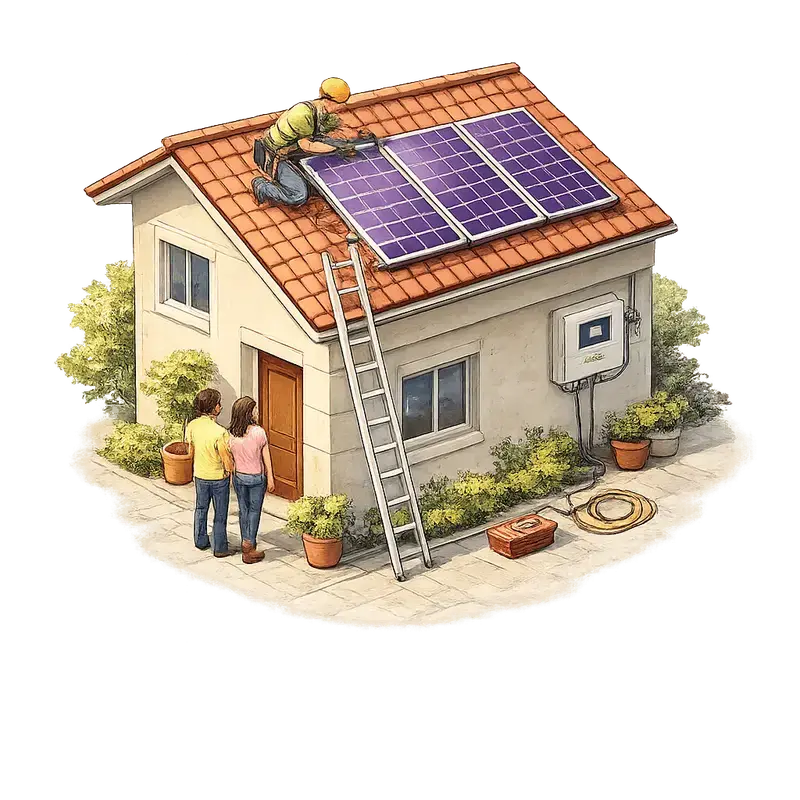
- •Primary Scheme: PM Surya Ghar Muft Bijli Yojana (Central) + HAREDA Facilitation.
- •Max Subsidy: ₹78,000 (Residential).
- •Net Metering: Available via DHBVN/UHBVN for loads up to 500kW.
- •Payback Period: 3–4 years for typical Haryana households.
- •Target: 1 Crore homes nationally, with Haryana aiming for massive urban solarization by 2026.
Haryana’s energy landscape is shifting faster than most homeowners realize. With the Haryana Electricity Regulatory Commission (HERC) recently determining the Tariff Order for FY 2026-27, it’s clear that while grid rates for high-consumption slabs remain steep at ₹7.1/unit, the push for decentralized solar is the state's primary strategy to manage peak load.
We’ve spent the last 35+ years installing power systems across North India, and I can tell you: the "new scheme in haryana 2026" isn't just one single document; it’s a convergence of the PM Surya Ghar central push and HAREDA’s streamlined digital workflow. If you’re waiting for a massive "state-only" cash handout, you might be waiting forever—Haryana currently focuses on seamless net metering and technical facilitation rather than a direct state-level cash top-up like Delhi or UP.
Timeline of Haryana Solar Policy Evolution
Understanding where we are requires looking at how HAREDA (Haryana Renewable Energy Development Agency) has pivoted from direct subsidies to policy-led growth.
| Period | Policy Phase | Key Feature |
|---|---|---|
| 2014-2018 | Early Adoption | 30% Benchmark subsidy (High wait times, manual filing) |
| 2019-2023 | Phase II Grid Connected | Shift to DBT (Direct Benefit Transfer) via National Portal |
| 2024-2025 | PM Surya Ghar Era | Focus on "Muft Bijli" & saturation of government buildings |
| 2026 (Anticipated) | Peak Grid Parity | Mandatory solar for plots >500 sq. yards & VNM rollout |
Anticipated Changes in Haryana’s Renewable Energy Targets
By 2026, Haryana is expected to aggressivey push for Virtual Net Metering (VNM) and Group Net Metering (GNM). Why? Because the state has a unique challenge: high-density urban clusters in Gurgaon and Faridabad where individual roof space is often shared or restricted.
We expect the new scheme in haryana 2026 to focus heavily on:
- MSME De-carbonization: Incentives for small industries to switch to solar to avoid the high industrial tariffs.
- Mandatory Solar Enforcement: Stricter compliance for new residential constructions on plots of 500 square yards or more.
- Storage Integration: As lithium prices drop, we anticipate HAREDA might introduce pilot incentives for hybrid systems to stabilize the local feeders in areas like Palam Vihar.
Current HAREDA Incentives for Residential and Institutional Solar
Right now, if you are looking for a HAREDA solar subsidy, you are essentially looking at the implementation of the PM Surya Ghar Muft Bijli Yojana.
Residential Subsidy Breakdown
The central government provides the following, which is facilitated locally by HAREDA and the DISCOMs (DHBVN/UHBVN):
- 1 kW to 2 kW: ₹30,000 to ₹60,000
- 3 kW and above: Fixed at ₹78,000
For a 3kW system in Haryana, which is the "sweet spot" for most 3BHK homes, the math works out beautifully. Use our Solar Calculator to see your specific ROI, but generally, a 3kW system costs roughly ₹2.40 Lakh (GST inclusive). After the ₹78,000 subsidy, your net investment is ~₹1.62 Lakh.
Institutional and Social Sector
Schools, hospitals, and NGOs often ask if they get the same "new scheme in haryana 2026" benefits. While they don't get the residential cash subsidy, they benefit from Solar for MSME through Accelerated Depreciation (40%) and lower GST rates.
The Haryana Solar Rooftop Portal: Your Gateway
You cannot get a subsidy in Haryana by just calling a local vendor who uses sub-standard panels. Everything—from the application to the final inspection—happens through the Haryana solar rooftop portal.
As an empanelled vendor, we handle the net metering process for our clients. The process involves:
- Feasibility Approval: DHBVN/UHBVN checks if your local transformer can handle the solar load.
- Installation: Must be done by an empanelled vendor using ALMM-approved modules (like the TOPCon Mono PERC panels we use).
- Inspection & Net Meter: The DISCOM replaces your old meter with a bidirectional one.
Real Example: 5kW Installation in South City, Gurgaon
A client in South City Gurgaon had a monthly bill of ₹7,500. We installed a 5kW system using Tier-1 600Wp modules.
- System Size: 5 kW
- Total Cost: ~₹3.43 Lakh (all inclusive)
- Subsidy Received: ₹78,000
- Net Cost: ₹2.65 Lakh
- Monthly Generation: ~600 units (avg)
- Monthly Savings: ₹4,200 - ₹5,000 (depending on the slab)
- Payback: Approx 4.2 years.
With a Solar Loan, this client actually paid an EMI that was lower than their previous electricity bill.
Talk to a solar engineer — not a salesperson
Check whether we install in your area, then get your answer on WhatsApp. No forms, no call centre.
What would solar save on YOUR bill?
Solar Depreciation & Tax Benefit Calculator
Based on Section 32 — 40% WDV + 20% additional depreciation (Year 1)
Interaction Between State and Central Subsidies

It is important to be direct here: Haryana does not currently offer a "Double Subsidy." Unlike Uttar Pradesh, which offers a ₹30,000 state bonus, or Delhi, which offers ₹3/unit GBI, Haryana’s renewable energy incentives are currently limited to the Central PM Surya Ghar pool.
However, the benefit of installing in Haryana is the Banking Facility. Haryana allows you to carry forward your excess solar units month-to-month and settle them annually. This is huge for the winter months when your ACs are off but your panels are still soaking up the sun.
Future Expectations for 2026
We are closely watching the Ministry of New & Renewable Energy (MNRE) and state updates for the next phase of the "new scheme in haryana 2026." The industry buzz suggests a shift toward Agri-PV (Component C of PM-KUSUM) and dedicated incentives for Electric Vehicle (EV) charging integration at the residential level.
If you're planning to buy an EV in 2026, sizing your solar system now to include that load is the smartest move you can make. Solar + EV charging at home essentially gives you "free fuel" for the next 25 years.
FAQ
Does Haryana have a state-specific solar subsidy in 2026?
Currently, Haryana residents benefit primarily from the PM Surya Ghar Muft Bijli Yojana (up to ₹78,000). While there is no additional cash "top-up" from the state government as of late 2025, HAREDA provides the technical framework and portal for all central subsidy claims.
What is the maximum load allowed for solar net metering in Haryana?
Under DHBVN and UHBVN rules, residential consumers can generally install solar up to 100% of their sanctioned load, capped at 500kW for LT connections. For systems above 10kW, a three-phase connection is mandatory in Delhi NCR.
How do I apply for the new scheme in haryana 2026?
All applications must be submitted via the national solar portal or the designated Haryana solar rooftop portal. You will need your latest electricity bill from DHBVN or UHBVN, proof of identity, and a clear photo of your rooftop. We recommend getting a free quote first to ensure your roof is technically viable.
Can I install solar on a rented house in Haryana?
Yes, but the net metering agreement must be signed by the meter owner (the landlord). The benefits of the reduced bill can then be adjusted in your rent or utility agreement. Alternatively, look into Virtual Net Metering if you don't have direct roof access.
Is the solar subsidy available for commercial buildings in Haryana?
No, the direct cash subsidy is strictly for residential properties. Commercial and industrial (C&I) entities in cities like Noida or Gurgaon should instead focus on the 40% Accelerated Depreciation benefit and the significant reduction in their per-unit electricity costs.
Don't let the complexity of DISCOM paperwork stop you from saving money. If your monthly bill is over ₹5,000, you are essentially paying for a solar system you don't own yet.
We can help you navigate the HAREDA portal and get your system live in under 45 days. Get a free quote or use our Solar Calculator to start your transition today.
Every 1 kW of solar on your roof offsets 1.5 tonnes of CO₂ per year
That's 40 trees planted — every year, for 25 years.
A typical 5 kW home system offsets 187 tonnes of carbon over its lifetime. That's equivalent to taking 8 cars off the road.
See your impact →How much can you save with solar?
Enter your electricity bill → get system size, subsidy amount & payback period
Get StartedLiked this article? Get a free solar quote
Tell us about your rooftop — we'll call with exact savings for your home.
Related Articles
Net Metering in India: How to Sell Solar Power Back to the Grid
Learn how net metering in India allows you to sell solar power back to the grid. Discover state policies, savings examples, and how to reduce your bill by 90%.
Read moreWhat Is Captive Open Access Solar (100% Equity Model)
Learn how Captive Open Access Solar (100% Equity Model) helps Indian businesses cut electricity costs by 40% using off-site solar plants. Guide on rules, savings & ROI.
Read moreSolar Installation Cost in Delhi NCR 2026: 3 kW at ₹1.32L net
Updated 2026 guide to solar costs in Delhi NCR. Learn about PM Surya Ghar subsidies, system pricing from 1kW-10kW, and how to reach zero electricity bills.
Read moreRelated guides
Delhi Electricity Rate 2026
BSES & Tata Power per-unit rates, PPAC, subsidy — sourced from DERC.
ExploreDelhi Solar Policy 2026
Free rooftop solar up to 3 kW for homes under 400 units. Eligibility & apply.
ExploreSolar Panel Price in Delhi
Live 2026 rooftop prices in Delhi after ₹1.56L subsidy. 1,200+ installs.
ExploreSolar Company in Gurgaon
Gurgaon's rooftop solar installer — 800+ systems, ₹78K PM Surya Ghar subsidy.
ExploreSolar Company in Noida
Noida & Greater Noida rooftop solar — 500+ installs, ₹1.08L stacked subsidy.
ExploreSolar Panel Price in Faridabad
Live 2026 Faridabad prices after ₹78K PM Surya Ghar subsidy. 350+ homes.
Explore