
By Mahendra Singh · Reviewed by Arshi Chadha, Founder
Solar Panel Financing: EMI Options and Loan Interest Rates

- •System size: 3 kW – 10 kW (Residential)
- •Interest Rates: 5.75% – 9.75% (PSU Banks) | 8% – 12% (NBFCs)
- •Monthly EMI: Starts at ~₹2,200 for a 3kW system (10-year tenure)
- •Payback Period: 4–5 years (while the loan tenure can be up to 10 years)
- •Key Benefit: Your monthly electricity savings often exceed the EMI amount, making the system "self-funding."
Most homeowners in India look at a solar quotation and see a "lump sum" hurdle. A high-quality 3kW system in Delhi costs roughly ₹2,40,000 before subsidies. Even with the PM Surya Ghar Yojana slashing that net cost to about ₹1,32,000, writing a single cheque is a deterrent. I’ve spent 35 years at Bridgeway Power watching customers hesitate over upfront costs, only to realize later that a solar system on EMI isn't just a convenience—it’s a financial arbitrage. You’re essentially swapping a permanent, rising electricity bill for a temporary, fixed EMI.
The Reality of a Solar System on EMI in 2026
In the current Indian market, financing a rooftop solar plant has become as standardized as a car loan. Gone are the days when banks didn't understand "solar assets." Today, whether you are looking for solar in Dwarka or a bungalow in Sushant Lok, you have two primary routes: Public Sector Banks (PSBs) and specialized Green-Tech NBFCs.
We’ve integrated these options into our Solar Calculator to show you how the math works in real-time. The goal isn't just to get solar; it's to ensure the solar on installment plan doesn't pinch your monthly cash flow.
EMI Breakdown: 3kW and 5kW Systems
Let’s look at the actual numbers. These figures assume a standard residential installation using Tier-1 TOPCon modules and a string inverter. The "Net Cost" reflects the price after the central subsidy is credited to your account.
| System Capacity | Net Cost (After Subsidy) | Tenure | Estimated Monthly EMI (at 8.5%) | Total Interest Paid |
|---|---|---|---|---|
| 3 kW | ₹1,32,000 | 36 Months | ₹4,168 | ₹18,048 |
| 3 kW | ₹1,32,000 | 60 Months | ₹2,704 | ₹30,240 |
| 5 kW | ₹2,65,035 | 36 Months | ₹8,365 | ₹36,105 |
| 5 kW | ₹2,65,035 | 60 Months | ₹5,432 | ₹60,885 |
Note: Interest rates vary based on CIBIL scores. The 3kW net cost is specific to Delhi with stacked subsidies. For other regions, check our solar installation cost in Delhi NCR guide.
Comparing Solar Panel Loan Interest Rates
Choosing between a bank and a specialized green financier like ECOFY or Aerem depends on how fast you want the money and how much paperwork you're willing to handle.
1. Traditional Banks (SBI, PNB, Canara)
Public sector banks offer the lowest solar panel loan interest rate under the PM Surya Ghar scheme. For systems up to 3kW, rates are capped at Repo + 0.5%. Currently, SBI PM Surya Ghar Loan and others like Canara Bank Solar Loan offer rates as low as 5.75% for the first tier.
- Pros: Lowest interest rates, up to 10-year tenure.
- Cons: Slower processing (15–30 days), strict documentation, and usually requires a pre-existing relationship with the bank.
2. Specialized Green Finance (NBFCs)
Partners like ECOFY Solar Financing have revolutionized the "instant" loan. Using an ecofy emi calculator, you can see that while their rates might be slightly higher (typically 10–12%), the approval happens in minutes.
- Pros: Digital process, 24-hour approval, minimal documentation (Pan, Aadhaar, and Electricity Bill).
- Cons: Higher interest rates compared to PSUs, shorter maximum tenures (usually 3–7 years).
Eligibility Criteria for Solar Loans in India
Banks don't just look at your roof; they look at your "repayment capacity." To qualify for a solar system on EMI, you typically need:
- Ownership Proof: The house must be in the name of the applicant (or a co-applicant).
- CIBIL Score: 700+ is usually mandatory for the best rates.
- Sanctioned Load: Your electricity bill should show a sanctioned load equal to or higher than the solar system size you’re installing. For example, if you want a 5kW system, your home should have at least a 5kW connection.
- Income Stability: Salaried individuals need 2 years of ITR/Form 16; business owners need audited financials.
The "Self-Funding" Solar Model: A Real Example
We recently finished a project for a homeowner in Sector 14, Gurgaon. They had a monthly bill of ₹8,500. We installed a 5kW system.
- Upfront Cost: ₹3,43,035 (Gross)
- Subsidy: ₹78,000 (Central)
- Net Financed Amount: ₹2,65,035
- EMI (5 Years): ₹5,432
- Monthly Savings on Bill: ~₹6,000 – ₹7,000
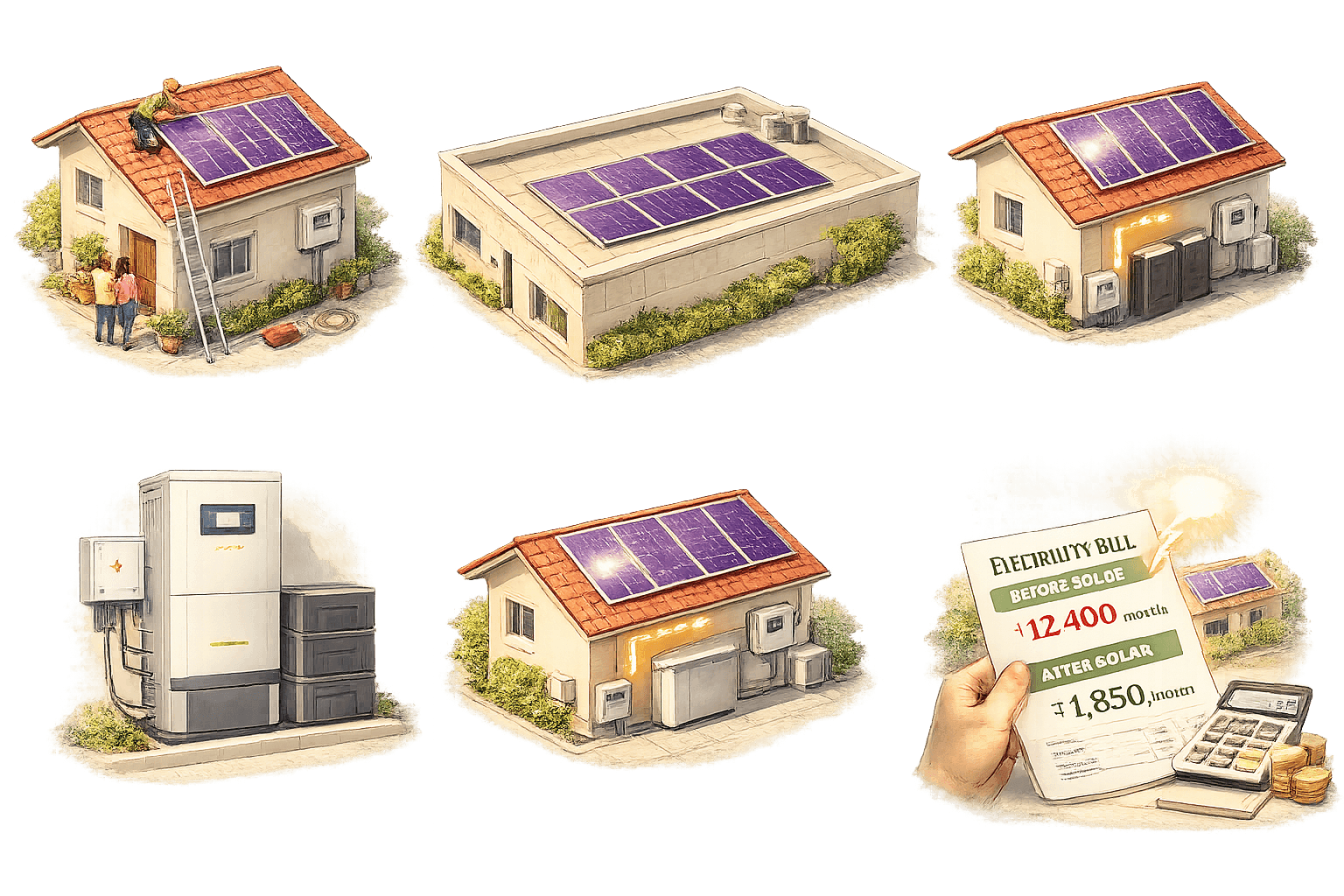
In this case, the customer wasn't "spending" money on solar. They were simply redirecting ₹5,432 of their usual ₹8,500 electricity expense toward the loan. Once the loan ends in 5 years, their electricity becomes practically free for the next 20 years. This is the smartest way to use solar on installment.
Talk to a solar engineer — not a salesperson
Check whether we install in your area, then get your answer on WhatsApp. No forms, no call centre.
What would solar save on YOUR bill?
Solar Depreciation & Tax Benefit Calculator
Based on Section 32 — 40% WDV + 20% additional depreciation (Year 1)
Tenure Options: Short-term vs. Long-term
I always tell my clients: don't just chase the lowest EMI.
- 36-Month Tenure: Ideal if you want to clear the debt quickly and maximize your ROI early. You pay the least interest overall.
- 60-Month to 120-Month Tenure: Best if you want the "Zero-Cost" feel—where the monthly savings from solar completely cover the EMI. SBI Solar Loan offers up to 10 years, which is excellent for larger systems like a 10kW solar system.
Why Structure and Quality Matter for Financing
Lenders are increasingly wary of "cheap" solar. If a system fails in year 3, the customer stops paying the EMI. That’s why we focus on high-quality structures and Tier-1 components. A system that doesn't generate units doesn't pay its own EMI. We’ve seen 5-year-old systems generating half their capacity due to poor maintenance; that’s why we recommend an AMC Plan to ensure your "self-funding" asset doesn't become a liability.
If you’re in the Delhi NCR area, we can assist with the entire bank liaison process. Whether it's navigating DHBVN net metering or BSES net metering, the financing is only the first step.
Get a free quote today to see which financing partner fits your profile.
FAQ
Can I get a solar loan without any down payment?
While some NBFCs offer 100% financing, most banks require a 10–20% margin money (down payment). However, since the government subsidy is credited directly to you, it often effectively covers a significant portion of the initial cost.
Does the solar loan cover the cost of the net meter?
Yes, most solar loans are "project-based," meaning they cover the panels, inverter, structure, cables, and even the DISCOM application fees for net metering.
What happens to the loan if I sell my house?
A solar loan is usually a personal or home improvement loan tied to the individual, not the property title itself. You would typically need to clear the loan or transfer it, depending on the bank's NOC policies.
Is the interest on a solar loan tax-deductible?
For residential users, there isn't a direct section in the Income Tax Act for solar interest like there is for home loans (Section 24). However, for MSMEs and businesses, the interest is a deductible business expense, and you can claim 40% accelerated depreciation.
Can I prepay my solar loan?
Most PSU banks allow prepayment with zero penalty. NBFCs might have a lock-in period of 6–12 months or a small foreclosure fee. Always check the fine print before signing.
The most expensive way to go solar is waiting for the "perfect" time while your DISCOM hikes tariffs. If the upfront cost is what's stopping you, the EMI route is the most logical exit from high electricity bills. Typical payback for a financed system is 4-5 years, but the panels will generate power for 25. You do the math.
Every 1 kW of solar on your roof offsets 1.5 tonnes of CO₂ per year
That's 40 trees planted — every year, for 25 years.
A typical 5 kW home system offsets 187 tonnes of carbon over its lifetime. That's equivalent to taking 8 cars off the road.
See your impact →How much can you save with solar?
Enter your electricity bill → get system size, subsidy amount & payback period
Get StartedLiked this article? Get a free solar quote
Tell us about your rooftop — we'll call with exact savings for your home.
Related Articles
Net Metering in India: How to Sell Solar Power Back to the Grid
Learn how net metering in India allows you to sell solar power back to the grid. Discover state policies, savings examples, and how to reduce your bill by 90%.
Read moreWhat Is Captive Open Access Solar (100% Equity Model)
Learn how Captive Open Access Solar (100% Equity Model) helps Indian businesses cut electricity costs by 40% using off-site solar plants. Guide on rules, savings & ROI.
Read moreSolar Installation Cost in Delhi NCR 2026: 3 kW at ₹1.32L net
Updated 2026 guide to solar costs in Delhi NCR. Learn about PM Surya Ghar subsidies, system pricing from 1kW-10kW, and how to reach zero electricity bills.
Read moreRelated guides
Delhi Electricity Rate 2026
BSES & Tata Power per-unit rates, PPAC, subsidy — sourced from DERC.
ExploreDelhi Solar Policy 2026
Free rooftop solar up to 3 kW for homes under 400 units. Eligibility & apply.
ExploreSolar Panel Price in Delhi
Live 2026 rooftop prices in Delhi after ₹1.56L subsidy. 1,200+ installs.
ExploreSolar Company in Gurgaon
Gurgaon's rooftop solar installer — 800+ systems, ₹78K PM Surya Ghar subsidy.
ExploreSolar Company in Noida
Noida & Greater Noida rooftop solar — 500+ installs, ₹1.08L stacked subsidy.
ExploreSolar Panel Price in Faridabad
Live 2026 Faridabad prices after ₹78K PM Surya Ghar subsidy. 350+ homes.
Explore