
By Bhawna Thakur · Reviewed by Arshi Chadha, Founder
How to Choose the Right Solar Inverter for Your Home in India: String vs. Microinverter
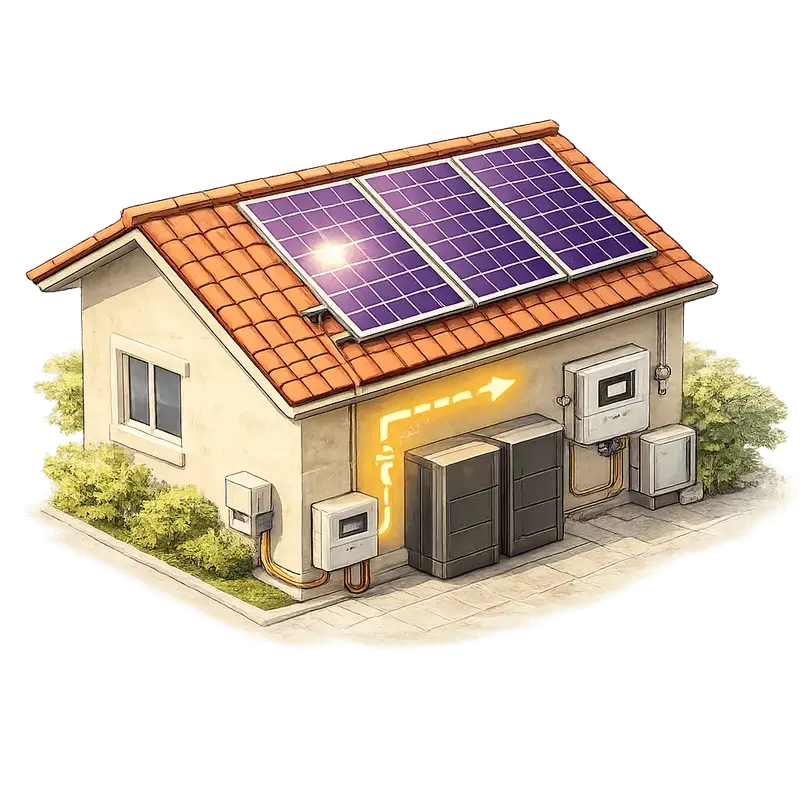
If solar panels are the "heart" of your solar power system, the inverter is undoubtedly its "brain." While panels capture sunlight, it is the inverter that converts that raw Direct Current (DC) into the Alternating Current (AC) used to run your ACs, refrigerators, and lights.
In India, where rooftop space can be cramped and shadows from water tanks or neighboring buildings are common, choosing the right inverter technology isn't just a technical detail—it’s a financial decision. The wrong choice can lead to a 20-30% loss in power generation, significantly extending your ROI and solar payback period.
In this guide, we will break down the two primary technologies dominating the Indian market: String Inverters and Microinverters, helping you decide which is right for your home.
1. What is a String Inverter?
The string inverter is the traditional choice and remains the most common technology for rooftop solar installations in India.
In this setup, solar panels are connected in a series (a "string"). The DC electricity from the entire string is sent to a single, large inverter usually mounted on a wall near your main electrical board.
Pros of String Inverters:
- Lower Upfront Cost: String inverters are significantly cheaper than microinverters.
- Proven Technology: They have been used for decades and are easy for any solar technician to maintain.
- Centralized Maintenance: If something goes wrong, the technician only needs to check one box at eye level rather than climbing onto the roof.
Cons of String Inverters:
- The "Christmas Light" Effect: Since panels are in a series, if one panel is shaded by a tree or a nearby building, the performance of every other panel in that string drops to the level of the lowest-performing panel.
- No Panel-Level Monitoring: You can see how the whole system is doing, but you can’t tell if one specific panel is underperforming due to dust or a crack.
- Limited Lifespan: Most string inverters last 10-12 years, meaning you will likely need to replace them at least once during the 25-year lifespan of your solar panels.
2. What is a Microinverter?
Microinverters are a newer, "smart" technology. Instead of one central inverter for the whole system, a small inverter is attached to the back of each individual solar panel. The DC to AC conversion happens right on the roof.
Pros of Microinverters:
- Shade Independence: If one panel is shaded by a chimney or a pigeon, the rest of the panels continue to produce power at 100% capacity. This is vital for solar for builder floors in Delhi where space is tight.
- Maximum Efficiency: Microinverters use "Maximum Power Point Tracking" (MPPT) on every single panel, often leading to 5-15% higher energy yield annually.
- Panel-Level Monitoring: Through a phone app, you can see exactly how much energy each individual panel is producing. This makes solar panel cleaning and maintenance much easier to track.
- Longevity: Most microinverters come with a 25-year warranty, matching the lifespan of the panels.
Cons of Microinverters:
- Higher Initial Investment: They can increase the total cost of your solar system by 20-30%.
- Complex Roof Repairs: If one fails, a technician must go up to the roof and potentially remove panels to replace it.
3. String vs. Microinverter: Head-to-Head Comparison
| Feature | String Inverter | Microinverter |
|---|---|---|
| Best For | Large, unshaded roofs | Small roofs with complex shading |
| Upfront Cost | Lower (Budget-friendly) | Higher (Premium) |
| System Efficiency | High (if zero shade) | Highest (especially with shade) |
| Warranty | 5 to 10 years | 15 to 25 years |
| Monitoring | System-level | Individual Panel-level |
| Expandability | Difficult to add more panels later | Very easy to add panels one-by-one |
Talk to a solar engineer — not a salesperson
Check whether we install in your area, then get your answer on WhatsApp. No forms, no call centre.
What would solar save on YOUR bill?
4. Which One Should You Choose for Your Indian Home?
Choose a String Inverter if:
- You have a clear, shadow-free roof: If your roof is large and has no obstructions like water tanks, trees, or taller buildings nearby, a string inverter is the most cost-effective choice.
- You are on a budget: If you are trying to maximize the benefits of the PM Surya Ghar Yojana subsidy and want the lowest possible initial cost.
- Simple Installation: You prefer a centralized system that is easy to service.
Choose a Microinverter if:
- You have shading issues: In cities like Delhi, Mumbai, or Bangalore, shadows from neighboring buildings are common. Microinverters are the only way to ensure these shadows don't "kill" your entire system's production.
- You have a complex roof: If your panels need to face different directions (e.g., some East, some South) to fit on a 1000 sq ft roof, microinverters are essential.
- You want the "Set it and Forget it" peace of mind: With a 25-year warranty, you won't have to worry about inverter replacement costs 10 years down the line.
- You plan to expand: If you want to start with a 3kW system now and upgrade to a 5kW system later, microinverters make expansion significantly simpler. To understand which size you currently need, check our guide on 3kW vs 5kW solar systems.
5. The Impact on Your Electricity Bill
In India, net metering allows you to "bank" the electricity you don't use and get credit from the DISCOM.
Because microinverters can produce more units in real-world Indian conditions (where dust and partial shade are common), they often allow homeowners to eliminate their electricity bills faster than a string inverter would, despite the higher initial cost.
For someone with a ₹10,000 monthly electricity bill, the choice of inverter could be the difference between a 4-year payback period and a 5.5-year payback period.
6. Hybrid Inverters: A Third Option?
It is worth mentioning Hybrid Inverters. If you face frequent power cuts and want to add a battery bank, a Hybrid Inverter is required. It manages power from the panels, the grid, and the battery simultaneously. Learn more about this in our 2026 guide to home solar batteries.
Conclusion: Making the Right Investment
Choosing an inverter isn't about which technology is "better" in a lab—it's about which one fits your roof and your wallet.
At Bridgeway Power, we have seen thousands of installations across India. For most large-scale residential projects with clear roofs, a high-quality String Inverter (like Growatt or Sungrow) offers the best value. However, for urban homes and "builder floors" where shadows are unavoidable, we almost always recommend Microinverters (like Enphase) to protect your investment.
Still confused about which inverter matches your roof? Contact Bridgeway Power today for a free site audit and a customized solar generation report!
FAQ
Should I choose a string inverter or a microinverter for my Indian home?
For an unshaded rooftop with a simple single-orientation array, a string inverter is the right call — it is cheaper, service networks are dense, and yields are near-identical to microinverters. Choose microinverters only when significant parts of the roof are shaded, when panels sit on multiple orientations, or when you want panel-level monitoring for a small array.
Are microinverters worth the higher upfront cost in India?
Microinverters cost roughly 30–50% more than a comparable string inverter setup. The extra spend pays back only if shading or multi-facet roofs would otherwise cost you more than 10–15% of annual generation, which is uncommon on a well-surveyed Delhi NCR rooftop.
What inverter capacity do I need for a 5 kW home system?
Most 5 kW residential systems use a 5 kW string inverter, or a 4 kW inverter if you have deliberately over-sized the panels for morning/evening yield (a DC:AC ratio of 1.2–1.3 is common and grid-compliant in most Indian states).
Do string inverters work with net metering in India?
Yes. Every BIS-certified grid-tied string inverter sold for residential use is designed to sync with the grid and feed excess generation back for net metering. What matters is that the model is on your state DISCOM's approved vendor list — always confirm before purchase.
How long do solar inverters last?
String inverters typically carry a 5–10 year warranty and last 10–12 years in practice. Microinverters carry 25-year warranties matching the panels. Plan for one inverter replacement over the 25-year life of the system when doing lifetime economics.
Every 1 kW of solar on your roof offsets 1.5 tonnes of CO₂ per year
That's 40 trees planted — every year, for 25 years.
A typical 5 kW home system offsets 187 tonnes of carbon over its lifetime. That's equivalent to taking 8 cars off the road.
See your impact →Get your exact solar cost — free in 30 seconds
Enter your electricity bill → see system size, govt subsidy & payback period
Get StartedLiked this article? Get a free solar quote
Tell us about your rooftop — we'll call with exact savings for your home.
Related Articles
Net Metering in India: How to Sell Solar Power Back to the Grid
Learn how net metering in India allows you to sell solar power back to the grid. Discover state policies, savings examples, and how to reduce your bill by 90%.
Read moreWhat Is Captive Open Access Solar (100% Equity Model)
Learn how Captive Open Access Solar (100% Equity Model) helps Indian businesses cut electricity costs by 40% using off-site solar plants. Guide on rules, savings & ROI.
Read moreSolar Installation Cost in Delhi NCR 2026: 3 kW at ₹1.32L net
Updated 2026 guide to solar costs in Delhi NCR. Learn about PM Surya Ghar subsidies, system pricing from 1kW-10kW, and how to reach zero electricity bills.
Read moreRelated guides
Delhi Electricity Rate 2026
BSES & Tata Power per-unit rates, PPAC, subsidy — sourced from DERC.
ExploreDelhi Solar Policy 2026
Free rooftop solar up to 3 kW for homes under 400 units. Eligibility & apply.
ExploreSolar Panel Price in Delhi
Live 2026 rooftop prices in Delhi after ₹1.56L subsidy. 1,200+ installs.
ExploreSolar Company in Gurgaon
Gurgaon's rooftop solar installer — 800+ systems, ₹78K PM Surya Ghar subsidy.
ExploreSolar Company in Noida
Noida & Greater Noida rooftop solar — 500+ installs, ₹1.08L stacked subsidy.
ExploreSolar Panel Price in Faridabad
Live 2026 Faridabad prices after ₹78K PM Surya Ghar subsidy. 350+ homes.
Explore