
By Bhawna Thakur · Reviewed by Arshi Chadha, Founder
Solar for ₹10,000–30,000 Electricity Bill: System Size, Cost & Savings
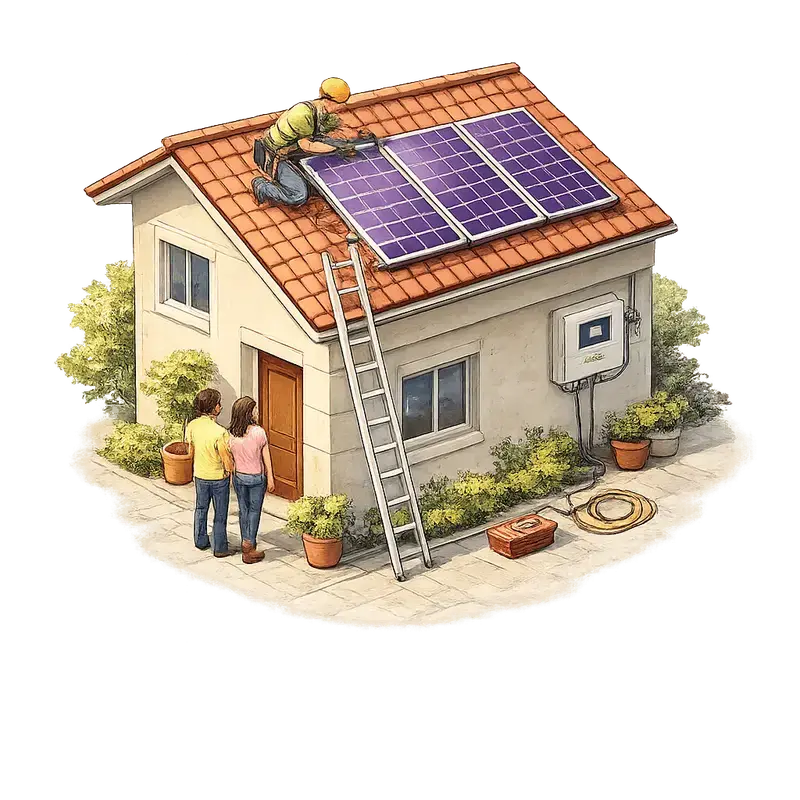
You're checking the rate — now see how much of your bill solar erases
If your monthly electricity bill falls between ₹10,000 and ₹30,000, you aren't just paying for power—you are paying a "luxury tax" on comfort. In India, residential electricity tariffs follow a slab system. Once you cross the 400 or 800-unit threshold in cities like Delhi, Noida, or Gurgaon, the cost per unit jumps significantly. For businesses and large households, this translates to thousands of rupees wasted every month.
With the launch of the PM Surya Ghar Muft Bijli Yojana, solar has become the most effective financial instrument to kill these high bills. At Bridgeway Power, with 35+ years of experience, we have seen how a well-sized solar system can bring a ₹25,000 bill down to just the fixed meter charges.
Why You Need Solar for High Electricity Bill India
When your bill is in the ₹10,000–₹30,000 range, you are likely consuming between 1,200 and 3,500 units per month. In Delhi, the top slab rate is ₹8/unit, but when you add the PPAC (Power Purchase Adjustment Charge)—which recently hit peaks of 35-40% for BSES consumers—and the 5% electricity tax, your effective landed cost per unit often exceeds ₹11–₹12.
Installing solar for high electricity bill India allows you to "lock in" your electricity rate for the next 25 years. Instead of being vulnerable to annual tariff hikes by DISCOMs like BSES Rajdhani or PVVNL, you produce your own free power.
Understanding the Unit Consumption vs. System Size
To eliminate a bill, you must match your solar generation with your monthly consumption. In the Delhi NCR region, 1 kW of solar generates approximately 120 units per month on average.
| Monthly Bill (Approx) | Monthly Consumption (Units) | Recommended Solar Size |
|---|---|---|
| ₹10,000 | 1,200 - 1,300 | 8 kW - 10 kW |
| ₹15,000 | 1,800 - 2,000 | 15 kW |
| ₹20,000 | 2,400 - 2,600 | 20 kW |
| ₹30,000 | 3,500 - 3,800 | 30 kW |
The Cost of Solar for High-Consumption Homes (2026)
For systems above 3 kW, the central subsidy is capped at ₹78,000. However, for residents in Delhi, the Delhi Solar Policy 2024 offers an additional state subsidy and a unique Generation-Based Incentive (GBI).
System Price Table (String Inverter, Mono PERC TOPCon Panels)
The following prices include GST and standard installation.
| System Size (kW) | Phase | Total Cost (Incl. GST) | Central Subsidy | Net Cost (Approx) |
|---|---|---|---|---|
| 8 kW | 3-Phase | ₹5,18,364 | ₹78,000 | ₹4,40,364 |
| 10 kW | 3-Phase | ₹6,29,442 | ₹78,000 | ₹5,51,442 |
| 14 kW | 3-Phase | ₹8,69,022 | ₹78,000 | ₹7,91,022 |
| 20 kW | 3-Phase | ₹11,97,900 | ₹78,000 | ₹11,19,900 |
| 25 kW | 3-Phase | ₹14,56,538 | ₹78,000 | ₹13,78,538 |
Note: For Delhi residents, a state subsidy of ₹10,000 per kW (up to ₹30,000) further reduces the cost. For example, a 10 kW solar system in Delhi could have a net cost of approximately ₹5,21,442 after both subsidies.
Real Example: The ₹18,000 Bill Transformation
A homeowner in Sushant Lok, Gurgaon was receiving a monthly bill of ₹18,500 during summers. Their consumption was roughly 2,200 units.
The Solution:
- System Size: 15 kW Rooftop Solar.
- Hardware: 580Wp TOPCon Mono PERC Panels + 15kW String Inverter.
- Investment: ₹9.45 Lakh (Gross).
- Subsidy: ₹78,000 (Central).
The Result:
- Generation: ~1,800 units/month.
- New Bill: ₹2,800 (mostly fixed charges and remaining units).
- Annual Savings: ₹1,88,400.
- Payback: 4.6 years.
Solar for Commercial Bills (₹20,000+)
If your high bill is for a factory, warehouse, or office, the ROI is even faster due to Accelerated Depreciation. Businesses can claim 40% depreciation in the first year, providing significant tax relief. Commercial tariffs in NCR range from ₹8 to ₹10 per unit, making solar for MSMEs a "no-brainer."
Commercial Solar Costing (B2B Tiers)
Excluding GST and net-metering charges.
| Capacity Tier | Rate per Wp (₹) | Total Cost (Excl. GST) |
|---|---|---|
| Up to 25 kW | ₹48 | ₹12,00,000 |
| 25 - 50 kW | ₹44 | ₹22,00,000 |
| 50 - 100 kW | ₹42 | ₹42,00,000 |
Talk to a solar engineer — not a salesperson
Enter your pincode and monthly bill. If we install in your area, an engineer answers on WhatsApp with your numbers.
See how much of this bill solar erases
Solar Depreciation & Tax Benefit Calculator
Based on Section 32 — 40% WDV + 20% additional depreciation (Year 1)
Choosing the Right Hardware for High-Yield Performance
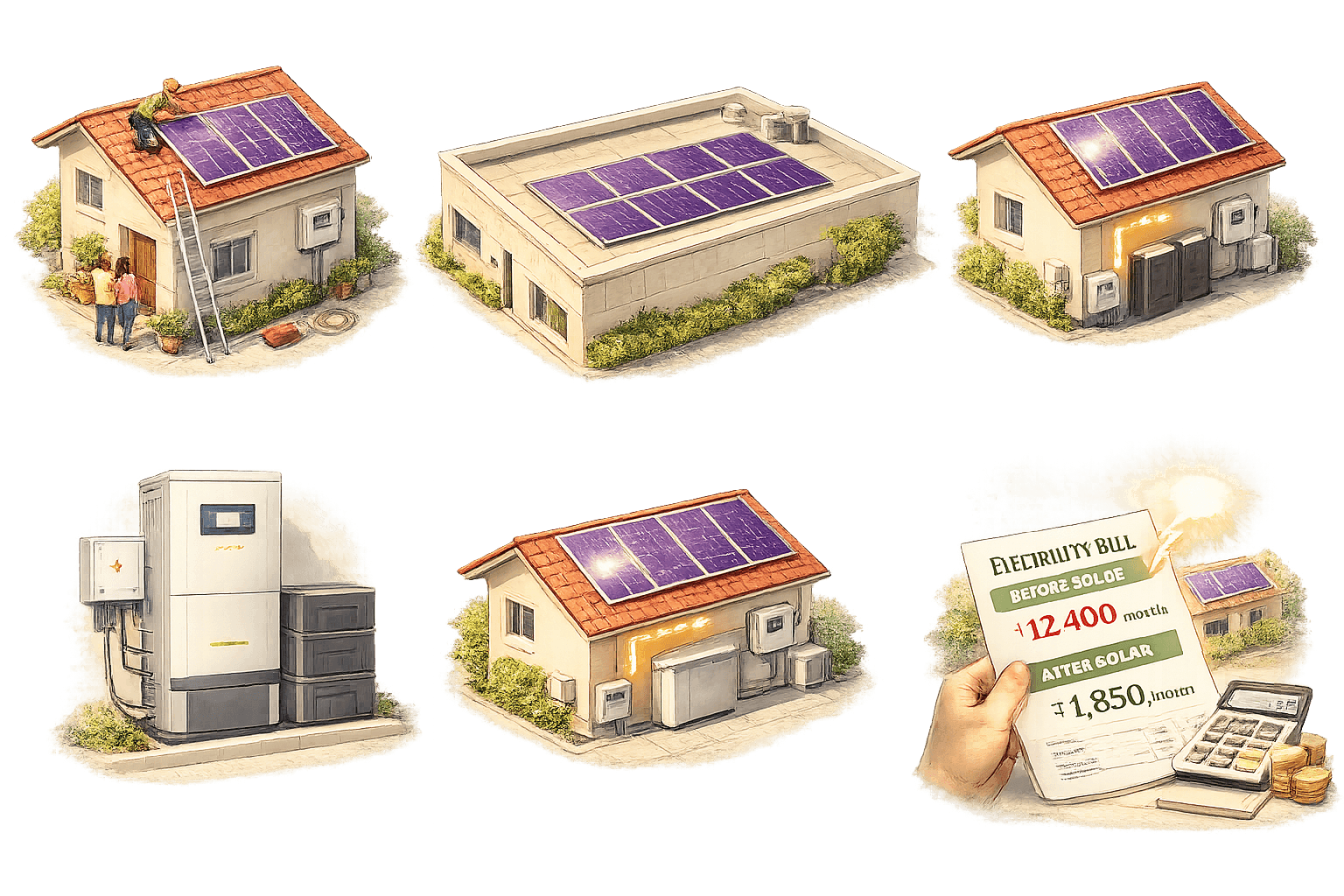
When you are trying to offset a ₹30,000 bill, every unit counts. A 5% drop in efficiency due to heat or dust can cost you thousands of rupees annually.
1. Solar Panels (TOPCon Technology)
We recommend TOPCon Mono PERC panels (580Wp–620Wp range). These panels have a 22% efficiency rating and better performance in the hazy, high-temperature conditions of North India. They come with a 12-year product warranty and a 30-year performance warranty.
2. Inverter Selection: String vs. Microinverter
- String Inverters: Most cost-effective for large, shadow-free roofs. Bridgeway provides a 10-year manufacturer warranty on standard string inverters.
- Microinverters: Ideal if your roof has shadows from nearby buildings or water tanks. Brands like Enphase offer 15-year warranties and module-level monitoring.
3. Mounting Structures
For high-capacity systems, the structure is critical. We offer:
- GI (Galvanized Iron): Standard and durable.
- High-Rise/Pergola Structures: If you want to use the roof space for gardening or seating while the panels are elevated 7–10 feet high.
Financing Your Solar System
You don't need to pay the full ₹5 Lakh or ₹10 Lakh upfront. Bridgeway Power partners with several institutions to offer competitive financing:
- PSB Solar Loans: Banks like SBI and PNB offer rates as low as 7% for loans up to ₹6 Lakh under the PM Surya Ghar scheme.
- Private NBFCs: ECOFY and Aerem provide faster processing and flexible EMI options for higher system sizes.
- SIDBI 4E: Specifically for MSMEs, providing loans from ₹10 Lakh to ₹10 Crore at 8.5–10% interest.
The Importance of Maintenance for High-Bill Offset
A dirty panel in a city like Delhi or Noida can lose 25% of its output due to soiling loss. For a 20 kW system, a 25% loss means losing 600 units a month—roughly ₹5,000 in savings gone!
At Bridgeway Power, our AMC (Annual Maintenance Contract) plans ensure your system is monitored and cleaned professionally. We have serviced over 5,000 rooftops, and our data shows that regular maintenance can improve ROI by up to 15%.
How to Get Started
- Analyze Your Bills: Look at your last 12 months of bills to find your peak summer consumption.
- Site Survey: A Bridgeway engineer will check your roof for shadow-free areas and load-bearing capacity. (Note: A solar system weighs much less than a 1000L water tank).
- Custom Quote: We design a system that maximizes your specific roof layout.
- Installation & Net Metering: We handle the entire process with DISCOMs like DHBVN or TPDDL.
FAQ
How much space do I need for a 10 kW solar system?
A 10 kW system typically requires about 600 to 800 square feet of shadow-free rooftop area. Using higher-wattage TOPCon panels (580W+) helps reduce the physical footprint of the system.
Can I run 3-4 Air Conditioners on solar?
Yes, a 10 kW to 15 kW system is generally sufficient to run 3-4 ACs during the day while also exporting surplus power to the grid. The net-metering mechanism ensures that the units you export during the day offset the units you consume at night.
What is the ROI for a solar system with a ₹20,000 bill?
The typical Return on Investment (ROI) for such a system is 25-30% annually. This means the system pays for itself in about 3.5 to 4.5 years, after which you enjoy free electricity for the remaining 20+ years of the panel's life.
Will solar work during a power cut?
Standard on-grid systems shut down during power cuts for safety reasons (Anti-islanding). However, if you install a Hybrid Solar System with lithium battery storage, you can have uninterrupted power even during grid failures.
Do I get a subsidy for a 15 kW residential system?
Yes, but the central subsidy under PM Surya Ghar is capped at ₹78,000 for any residential system 3 kW or larger. In Delhi, you may also be eligible for the state capital subsidy of ₹30,000 and GBI earnings.
Conclusion
A monthly bill of ₹10,000 to ₹30,000 is a significant financial drain, but it also represents the highest potential for solar savings. By switching to solar, you turn a recurring expense into a high-yielding asset.
Bridgeway Power’s 35+ years of electrical lineage ensures that your high-capacity system is engineered for longevity and maximum unit generation. Book a Free Technical Site Survey today and let us help you eliminate your electricity bill forever.
Every 1 kW of solar on your roof offsets 1.5 tonnes of CO₂ per year
That's 40 trees planted — every year, for 25 years.
A typical 5 kW home system offsets 187 tonnes of carbon over its lifetime. That's equivalent to taking 8 cars off the road.
See your impact →How much can you save with solar?
Enter your electricity bill → get system size, subsidy amount & payback period
Get StartedSee how much of this bill solar erases
Related Articles
What Is Captive Open Access Solar (100% Equity Model)
Learn how Captive Open Access Solar (100% Equity Model) helps Indian businesses cut electricity costs by 40% using off-site solar plants. Guide on rules, savings & ROI.
Read moreHow Rooftop Solar Can Eliminate Your Electricity Bill
Discover how Net Metering and PM Surya Ghar subsidies can reduce your monthly electricity bill to near-zero. Learn about system sizing, costs, and real-world savings.
Read moreSolar Subsidy in Uttar Pradesh 2026: ₹1,08,000 for Noida, Ghaziabad & Greater Noida
UP's stacked solar subsidy 2026: ₹78,000 central + ₹30,000 UPNEDA state top-up = ₹1.08L. Real PVVNL net-cost math for Noida, Greater Noida, Ghaziabad & Meerut.
Read moreRelated guides
Delhi Electricity Rate 2026
BSES & Tata Power per-unit rates, PPAC, subsidy — sourced from DERC.
ExploreDelhi Solar Policy 2026
Free rooftop solar up to 3 kW for homes under 400 units. Eligibility & apply.
ExploreSolar Panel Price in Delhi
Live 2026 rooftop prices in Delhi after ₹1.56L subsidy. 1,200+ installs.
ExploreSolar Company in Gurgaon
Gurgaon's rooftop solar installer — 800+ systems, ₹78K PM Surya Ghar subsidy.
ExploreSolar Company in Noida
Noida & Greater Noida rooftop solar — 500+ installs, ₹1.08L stacked subsidy.
ExploreSolar Panel Price in Faridabad
Live 2026 Faridabad prices after ₹78K PM Surya Ghar subsidy. 350+ homes.
Explore