
By Sandeep Maurya · Reviewed by Arshi Chadha, Founder
10 kWp Enphase IQ8 Microinverter Rooftop on a Gurgaon Bungalow: Module-Level Yield, Built for Indian Conditions
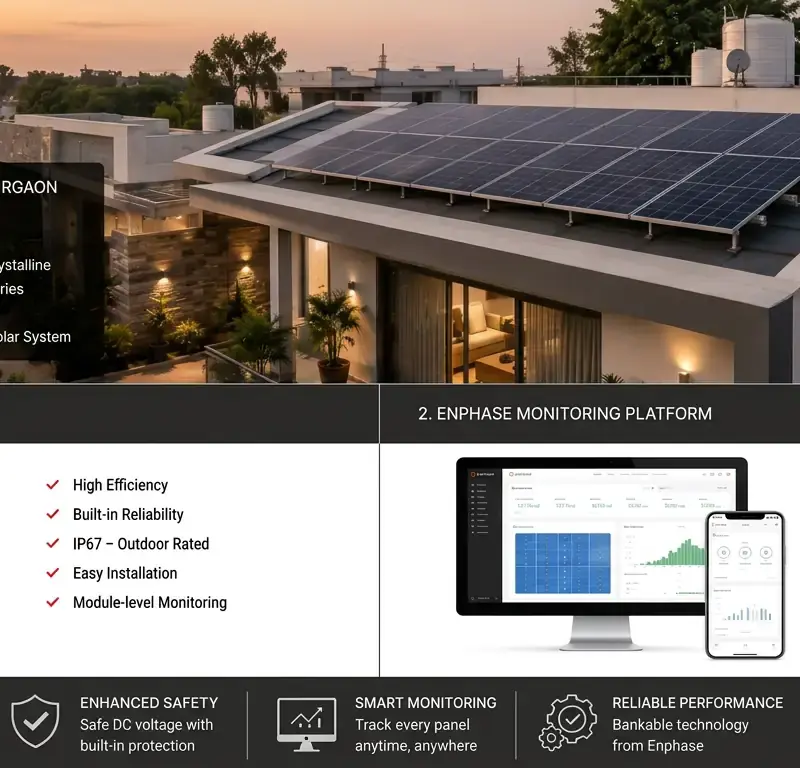
A Gurgaon family asked Bridgeway Power one question: "We have water tanks, a satellite dish and an access ladder casting shade on parts of our roof — will solar still work?" The answer was a 10 kWp on-grid rooftop using Enphase IQ8 series microinverters, 580 Wp monocrystalline modules, and an elevated 6.5 ft mounting structure. This case study walks through why microinverters made sense for this bungalow in Gurgaon, the full bill of materials, what Enphase Enlighten actually shows you day to day, and where Enphase is — and isn't — the right call.
The Gurgaon bungalow at a glance
| Parameter | Value |
|---|---|
| Location | Residential bungalow, Gurgaon |
| System size | 10 kWp |
| System type | On-grid, net-metered |
| Modules | 580 Wp monocrystalline, ≈18 panels |
| Inverter architecture | Microinverter (1 per module) |
| Microinverter family | Enphase IQ8 series (IQ8PLUS / IQ8M / IQ8A — SKU mix per shading map) |
| Monitoring | Enphase Enlighten (web + mobile) |
| Structure | Elevated GI, 6.5 ft clear height |
| Commissioned by | Bridgeway Power |
Why a Gurgaon bungalow needs microinverters
Most NCR bungalows have the same problem this one did: a roof that looks clean from below but, by 10 a.m., has a water tank shadow on one corner, a satellite dish shadow on another, and a service ladder cutting a stripe through the southern array.
In a string inverter layout, those shadows hurt the entire string the shaded module sits on — the string operates at the weakest module's current. In a microinverter layout, each panel has its own MPPT and its own inverter. A shaded panel loses its own yield; the other 17 don't notice.
For a 10 kWp residential system in Gurgaon with three discrete shade zones across the day, this difference is meaningful — and it shows up clearly in the per-module curves on Enlighten.
The Enphase BOM
- Microinverters: Enphase IQ8 family — one per 580 Wp module. The IQ8 series operates grid-tied and is the platform Enphase sells in India through its installer network.
- IQ8PLUS on the highest-output, unshaded modules
- IQ8M / IQ8A across the rest of the array
- AC Combiner / Q-Cable trunk: Enphase Q-Cable carries the 230 V AC output of each microinverter into the combiner.
- Monitoring: Enphase Envoy / IQ Gateway uploads per-module data to Enphase Enlighten, accessible via web and the Enlighten mobile app.
- Modules: 580 Wp monocrystalline PERC, tier-1.
- Structure: Elevated MS hot-dip galvanised, 6.5 ft clear height — lets the family still use the roof.
Every SKU is linked to its official Enphase datasheet in the references at the bottom of this post.
IQ8 vs string inverter for Indian rooftops — when each wins
| Scenario | Better fit |
|---|---|
| Shade-free, single-orientation roof, tight budget | String inverter |
| Multiple roof faces, water tanks, dish/antenna shade | Microinverter (Enphase IQ8) |
| Owner wants per-panel visibility | Microinverter (Enphase IQ8) |
| Future panel additions in different orientations | Microinverter (Enphase IQ8) |
| Large MW-scale ground-mount | String / central |
This is not "Enphase is always better". It's "Enphase wins where shade, orientation, or per-module visibility matter".
Enphase Enlighten: real module-level monitoring
The Enlighten dashboard shows each panel's output — not just total plant generation. For a Gurgaon family that means:
- A 5-minute alert when one microinverter drops out (not a 24-hour delay)
- Visible proof when a tank shadow is costing you 0.4 kWh/day on a specific panel
- Lifetime energy per module — useful when a panel ages out of tolerance
For comparison, plant-level monitoring on a typical string inverter can hide a single underperforming module for months.
Talk to a solar engineer — not a salesperson
Check whether we install in your area, then get your answer on WhatsApp. No forms, no call centre.
What would solar save on YOUR bill?
Safety: rapid shutdown, low-voltage DC, IP67
Microinverters convert DC to 230 V AC at each module. That means:
- The high-voltage DC strings that worry firefighters on rooftop fires don't exist — only short, low-voltage DC stubs between module and microinverter.
- Rapid shutdown is inherent: cut the AC, the microinverters stop producing within seconds.
- IQ8 enclosures are IP67-rated for outdoor exposure — relevant for an Indian monsoon roof.
Designed-for-India notes
A few things we paid attention to during commissioning:
- Temperature derating — Gurgaon May rooftop temperatures cross 60 °C. IQ8 series is rated for ambient up to 65 °C; we still spaced the units under the module frame for airflow.
- Monsoon ingress — IP67 enclosure + downward-facing Q-Cable connectors prevent water collection.
- Dust — Enphase units have no fans, no vents. Sealed enclosure means Gurgaon's PM2.5 doesn't degrade them the way it can degrade an unsealed string inverter.
What a 10 kWp residential solar plant costs in Gurgaon today
We don't hardcode prices on case studies — pricing on residential rooftop in Gurgaon moves quarter-to-quarter with module spot rates and the PM Surya Ghar subsidy schedule. See the live, audited number on 10 kW Solar Panel Price (Gurgaon, 2026) and PM Surya Ghar Subsidy. A 10 kWp residential rooftop in Gurgaon generates roughly 4.0–4.6 kWh per kWp per day on an annualised basis, after typical soiling and weather losses.
When Enphase is the wrong choice
Stated plainly, because credibility matters more than pitching:
- MW-scale ground mounts. String or central inverters dominate this segment — microinverter economics don't pencil out.
- Tightest possible budget on a clean roof. A well-designed string inverter system on a fully unshaded south-facing roof costs less per kWp and performs identically.
- Sites with bad LAN/Wi-Fi. The IQ Gateway needs internet for Enlighten to work; mesh extenders are doable but it's a real prerequisite.
If you fall into one of these three buckets, we'll tell you — and quote a SolarEdge or Sungrow string system instead.
Frequently Asked Questions
Is Enphase IQ8 available in India?
Yes. Enphase sells the IQ8 series in India through its authorised installer network and ships en-IN datasheets, support, and the Enlighten cloud localised for the region. See the Enphase India installer page.
How much does a 10 kWp Enphase microinverter system cost in Gurgaon?
It moves with module prices and the prevailing subsidy. We publish a live number on the 10 kW Solar Panel Price (Gurgaon, 2026) page and apply the current PM Surya Ghar slab automatically — Enphase microinverter systems typically carry a single-digit-percent premium over a string inverter system of the same kWp, justified on shaded or multi-orientation roofs.
Are microinverters better than string inverters for Indian homes?
Not universally. Microinverters win when there is shade, multiple roof orientations, or a clear requirement for per-panel visibility. On a single-orientation, fully unshaded roof with a tight budget, a string inverter is the honest call.
Does Enphase Enlighten work in India?
Yes. The Envoy / IQ Gateway uploads data over the home internet to Enphase's cloud, accessible via web and the Enlighten mobile app. The localised India dashboard is available to all Enphase-installed systems in the country.
Talk to Bridgeway Power
If your roof has water tanks, multiple faces, or you simply want per-panel visibility for the next 25 years, ask us to scope an Enphase IQ8 system: get a quote • rooftop solar overview • AMC & cleaning plans.
Every 1 kW of solar on your roof offsets 1.5 tonnes of CO₂ per year
That's 40 trees planted — every year, for 25 years.
A typical 5 kW home system offsets 187 tonnes of carbon over its lifetime. That's equivalent to taking 8 cars off the road.
See your impact →How much can you save with solar?
Enter your electricity bill → get system size, subsidy amount & payback period
Get StartedLiked this article? Get a free solar quote
Tell us about your rooftop — we'll call with exact savings for your home.
Related Articles
Net Metering in India: How to Sell Solar Power Back to the Grid
Learn how net metering in India allows you to sell solar power back to the grid. Discover state policies, savings examples, and how to reduce your bill by 90%.
Read moreWhat Is Captive Open Access Solar (100% Equity Model)
Learn how Captive Open Access Solar (100% Equity Model) helps Indian businesses cut electricity costs by 40% using off-site solar plants. Guide on rules, savings & ROI.
Read moreSolar Installation Cost in Delhi NCR 2026: 3 kW at ₹1.32L net
Updated 2026 guide to solar costs in Delhi NCR. Learn about PM Surya Ghar subsidies, system pricing from 1kW-10kW, and how to reach zero electricity bills.
Read moreRelated guides
Solar for Farmhouses
10-25 kW hybrid systems for farmhouses with backup needs.
ExploreSolar for Large Homes (5-10 kW)
Mid-size rooftops: sizing, financing & payback in Delhi NCR.
ExploreHousing Society Solar — RWA & CGHS
Common-area rooftop solar, subsidy and VNM/GNM for Delhi societies.
ExploreCommunity Solar — Delhi Homeowners
No rooftop needed. Govt covers 80%. Credits land on your BSES bill via VNM.
ExploreSolar Savings Calculator
60-second estimate: system size, cost, savings & payback.
Explore10 kW Solar Price in Delhi
10 kW system price in Delhi after PM Surya Ghar + state subsidy.
Explore