
By Arshi Chadha, Founder · Bridgeway Power
Battery ROI: When Does a Solar Battery Actually Pay for Itself in India?
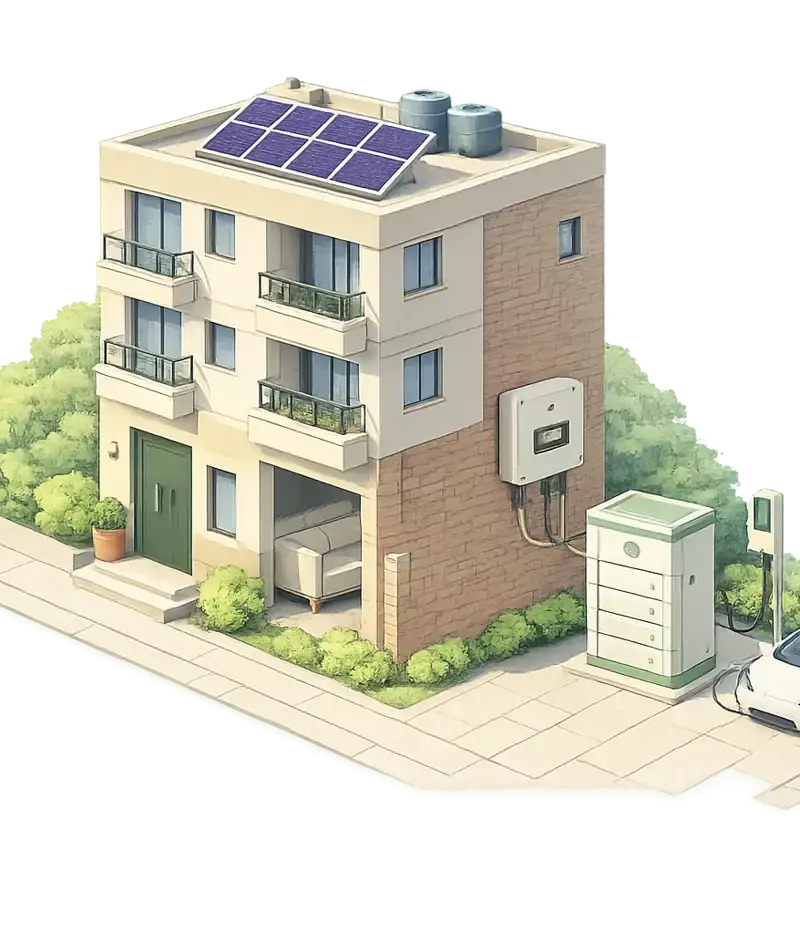
- •Primary Value: Power backup & Time-of-Day (ToD) optimization
- •Battery Payback (Frequent Cuts): 4–6 years
- •Battery Payback (Stable Grid): 10–12 years
- •Avoided Cost: ₹25–₹35 per unit vs Diesel Generators
- •Technology: Lithium Ferro Phosphate (LFP) with 6,000+ cycles
For years, the conversation around rooftop solar in India was simple: install panels, get a net meter, and watch your bill drop to zero. But as we move into 2026, the question Indian homeowners and businesses are asking has shifted. It is no longer just "Should I get solar?" but "Should I add a battery?"
The honest truth? While rooftop solar eliminates your electricity bill with a 3-4 year payback, solar battery ROI India works on a different timeline. If you live in a posh colony in South Delhi or Dwarka with 24/7 power, a battery is a luxury. But if you are a business in Manesar or a homeowner in a power-cut-prone area of Noida Extension, a battery isn't just a cost—it’s an investment that pays for itself by killing the expensive diesel generator (DG) habit.
At Bridgeway Power, with our 35+ years of experience, we’ve seen the technology evolve from heavy lead-acid blocks to sleek lithium-ion systems. In this guide, we break down the real math of when a solar battery actually pays for itself in the Indian context.
The Honest Take: Solar Battery vs. Solar Panels ROI
We must be transparent: solar panels are a "financial product" that generates 15-20% annual returns. A battery, currently, is closer to an "insurance product."
A standard on-grid solar system in Delhi NCR costs roughly ₹68,607 per kW (before subsidies). With the PM Surya Ghar Muft Bijli Yojana, a 3kW system costs only ₹1.32L net. Adding a 5kWh lithium battery adds another ₹1.5L to ₹2L to that cost.
Because the battery doesn't generate electricity (it only stores what the panels already made), its ROI comes from how you use that stored energy—specifically, avoiding peak tariffs and expensive backup fuel.
Battery ROI Scenarios: India 2026-2027
The solar battery payback period India depends entirely on your "grid profile." If your grid is perfect, the battery is slow to pay back. If your grid is flaky or expensive, the battery is a goldmine.
Table 1: Battery ROI Scenarios by User Type
| User Scenario | Typical Power Cut Profile | Primary Benefit | Estimated Payback |
|---|---|---|---|
| Urban Residential (Stable Grid) | < 2 hours / month | Convenience & Emergency Backup | 10–12 Years |
| Semi-Urban / Industrial (Frequent Cuts) | 2+ hours / day | Replacing DG Sets (₹25/unit) | 4–6 Years |
| Commercial (High ToD Tariff) | Any | Peak Shaving (Arbitrage) | 3–5 Years |
| Off-Grid (No Utility Power) | 100% off-grid | Essential Energy Access | < 3 Years |
Where the Value Comes From: The "Hidden" Savings
To understand is solar battery worth it India, you have to look beyond the electricity bill. You have to look at what you stop spending elsewhere.
1. Avoided DG Cost (The Diesel Killer)
For a factory in Ghaziabad or a large bungalow in Gurgaon, power cuts mean firing up the Diesel Generator. Between fuel, maintenance, and the inefficiency of running a large engine for a small load, the landed cost of DG power is ₹25–₹35 per unit. Comparing that to solar-stored energy (which costs roughly ₹8–₹10 per unit over the battery's life) shows an immediate 70% saving per unit.
2. Time-of-Day (ToD) Arbitrage
State DISCOMs like BSES Rajdhani and TPDDL are moving toward Time-of-Day metering for residential users by 2026. This means electricity might cost ₹4/unit at 11 AM (when solar is peaking) but ₹12/unit at 8 PM (peak demand). A battery allows you to "buy low and use high," effectively doubling your savings per unit.
3. Productivity & Opportunity Cost
What is the cost of a 2-hour power cut during a board meeting or while working from home? For a business, it could be thousands in lost man-hours. For a home, it’s the discomfort of no AC in 45°C heat.
Table 2: Sources of Battery Value (Annualized)
| Value Source | Financial Impact (Estimated) | Description |
|---|---|---|
| DG Set Avoidance | ₹25–₹35 per unit saved | Replacing diesel fuel with solar energy |
| ToD Arbitrage | ₹5–₹8 per unit spread | Charging at low-tariff, discharging at peak |
| Power Cut Avoidance | ₹500–₹2,000 per event | Subjective value of comfort & productivity |
| Grid Independence | High / Intangible | Shielding against future tariff hikes |
The Price Drop: Why Waiting Might Be Smart
If your primary concern is battery storage ROI, you should know that prices are in a freefall. Lithium-ion cell manufacturing is scaling globally, and India is setting up its own Gigafactories. We are seeing an annual price reduction of 15-20%.
Table 3: Solar Battery Cost Trajectory in India
| Year | Estimated Cost per kWh (LFP) | Change (%) | ROI Outlook |
|---|---|---|---|
| 2023 | ₹12,000 – ₹15,000 | Baseline | Niche/Luxury |
| 2025 | ₹8,000 – ₹10,000 | -30% | Viable for frequent cuts |
| 2027 (Proj.) | ₹5,000 – ₹7,000 | -50% | Mass Market Adoption |
Note: These are internal Bridgeway Power estimates based on 2026 supply chain data.
Talk to a solar engineer — not a salesperson
Check whether we install in your area, then get your answer on WhatsApp. No forms, no call centre.
What would solar save on YOUR bill?
Real-World Example: The Gurgaon Bungalow
Consider a 3BHK home in Sushant Lok, Gurgaon.
- Current Bill: ₹10,000/month (Avg.)
- System: 5kW Hybrid Solar System
- Battery: 10kWh Lithium (LFP)
- Problem: Frequent 1-hour cuts in summer evenings.
Before solar, the owner spent ₹3,000/month on diesel for their silent DG set. After installing a hybrid system, the diesel expense went to zero. The 10kWh battery now powers the ACs during those evening cuts.
- Solar ROI (Panels): 3.5 years.
- Battery ROI (Incremental): 5.2 years (calculated by dividing the battery cost by the saved diesel + ToD savings).
For this homeowner, the hybrid solar system setup was a no-brainer because the solar battery cost benefit India was tied to diesel replacement.
Non-Financial ROI: The Peace of Mind Factor
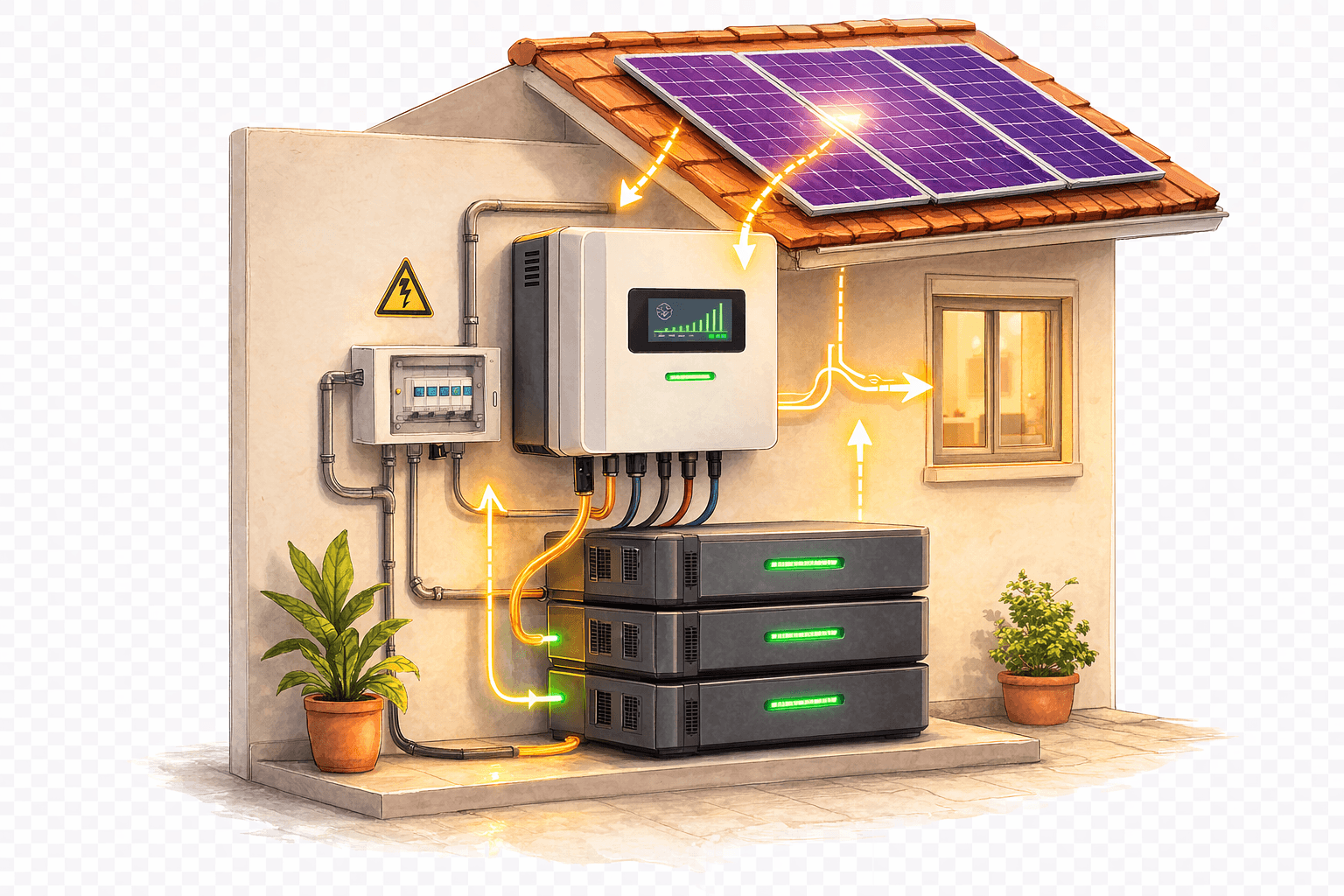
Sometimes, the solar battery ROI India isn't just about Rupees.
- Silent Operation: Unlike a DG set that vibrates and emits fumes, a battery is silent.
- Instant Switchover: Lithium batteries coupled with high-end hybrid inverters have a switchover time of <20ms. Your computers won't even restart.
- EV Readiness: A home battery can act as a buffer. You can charge the battery slowly via solar all day and fast-charge your EV at night without tripping your home's main MCB. Solar + EV charging is the future of Indian urban mobility.
Financing Your Battery Investment
Because the upfront cost of lithium batteries is high, financing is key. All our partners offer competitive rates for hybrid systems:
- PSU Banks: SBI Solar Loan, PNB Solar Rooftop Scheme, and Canara Bank Solar Loan offer rates as low as 8-10% for residential solar.
- NBFCs: ECOFY Solar Financing and Aerem Solar Finance provide faster processing and Zero-Down Payment options.
FAQ
Is solar battery worth it in India for a flat owner?
For flat owners, a battery is often more viable than panels if they have limited roof space. A balcony solar system paired with a small battery can provide 2-4 hours of backup for lights and fans, though the ROI is longer (7-9 years) due to the small scale.
How long do lithium solar batteries last in India?
Modern LFP (Lithium Ferro Phosphate) batteries used by Bridgeway Power are rated for 6,000 cycles at 85% depth of discharge. In typical Indian conditions, this translates to a lifespan of 10–12 years, assuming one full cycle per day.
Can I add a battery to my existing on-grid solar system?
Yes, but you will likely need to replace your existing string inverter with a hybrid inverter or add an "AC-coupled" battery system. It is usually more cost-effective to plan for a battery during the initial solar installation process.
Does PM Surya Ghar subsidy cover batteries?
The central subsidy for the PM Surya Ghar Yojana is calculated based on the solar panel capacity (kWp), not the battery storage. While you can install a battery with the system, the subsidy amount remains capped at ₹78,000 for residential systems above 3kW.
Which is better: Lead-acid or Lithium for solar ROI?
Lithium-ion (LFP) has a much higher ROI over 10 years. While lead-acid is cheaper upfront, it only lasts 3 years and has a lower discharge efficiency. Lithium-ion vs Lead-acid is a clear win for Lithium when you factor in replacement costs.
Conclusion
So, when does a solar battery actually pay for itself?
- If you are replacing a diesel generator, the ROI is 4–6 years.
- If you are optimizing for ToD tariffs, the ROI is 6–8 years.
- If you just want backup for a stable grid, the ROI is 10+ years.
As battery prices continue to drop by 15-20% annually, the "payback gap" between panels and batteries is closing. By 2027, we expect every second solar installation in India to include storage.
Ready to see the math for your own roof? Use our Solar Calculator or book a free site survey with Bridgeway Power. With 25+ MW installed and a legacy of 35+ years, we’ll help you decide if a battery is the right move for your home or business.
Contact Bridgeway Power for a Free Consultation | Explore AMC Plans | Learn about Community Solar
Every 1 kW of solar on your roof offsets 1.5 tonnes of CO₂ per year
That's 40 trees planted — every year, for 25 years.
A typical 5 kW home system offsets 187 tonnes of carbon over its lifetime. That's equivalent to taking 8 cars off the road.
See your impact →How much can you save with solar?
Enter your electricity bill → get system size, subsidy amount & payback period
Get StartedLiked this article? Get a free solar quote
Tell us about your rooftop — we'll call with exact savings for your home.
Related Articles
Net Metering in India: How to Sell Solar Power Back to the Grid
Learn how net metering in India allows you to sell solar power back to the grid. Discover state policies, savings examples, and how to reduce your bill by 90%.
Read moreWhat Is Captive Open Access Solar (100% Equity Model)
Learn how Captive Open Access Solar (100% Equity Model) helps Indian businesses cut electricity costs by 40% using off-site solar plants. Guide on rules, savings & ROI.
Read moreSolar Installation Cost in Delhi NCR 2026: 3 kW at ₹1.32L net
Updated 2026 guide to solar costs in Delhi NCR. Learn about PM Surya Ghar subsidies, system pricing from 1kW-10kW, and how to reach zero electricity bills.
Read moreRelated guides
Delhi Electricity Rate 2026
BSES & Tata Power per-unit rates, PPAC, subsidy — sourced from DERC.
ExploreDelhi Solar Policy 2026
Free rooftop solar up to 3 kW for homes under 400 units. Eligibility & apply.
ExploreSolar Panel Price in Delhi
Live 2026 rooftop prices in Delhi after ₹1.56L subsidy. 1,200+ installs.
ExploreSolar Company in Gurgaon
Gurgaon's rooftop solar installer — 800+ systems, ₹78K PM Surya Ghar subsidy.
ExploreSolar Company in Noida
Noida & Greater Noida rooftop solar — 500+ installs, ₹1.08L stacked subsidy.
ExploreSolar Panel Price in Faridabad
Live 2026 Faridabad prices after ₹78K PM Surya Ghar subsidy. 350+ homes.
Explore