
By Sandeep Maurya · Reviewed by Arshi Chadha, Founder
Lithium-ion vs Lead-Acid Batteries: What Actually Makes Sense for Indian Homes?
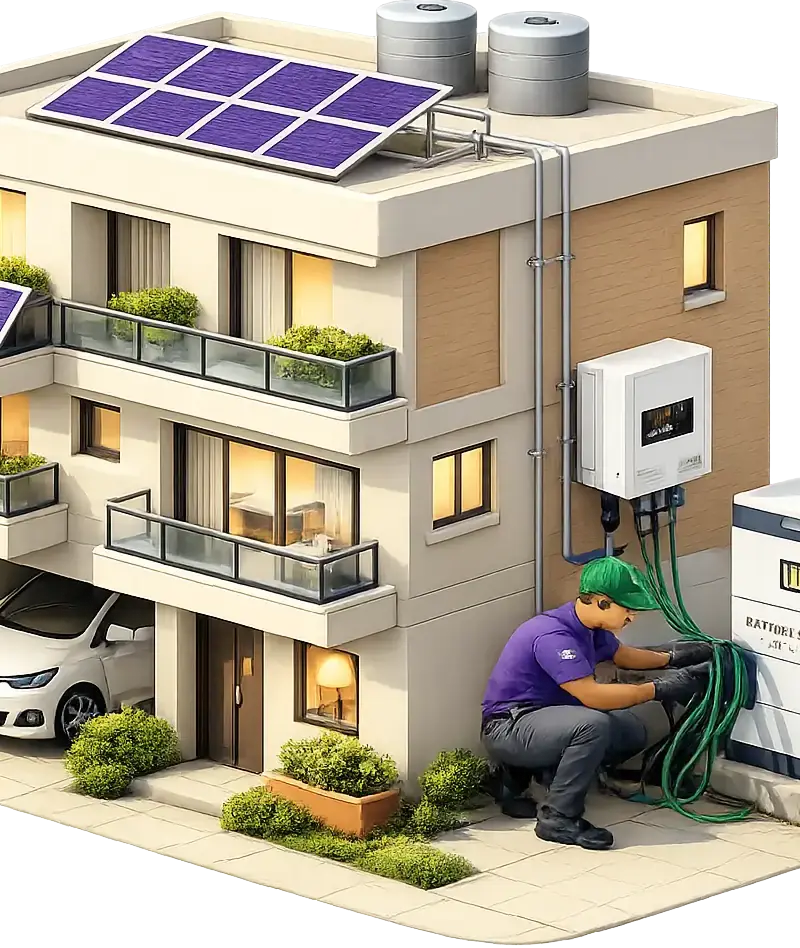
- •Technology: Lithium-ion (LFP) vs. Lead-Acid (Tubular)
- •Upfront Cost: ₹8,000–₹15,000 (Lead-Acid) vs ₹40,000–₹80,000 (Lithium)
- •Usable Energy: 50% (Lead-Acid) vs 80-90% (Lithium)
- •Lifespan: 3–4 Years vs 10–15 Years
- •10-Year Verdict: Lithium is ~25% cheaper when accounting for replacements.
Imagine it is a sweltering June afternoon in Delhi. The temperature has hit 45°C, the grid is struggling, and your power goes out. You wait for your inverter to kick in, but within an hour, the fans slow down and the lights flicker. If you are using a traditional lead-acid battery, this scenario is all too common.
For decades, the "tall tubular" lead-acid battery has been the heartbeat of Indian homes. It was the only choice. But as we move into 2026, the landscape of energy storage in India has shifted. With the rise of the PM Surya Ghar Yojana and the falling costs of advanced electronics, homeowners are facing a critical choice: lithium battery vs inverter battery India.
Should you stick with the "tried and tested" lead-acid technology, or is it time to upgrade to lithium battery? In this guide, we will break down the real-world math, the performance in Indian heat, and why the "cheap" option might actually be the most expensive mistake you make this year.
The Technological Divide: Head-to-Head Comparison
Before we dive into the costs, we must understand why these two technologies are fundamentally different. Lead-acid batteries rely on a chemical reaction between lead plates and sulfuric acid. Lithium batteries (specifically Lithium Iron Phosphate or LFP, which is the standard for Indian homes) move lithium ions between an anode and a cathode.
Table 1: Head-to-Head Comparison (2026 Standards)
| Feature | Lead-Acid (Tubular) | Lithium-ion (LFP) |
|---|---|---|
| Upfront Cost | ₹8,000 – ₹15,000 | ₹40,000 – ₹80,000 |
| Lifespan | 3 – 4 Years | 10 – 15 Years |
| Depth of Discharge (DoD) | 50% (Max Recommended) | 80% – 90% |
| Cycle Life | 150 – 200 Cycles | 3,000 – 6,000 Cycles |
| Maintenance | Distilled water topping every 3 months | Zero Maintenance |
| Charging Speed | 8 – 12 Hours (Slow) | 2 – 3 Hours (Fast) |
| Weight/Space | Heavy, bulky, floor-standing | Compact, wall-mountable |
As the table shows, a lithium battery vs inverter battery India comparison isn't just about price; it’s about a generational leap in efficiency.
1. The "Cheap" Illusion: Total Cost of Ownership (TCO)
The biggest hurdle for most Indian families is the initial price tag. A 150Ah lead-acid battery costs around ₹12,000, while a comparable lithium storage unit might start at ₹45,000. However, looking at the sticker price is like buying a cheap car that needs a new engine every two years.
In a solar battery comparison India context, lead-acid batteries fail much faster because solar systems "cycle" the battery every single day. While a standard home inverter might only use the battery twice a week during power cuts, a solar system charges it every morning and discharges it every night. Under this daily stress, a lead-acid battery rarely lasts beyond 36 months.
Table 2: 10-Year TCO for 5kWh Storage
| Expense Item | Lead-Acid Setup | Lithium-ion Setup |
|---|---|---|
| Initial Purchase | ₹36,000 (3 batteries for 5kWh) | ₹65,000 (5kWh LFP Pack) |
| Replacement 1 (Year 3.5) | ₹40,000 (Inflation adjusted) | ₹0 |
| Replacement 2 (Year 7) | ₹45,000 (Inflation adjusted) | ₹0 |
| Maintenance Costs | ₹5,000 (Water & Cleaning) | ₹0 |
| Total 10-Year Spend | ₹126,000+ | ₹65,000 |
Note: Lead-acid prices include the scrap value trade-in of old batteries, yet lithium remains significantly cheaper over a decade.
2. Usable Capacity: Why 5kWh Doesn't Always Mean 5kWh
One of the most misunderstood parts of lithium ion vs lead acid solar India discussions is the "Depth of Discharge" (DoD).
If you have a 5kWh lead-acid battery bank, you can only safely use 2.5kWh. If you regularly drain a lead-acid battery to 0%, the lead plates will "sulphate" and die within months. You are essentially paying for a tank that you can only ever half-fill.
In contrast, a lithium battery allows you to use 80% to 90% of its capacity without damage. This means:
- A 3kW lithium system provides more actual backup than a 5kW lead-acid system.
- Lithium batteries maintain a steady voltage until they are nearly empty, meaning your fans don't slow down as the battery drains.
For those planning a home solar battery system in India, this efficiency is the difference between running your AC through a power cut or just a single lightbulb.
3. Performance in Indian Conditions: Heat is the Enemy
India’s climate is brutal on energy storage. Most lead-acid batteries are rated for performance at 25°C. For every 8°C rise in temperature above that, the lifespan of a lead-acid battery is cut in half. In states like Rajasthan, Delhi, and UP, where summer temperatures frequently cross 40°C, lead-acid batteries are essentially "cooking" in their own acid.
Table 3: Performance in Indian Conditions (40°C+ Ambient)
| Metric | Lead-Acid (Tubular) | Lithium-ion (LFP) |
|---|---|---|
| Thermal Degradation | Capacity drops 30% faster above 35°C | Maintains ~95% capacity up to 45°C |
| Installation Requirement | Must be in a ventilated room (fumes) | Can be installed in bedrooms/hallways |
| Safety | Risk of acid leaks and explosive gases | LFP is non-combustible and sealed |
| Efficiency | 70–80% (Energy lost as heat) | 95–98% (Highly efficient) |
When comparing lithium vs tubular battery performance, lithium wins because it is designed for high-density, high-temperature environments. It doesn't emit toxic hydrogen fumes, and it doesn't require a dedicated "battery corner" with acid-resistant flooring.
4. The Solar Synergy: Why Daily Cycling Changes the Math
If you are installing solar now, the battery isn't just for emergencies—it’s a tool to maximize your ROI.
In a daily cycling scenario (charging from the sun by day, using at night), a lead-acid battery will reach its 300-cycle limit in less than a year. A lithium battery, with 3,000 to 6,000 cycles, can handle daily use for 10-15 years. This is why the best battery for solar India is almost always lithium.
Bridgeway Power has observed that systems using hybrid solar technology with lithium batteries achieve a payback period 18-24 months faster than those using lead-acid, simply because the battery doesn't need to be replaced twice during the system's life.
Talk to a solar engineer — not a salesperson
Check whether we install in your area, then get your answer on WhatsApp. No forms, no call centre.
What would solar save on YOUR bill?
5. When Does Lead-Acid Still Make Sense?
Despite the advantages of lithium, lead-acid batteries aren't obsolete yet. They serve a specific niche in the Indian market:
- Low-Usage Homes: If your monthly electricity bill is under ₹2,000 and you only experience 1-2 power cuts a month, a high-end lithium system is likely overkill.
- Strict Budget Constraints: If you cannot secure financing and only have ₹15,000 today, a tubular battery will get your lights back on.
- Temporary Residences: If you are renting a home and don't want to invest in a permanent wall-mounted lithium setup, a portable lead-acid inverter is easier to move.
However, for anyone looking at solar for 2BHK & 3BHK homes, the math overwhelmingly favors lithium.
Real-World Example: A Gurgaon Bungalow
A client in Sushant Lok, Gurgaon was frustrated with their "Tall Tubular" setup. They had a 5kVA inverter with 4 lead-acid batteries. Despite spending ₹50,000 on batteries every 3 years, they couldn't run their 1.5-ton AC during the frequent 2-hour summer power cuts.
They switched to a 5kW Hybrid Solar System with a 10kWh Lithium (LFP) bank.
- Old System: 4x 150Ah Lead-Acid (Total 7.2kWh, but only 3.6kWh usable). Backup time for AC: 45 minutes.
- New System: 10kWh Lithium (9kWh usable). Backup time for AC: 5+ hours.
- The Result: The client now saves ₹6,000/month on electricity bills and hasn't checked "water levels" in two years. Their ROI on the solar system is projected at 4.2 years.
Financing the Future: Making Lithium Affordable
At Bridgeway Power, we recognize that the upfront cost is a barrier. That is why we partner with various lenders to offer EMI options that make lithium as affordable as lead-acid on a monthly basis.
You can explore financing through:
- SBI PM Surya Ghar Loan for residential setups.
- Aerem Solar Finance for flexible EMI plans.
- ECOFY Solar Financing for quick, paperless approvals.
- Canara Bank Solar Loan or PNB Solar Rooftop Scheme.
All our financing partners offer competitive rates, ensuring you can choose the one that fits your credit profile best.
Conclusion: Don't Buy Technology from the 1970s
The "cheapness" of lead-acid is an illusion created by ignoring the future. If you buy lead-acid today, you are signing up for a subscription of replacements, maintenance, and reduced performance in the heat.
If you're installing solar, go lithium. The price gap has narrowed, the safety has increased, and the peace of mind of a 10-year "fit and forget" system is priceless.
Ready to see which battery fits your roof? Calculate your savings or book a free site visit with Bridgeway Power today. With 35+ years of experience and 5,000+ installations, we help you build a system that actually lasts.
FAQ
Is lithium-ion safer than lead-acid for home use?
Yes, especially if you use Lithium Iron Phosphate (LFP) chemistry. Unlike lead-acid batteries, LFP batteries are sealed, do not leak acid, and do not emit explosive hydrogen gas during charging. They also have built-in Battery Management Systems (BMS) that prevent overcharging and overheating, making them much safer for indoor installation.
Can I use my old inverter with a new lithium battery?
Generally, no. Standard lead-acid inverters have different charging profiles (voltage and current) than what lithium batteries require. Using a lead-acid inverter on a lithium battery can damage the cells or void the warranty. You should upgrade to a "Lithium-ready" or "Hybrid" inverter to ensure compatibility and safety.
Why is the 10-year cost of lithium lower if the battery is so expensive?
A lithium battery lasts 10-15 years (3,000+ cycles), whereas a lead-acid battery lasts only 3-4 years (200-500 cycles) in a solar setup. Over a decade, you will buy at least three sets of lead-acid batteries. When you add the cost of those replacements plus the energy lost to inefficiency, lithium ends up being roughly 25-30% cheaper over the long run.
Does the government provide a subsidy for solar batteries?
Under the current PM Surya Ghar Muft Bijli Yojana, the subsidy is primarily for the grid-connected solar panels and inverter. However, the savings you generate from the solar subsidy in Delhi or other states can effectively "pay" for your battery upgrade within the first two years of operation.
Can a lithium battery run an AC during a power cut?
Yes, provided your inverter is sized correctly (usually 5kVA or higher). Because lithium batteries can handle high "discharge rates" without a massive drop in voltage, they are much better at starting and running heavy loads like air conditioners and pumps compared to traditional tubular batteries.
How much maintenance does a lithium battery need?
Zero. Unlike lead-acid batteries that require regular distilled water topping and terminal cleaning to prevent corrosion, lithium batteries are "fit and forget." The internal BMS manages the health of the cells automatically, requiring no manual intervention from the homeowner.
Every 1 kW of solar on your roof offsets 1.5 tonnes of CO₂ per year
That's 40 trees planted — every year, for 25 years.
A typical 5 kW home system offsets 187 tonnes of carbon over its lifetime. That's equivalent to taking 8 cars off the road.
See your impact →How much can you save with solar?
Enter your electricity bill → get system size, subsidy amount & payback period
Get StartedLiked this article? Get a free solar quote
Tell us about your rooftop — we'll call with exact savings for your home.
Related Articles
Net Metering in India: How to Sell Solar Power Back to the Grid
Learn how net metering in India allows you to sell solar power back to the grid. Discover state policies, savings examples, and how to reduce your bill by 90%.
Read moreWhat Is Captive Open Access Solar (100% Equity Model)
Learn how Captive Open Access Solar (100% Equity Model) helps Indian businesses cut electricity costs by 40% using off-site solar plants. Guide on rules, savings & ROI.
Read moreSolar Installation Cost in Delhi NCR 2026: 3 kW at ₹1.32L net
Updated 2026 guide to solar costs in Delhi NCR. Learn about PM Surya Ghar subsidies, system pricing from 1kW-10kW, and how to reach zero electricity bills.
Read moreRelated guides
Delhi Electricity Rate 2026
BSES & Tata Power per-unit rates, PPAC, subsidy — sourced from DERC.
ExploreDelhi Solar Policy 2026
Free rooftop solar up to 3 kW for homes under 400 units. Eligibility & apply.
ExploreSolar Panel Price in Delhi
Live 2026 rooftop prices in Delhi after ₹1.56L subsidy. 1,200+ installs.
ExploreSolar Company in Gurgaon
Gurgaon's rooftop solar installer — 800+ systems, ₹78K PM Surya Ghar subsidy.
ExploreSolar Company in Noida
Noida & Greater Noida rooftop solar — 500+ installs, ₹1.08L stacked subsidy.
ExploreSolar Panel Price in Faridabad
Live 2026 Faridabad prices after ₹78K PM Surya Ghar subsidy. 350+ homes.
Explore