
By Arshi Chadha, Founder · Bridgeway Power
Does Solar Work in Rain and Cloudy Weather? What Indian Data Actually Shows
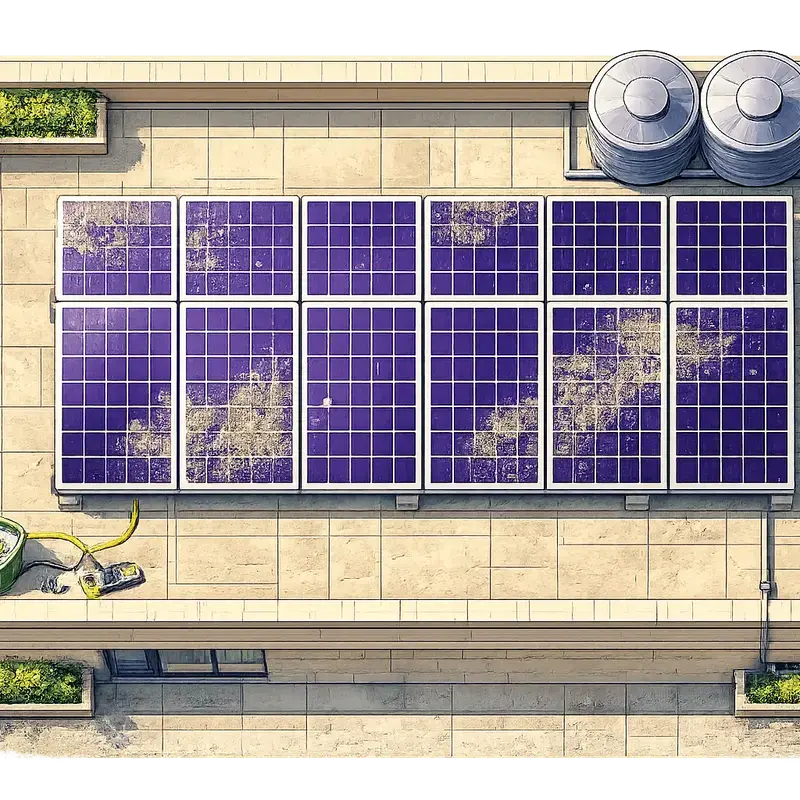
- •Efficiency in Rain: 10%–25% of peak output.
- •Efficiency in Clouds: 20%–80% depending on density.
- •Monsoon Impact: 25%–40% reduction in monthly generation.
- •The Silver Lining: Rain acts as a natural cleaning agent, potentially recovering 25% of lost output due to dust.
- •Annual Reality: India’s 300+ sunny days easily compensate for seasonal dips.
I get this question at almost every site survey from Dwarka to Indirapuram: "What happens when it pours?" Most homeowners worry that their ₹3–5 lakh investment will become a dead weight the moment the monsoon clouds roll in. The short answer is: No, your solar system doesn't shut down. In fact, a 5kW system in Delhi that generates 25 units on a scorching June day will still give you 5 to 8 units during a heavy monsoon afternoon.
We’ve monitored over 5,000 installations across North India for 35+ years, and the data tells a story very different from the common myths. Solar panels don't need direct "heat" or even "blinding sunlight" to work; they need photons. Even when the sky is gray, photons are hitting your roof.
The Science: How Solar Panels Handle Clouds and Rain in India
Solar panels use two types of radiation: direct and diffused. On a clear day in Jaipur, you get mostly direct radiation. On a cloudy day in Mumbai, your panels rely on diffused radiation—light that has been scattered by water vapor and clouds.
Modern TOPCon Mono PERC panels (the current industry standard we install) are significantly better at capturing this diffused light than the old polycrystalline modules from a decade ago. While solar efficiency rain India might seem like a contradiction, the technology has evolved to ensure the "low-light response" is high enough to keep your inverter awake.
Table 1: Solar Output by Weather Conditions
| Weather Condition | Estimated Output (% of Peak) | Impact Level |
|---|---|---|
| Clear Sky (Sunny) | 100% | Maximum |
| Light Clouds / Hazy | 60% – 80% | Moderate |
| Heavy Overcast | 20% – 40% | Significant |
| Active Rain | 10% – 25% | High |
| Dense Fog (Smog) | 5% – 15% | Extreme |
The Monsoon Reality: Regional Variations
The impact of the rainy season isn't uniform across the country. If you’re looking at solar in Noida, your monsoon dip is far less severe than someone in Mumbai. In Delhi NCR, the "monsoon" is often a series of heavy bursts followed by bright sun. In the South and West, the cloud cover can be persistent for weeks.
Table 2: Monsoon Impact on Generation by City
| City | Typical Generation Reduction (July-Sept) | Why? |
|---|---|---|
| Mumbai | 35% – 40% | Long, continuous heavy cloud cover and high humidity. |
| Delhi / NCR | 25% – 30% | Intermittent rain; dust washing actually boosts post-rain yield. |
| Bangalore | 20% – 25% | More consistent light rain rather than heavy dark overcast. |
| Jaipur | 15% – 20% | Arid climate; fewer total rainy days. |
| Chennai | 20% – 25% | Influenced by both monsoons but high overall irradiance. |
Monthly Generation Variation: The 5kW Case Study
To understand how solar output rainy season India affects your wallet, you have to look at the annual average, not just a bad Tuesday in July. When we use our Solar Calculator, we factor in these dips to ensure your net-metering credits from the summer cover your monsoon consumption.
Let’s look at the actual generation data for a standard 5kW system installed in Delhi.
Table 3: Monthly Generation Variation (5kW System, Delhi)
| Season / Months | Monthly Generation (Units) | Daily Average |
|---|---|---|
| Peak Summer (March-June) | 600 – 750 | 20 – 25 units |
| Monsoon (July-Sept) | 350 – 450 | 11 – 15 units |
| Winter (Oct-Feb) | 450 – 550 | 15 – 18 units |
| Annual Total | 6,000 – 7,000 Units | ~18 units/day |
The Real Example: Take a 3BHK home in Gurgaon with a ₹8,000 monthly bill. In May, they might generate 700 units, but their ACs consume 900. In August, they generate only 400 units because of the monsoon solar generation India dip, but because the weather is cooler, their AC usage drops to 300. Through net metering, the excess credits from the sunny months offset the lower generation months.
Talk to a solar engineer — not a salesperson
Enter your pincode and monthly bill. If we install in your area, an engineer answers on WhatsApp with your numbers.
What would solar save on YOUR bill?
Why Rain Is Actually Good for Your Solar Panels

It sounds counterintuitive, but I often tell my clients that a good rainstorm is the best thing that can happen to their roof. In cities like Delhi, Ghaziabad, and Faridabad, air pollution and construction dust are the silent killers of solar ROI.
We’ve observed that panel soiling loss can reach 25% in North India if not cleaned. Rain provides a "free" professional-grade cleaning. It washes away the thick layer of particulate matter that manual cleaning often just smears around. After a heavy downpour, once the sky clears, we often see a "spike" in generation where the panels perform at 105% of their rated capacity because they are both clean and cool.
Temperature: The Secret Factor
People assume solar panels love heat. They don't. Solar panels are electronic devices. Just like your smartphone gets glitchy when it's hot, solar panels lose efficiency as the temperature rises above 25°C. On a 45°C day in June, a panel might lose 10-15% efficiency due to heat alone. On a cloudy, rainy day in July, the temperature drops to 28°C. This cooler operating temperature partially offsets the loss from solar panel cloudy day output.
What About Safety? (Water and Electricity)
"Will my roof become live?" "Will the inverter short-circuit?" If your system is installed correctly with proper earthing and IP67-rated junction boxes, rain is a non-issue.
- Inverters: High-quality string inverters are usually IP65 rated, meaning they are protected against water jets.
- Structure: We use Hot-Dipped Galvanized (GI) structures to ensure that 20 years of monsoons won't cause rust. You can read more about choosing the best solar mounting structure to see how we handle wind loads during monsoon storms.
How to Manage Low Generation Periods
If you are worried about solar efficiency rain India, here are three field-tested tips:
- Optimize Tilt: We usually set panels at a 15-20 degree tilt in North India. This isn't just for the sun; it's so rain slides off and takes the dirt with it, rather than pooling and leaving "mud spots."
- Consider a Hybrid System: If you live in an area with frequent monsoon power cuts, an on-grid system won't help you during the outage. A hybrid solar system with a battery bank (like the LFP batteries we use) ensures that even if generation is low, you have stored energy for the night.
- Data Monitoring: Use your inverter’s app. If you see your solar panels rain cloudy weather India output drop to zero during the day, it’s not the rain—it’s likely a tripped MCB or a grid failure.
The Bottom Line
Don't let the fear of 60 days of rain stop you from 300 days of free energy. In the Indian context, the monsoon is a temporary dip in a very profitable annual cycle. When we design a system, we don't look at July; we look at the whole year.
If you're ready to see how a system would perform on your specific roof—rain or shine—get a free quote from our engineering team.
FAQ
Do solar panels work at night during heavy rain?
No, solar panels require light to generate electricity. Whether it is raining or clear, panels do not produce power at night. For night-time usage, you either need a hybrid system with batteries or a net-metering connection to draw power back from the grid. You can read more about this in our guide: Does solar work at night?
How much does solar output drop on a rainy day in India?
On a typical rainy day with heavy overcast skies, you can expect a drop of 75% to 90% compared to a bright sunny day. However, since the rain cleans the panels, the generation usually improves significantly the following day.
Can rain damage my solar panels or inverter?
High-quality Tier-1 panels are designed to withstand heavy rain and even hail. As long as your installation uses waterproof DC connectors (MC4) and the inverter is properly sheltered or IP-rated, there is no risk of water damage.
Is solar worth it in cities with high rainfall like Mumbai or Bangalore?
Yes, absolutely. Even with higher rainfall, these cities have high annual solar irradiance. The system is sized to account for the monsoon months, ensuring that your total annual savings still result in a payback period of 4 to 5 years.
Do I need to clean my panels after it rains?
Usually, no. Rain is excellent for removing dust. However, if it was a light drizzle following a dust storm (common in Delhi/NCR), it might leave "mud spots." In that case, a quick rinse with plain water is recommended to restore full efficiency. Check out our maintenance guide for more tips.
Every 1 kW of solar on your roof offsets 1.5 tonnes of CO₂ per year
That's 40 trees planted — every year, for 25 years.
A typical 5 kW home system offsets 187 tonnes of carbon over its lifetime. That's equivalent to taking 8 cars off the road.
See your impact →How much can you save with solar?
Enter your electricity bill → get system size, subsidy amount & payback period
Get StartedLiked this article? Get a free solar quote
Tell us about your rooftop — we'll call with exact savings for your home.
Related Articles
What Is Captive Open Access Solar (100% Equity Model)
Learn how Captive Open Access Solar (100% Equity Model) helps Indian businesses cut electricity costs by 40% using off-site solar plants. Guide on rules, savings & ROI.
Read moreHow Rooftop Solar Can Eliminate Your Electricity Bill
Discover how Net Metering and PM Surya Ghar subsidies can reduce your monthly electricity bill to near-zero. Learn about system sizing, costs, and real-world savings.
Read moreSolar Subsidy in Uttar Pradesh 2026: ₹1,08,000 for Noida, Ghaziabad & Greater Noida
UP's stacked solar subsidy 2026: ₹78,000 central + ₹30,000 UPNEDA state top-up = ₹1.08L. Real PVVNL net-cost math for Noida, Greater Noida, Ghaziabad & Meerut.
Read moreRelated guides
Delhi Electricity Rate 2026
BSES & Tata Power per-unit rates, PPAC, subsidy — sourced from DERC.
ExploreDelhi Solar Policy 2026
Free rooftop solar up to 3 kW for homes under 400 units. Eligibility & apply.
ExploreSolar Panel Price in Delhi
Live 2026 rooftop prices in Delhi after ₹1.56L subsidy. 1,200+ installs.
ExploreSolar Company in Gurgaon
Gurgaon's rooftop solar installer — 800+ systems, ₹78K PM Surya Ghar subsidy.
ExploreSolar Company in Noida
Noida & Greater Noida rooftop solar — 500+ installs, ₹1.08L stacked subsidy.
ExploreSolar Panel Price in Faridabad
Live 2026 Faridabad prices after ₹78K PM Surya Ghar subsidy. 350+ homes.
Explore