
By Bhawna Thakur · Reviewed by Arshi Chadha, Founder
Does Solar Work at Night? And Other Questions You're Embarrassed to Ask
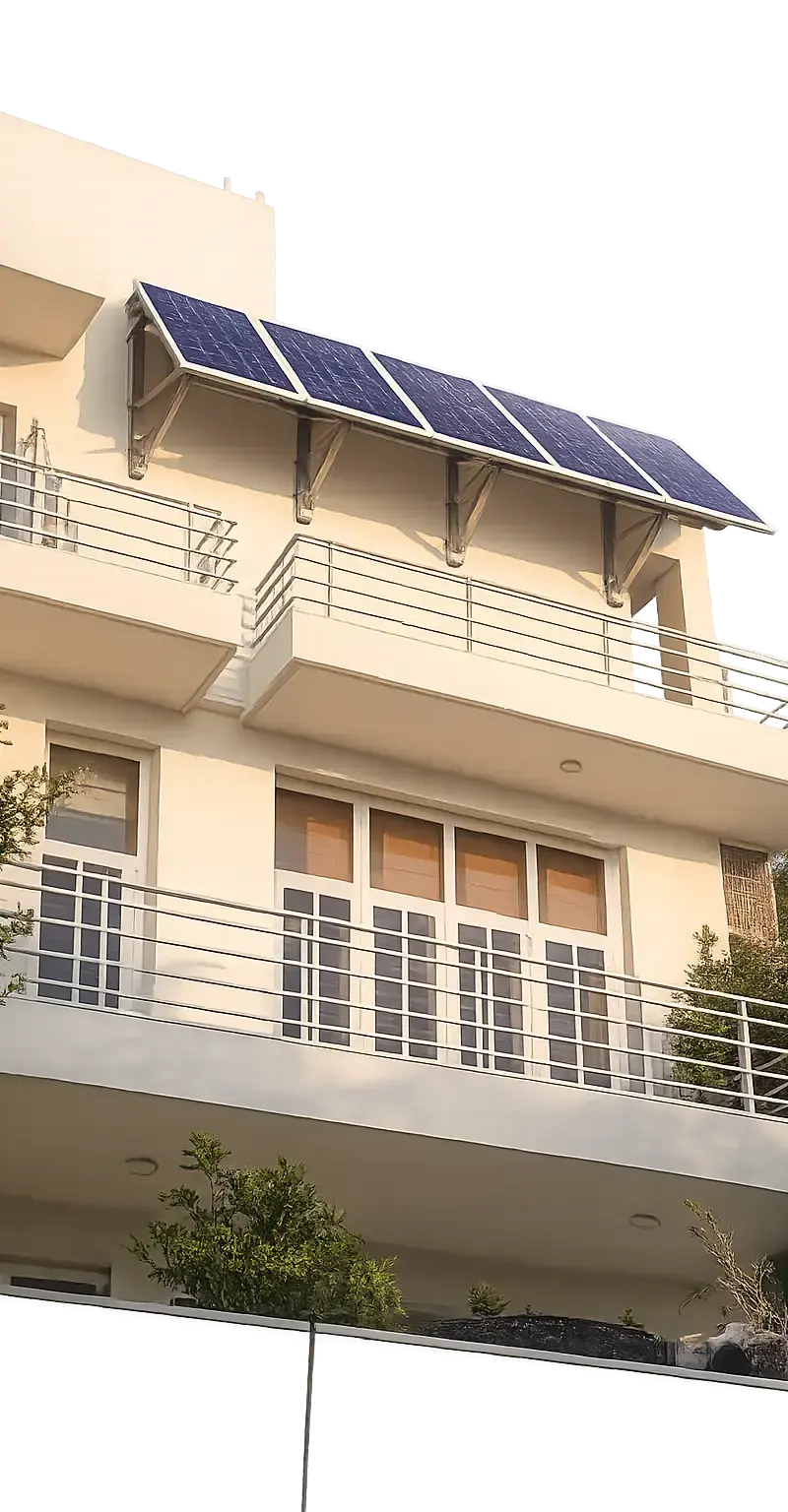
- •Does solar work at night? Functionally no (0% generation), but systems provide power via batteries or Net Metering.
- •Rainy/Cloudy Performance: Panels still work at 10% to 50% capacity.
- •Average Cost: ₹67,000 per kW (before central & state subsidies).
- •Primary Benefit: Eliminates bills by "banking" daytime energy for nighttime use.
It is 11:30 PM in a bustling neighborhood in Dwarka. The AC is humming, the fridge is whirring, and the LED lights are bright. You look up at the dark sky and then at your neighbor’s roof, which is covered in sleek solar panels. A thought crosses your mind—one you’ve been hesitant to ask out loud: “Wait, if the sun is gone, where is their electricity coming from right now? Does solar work at night?”
Don’t worry. You aren’t alone. In our 35+ years of experience at Bridgeway Power, we’ve heard it all. From concerns about panels attracting lightning to whether moonlight can charge a battery, there are no "silly" questions when it comes to a technology that’s supposed to last 25 years on your roof.
In this guide, we’re going to pull back the curtain on solar panel night time performance, debunk the most common solar myths India faces, and answer the solar common questions India homeowners are often too embarrassed to ask.
The Short Answer: Does Solar Work at Night?
Technically, the answer is no. Solar photovoltaic (PV) panels require photons from sunlight to initiate the "photovoltaic effect," which creates an electric current. When the sun sets, the flow of photons stops, and your panels go to sleep.
However, a solar system definitely works at night. There is a massive difference between generation and availability. While the panels aren't generating, your home stays powered through two primary methods:
- Net Metering (The Virtual Battery): Most urban homes in India use "On-Grid" systems. You send your massive excess generation during the day to the DISCOM (like BSES or Tata Power). At night, you simply take that energy back. You can learn exactly how the math works in our guide on Net Metering Calculation Explained.
- Solar Batteries (The Physical Battery): If you have a Hybrid Solar System, your excess daytime power is stored in Lithium Ferrophosphate (LFP) batteries to be used the moment the sun goes down.
Table 1: Solar Generation Efficiency by Time of Day
This table shows how a typical 5kW system behaves throughout a 24-hour cycle in the Delhi NCR climate.
| Time Window | Generation Capacity | System Status | Activity |
|---|---|---|---|
| 6 AM – 9 AM | 20% – 40% | Waking Up | Powering base loads (fridge, fans) |
| 9 AM – 3 PM | 80% – 100% | Peak Performance | Running ACs, pumps; exporting to grid |
| 3 PM – 6 PM | 30% – 60% | Winding Down | Powering evening prep; battery charging |
| 6 PM – 6 AM | 0% | Dormant | Using Grid (Net Metering) or Battery |
Can Solar Panels Work Without Sunlight? (The Moonlight Myth)
Can you get solar without sunlight? People often ask if moonlight—which is just reflected sunlight—can trigger the panels.
The scientific answer is yes, but the practical answer is a resounding no. Moonlight is roughly 400,000 times weaker than direct sunlight. Even under a glorious full moon in a clear Rajasthan sky, a solar panel might produce less than 0.1% of its rated capacity. That’s not enough to power a single LED bulb. For all functional purposes, solar panels do not work under moonlight.
6 "Embarrassing" Questions About Solar Performance
Beyond the night-time dilemma, homeowners often worry about weather changes and "what-if" scenarios. Let's look at the data for how panels handle the diverse Indian climate.
Table 2: Quick Answers to Performance Questions
| Condition | Does it work? | Expected Output | How it works |
|---|---|---|---|
| Night | No | 0% | Relies on stored or grid energy. |
| Heavy Rain | Yes | 10% – 25% | Uses "diffuse" light; rain actually cleans panels! |
| Cloudy/Overcast | Yes | 30% – 50% | Photons still penetrate clouds. |
| Winter (Fog) | Yes | 70% – 80% | Cold temperatures actually improve panel efficiency. |
1. "Do panels attract lightning?"
This is a very common fear. Solar panels do not "attract" lightning any more than any other metal object on your roof. However, because they are often the highest point on a building, we install a dedicated Lightning Arrester (LA) and a robust earthing system. This ensures that if a strike does occur, the energy is safely diverted into the ground without harming your home or the system.
2. "Will solar panels make my top floor hotter?"
Actually, the opposite is true! Solar panels act as a secondary shade for your roof. They absorb the solar radiation that would otherwise heat up your RCC slab. Homeowners in Noida and Gurgaon often report that their top-floor rooms feel 3-5 degrees cooler after installation.
3. "Can the panels fly off during a storm?"
Not if they are installed with the right engineering. At Bridgeway Power, we use high-grade galvanized iron (GI) or aluminum structures designed to withstand wind speeds of up to 150 km/h. Check out our guide on the 7 Types of Solar Panel Mounting Structures to see how we secure them.
4. "Do I need to wash them every day?"
No. While dust (soiling) can reduce output by up to 25% in dusty areas like Faridabad, a professional cleaning once every 2 weeks is usually sufficient. You can read more about why this matters in our Solar Panel Cleaning Guide.
Talk to a solar engineer — not a salesperson
Check whether we install in your area, then get your answer on WhatsApp. No forms, no call centre.
What would solar save on YOUR bill?
Real-Life Example: The 24-Hour Solar Cycle in a Delhi Home
Let’s look at a real case study of a bungalow in South City, Gurgaon.
- System Size: 5kW On-Grid Solar
- Monthly Bill Before Solar: ₹8,500 (approx. 800 units)
- Daytime Activity (9 AM - 5 PM): The home generates about 20-25 units. The family is at work/school, so they only use 5 units. The remaining 20 units are exported to the DHBVN grid.
- Nighttime Activity (7 PM - 7 AM): The family returns. ACs are turned on, dinner is cooked, and TVs are running. They consume 15 units.
- The Result: Even though the panels produced zero electricity at night, the "banked" 20 units from the morning covered the 15 units used at night. At the end of the month, their bill is virtually zero, and they still have a 5-unit credit!
This is why "Does solar work at night?" is the wrong question. The right question is: "Does my solar system cover my night-time consumption?" For most Indian homes, the answer is a clear yes.
Why Solar is Different in 2026
If you asked these questions 10 years ago, the answers would be different. Today, technology has evolved:
- Bifacial Panels: Some modern panels can capture light reflecting off the roof surface, increasing efficiency even in low-light conditions.
- High-Wattage Modules: With Topcon Mono PERC 600Wp panels, even 30% output on a cloudy day is often more than what older 250W panels produced in full sun!
- Smart Inverters: Modern inverters can seamlessly switch between solar, battery, and grid power without you ever noticing a flicker in your lights.
Solar Myths India: The "Hidden" Questions
"Can I run my AC on solar?"
Yes! As long as your system is sized correctly (usually 3kW for one AC plus home loads, or 5kW for two ACs), you can run your air conditioning directly on solar power. In fact, summer is when solar panels perform their best! For a deeper dive, read Can I Run AC on Solar?
"Will the panels damage my roof?"
We use chemical anchoring or specialized fasteners that ensure the water-tight integrity of your roof. Your roof remains as strong as it was, now just more productive. In fact, per IS 875-2 standards, an RCC roof is designed to handle 150 kg/sqm—a solar system weighs only about 15-20 kg/sqm. It's lighter than a full 1000L water tank!
"What happens if I don't use the electricity I generate?"
In an On-Grid system, it goes to the government grid and shows up as a credit on your bill. Under the PM Surya Ghar Yojana, this is the most efficient way to maximize your ROI.
Frequently Asked Questions
Does solar work on rainy days in India?
Yes, solar panels work on rainy days, though their output drops to about 10–25% of their peak capacity. Solar panels don't need direct "heat"; they need light. Even on a rainy day, there is enough diffuse light for the panels to generate electricity. Plus, the rain helps by washing away dust!
Do solar panels work during a power cut at night?
If you have a standard On-Grid system, no. For safety reasons (anti-islanding), on-grid systems shut down during a power cut. However, if you have a Hybrid system with batteries, your house will remain powered using the energy stored during the day.
Can I get a solar subsidy if I install a battery?
The central government subsidy under PM Surya Ghar Yojana is currently focused on the solar plant itself (panels and inverter). While you can add batteries to your system, the subsidy amount remains capped based on the solar kW capacity, not the battery size.
Do panels work in the winter fog of North India?
Yes. While heavy smog or "smog" in Delhi can reduce output, the cold temperatures of winter actually make solar cells more efficient. A clear, sunny winter day in January can often result in higher peak voltage than a hazy summer day in June.
What is the lifespan of a solar panel in Indian conditions?
Most Tier-1 panels come with a 25-year performance warranty. Even after 25 years, they don't stop working; they just produce about 80-85% of their original capacity. You can learn more about this in our Lifespan and Warranty Guide.
Conclusion: Stop Worrying and Start Saving
The fear that solar "stops working" when the sun goes down is a relic of the past. With modern Net Metering and affordable battery storage, your transition to clean energy is seamless, 24/7.
At Bridgeway Power (operating since 1990), we’ve helped over 5,000+ homes and businesses navigate these exact questions. Whether you are in Pitampura or Indirapuram, our team is ready to design a system that works for your specific night-time load.
Ready to see the math for your own roof?
- Use our Solar Calculator to estimate your savings.
- Book a Free Site Survey with Bridgeway Power today. Let’s turn your roof into a 24-hour power plant!
Every 1 kW of solar on your roof offsets 1.5 tonnes of CO₂ per year
That's 40 trees planted — every year, for 25 years.
A typical 5 kW home system offsets 187 tonnes of carbon over its lifetime. That's equivalent to taking 8 cars off the road.
See your impact →How much can you save with solar?
Enter your electricity bill → get system size, subsidy amount & payback period
Get StartedLiked this article? Get a free solar quote
Tell us about your rooftop — we'll call with exact savings for your home.
Related Articles
Net Metering in India: How to Sell Solar Power Back to the Grid
Learn how net metering in India allows you to sell solar power back to the grid. Discover state policies, savings examples, and how to reduce your bill by 90%.
Read moreWhat Is Captive Open Access Solar (100% Equity Model)
Learn how Captive Open Access Solar (100% Equity Model) helps Indian businesses cut electricity costs by 40% using off-site solar plants. Guide on rules, savings & ROI.
Read moreSolar Installation Cost in Delhi NCR 2026: 3 kW at ₹1.32L net
Updated 2026 guide to solar costs in Delhi NCR. Learn about PM Surya Ghar subsidies, system pricing from 1kW-10kW, and how to reach zero electricity bills.
Read moreRelated guides
Delhi Electricity Rate 2026
BSES & Tata Power per-unit rates, PPAC, subsidy — sourced from DERC.
ExploreDelhi Solar Policy 2026
Free rooftop solar up to 3 kW for homes under 400 units. Eligibility & apply.
ExploreSolar Panel Price in Delhi
Live 2026 rooftop prices in Delhi after ₹1.56L subsidy. 1,200+ installs.
ExploreSolar Company in Gurgaon
Gurgaon's rooftop solar installer — 800+ systems, ₹78K PM Surya Ghar subsidy.
ExploreSolar Company in Noida
Noida & Greater Noida rooftop solar — 500+ installs, ₹1.08L stacked subsidy.
ExploreSolar Panel Price in Faridabad
Live 2026 Faridabad prices after ₹78K PM Surya Ghar subsidy. 350+ homes.
Explore