
By Vansh Dahiya · Reviewed by Arshi Chadha, Founder
How to Reduce Commercial Electricity Bill in Delhi NCR (2026): Solar, Open Access & More
- •Average Commercial Tariff: ₹8–₹11 per unit (including surcharges).
- •Top Saving Method: Rooftop Solar or Community Solar.
- •Tax Benefits: 40% Accelerated Depreciation + 18% GST Input Tax Credit.
- •Payback Period: 3–4 years for most commercial installations.
- •Primary Goal: To reduce commercial electricity bill Delhi by up to 80%.
You're checking the rate — now see how much of your bill solar erases
Running a business in Delhi NCR in 2026 comes with its own set of challenges—rising labor costs, competitive markets, and perhaps the most persistent overhead: the electricity bill. Whether you are operating a showroom in South City Gurgaon, a manufacturing unit in Okhla, or a corporate office in Noida Extension, your power bill likely consumes a significant portion of your monthly revenue.
In Delhi, commercial electricity rates are among the highest in the country when you factor in fixed charges, PPAC surcharges, and electricity duty. However, 2026 is also the year of unprecedented opportunity. With the PM Surya Ghar Yojana pushing solar adoption and the rise of Virtual Net Metering (VNM), businesses have more tools than ever to reduce commercial electricity bill Delhi.
In this comprehensive guide, we explore how Bridgeway Power is helping Delhi NCR businesses transition from passive energy consumers to active energy producers.
1. Commercial Electricity Rates in Delhi NCR (2026)
To understand how to save, we must first understand what we are paying for. Commercial tariffs in Delhi NCR are structured differently than residential ones. You aren’t just paying for the units consumed; you are paying for the "Sanctioned Load" (Fixed Charges) and "Maximum Demand."
As of early 2026, the electricity tariff structures for major DISCOMs like BSES Rajdhani, TPDDL, and PVVNL (Noida) are as follows:
- Delhi Commercial: Average ₹8.00 - ₹9.50/unit + 16% to 25% PPAC + 5% Electricity Duty.
- Noida/Greater Noida: Average ₹7.00 - ₹8.50/unit + Fixed charges based on kVA.
- Gurgaon/Faridabad: Average ₹7.50 - ₹9.00/unit.
For a business with a monthly bill of ₹1,00,000, nearly ₹30,000 often goes toward taxes and surcharges. This is why finding a way to lower office electricity bill amounts is no longer a luxury—it is a fiscal necessity.
2. Commercial Electricity Saving Options (Comparison)
Before diving into the details, here is a snapshot of the most effective ways to lower your costs:
| Method | Investment | Savings | Payback (Years) | Best For |
|---|---|---|---|---|
| Rooftop Solar | High (Capex) / Zero (Opex) | 70–90% | 3–4 Years | Owned roofs (Factories, Schools) |
| Community Solar (VNM) | Low to Medium | 20–40% | 4–5 Years | Rented offices, Shops in Malls |
| Open Access Solar | Zero (PPA Model) | 15–25% | Immediate | Large Units (>100kW load) |
| Energy Audit & Retrofitting | Low | 5–10% | 1 Year | All businesses |
3. Rooftop Solar for Owned Premises: The Gold Standard
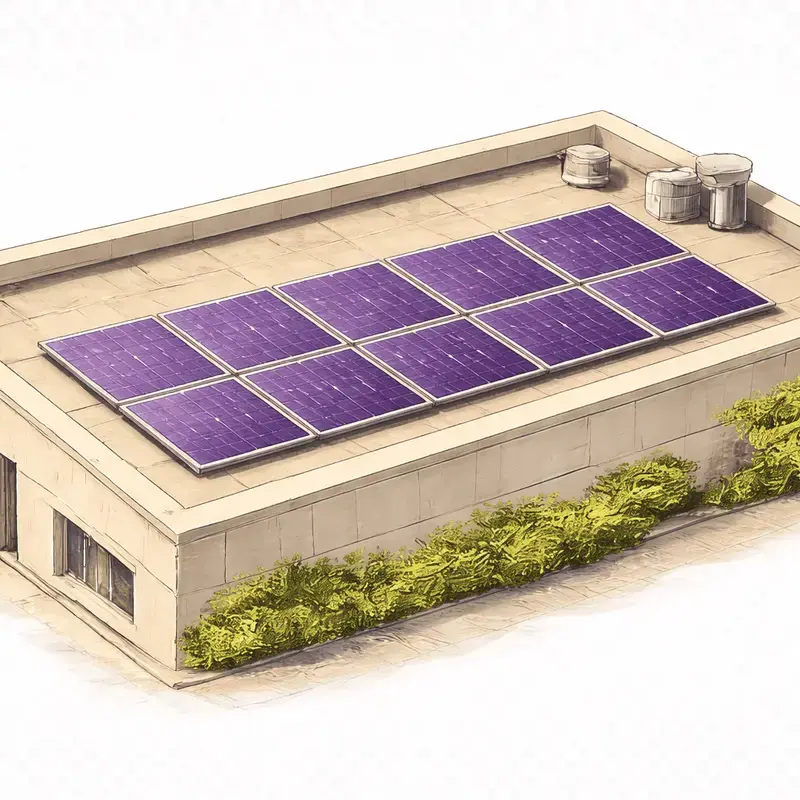
If you own the roof of your commercial building, commercial solar Delhi is the single best investment you can make. Unlike residential systems, commercial solar systems benefit from "Scale of Economy."
Why Rooftop Solar is a Winner:
- Net Metering: You can send excess power generated during Sundays or holidays back to the grid. In Delhi, Net Metering allows you to adjust these units against your nighttime or peak-hour consumption.
- Offsetting Peak Charges: Solar generates the most power during the day when commercial tariffs are often at their peak (Time of Day or ToD charging).
- Property Value: A solar-enabled building has a higher market value and a lower "Common Area Maintenance" (CAM) cost.
Recent trends show that businesses in areas like Rohini and Janakpuri are increasingly moving toward 10kW to 50kW systems to offset their entire air-conditioning load.
4. Community Solar & VNM: Reducing Bills Without a Roof
One of the biggest hurdles for Delhi businesses has been the lack of roof space. If you are a boutique in Greater Kailash or an IT firm in a leased space in Gurgaon, you don't own the roof.
Community Solar via Virtual Net Metering (VNM) is the 2026 solution.
How it works:
- A solar plant is installed at a remote location (or a shared roof).
- The electricity generated is fed into the grid.
- The "credits" from this generation are proportionately deducted from your specific commercial electricity bill.
This allows you to lower office electricity bill costs without installing a single panel on your own premises. It is the perfect solution for businesses in Dwarka or Lajpat Nagar where rooftop space is either shared or non-existent.
5. Open Access for Large Consumers (100kW+)
For heavy industrial units or large corporate parks in Manesar or Noida Extension with a sanctioned load exceeding 100kW, open access solar Delhi NCR is a game-changer.
Through Open Access, you don't buy power from your local DISCOM (like BSES). Instead, you sign a Power Purchase Agreement (PPA) with a third-party solar farm.
- The Benefit: You get green power at ₹4.50 – ₹5.50 per unit, compared to the DISCOM rate of ₹9.00.
- The Catch: It is generally applicable only for high-tension (HT) consumers with a load of 100kW or more.
6. Massive Tax Benefits: Accelerated Depreciation & GST ITC
The Indian government provides strong fiscal incentives for commercial solar Delhi through the Ministry of New & Renewable Energy (MNRE).
40% Accelerated Depreciation (AD)
Under Section 32 of the Income Tax Act, businesses can claim 40% depreciation on solar assets in the very first year. This significantly reduces your taxable income, effectively giving you a "discount" on the system through tax savings.
GST Input Tax Credit (ITC)
Solar systems for businesses are usually taxed at a concessional rate. As a commercial entity, you can claim the GST paid on the solar equipment as an Input Tax Credit, further reducing your effective investment by 13–18%.
Learn more about solar tax benefits for MSMEs.
Talk to a solar engineer — not a salesperson
Enter your pincode and monthly bill. If we install in your area, an engineer answers on WhatsApp with your numbers.
See how much of this bill solar erases
Solar Depreciation & Tax Benefit Calculator
Based on Section 32 — 40% WDV + 20% additional depreciation (Year 1)
7. Real Example: 50kW Commercial System ROI
Let’s look at a real-world scenario. A small manufacturing unit in Ghaziabad with a monthly bill of ₹75,000 installs a 50kW Rooftop Solar System.
| Parameter | Value |
|---|---|
| System Size | 50 kW |
| Total Investment (Approx) | ₹22,50,000 (at ₹45,000/kW) |
| Monthly Generation | 6,000 Units (avg 120 units/kW) |
| Savings per Unit | ₹8.50 |
| Monthly Bill Reduction | ₹51,000 |
| Annual Savings | ₹6,12,000 |
| Year 1 Tax Savings (AD) | ~₹2,25,000 (assuming 25% tax bracket) |
| Net Payback Period | ~2.8 Years |
After 3 years, the electricity for this business is essentially free for the next 22 years of the panel's lifespan.
8. Financing Your Solar Journey
Most businesses prefer not to lock up capital in equipment. 2026 offers excellent financing options:
- SBI Solar Loan: Competitive rates for commercial rooftops.
- Canara Bank Solar Loan: Specific schemes for MSMEs.
- NBFCs: Specialized lenders like Aerem and Ecofy offer quick approvals and 100% financing for solar.
9. Solar Maintenance: Protecting Your Investment
In the dusty environment of Delhi NCR, "soiling" is the biggest enemy of energy efficiency.
- Power Loss: Dirty panels can lose up to 25% efficiency.
- Solution: Regular cleaning and AMC (Annual Maintenance Contracts).
Read our Solar AMC Case Study to see how a professional cleaning schedule recovered 6x the generation for a Delhi client.
Frequently Asked Questions
How much can I really reduce my commercial electricity bill in Delhi?
By installing a correctly sized solar system, most businesses can reduce their "Variable Charges" by 80–90%. However, you will still need to pay "Fixed Charges" based on your sanctioned load, which solar does not eliminate unless you go completely off-grid (which is not recommended for commercial use).
Does solar work for rented office spaces in Delhi?
Yes, through Virtual Net Metering (VNM) or Group Net Metering (GNM). This allows you to benefit from solar energy generated at a different location. It is an ideal way to reduce commercial electricity bill Delhi for tenants. Learn about VNM here.
What is the lifespan of a commercial solar system in India?
A high-quality commercial solar system has a life of 25 years. Most Tier-1 panels come with a 10-12 year product warranty and a 25-year performance warranty.
Is there a subsidy for commercial solar?
No, the PM Surya Ghar Yojana subsidies are only for residential consumers. However, businesses get "Indirect Subsidies" in the form of 40% Accelerated Depreciation and GST Input Tax Credits, which often result in better ROI than flat subsidies.
Is Open Access better than Rooftop Solar?
Rooftop solar is better if you have the space, as it eliminates "wheeling and transmission" charges. Open access solar Delhi NCR is the preferred choice for massive energy consumers (like hospitals or hotels) who have limited roof space but high energy demands.
Practical Steps to Start Saving Today
To effectively reduce commercial electricity bill Delhi, follow these three steps:
- Analyze Your Bill: Check your last 12 months of consumption to find your peak demand and average unit cost.
- Request a Site Survey: Bridgeway Power offers free technical site surveys across Delhi, Gurgaon, and Noida. We check roof health, shadow analysis, and technical feasibility.
- Choose a Financing Model: Decide whether you want to own the system (Capex) or pay per unit (Opex/PPA).
The Future is Bright (and Solar)
High electricity bills are a choice, not a necessity. With Bridgeway Power’s 35+ years of experience and over 5,000 successful installations, we help you navigate the complexities of net metering, subsidies, and technical design.
Ready to slash your operating costs? Contact Bridgeway Power today for a free Solar ROI Consultation and see how much your business can save by 2026. High bills stop here!",excerpt:
Every 1 kW of solar on your roof offsets 1.5 tonnes of CO₂ per year
That's 40 trees planted — every year, for 25 years.
A typical 5 kW home system offsets 187 tonnes of carbon over its lifetime. That's equivalent to taking 8 cars off the road.
See your impact →How much can you save with solar?
Enter your electricity bill → get system size, subsidy amount & payback period
Get StartedGo solar without owning a rooftop
Community Solar gives commercial & institutional consumers the same savings — zero capex, zero roof needed.
Or get a free solar quote
Tell us about your rooftop — we'll call with exact savings for your home.
Related Articles
Lock In a Fixed Electricity Rate for Your School — Before Delhi Tariffs Rise Again
Lock in your school's electricity rate before Delhi tariffs hit ₹16/unit. Learn how Community Solar offers zero-capex savings of ₹10L+ annually.
Read moreWhat Delhi's Solar Policy Means for Apartment Owners and Non-Rooftop Residents
Discover how Delhi's 2026 solar policy enables apartment owners to save 40% on bills using Virtual Net Metering. No roof access or RWA NOC required.
Read moreVirtual Net Metering (VNM) in India: How It Enables Community Solar for Homeowners
Learn how Virtual Net Metering (VNM) enables community solar in India. Discover how DERC and RERC policies allow flat owners to share solar credits without individual rooftops.
Read moreRelated guides
Delhi Electricity Rate 2026
BSES & Tata Power per-unit rates, PPAC, subsidy — sourced from DERC.
ExploreDelhi Solar Policy 2026
Free rooftop solar up to 3 kW for homes under 400 units. Eligibility & apply.
ExploreSolar Panel Price in Delhi
Live 2026 rooftop prices in Delhi after ₹1.56L subsidy. 1,200+ installs.
ExploreSolar Company in Gurgaon
Gurgaon's rooftop solar installer — 800+ systems, ₹78K PM Surya Ghar subsidy.
ExploreSolar Company in Noida
Noida & Greater Noida rooftop solar — 500+ installs, ₹1.08L stacked subsidy.
ExploreSolar Panel Price in Faridabad
Live 2026 Faridabad prices after ₹78K PM Surya Ghar subsidy. 350+ homes.
Explore