
By Mahendra Singh · Reviewed by Arshi Chadha, Founder
Open Access Solar for Data Centres: Green PPA Contract Structures
- •Primary Segment: High-load Data Centres (Uptime Tier III & IV)
- •Model: Open Access (Captive or Third-Party PPA)
- •Key Benefit: 30–50% reduction in per-unit energy cost vs. local DISCOM tariffs
- •Carbon Impact: Up to 100% Green Energy transition for Scope 2 emissions
- •Financing: Zero-Capex OPEX models available for 15–25 years
India is rapidly becoming a global hub for data storage and processing. However, the backbone of this digital revolution—the Data Centre—is inherently energy-hungry. With server racks running 24/7, cooling systems consuming nearly 40% of total power, and the rising pressure to meet ESG (Environmental, Social, and Governance) targets, traditional grid power is no longer sustainable or cost-effective.
For a data centre operator in Delhi NCR or Maharashtra, electricity is the largest operational expense. Transitioning to open access solar for data centres isn't just an environmental choice; it is a strategic financial hedge against rising grid tariffs. Through Green Power Purchase Agreements (PPAs), data centres can now source solar energy from off-site solar farms and have it "wheeled" through the grid to their facility.
Why Data Centres are Shifting to Open Access Solar
Data centres require massive, constant loads. Rooftop solar is often insufficient because the available roof area cannot support the multi-megawatt (MW) capacity needed to offset a significant portion of the bill. This is where Open Access Solar in Delhi NCR and other states becomes the ideal solution.
1. Cost Optimization and Price Certainty
Grid tariffs for commercial and industrial (C&I) consumers in India are among the highest in the world. In cities like Mumbai or Delhi, these can range from ₹8 to ₹10 per unit.
- Grid Tariff: ₹9.00/kWh (Variable and prone to annual hikes)
- Solar PPA Rate: ₹4.00–₹5.00/kWh (Fixed for 15–25 years)
2. Meeting Global PUE and Sustainability Standards
Hyperscalers like Google, AWS, and Microsoft demand that their data centre partners provide "Green Power." Utilizing open access vs rooftop vs community solar allows operators to claim Renewable Energy Certificates (RECs) and achieve 100% renewable status for specific sites.
3. Hedging Against PPAC and Surcharges
In Delhi specifically, the PPAC surcharge in Delhi can inflate bills by nearly 18% overnight. Open access contracts allow businesses to lock in a fixed generation rate, minimizing the impact of these fluctuating grid surcharges.
Commercial Comparison: Grid vs. Open Access Solar (2025-26)
| Parameter | Grid Power (DISCOM) | Open Access Solar (PPA) |
|---|---|---|
| Average Tariff | ₹8.50 – ₹10.00 / unit | ₹4.00 – ₹5.00 / unit |
| Price Stability | Inflation-linked hikes (3-5% p.a.) | Fixed or pre-defined escalation |
| Additional Charges | Fixed charges, PPAC, Electricity Tax | Wheeling, Banking & Cross-Subsidy Surcharge |
| Carbon Footprint | High (Thermal-dominated grid) | Zero (Renewable source) |
| Investment Required | Zero | Zero (in OPEX/PPA model) |
Green PPA Contract Structures for Data Centres
When procuring open access solar for data centres, there are three primary legal and financial structures used in the Indian market. Each has different implications for the balance sheet and tax benefits.
1. Captive Model (100% Equity)
In this model, the data centre operator owns the solar plant entirely. It offers the highest savings because "Cross-Subsidy Surcharge (CSS)" and "Additional Surcharge (AS)" are waived under the Electricity Act 2003.
- Best for: Operators with surplus capital looking for 25%+ IRR.
- Benefit: Long-term asset ownership and 40% accelerated depreciation benefits.
2. Group Captive Model (26/51 Rule)
This is the most popular model in India. The data centre operator holds at least 26% equity in the solar project, and they must consume at least 51% of the electricity generated.
- Savings: Waiver of CSS and AS (similar to captive).
- Reference: Read more on the group captive 26% equity rule.
3. Third-Party PPA (OPEX Model)
The developer builds, owns, and operates the plant. The data centre simply signs a solar PPA vs Capex agreement to buy power at a fixed rate.
- Best for: Rapid scaling where the operator does not want to lock up capital in energy assets.
- Savings: Lower than captive (as CSS/AS are usually applicable), but still 15-20% cheaper than the grid.
The Financial Math: Impact of Wheeling and Banking Charges
One of the most critical aspects of "Open Access Solar for Data Centres" is understanding the "landed cost." The power is generated at a solar farm (e.g., in Rajasthan) and delivered to a data centre in Manesar or Noida. The following charges apply:
Wheeling & Banking Charges Table (Estimated 2026)
| Charge Type | Impact on Landed Cost | Description |
|---|---|---|
| Wheeling Charge | ₹0.60 – ₹1.20 | Cost of using the DISCOM’s wires. |
| Transmission Charge | ₹0.30 – ₹0.50 | Cost of using the State/National grid. |
| Banking Charges | 2% – 10% of units | Cost to "store" excess day power for night use (varies by state). |
| CSS & AS | ₹1.50 – ₹3.00 | Applicable only for Third-Party PPA; waived for Captive. |
For a deep dive into how these charges affect MSMEs and large loads, see our guide on Wheeling and Banking charges across India.
Talk to a solar engineer — not a salesperson
Enter your pincode and monthly bill. If we install in your area, an engineer answers on WhatsApp with your numbers.
What would solar save on YOUR bill?
Solar Depreciation & Tax Benefit Calculator
Based on Section 32 — 40% WDV + 20% additional depreciation (Year 1)
Real Example: A 2MW Load Data Centre in Noida
A Tier III data centre in Noida with a sanctioned load of 2,500 kVA and an average monthly bill of ₹1.8 Crore transitioned to a Group Captive Solar model for 40% of its energy needs.
- Before Solar: Average cost of ₹9.20 per unit.
- Solar Proportion: 3.5 Million units per year sourced from a 5MWp Open Access plant.
- Solar Landed Cost: ₹5.10 per unit (inclusive of wheeling and group captive fees).
- Annual Savings: ₹(9.20 - 5.10) * 3,500,000 = ₹1.43 Crores per year.
- Carbon Offset: ~2,800 tonnes of CO2 annually.
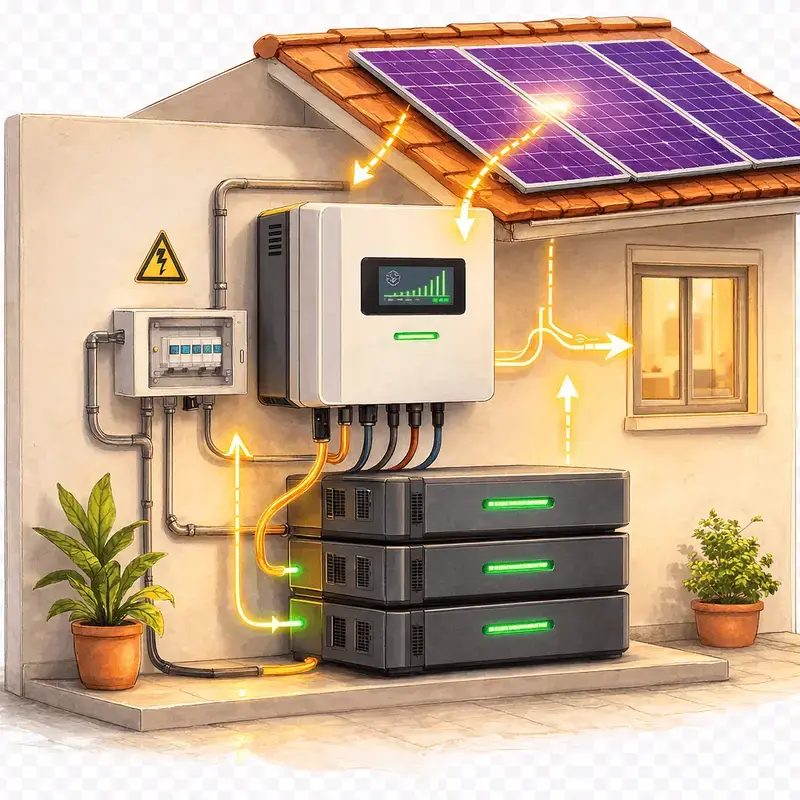
Technical Considerations: Solar + BESS (Battery Energy Storage)
Since data centres require 100% uptime, solar alone (which is intermittent) cannot be the primary source. Future-driven data centres are now looking at Hybrid Open Access—combining solar, wind, and Battery Energy Storage Systems (BESS).
With BESS, "Round-The-Clock" (RTC) green power becomes possible. While the current cost of Li-ion batteries is higher than grid power for large-scale storage, the hybrid solar system pricing is falling, making 4-hour evening backup via batteries increasingly viable for critical rack loads.
Challenges in Open Access Implementation
Despite the benefits, setting up open access solar for data centres involves navigating complex regulatory hurdles:
- DISCOM Approvals: Many DISCOMs are hesitant to lose high-paying industrial consumers. This often leads to delays in net-metering and open access permission.
- Banking Restrictions: Some states like Haryana and Uttar Pradesh have introduced monthly banking or abolished banking altogether, requiring data centres to match their load profile with solar generation in real-time.
- LTOA vs MTOA: Choosing between Long-Term Open Access (LTOA) and Medium-Term (MTOA) affects the transmission priority and costs.
Why Partner with Bridgeway Power?
With 35+ years of experience, Bridgeway Power has transitioned from traditional power solutions to becoming a leader in solar EPC and Open Access consulting.
- 25+ MW Installed: Deep expertise in high-capacity C&I projects.
- End-to-End Liaison: We handle the complex net metering in Delhi and DISCOM approvals so you don’t have to.
- O&M Excellence: Our Solar AMC plans ensure that off-site assets maintain 99%+ uptime—critical for the data centre industry.
Frequently Asked Questions
What is the minimum load required for Open Access Solar in India?
Per the Green Energy Open Access Rules, any consumer with a contracted demand/sanctioned load of 100 kW or more is eligible to source green power through open access. Previously, this limit was 1 MW.
Can a data centre get 100% of its power from Open Access Solar?
Technically, yes, through "Banking" or a hybrid of Solar + Wind. However, because solar generation only happens during the day (~5-6 hours of peak generation), you would need to "bank" the excess units with the DISCOM to use at night, or use a Battery Energy Storage System.
Is Group Captive better than Third-Party PPA for Data Centres?
Generally, yes. The Group Captive model allows for the waiver of Cross-Subsidy Surcharge (CSS) and Additional Surcharge (AS), which can save an extra ₹2 to ₹3 per unit compared to a Third-Party PPA.
How long does it take to start receiving solar power via Open Access?
The technical setup (building the solar farm) takes 6-9 months. However, the regulatory process (obtaining NOC from DISCOM, LTOA approval) usually takes 3-4 months. Many developers offer "pre-commissioned" capacity in existing solar parks for faster migration.
What happens if the solar plant under-generates?
In a Green PPA, you only pay for the units actually delivered to your meter. If the plant under-generates due to weather, you simply draw more power from the grid at your standard DISCOM tariff.
Conclusion
Open Access Solar for Data Centres is no longer a "green luxury"—it is a competitive necessity. As global hyperscalers tighten their environmental requirements and Indian grid tariffs continue to rise, locking in a low-cost, fixed-rate Green PPA is the most effective way to protect your margins.
Ready to audit your data centre's energy profile? Bridgeway Power offers free feasibility studies for open access and captive solar projects. Contact our experts today to see how much your facility can save.
Every 1 kW of solar on your roof offsets 1.5 tonnes of CO₂ per year
That's 40 trees planted — every year, for 25 years.
A typical 5 kW home system offsets 187 tonnes of carbon over its lifetime. That's equivalent to taking 8 cars off the road.
See your impact →How much can you save with solar?
Enter your electricity bill → get system size, subsidy amount & payback period
Get StartedGo solar without owning a rooftop
Community Solar gives commercial & institutional consumers the same savings — zero capex, zero roof needed.
Or get a free solar quote
Tell us about your rooftop — we'll call with exact savings for your home.
Related Articles
What Is Captive Open Access Solar (100% Equity Model)
Learn how Captive Open Access Solar (100% Equity Model) helps Indian businesses cut electricity costs by 40% using off-site solar plants. Guide on rules, savings & ROI.
Read moreHow Rooftop Solar Can Eliminate Your Electricity Bill
Discover how Net Metering and PM Surya Ghar subsidies can reduce your monthly electricity bill to near-zero. Learn about system sizing, costs, and real-world savings.
Read moreSolar Subsidy in Uttar Pradesh 2026: ₹1,08,000 for Noida, Ghaziabad & Greater Noida
UP's stacked solar subsidy 2026: ₹78,000 central + ₹30,000 UPNEDA state top-up = ₹1.08L. Real PVVNL net-cost math for Noida, Greater Noida, Ghaziabad & Meerut.
Read moreRelated guides
Delhi Electricity Rate 2026
BSES & Tata Power per-unit rates, PPAC, subsidy — sourced from DERC.
ExploreDelhi Solar Policy 2026
Free rooftop solar up to 3 kW for homes under 400 units. Eligibility & apply.
ExploreSolar Panel Price in Delhi
Live 2026 rooftop prices in Delhi after ₹1.56L subsidy. 1,200+ installs.
ExploreSolar Company in Gurgaon
Gurgaon's rooftop solar installer — 800+ systems, ₹78K PM Surya Ghar subsidy.
ExploreSolar Company in Noida
Noida & Greater Noida rooftop solar — 500+ installs, ₹1.08L stacked subsidy.
ExploreSolar Panel Price in Faridabad
Live 2026 Faridabad prices after ₹78K PM Surya Ghar subsidy. 350+ homes.
Explore