
By Arshi Chadha, Founder · Bridgeway Power
GST Input Tax Credit on Solar: Benefits for Business
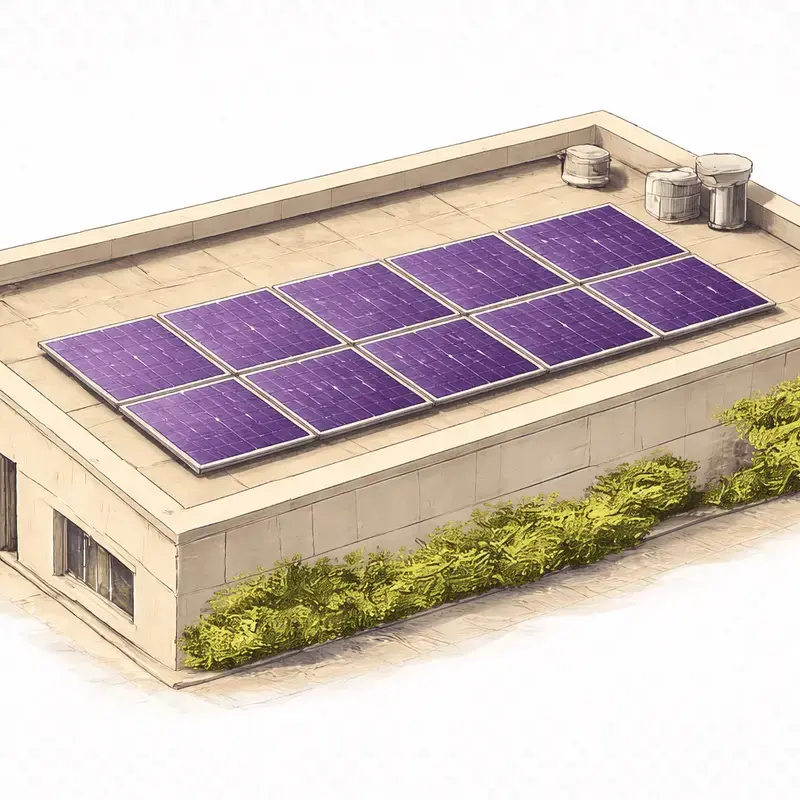
- •Primary Benefit: Recover ~12% or more of project cost via GST Input Tax Credit (ITC).
- •Eligibility: Commercial, Industrial, and Institutional entities with GST registration.
- •Solar GST Rate: Blended rate of 12% for the entire project (goods + services).
- •Tax Advantage: 40% Accelerated Depreciation + 100% ITC recovery.
- •Payback Reduction: ITC typically reduces the ROI period by 6–10 months.
Most business owners I talk to in Delhi NCR focus entirely on the saving per unit of electricity. They miss the biggest "upfront" discount available: the GST Input Tax Credit (ITC). If you are running a factory in Okhla or a warehouse in Faridabad, the GST you pay on your solar plant isn't a cost—it’s an asset you can pull back into your business.
At Bridgeway Power, we’ve handled the engineering for over 45+ MW of solar. I’ve seen CFOs get excited about the solar GST rate 2024 and 2025 updates because, for a 100kW plant, we are talking about a potential tax recovery of ₹5–6 lakhs. If you aren't claiming gst input credit on solar plant business, you are effectively leaving a high-end luxury car's worth of money on the table.
Eligibility: Can Your Business Claim ITC on Solar?
The rule under the CGST Act is straightforward but strict: you can claim ITC on any "Capital Goods" used in the course or furtherance of business.
Since a solar power plant generates electricity that powers your machinery, computers, and lights—all of which are essential to your business—it qualifies. However, there are three non-negotiables:
- GST Registration: You must have a valid GSTIN.
- Business Use: The power must be used for the business. You cannot claim ITC on a system installed at the Managing Director's private bungalow using the company’s GSTIN.
- No "Immovable Property" Trap: This is where most people get confused. To claim ITC, the solar plant should ideally be treated as "Plant and Machinery" and not as part of the building structure itself.
The Section 17(5) Hurdle: Blocked Credit Clarified
Section 17(5) of the CGST Act lists "blocked credits"—expenses where you cannot claim GST back. Historically, some tax officers argued that since solar panels are fixed to a roof, they become "immovable property," and therefore credit should be blocked.
However, various Advance Rulings and the common industry practice align on this: Solar plants are "Plant and Machinery." Because the panels, inverters, and structures can be dismantled and moved without destroying the property, they do not qualify as "civil structures."
Pro Tip: We always advise our clients to ensure their installer provides a clear breakdown in the invoice. You want your solar system categorized as a functional machine, not a roof repair. This is vital for securing ITC on solar panels India.
Impact of GST on Total Project Cost
For a business, the "Sticker Price" of a solar system is irrelevant. What matters is the Net Landed Cost. In India, the GST on solar systems is a "composite supply." This means a blended rate (currently effectively 12% for most commercial projects) is applied.
Table: Net Cost Calculation With vs Without ITC Benefits (Typical 50kW System)
| Component | Amount (Cost) | GST Rate | GST Amount |
|---|---|---|---|
| Gross Project Value | ₹20,00,000 | 12% | ₹2,40,000 |
| Total Outflow (Unregistered/Residential) | ₹22,40,000 | - | - |
| ITC Refundable (For Registerd Businesses) | - | - | (₹2,40,000) |
| Net Landed Cost for Business | ₹20,00,000 | - | - |
By claiming the gst input credit on solar plant business, the company effectively pays the base price only. When you combine this with the corporate tax benefits solar offers—specifically the 40% accelerated depreciation—the government is essentially subsidizing nearly 50% of your plant through tax breaks in the first few years.
Documentation Required for Successful GST Filings
The GST department doesn't just take your word for it. To ensure your 100% ITC claim isn't flagged in an audit, you need a paper trail:
- Tax Invoice: Must mention the business GSTIN, correct HSN codes (usually 8541 for panels), and the 12% blended rate.
- Proof of Receipt: The goods must have physically reached your site.
- Payment Proof: Under GST rules, you must pay the supplier within 180 days to keep the ITC valid.
- GSTR-2B Reflectance: Ensure your installer (like us) is compliant and files their GSTR-1 on time so the credit reflects in your 2B statement.
If you’re unsure about the math, check our Solar Calculator. It helps you estimate the system size you need before you even look at the tax paperwork.
Talk to a solar engineer — not a salesperson
Enter your pincode and monthly bill. If we install in your area, an engineer answers on WhatsApp with your numbers.
What would solar save on YOUR bill?
Solar Depreciation & Tax Benefit Calculator
Based on Section 32 — 40% WDV + 20% additional depreciation (Year 1)
Real Example: A Factory in Gurgaon

A manufacturing unit in Sector 14, Gurgaon with a monthly bill of ₹75,000 decided to go solar.
- System Size: 40 kW.
- Project Cost: ₹18.5 Lakhs + GST.
- GST Paid: ₹2.22 Lakhs.
- The Outcome: The business used the ₹2.22 Lakhs ITC to offset their GST liability on their outgoing sales in the very next month. Their "cash" payback period dropped from 4.2 years to 3.5 years just by filing their GST returns correctly.
From our installs
We recently completed an installation for a small chemical unit in an industrial pocket of Ghaziabad. They installed a 30kW system to offset their heavy cooling load.
- System Size: 30 kW.
- Generation: Observed 124 units/day on clear days.
- Result: ~₹28,000 reduction in their monthly PVVNL bill.
- Caveat: The client initially tried to claim ITC on the civil foundation work separately at 18%, but their auditor advised staying within the 12% composite supply to avoid red flags during a GST audit.
Corporate Tax Benefits and Depreciation
Beyond the GST credit, solar is a triple-win for the balance sheet.
- Accelerated Depreciation: You can claim 40% depreciation in the first year. This reduces your taxable profit significantly.
- Lower OpEx: Your electricity bill is a recurring expense. Solar turns it into a one-time capital investment.
- Green Branding: Increasingly, MNCs prefer suppliers with green certifications.
If you are a business in Delhi or Noida, the combination of high commercial tariffs (often ₹10+/unit with surcharges) and 100% ITC makes solar a "no-brainer" investment. For those in Delhi specifically, the PPAC Surcharge alone can add 30-40% to your bill—solar is the only way to bypass that.
Before you sign a contract, make sure your Solar EPC Company understands the difference between a residential install and a commercial tax-optimized install. We’ve been doing this for 35+ years, and often the "cheapest" quote is the most expensive because the installer fails to provide the proper documentation for you to claim your ₹5 lakh credit. Get a free quote from our team to see the actual tax-adjusted ROI for your roof.
FAQ
Can I claim ITC on solar panels for my home office?
No, the GST Input Tax Credit is generally not allowed for residential properties, even if you work from home. The installation must be at a registered commercial or industrial site, and the electricity must be used for business operations to satisfy the "furtherance of business" clause of the GST Act.
What is the current solar GST rate in 2024 and 2025?
For a complete rooftop solar system (composite supply), the effective GST rate is roughly 12%. This is based on a split where 70% of the value is treated as goods (taxed at 12%) and 30% is treated as services (taxed at 18%). Most installers provide a single consolidated invoice at this blended rate.
Is solar GST credit blocked under Section 17(5)?
Generally, no. While Section 17(5) blocks credit for "immovable property," solar plants are considered "Plant and Machinery" because they are not permanent civil structures. They are bolted to the roof and can be relocated. Most Advance Rulings in India have supported the claim for ITC on solar plants.
Can I claim both the subsidy and GST ITC?
For commercial and industrial (C&I) projects, there is currently no central subsidy under the PM Surya Ghar Yojana—that scheme is for residential users. Businesses get tax benefits instead, such as the GST ITC and 40% accelerated depreciation, which usually provide a higher financial benefit than a flat subsidy would.
What happens to the ITC if I sell the solar plant later?
If you sell the solar plant as "old and used capital goods," you will have to pay GST on the transaction value or pay back a portion of the ITC claimed (reduced by 5% per quarter of use). It is best to consult with your tax advisor if you plan to move or sell the asset within 5 years.
Reviewed by: Gurubaksh Singh, Senior Solar Advisor, Bridgeway Power",excerpt:
Every 1 kW of solar on your roof offsets 1.5 tonnes of CO₂ per year
That's 40 trees planted — every year, for 25 years.
A typical 5 kW home system offsets 187 tonnes of carbon over its lifetime. That's equivalent to taking 8 cars off the road.
See your impact →How much can you save with solar?
Enter your electricity bill → get system size, subsidy amount & payback period
Get StartedLiked this article? Get a free solar quote
Tell us about your rooftop — we'll call with exact savings for your home.
Related Articles
What Is Captive Open Access Solar (100% Equity Model)
Learn how Captive Open Access Solar (100% Equity Model) helps Indian businesses cut electricity costs by 40% using off-site solar plants. Guide on rules, savings & ROI.
Read moreHow Rooftop Solar Can Eliminate Your Electricity Bill
Discover how Net Metering and PM Surya Ghar subsidies can reduce your monthly electricity bill to near-zero. Learn about system sizing, costs, and real-world savings.
Read moreSolar Subsidy in Uttar Pradesh 2026: ₹1,08,000 for Noida, Ghaziabad & Greater Noida
UP's stacked solar subsidy 2026: ₹78,000 central + ₹30,000 UPNEDA state top-up = ₹1.08L. Real PVVNL net-cost math for Noida, Greater Noida, Ghaziabad & Meerut.
Read moreRelated guides
Delhi Electricity Rate 2026
BSES & Tata Power per-unit rates, PPAC, subsidy — sourced from DERC.
ExploreDelhi Solar Policy 2026
Free rooftop solar up to 3 kW for homes under 400 units. Eligibility & apply.
ExploreSolar Panel Price in Delhi
Live 2026 rooftop prices in Delhi after ₹1.56L subsidy. 1,200+ installs.
ExploreSolar Company in Gurgaon
Gurgaon's rooftop solar installer — 800+ systems, ₹78K PM Surya Ghar subsidy.
ExploreSolar Company in Noida
Noida & Greater Noida rooftop solar — 500+ installs, ₹1.08L stacked subsidy.
ExploreSolar Panel Price in Faridabad
Live 2026 Faridabad prices after ₹78K PM Surya Ghar subsidy. 350+ homes.
Explore