
By Mahendra Singh · Reviewed by Arshi Chadha, Founder
3kW Solar Panel Price in Delhi with Subsidy Benefits
Get a 3 kW quote for your Delhi roof
Share your pincode and electricity bill. Get your system specification, applicable subsidy and written installation price together.
Delhi is currently the most lucrative market for residential solar in India. With the combination of the PM Surya Ghar Muft Bijli Yojana and the Delhi Solar Policy 2024, the 3kw solar panel price in delhi with subsidy has dropped to a point where the system pays for itself faster than a fixed deposit matures. We’ve installed over 5,000 systems across the NCR, and I can tell you that 3kW is the absolute "sweet spot" for the typical Delhi household.
Why 3kW is Delhi’s Most Popular System Size
If your 400 unit electricity bill in delhi is bothering you, you aren't alone. Most 2BHK and 3BHK homes in areas like Dwarka or Rohini consume between 350 to 500 units a month during the summer.
A 3kW system generates roughly 360 units per month on average. Because the Delhi government domestic electricity subsidy provides a 50% rebate only up to 400 units, crossing that threshold causes your bill to skyrocket as you hit the higher BSES unit rate slabs. By installing 3kW, you effectively wipe out the expensive units, keeping your grid consumption within the "free" or heavily subsidized zone.
3kW Solar Cost Breakdown: The Real Math
Don't get confused by "starting at" prices you see on social media. In Delhi, a high-quality 3kW installation using TOPCon Mono PERC modules and a standard structure has a fixed price point if you want it to last 25 years.
| Component | Price Details (2025-26) |
|---|---|
| Gross System Price (Incl. 8.9% GST) | ₹2,40,000 |
| Central Subsidy (CFA) | (-) ₹78,000 |
| Delhi State Subsidy | (-) ₹30,000 |
| Net Final Cost to Homeowner | ₹1,32,000 |
Note: The state subsidy is a direct capital incentive provided by the Delhi Govt, and the Central subsidy is via the National Portal.
DCR vs. Non-DCR Panels: The Subsidy Trap
If you want the solar panel price 3kw government subsidy benefits, you must use DCR (Domestic Content Requirement) modules. These are solar cells and modules manufactured right here in India.
- DCR Panels: Mandatory for subsidy. Prices are slightly higher due to manufacturing costs, but the ₹1,08,000 total subsidy makes the net cost much lower.
- Non-DCR Panels: Usually imported cells. While the base price might be ₹5,000–₹10,000 cheaper, you lose the entire ₹1,08,000 subsidy. We never recommend this for residential rooftop solar in Delhi.
The Double Benefit: Subsidy + GBI
Delhi is unique because it offers a Generation-Based Incentive (GBI). Under the Delhi Solar GBI 2026 rules, you earn ₹3 for every unit your system produces, regardless of whether you consume it or send it to the grid.
For a 3kW system:
- Generation: ~4,300 units/year
- GBI Earnings: 4,300 x ₹3 = ₹12,900 per year paid directly to your bank account for 5 years.
When you add this to the electricity bill savings, the pm surya ghar yojana 3kw price of ₹1.32L feels even smaller. You can use our Solar Calculator to see how this impacts your specific ROI.
BSES Net Metering Process in Delhi
Whether you are under BSES Rajdhani or BSES Yamuna, the process is now streamlined through the PM Surya Ghar portal. As an EPC provider, we handle this end-to-end, but here is what the timeline looks like:
- Feasibility Approval: Once we apply, BSES checks if the local transformer can handle your 3kW load. This usually takes 7-10 days.
- Installation: We install the panels, inverter, and mounting structure.
- Inspection & Metering: BSES inspectors visit to verify the installation and replace your current meter with a Bi-directional Net Meter.
- Subsidy Release: Once the net meter is installed and the "Commissioning Certificate" is uploaded, the subsidy hits your bank account within 30 days.
Talk to a solar engineer — not a salesperson
Enter your pincode and monthly bill. If we install in your area, an engineer answers on WhatsApp with your numbers.
See your exact subsidy after state stacking
Real Example: A 3BHK in Janakpuri
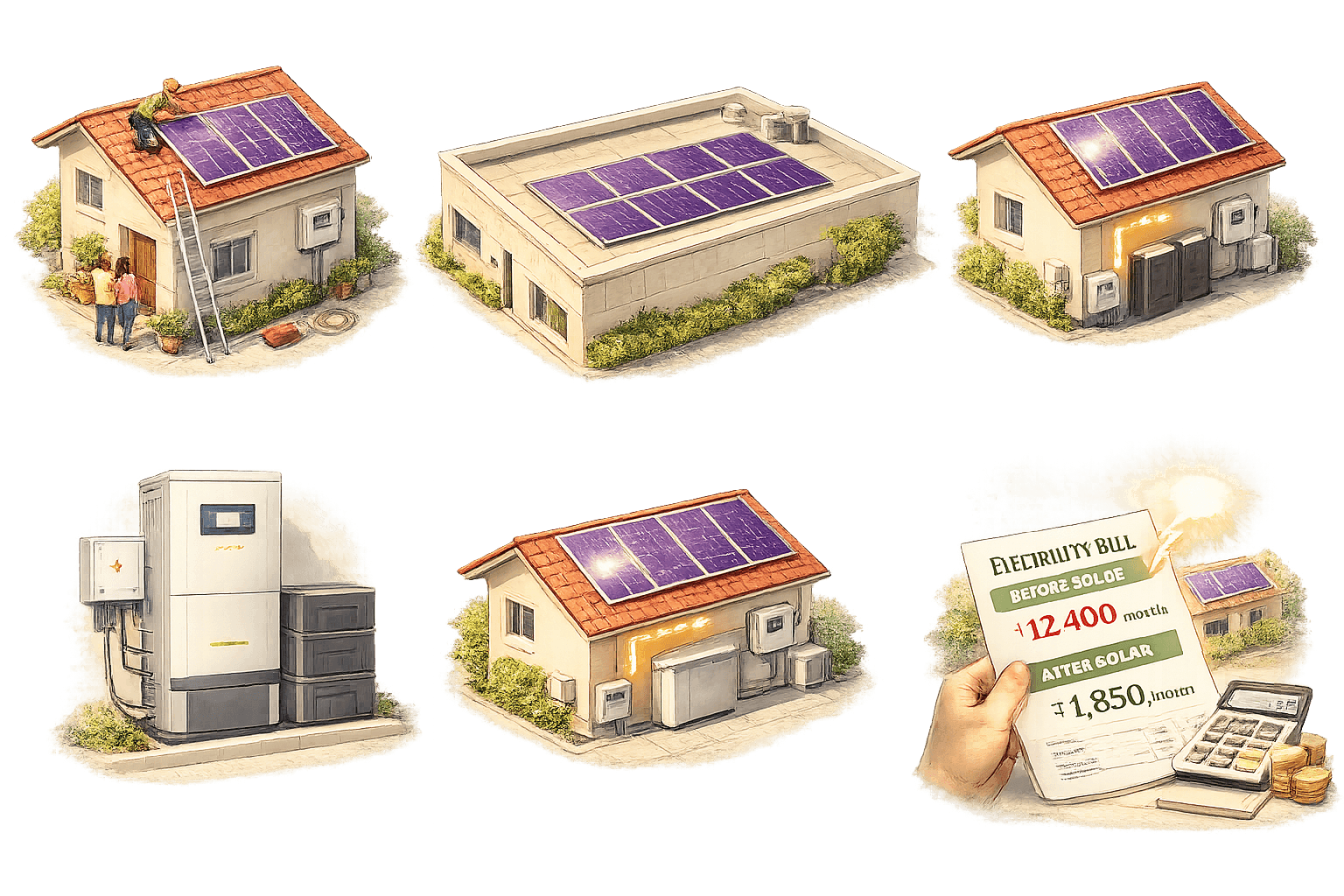
A family in Janakpuri was receiving an average monthly bill of ₹4,800. They installed a 3kW system with us in early 2025.
- Investment: ₹1,32,000 (after all subsidies).
- New Monthly Bill: ~₹400 (Fixed charges + taxes).
- Monthly Savings: ₹4,400.
- Annual GBI Earnings: ₹12,500.
- Total Annual Benefit: ₹65,300.
- Payback Period: Just 2 years and 2 months.
Technical Checklist for 3kW Systems
- Panel Type: We use TOPCon Mono PERC modules (580Wp-620Wp) because they perform better in Delhi's high heat and smog.
- Inverter: A high-efficiency string inverter is standard, but if you have shading from a nearby water tank, we recommend looking at microinverters.
- Space Required: You need approximately 250–300 sq. ft. of clear roof space.
- Weight: Don't worry about your roof; a solar system weighs significantly less than a full 1000L water tank.
If you're ready to stop paying for Delhi's rising tariffs, you can get a free quote or a site survey from our team. We’ve been doing this since 1997, and we know exactly how to handle the paperwork so your subsidy doesn't get stuck.
FAQ
How much subsidy do I get for a 3kW solar system in Delhi?
You receive a total of ₹1,08,000. This is split into two parts: ₹78,000 from the Central Government under the PM Surya Ghar Yojana and ₹30,000 from the Delhi State Government. Both are processed through the national solar portal.
Can I run a 1.5 ton AC on a 3kW solar system?
Yes, you can. However, solar works on a "net" basis. During the day, the 3kW system will power your AC directly. If the AC needs more power than the panels are producing, it will pull the difference from the grid. At the end of the month, your bill is only for the "net" units used.
What is the BSES net metering settlement period?
In Delhi, the net metering cycle follows the financial year. Any surplus units you generate in the sunny months (like March-May) are carried forward to offset your bills in the high-AC months. On March 31st, any remaining surplus is paid out by BSES at the APPC rate.
How long does it take to get the subsidy in Delhi?
Once the system is installed and the net meter is commissioned, you must upload a photo of the meter and the final invoice to the PM Surya Ghar portal. Typically, the central subsidy is disbursed within 30 days of this upload. The Delhi state subsidy follows a similar timeline.
Is 3kW enough for a 400 unit monthly consumption?
Yes, it is almost perfect. A 3kW system in Delhi produces roughly 12 units a day or 360 units a month. If your consumption is 400 units, solar will cover 90% of your bill, leaving you in the lowest possible tariff slab for the remaining 40 units.
Do I need to change my sanctioned load for a 3kW solar system?
Your solar system capacity cannot exceed your sanctioned load. If your house has a 2kW sanctioned load, you must first apply for a load enhancement to 3kW through the BSES website before you can install a 3kW solar system. We usually assist our clients with this paperwork.
Every 1 kW of solar on your roof offsets 1.5 tonnes of CO₂ per year
That's 40 trees planted — every year, for 25 years.
A typical 5 kW home system offsets 187 tonnes of carbon over its lifetime. That's equivalent to taking 8 cars off the road.
See your impact →How much can you save with solar?
Enter your electricity bill → get system size, subsidy amount & payback period
Get StartedSee your exact subsidy after state stacking
Related Articles
What Is Captive Open Access Solar (100% Equity Model)
Learn how Captive Open Access Solar (100% Equity Model) helps Indian businesses cut electricity costs by 40% using off-site solar plants. Guide on rules, savings & ROI.
Read moreHow Rooftop Solar Can Eliminate Your Electricity Bill
Discover how Net Metering and PM Surya Ghar subsidies can reduce your monthly electricity bill to near-zero. Learn about system sizing, costs, and real-world savings.
Read moreSolar Subsidy in Uttar Pradesh 2026: ₹1,08,000 for Noida, Ghaziabad & Greater Noida
UP's stacked solar subsidy 2026: ₹78,000 central + ₹30,000 UPNEDA state top-up = ₹1.08L. Real PVVNL net-cost math for Noida, Greater Noida, Ghaziabad & Meerut.
Read moreRelated guides
Delhi Electricity Rate 2026
BSES & Tata Power per-unit rates, PPAC, subsidy — sourced from DERC.
ExploreDelhi Solar Policy 2026
Free rooftop solar up to 3 kW for homes under 400 units. Eligibility & apply.
ExploreSolar Panel Price in Delhi
Live 2026 rooftop prices in Delhi after ₹1.56L subsidy. 1,200+ installs.
ExploreSolar Company in Gurgaon
Gurgaon's rooftop solar installer — 800+ systems, ₹78K PM Surya Ghar subsidy.
ExploreSolar Company in Noida
Noida & Greater Noida rooftop solar — 500+ installs, ₹1.08L stacked subsidy.
ExploreSolar Panel Price in Faridabad
Live 2026 Faridabad prices after ₹78K PM Surya Ghar subsidy. 350+ homes.
Explore