
By Bhawna Thakur · Reviewed by Arshi Chadha, Founder
Area Needed for 5kW Solar: Square Feet and Layout Guide
- •System Size: 5 kW
- •Area Required: 300–400 sq. ft. (Shadow-free)
- •Number of Panels: 8–9 (using 600Wp TOPCon modules)
- •Monthly Generation: ~600 Units
- •Monthly Savings: ₹4,500–₹5,500 (Delhi NCR rates)
A standard 5kW solar system requires approximately 300 to 400 square feet of shadow-free rooftop space. While many installers give you a generic "100 sq. ft. per kW" rule of thumb, that math is becoming outdated as panel efficiency climbs. In my 35 years of installing systems across North India, I’ve seen 5kW plants fit comfortably on small builder floor roofs in Dwarka and struggle on massive bungalows in Sushant Lok because of poor layout planning.
The real question isn't just about the area required for 5kw solar panel in square feet; it’s about how much of your roof is actually usable after accounting for shadows, water tanks, and maintenance walkways.
Calculating the Footprint of Modern Modules
We don't use the small 335Wp panels much anymore. Today’s industry standard for residential rooftops is the Topcon Mono PERC module, typically ranging from 580Wp to 620Wp.
Each of these high-efficiency panels has solar panel dimensions of roughly 2.3 meters by 1.1 meters. That’s about 25 square feet per panel. To get a 5kW capacity (5,000 Watts), you’ll need about 8 or 9 panels.
- 8 Panels x 600Wp = 4.8 kW (Commonly rounded to 5kW in quotes)
- 9 Panels x 600Wp = 5.4 kW (Ideal for maximizing a 5kW net metering limit)
Mathematically, 9 panels only take up 225 square feet of physical space. So why do we ask for 350+ square feet? Because solar panels don't exist in a vacuum. You need gaps for wind loading, row spacing to prevent one panel from shading the next, and room for a technician to walk around with a cleaning brush.
Solar System Size vs Required Square Footage (2025-26)
| System Size | Number of Panels (600Wp) | Physical Panel Area | Total Shadow-Free Area Needed |
|---|---|---|---|
| 3 kW | 5 | 125 sq. ft. | 200–250 sq. ft. |
| 5 kW | 8–9 | 200–225 sq. ft. | 300–400 sq. ft. |
| 8 kW | 13–14 | 325–350 sq. ft. | 500–600 sq. ft. |
| 10 kW | 17 | 425 sq. ft. | 700–800 sq. ft. |
Note: These figures assume standard flat RCC roofs. Slanted tin sheds may require less area as spacing between rows is often unnecessary.
Total Roof Area vs. Shadow-Free Usable Space
This is where most homeowners get tripped up. You might have a 1,000 sq. ft. roof, but that doesn't mean you can install a 15kW system. In cities like Noida, we often deal with "shadow-rich" environments.
A shadow-free area for 5kW solar means space that receives direct sunlight from 9:00 AM to 4:00 PM throughout the year. If your neighbor’s third-floor balcony casts a shadow on your roof at 3:00 PM in December, those square feet are effectively useless for solar.
When we perform a site survey, we use a 3D shadow analysis tool. We aren't just looking at where the sun is today; we’re looking at where the sun will be during the winter solstice when shadows are longest. If you’re curious about how these constraints affect your specific ROI, check our Solar Calculator.
The Impact of Parapet Walls and Water Tanks
In the Indian context, the two biggest enemies of a clean rooftop solar layout design are the Sintex water tank and the parapet wall.
- Water Tanks: A standard 1000L water tank is about 4-5 feet tall. Because it sits on a raised platform, it can cast a 10-foot shadow during the morning or evening. We usually recommend placing the solar array to the South of the water tank so the tank’s shadow falls away from the panels.
- Parapet Walls: If you have a 3-foot parapet wall, you cannot place panels right against the edge of the roof. We have to offset the structure by at least 3 to 4 feet to avoid the wall's shadow.
- Lift Rooms: On modern builder floors in Delhi, the lift machine room is often the highest point. While it's tempting to put panels on top of the lift room, the solar panel weight on roof and wind uplift at that height require specialized anchoring.
Talk to a solar engineer — not a salesperson
Enter your pincode and monthly bill. If we install in your area, an engineer answers on WhatsApp with your numbers.
What would solar save on YOUR bill?
Spacing for Maintenance: Don't Cram the Panels
I’ve seen "fly-by-night" installers pack panels edge-to-edge to make a system fit a small space. This is a disaster waiting to happen.
We insist on a minimum of 2 feet of walking space between rows and around the perimeter. Why?
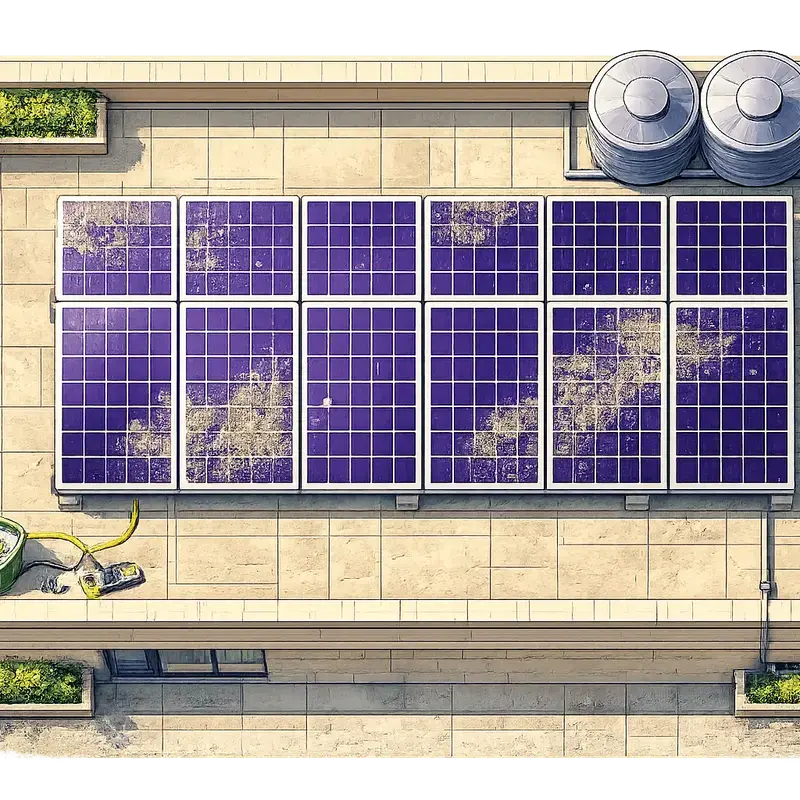
- Cleaning Access: Solar panel cleaning in India is a weekly chore due to high dust levels. If a cleaner can’t reach the middle panels, those panels will eventually lose 25% of their output due to soiling.
- Heat Dissipation: Panels get incredibly hot. Airflow underneath and between panels helps keep them cool, which actually improves their efficiency.
- Maintenance: If a single MC4 connector fails in the middle of your 5kW array, a technician needs to be able to reach it without stepping on other panels (which causes micro-cracks).
Real Example: A 3BHK in Rohini
A client in Rohini had a total roof area of 900 sq. ft. On paper, a 5kW system should have taken up only a third of the roof. However, the roof was split into two sections by a central staircase room and had three large AC outdoor units and a solar water heater already installed.
After mapping the shadow-free area for 5kW solar, we found only 380 sq. ft. of usable space. By using high-efficiency 610Wp panels, we managed to fit the 5kW system using a "Portrait" layout with an elevated structure. This allowed the client to continue using the roof for evening walks while the panels sat 7 feet above the ground.
FAQ
How much space is required for 5kW solar panels in India?
For a standard residential rooftop in India, you need between 300 and 400 square feet of clear, shadow-free space. This accounts for the panels themselves, row spacing for maintenance, and offsets to avoid shadows from parapet walls or water tanks.
Can I install 5kW solar on a 300 sq. ft. roof?
It is possible but tight. You would need to use the highest wattage panels available (like 615Wp+) and likely use an elevated structure to minimize the footprint of the legs. You must ensure there are no shadows from surrounding buildings, as there is no "margin for error" on a small roof.
What are the dimensions of a 5kW solar array?
A 5kW array typically consists of 8 to 9 panels. If arranged in two rows of four, the array would be roughly 9 meters wide and 2.5 meters deep, plus the necessary walking space around the perimeter.
Does an elevated structure require more area?
No, an elevated structure requires the same "solar footprint," but it frees up the "floor area." The shadow cast by the panels remains the same, but you can walk, sit, or even place small plants underneath the structure.
How many units will 5kW solar generate in Delhi NCR?
A well-designed 5kW system in the Delhi NCR region will generate an average of 20 units per day, or roughly 600 units per month. This varies seasonally, with peaks in April-May and dips during the monsoon and peak winter fog.
If you’re unsure whether your roof has enough shadow-free space, Get a free quote and we can perform a remote shadow analysis for you. Generating power is easy; ensuring that power doesn't drop because of a poorly placed water tank requires experience.
We’ve spent 35 years figuring out these nuances so you don’t have to. Check out our Solar Installation in Noida guide for more specific regional details.
Every 1 kW of solar on your roof offsets 1.5 tonnes of CO₂ per year
That's 40 trees planted — every year, for 25 years.
A typical 5 kW home system offsets 187 tonnes of carbon over its lifetime. That's equivalent to taking 8 cars off the road.
See your impact →How much can you save with solar?
Enter your electricity bill → get system size, subsidy amount & payback period
Get StartedLiked this article? Get a free solar quote
Tell us about your rooftop — we'll call with exact savings for your home.
Related Articles
What Is Captive Open Access Solar (100% Equity Model)
Learn how Captive Open Access Solar (100% Equity Model) helps Indian businesses cut electricity costs by 40% using off-site solar plants. Guide on rules, savings & ROI.
Read moreHow Rooftop Solar Can Eliminate Your Electricity Bill
Discover how Net Metering and PM Surya Ghar subsidies can reduce your monthly electricity bill to near-zero. Learn about system sizing, costs, and real-world savings.
Read moreSolar Subsidy in Uttar Pradesh 2026: ₹1,08,000 for Noida, Ghaziabad & Greater Noida
UP's stacked solar subsidy 2026: ₹78,000 central + ₹30,000 UPNEDA state top-up = ₹1.08L. Real PVVNL net-cost math for Noida, Greater Noida, Ghaziabad & Meerut.
Read moreRelated guides
Delhi Electricity Rate 2026
BSES & Tata Power per-unit rates, PPAC, subsidy — sourced from DERC.
ExploreDelhi Solar Policy 2026
Free rooftop solar up to 3 kW for homes under 400 units. Eligibility & apply.
ExploreSolar Panel Price in Delhi
Live 2026 rooftop prices in Delhi after ₹1.56L subsidy. 1,200+ installs.
ExploreSolar Company in Gurgaon
Gurgaon's rooftop solar installer — 800+ systems, ₹78K PM Surya Ghar subsidy.
ExploreSolar Company in Noida
Noida & Greater Noida rooftop solar — 500+ installs, ₹1.08L stacked subsidy.
ExploreSolar Panel Price in Faridabad
Live 2026 Faridabad prices after ₹78K PM Surya Ghar subsidy. 350+ homes.
Explore