
By Mahendra Singh · Reviewed by Arshi Chadha, Founder
Shading Effect on Solar Panels: How to Protect Output
- •Shadow Impact: Even 10% shading can cause a 30–50% solar panel output drop in traditional systems.
- •Mitigation Tech: Half-cut cells and Micro-inverters can recover up to 25% of lost generation.
- •Maintenance: Bird droppings and dust (soiling) account for nearly 25% of efficiency loss in Indian cities.
- •ROI Factor: Proper shadow analysis can shorten your payback period by 1.2 years.
Shading isn't just a minor nuisance; it’s the primary reason rooftop solar systems underperform in dense urban areas like Delhi and Gurugram. We’ve visited hundreds of sites where a customer complains their "5kW system only generates 12 units a day," and nine times out of ten, the culprit is a neighbor's water tank or a newly grown Neem tree casting a sliver of shadow across one corner of the array.
At Bridgeway Power, we’ve spent 35+ years dealing with the realities of the Indian roof. We know that a single shadow doesn't just block one cell—it can choke your entire power plant. Understanding the shading effect on solar panel output is the difference between a system that pays for itself in 4 years and one that lingers for 7.
The "Christmas Tree Light" Problem: How Partial Shading Destroys Output
Most residential solar systems in India use a string inverter. Think of a "string" of panels like an old-school string of Christmas lights—if one bulb goes out (or gets shaded), the whole string suffers.
In technical terms, panels in a string are connected in series. The current flowing through the string is limited by the "weakest link." If a chimney casts a shadow on just one panel, reducing its output to 20%, every other panel in that string—even those in full, glorious sunlight—will have their current throttled down to match that shaded panel. This leads to a massive solar panel output drop that most homeowners don't see coming until they check their Solar Calculator results against their actual bill.
String vs. Micro-inverters: The Shade Showdown
This is where hardware choice becomes critical. If your roof has inevitable shadows from nearby builder floors or mobile towers, sticking with a standard string inverter is a mistake.
| Feature | String Inverter (Standard) | Micro-inverter (e.g., Enphase/Hoymiles) |
|---|---|---|
| System Architecture | Panels connected in series (String) | Panels connected in parallel (Individual) |
| Impact of 10% Shade | Entire string output drops by ~30–50% | Only the shaded panel output drops |
| Optimization | Single MPPT for the whole string | Module-Level Power Electronics (MLPE) |
| Real-world Recovery | Low; bypass diodes offer limited help | High; 20-25% more energy in shaded sites |
| Warranty Window | 10-year manufacturer warranty | 15–25 years (depending on brand) |
If you are looking at Solar in Delhi, where buildings are packed tight, micro-inverters are often worth the premium. You can read more about this in our guide on choosing the right solar inverter.
Bypass Diodes: The First Line of Defense
To prevent a single shaded cell from killing a whole panel, manufacturers include bypass diodes. These act like a "detour" on a highway. When a cell is shaded, it becomes highly resistive and starts heating up (creating a hot spot). The bypass diode senses this and allows the current to flow around the shaded section.
However, bypass diodes are a blunt instrument. A typical 540Wp or 600Wp panel has three bypass diodes. If a shadow hits even a tiny part of one section, the diode shuts off that entire third of the panel. You lose 33% of that panel's power instantly just to protect it from burning out. While necessary for safety, it’s a poor way to manage efficiency.
Why We Recommend Half-Cut Cell Technology for Shaded Roofs
If you’ve looked at modern modules, you’ll notice the cells look like smaller rectangles rather than squares. These are half-cut cell solar panels shading specialists.
By cutting a standard solar cell in half, the internal current is halved, which reduces resistive losses. More importantly, half-cut panels are wired in a way that splits the panel into two independent top and bottom halves.
- Traditional Panel: If the bottom row is shaded by a parapet wall, the whole panel stops producing.
- Half-Cut Panel: If the bottom half is in shadow, the top half continues to operate at 100% capacity.
When we perform a shadow analysis for rooftop solar, we specifically look for "low-string" shadows. If your parapet wall is high, we always specify half-cut modules to ensure you don't lose your entire morning generation.
The Silent Killers: Dust, Pollution, and Bird Droppings
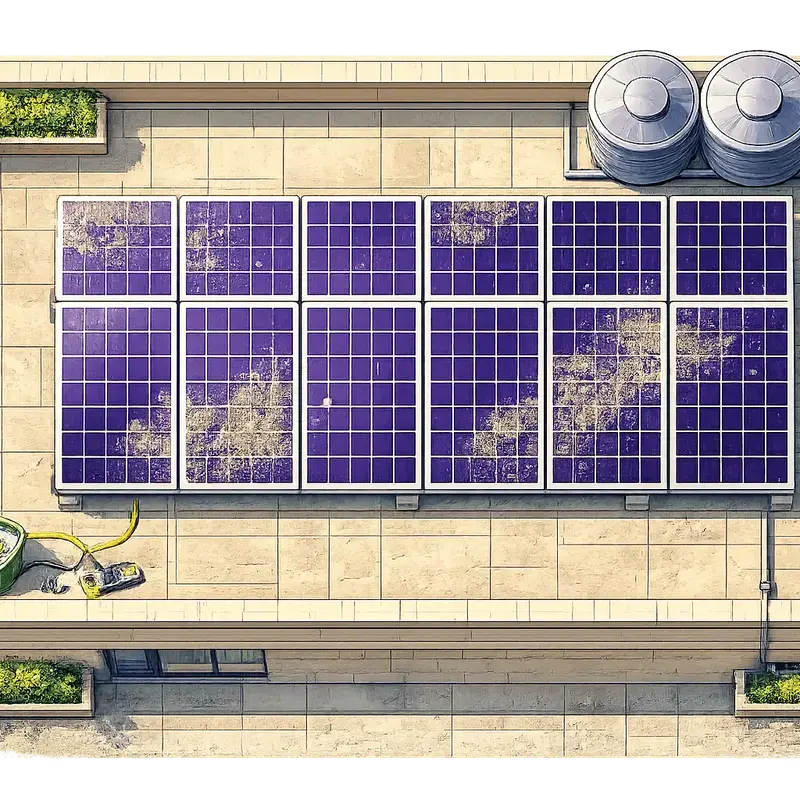
In cities like Ghaziabad or Noida, the shading effect on solar panel output isn't always caused by a building. It’s often caused by "soiling."
- Dust & Smog: The particulate matter in NCR is notorious. A thin layer of grey dust can act like a semi-transparent shadow. According to our field data, panel soiling loss can reach 25% if not cleaned for a month.
- Bird Droppings: This is worse than dust. A single, opaque bird dropping creates a "hard shadow" on a few cells. Because it is completely opaque, it triggers the bypass diode or, worse, creates a localized hot spot that can eventually crack the glass or cause a fire.
We always tell our customers: if you aren't going to clean your panels, don't install solar. Regular maintenance is so critical that we include 2 professional cleanings in Year 1 for every install. For long-term protection, an AMC plan is usually cheaper than the energy you lose to dirt.
Talk to a solar engineer — not a salesperson
Enter your pincode and monthly bill. If we install in your area, an engineer answers on WhatsApp with your numbers.
What would solar save on YOUR bill?
From our installs
We recently monitored a 10kW system on a bungalow in Sushant Lok, Gurugram. The client had a beautiful ornamental tree on the south side. During our initial site survey, our engineers flagged that the tree would shade 15% of the array from 2 PM onwards in the winter months.
- The Result: By using half-cut TOPCon modules and a string inverter with dual MPPTs (tracking two separate groups of panels), we maintained a daily average of 3.8 units/kW/day, even in December.
- The Caveat: Had we used older full-cell technology, the generation would have likely dipped to 2.9 units/kW/day, extending the payback period by nearly two years.
Professional Shadow Analysis: How We Design
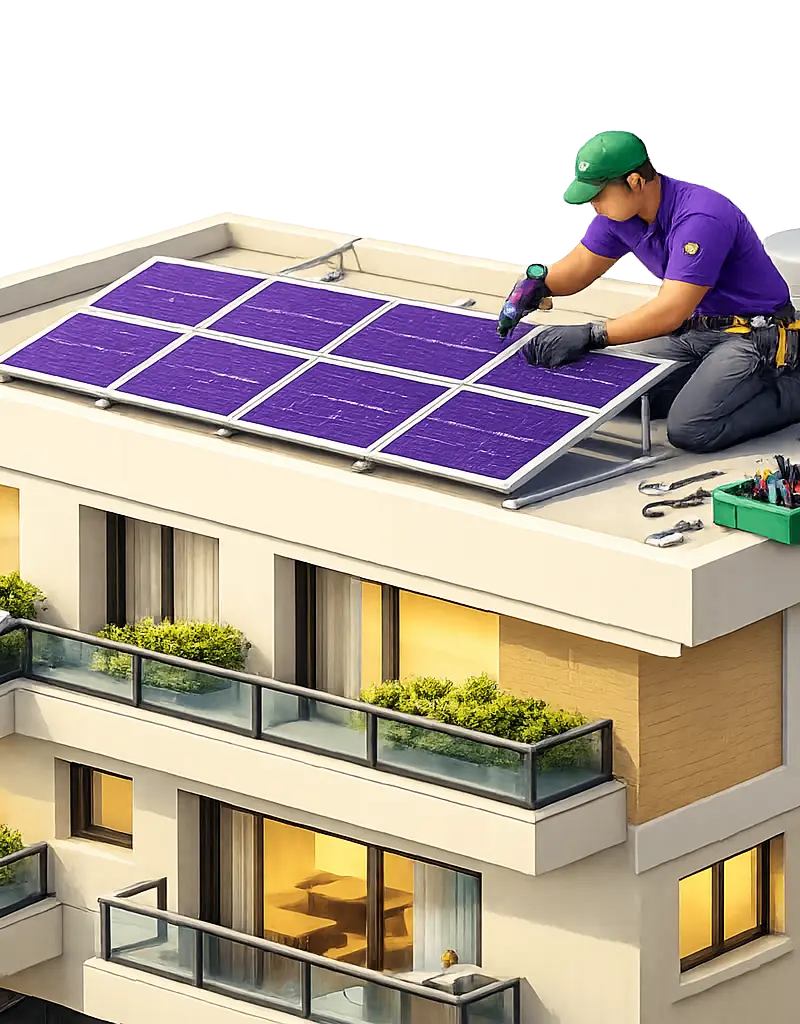
Before we ever bolt a structure to your roof, we use 3D modeling software (like Helioscope or PVSyst) to map your roof's "solar window." We don't just look at where the shadows are today; we look at where they will be at 9 AM on December 21st (the winter solstice, when shadows are longest).
If your roof is small, we might suggest an elevated structure to "get above" the shadows. A standard structure adds about ₹1,500/kW to the cost, but an elevated pergola-style structure can be ₹15,000/kW. It sounds expensive, but if it moves your panels out of the shade, it pays for itself through increased generation in less than 3 years. You can check the price difference on our solar structure cost guide.
FAQ
Does a small shadow really matter that much?
Yes. Because solar cells are connected in series, a shadow on a single cell can act like a clog in a pipe, restricting the flow of electricity for the entire panel or even the entire string. In a standard string inverter setup, shading just 10% of the surface area can lead to a 50% drop in total power output.
Can I fix shading issues after installation?
It is difficult and expensive to fix after the fact. You might need to add power optimizers to each panel or rewire the system into different "strings" so that shaded panels don't affect sunny ones. This is why a proper site survey by an experienced team like Bridgeway is vital before you get a free quote.
Do half-cut panels cost more?
Not significantly. In the 2025-2026 market, half-cut Mono PERC or TOPCon panels are the industry standard. While they might carry a small premium over older technology, the performance gains on a typical Indian roof (which always has some shading) make them the smarter financial choice.
How often should I clean panels to avoid "soft shading"?
In Delhi NCR, we recommend a water wash every 10–15 days. During the peak smog season (October–November), weekly cleaning is better. Never use harsh chemicals or abrasive brushes, as scratching the glass creates permanent micro-shadows that trap more dust.
Is a micro-inverter better than a string inverter for shade?
For roofs with complex shading (trees, chimneys, multiple roof levels), yes. Micro-inverters allow each panel to work independently. If one panel is 50% shaded, only that panel's output is affected, while the rest of the system produces at 100%. This module-level optimization is the gold standard for shaded urban roofs.
If you're worried about shadows on your roof, don't guess. The PM Surya Ghar Yojana offers massive subsidies, but those savings only matter if your system actually generates power.
Reviewed by: Gurubaksh Singh, Senior Solar Advisor, Bridgeway Power
Every 1 kW of solar on your roof offsets 1.5 tonnes of CO₂ per year
That's 40 trees planted — every year, for 25 years.
A typical 5 kW home system offsets 187 tonnes of carbon over its lifetime. That's equivalent to taking 8 cars off the road.
See your impact →How much can you save with solar?
Enter your electricity bill → get system size, subsidy amount & payback period
Get StartedLiked this article? Get a free solar quote
Tell us about your rooftop — we'll call with exact savings for your home.
Related Articles
What Is Captive Open Access Solar (100% Equity Model)
Learn how Captive Open Access Solar (100% Equity Model) helps Indian businesses cut electricity costs by 40% using off-site solar plants. Guide on rules, savings & ROI.
Read moreHow Rooftop Solar Can Eliminate Your Electricity Bill
Discover how Net Metering and PM Surya Ghar subsidies can reduce your monthly electricity bill to near-zero. Learn about system sizing, costs, and real-world savings.
Read moreSolar Subsidy in Uttar Pradesh 2026: ₹1,08,000 for Noida, Ghaziabad & Greater Noida
UP's stacked solar subsidy 2026: ₹78,000 central + ₹30,000 UPNEDA state top-up = ₹1.08L. Real PVVNL net-cost math for Noida, Greater Noida, Ghaziabad & Meerut.
Read moreRelated guides
Delhi Electricity Rate 2026
BSES & Tata Power per-unit rates, PPAC, subsidy — sourced from DERC.
ExploreDelhi Solar Policy 2026
Free rooftop solar up to 3 kW for homes under 400 units. Eligibility & apply.
ExploreSolar Panel Price in Delhi
Live 2026 rooftop prices in Delhi after ₹1.56L subsidy. 1,200+ installs.
ExploreSolar Company in Gurgaon
Gurgaon's rooftop solar installer — 800+ systems, ₹78K PM Surya Ghar subsidy.
ExploreSolar Company in Noida
Noida & Greater Noida rooftop solar — 500+ installs, ₹1.08L stacked subsidy.
ExploreSolar Panel Price in Faridabad
Live 2026 Faridabad prices after ₹78K PM Surya Ghar subsidy. 350+ homes.
Explore