
By Bhawna Thakur · Reviewed by Arshi Chadha, Founder
How an RWA Applies for Virtual Net Metering Solar in Delhi (7 Steps)
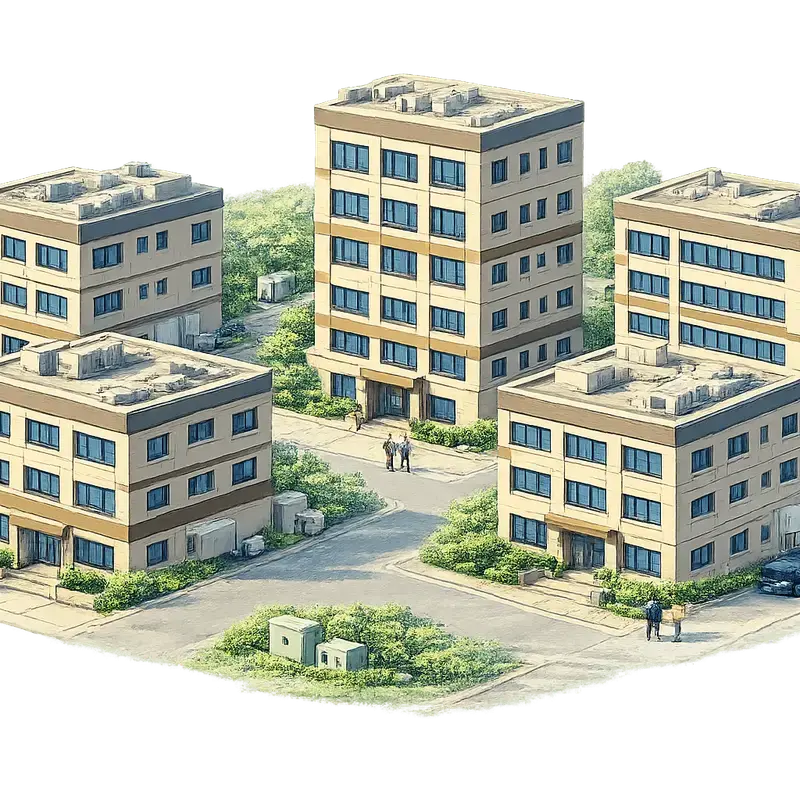
If your society wants solar for common areas or across flats, this is the process, in order. For the bigger picture, start with our pillar guide to community solar and virtual net metering in Delhi.
How an RWA applies: the 7 steps
- Assess the society's load and connections. List the society's electricity connections (common-area and, where relevant, individual flats), the sanctioned load, and the last 12 months of bills. This tells you how big the plant should be and how credits will be shared. (Bridgeway does this from your bills.)
- Pass an RWA / managing-committee resolution. The committee formally resolves to go solar, approves the model (own vs zero-investment/RESCO), and authorises a signatory. This one document unblocks everything downstream.
- Appoint an empanelled installer. Choose an installer empanelled with your discom and registered on the national rooftop portal (required to claim subsidy and to file net metering). Bridgeway files net-metering applications for societies across BRPL, BYPL and TPDDL.
- Apply to the discom for net metering. The installer files the Group/Virtual Net Metering application with your discom under the DERC framework, along with the technical details and society documents.
- Feasibility check and meter approval. The discom carries out a feasibility check of the connection and sanctions the bi-directional/net meter arrangement. Any queries are resolved by the installer.
- Install, commission and change the meter. The plant is installed and commissioned; the discom installs or reconfigures the meter so generation is officially recorded and credited.
- Sign the net-metering agreement and start crediting. The society signs the net-metering agreement, the credit-sharing across connections is registered, and from the next cycle the solar generation starts reducing bills. Subsidy claims (where applicable) are filed in parallel.
What the RWA provides vs what Bridgeway does
| The RWA provides | Bridgeway handles |
|---|---|
| Committee resolution + signatory | System design and sizing |
| Last 12 months of bills | Discom net-metering application & liaison |
| Site / roof access (or agreement to a shared plant) | Installation, commissioning, meter coordination |
| Timely decisions | Subsidy filing, O&M, insurance |
Bridgeway Power has been installing solar across Delhi NCR since 2019, backed by the Sunson group's 45 MW+ project legacy, a 4.7-star customer rating, and Delhi's first Virtual Net Metering plant under BRPL (2024) — see how it worked for a Dwarka housing society.
Talk to a solar engineer — not a salesperson
Check whether we install in your area, then get your answer on WhatsApp. No forms, no call centre.
Translate your bill into a system size
FAQ
How long does an RWA solar application take in Delhi?
After the committee approves and the discom clears feasibility, installation and crediting typically follow within a few weeks — most of the calendar time is decision-making and discom processing, not the build.
Can a society object to a member's solar?
Under a society-level VNM/GNM project the society itself is the applicant, so it's a collective decision — which is exactly why the committee resolution (Step 2) matters.
Does the society get a subsidy?
Government support for rooftop solar in Delhi is currently strong; eligibility for a specific society/VNM configuration is confirmed at sizing. See our Delhi solar subsidy guide for what applies today.
Do all flats benefit, or just common areas?
Both models exist — common-area-only, or credits shared across flats. We design the split with your committee, and our community solar page for Delhi homeowners explains the homeowner side.
Want a society proposal with the numbers filled in? Share your last bill and connection list on WhatsApp: +91 92890 27500 · sales@bridgewaypower.in
See also: Community Solar & Virtual Net Metering in Delhi (pillar guide).
Every 1 kW of solar on your roof offsets 1.5 tonnes of CO₂ per year
That's 40 trees planted — every year, for 25 years.
A typical 5 kW home system offsets 187 tonnes of carbon over its lifetime. That's equivalent to taking 8 cars off the road.
See your impact →How much can you save with solar?
Enter your electricity bill → get system size, subsidy amount & payback period
Get StartedTranslate your bill into a system size
Related Articles
Lock In a Fixed Electricity Rate for Your School — Before Delhi Tariffs Rise Again
Lock in your school's electricity rate before Delhi tariffs hit ₹16/unit. Learn how Community Solar offers zero-capex savings of ₹10L+ annually.
Read moreWhat Delhi's Solar Policy Means for Apartment Owners and Non-Rooftop Residents
Discover how Delhi's 2026 solar policy enables apartment owners to save 40% on bills using Virtual Net Metering. No roof access or RWA NOC required.
Read moreVirtual Net Metering (VNM) in India: How It Enables Community Solar for Homeowners
Learn how Virtual Net Metering (VNM) enables community solar in India. Discover how DERC and RERC policies allow flat owners to share solar credits without individual rooftops.
Read moreRelated guides
Housing Society Solar — RWA & CGHS
Common-area rooftop solar, subsidy and VNM/GNM for Delhi societies.
ExploreCommunity Solar — Delhi Homeowners
No rooftop needed. Govt covers 80%. Credits land on your BSES bill via VNM.
ExploreSolar Without a Roof
Flats, societies, rentals — three routes to solar when the roof isn't yours.
ExploreEnphase IQ8 10 kWp Bungalow, Gurgaon
Case study: module-level monitoring, IP67 microinverters, shade-tolerant yield.
ExploreVirtual Net Metering in Delhi
No usable roof? Own a share of a shared solar plant — credits land on your BSES bill via VNM.
ExploreVNM vs GNM vs Community Solar
Rooftop, group or virtual net metering — which one actually fits your Delhi flat?
Explore