
By Bhawna Thakur · Reviewed by Arshi Chadha, Founder
Community Solar & Virtual Net Metering in Delhi: How to Go Solar Without a Rooftop
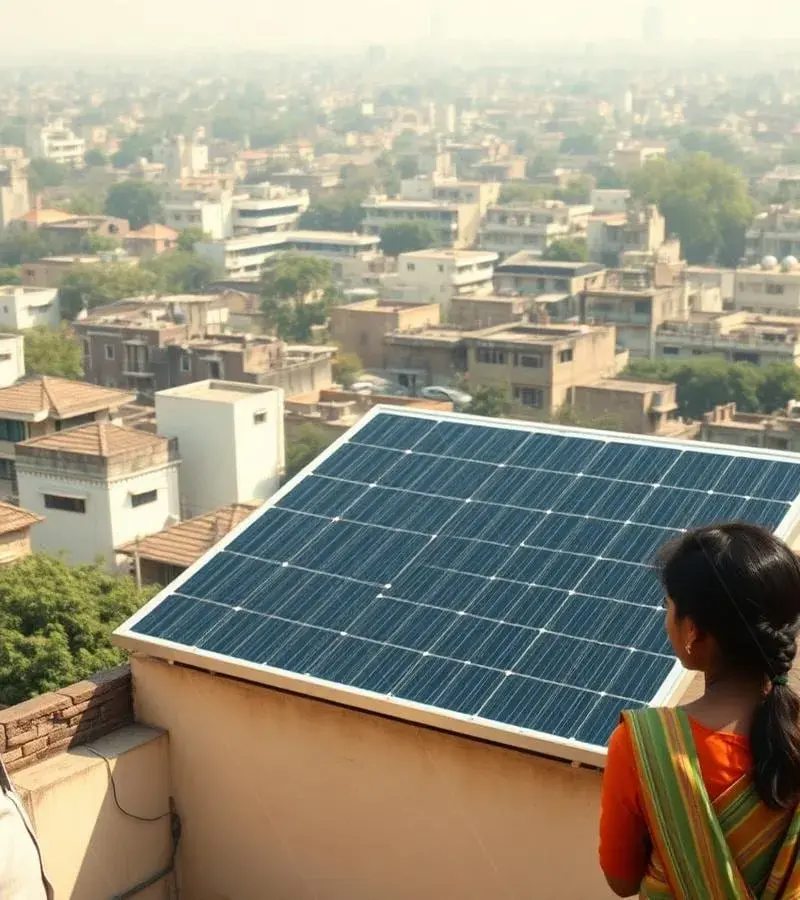
- •No rooftop needed: Virtual Net Metering (VNM) credits solar from a shared plant straight onto your BSES/TPDDL bill
- •Who it is for: flat owners, tenants, shaded or small roofs, RWAs and institutions
- •Official framework: metered and credited by your discom under the DERC net-metering regulations
- •Proven in Delhi: Bridgeway commissioned Delhi''s first VNM plant under BRPL in 2024
In short: Virtual Net Metering (VNM) lets you go solar in Delhi even if you don''t have a usable rooftop. You own — or subscribe to — a share of a solar plant located somewhere else, and the electricity it generates is credited straight onto your own BSES/DISCOM bill, month after month, under the DERC net-metering framework. No panels on your home, no roof rights needed, a lower bill from day one.
If you live in a flat, rent your home, have a shaded or small roof, or your society can''t agree on a rooftop project, VNM is the route that finally makes solar possible for you. This guide explains exactly how it works in Delhi, who qualifies, what it costs and saves, and how to get started.
What is Virtual Net Metering?
Virtual Net Metering is an arrangement where the solar generation from a plant that is not on your own roof is credited to your electricity connection. You get a share of a larger solar plant; the DISCOM meters that plant''s output and adjusts your allotted units against your monthly consumption — exactly as a rooftop system would, but the panels sit elsewhere. It''s "solar without a rooftop."
Delhi enables this through the DERC net-metering regulations, which recognise both Group Net Metering and Virtual Net Metering, so the credits flow officially through your discom (BSES Rajdhani / BSES Yamuna / TPDDL) rather than through any private arrangement.
Who is VNM / community solar for?
VNM is built for everyone rooftop solar leaves out:
- Flat and apartment owners with no independent roof of their own.
- Tenants and renters who won''t invest in a roof they don''t own.
- Homes with a shaded, small, or structurally weak roof where a rooftop plant won''t perform.
- RWAs and housing societies that want solar for many flats but can''t fit — or agree on — a single rooftop system. (See our Dwarka society RWA guide for how one GBM resolution splits a rooftop two ways.)
- Institutions (schools, hospitals, offices) that want the savings without the capex or roof works.
If you have a good, unshaded roof you own outright, conventional rooftop solar is usually still the simplest option. For everyone else, VNM is the answer.
How does it actually work in Delhi?
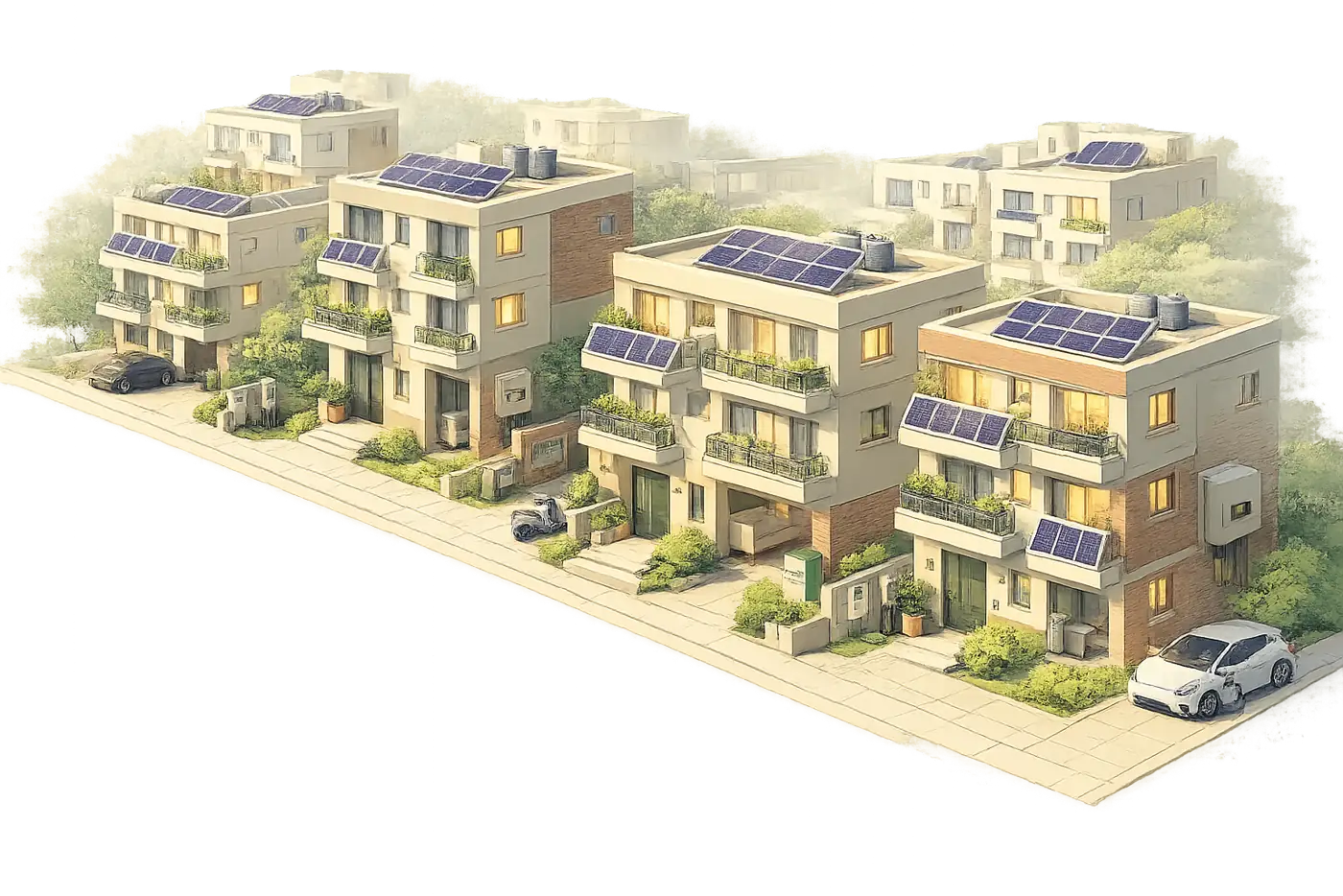
- You take a share of a shared solar plant — sized to roughly match your yearly consumption. Nothing is installed at your home.
- The plant is metered and registered with your discom under the net-metering framework, so its generation is officially recognised.
- Your share''s units are credited to your bill every month through virtual net metering, reducing what you pay the discom.
- Maintenance, insurance and generation are handled for you — you simply enjoy a lower bill for the life of the contract.
What does it cost, and what do you save?
You can go solar under VNM either by owning a share (a one-time cost, like buying a small rooftop system) or, where offered, by subscribing with little-to-no upfront cost and simply paying a lower per-unit rate than the grid. Either way the goal is the same: your effective cost of electricity drops below the discom tariff, and stays there for years.
Actual savings depend on your consumption, your tariff slab and the plan you choose — but the principle is simple: every solar unit credited to your bill replaces a grid unit you would have paid full price for. Ask us for a quick estimate against your latest bill.
Talk to a solar engineer — not a salesperson
Check whether we install in your area, then get your answer on WhatsApp. No forms, no call centre.
Translate your bill into a system size
VNM vs Group Net Metering vs rooftop — which is which?
| Rooftop net metering | Group Net Metering (GNM) | Virtual Net Metering (VNM) / community solar | |
|---|---|---|---|
| Where are the panels? | On your own roof | On one property you own | On a shared plant elsewhere |
| Do you need a roof? | Yes | Yes (one of your properties) | No |
| Best for | Owners with a good roof | One owner, multiple connections | Flats, tenants, no/shaded roof, societies |
| Credits flow via | Your meter | Across your connections | Your bill, from a share of the shared plant |
Why Bridgeway for community solar in Delhi
Bridgeway Power Services has been installing solar across Delhi NCR since 2019, carries the Sunson group''s 45 MW+ project legacy, and holds a 4.7-star customer rating. We commissioned Delhi''s first Virtual Net Metering solar plant under BRPL in 2024 — the model this whole category is built on. When you go solar without a roof with us, your allocation is backed by the team that actually pioneered and runs it here. Start with our community solar page for Delhi homeowners.
Frequently asked questions
Do I need a rooftop to go solar in Delhi?
No. With Virtual Net Metering you take a share of a shared solar plant and its generation is credited to your bill — nothing is installed at your home.
Is Virtual Net Metering legal and official in Delhi?
Yes. It runs through the DERC net-metering framework and is metered and credited by your discom (BSES Rajdhani, BSES Yamuna or TPDDL).
Can tenants and renters use VNM?
Yes — because nothing is fixed to your home, VNM suits renters and flat-dwellers who can''t or won''t install a rooftop system.
What happens to my VNM share if I move?
Your allocation is virtual, so it can typically be transferred — talk to us about the reallocation process for your plan.
How do I start with community solar in Delhi?
Share your latest electricity bill on WhatsApp and we''ll size the right share and show your monthly saving.
Go solar without a rooftop. WhatsApp/Call +91 92890 27500 · sales@bridgewaypower.in · bridgewaypower.in
Sources / further reading: DERC net-metering (Group & Virtual Net Metering) guidelines; Delhi government "Pathways to install solar" (solar.delhi.gov.in).
Every 1 kW of solar on your roof offsets 1.5 tonnes of CO₂ per year
That's 40 trees planted — every year, for 25 years.
A typical 5 kW home system offsets 187 tonnes of carbon over its lifetime. That's equivalent to taking 8 cars off the road.
See your impact →How much can you save with solar?
Enter your electricity bill → get system size, subsidy amount & payback period
Get StartedTranslate your bill into a system size
Related Articles
Lock In a Fixed Electricity Rate for Your School — Before Delhi Tariffs Rise Again
Lock in your school's electricity rate before Delhi tariffs hit ₹16/unit. Learn how Community Solar offers zero-capex savings of ₹10L+ annually.
Read moreWhat Delhi's Solar Policy Means for Apartment Owners and Non-Rooftop Residents
Discover how Delhi's 2026 solar policy enables apartment owners to save 40% on bills using Virtual Net Metering. No roof access or RWA NOC required.
Read moreVirtual Net Metering (VNM) in India: How It Enables Community Solar for Homeowners
Learn how Virtual Net Metering (VNM) enables community solar in India. Discover how DERC and RERC policies allow flat owners to share solar credits without individual rooftops.
Read moreRelated guides
Housing Society Solar — RWA & CGHS
Common-area rooftop solar, subsidy and VNM/GNM for Delhi societies.
ExploreCommunity Solar — Delhi Homeowners
No rooftop needed. Govt covers 80%. Credits land on your BSES bill via VNM.
ExploreSolar Without a Roof
Flats, societies, rentals — three routes to solar when the roof isn't yours.
ExploreEnphase IQ8 10 kWp Bungalow, Gurgaon
Case study: module-level monitoring, IP67 microinverters, shade-tolerant yield.
ExploreHousing Society VNM: RWA & CGHS Steps
How a Delhi society files VNM/GNM — resolution to credits on enrolled flats.
ExploreVNM vs GNM vs Community Solar
Rooftop, group or virtual net metering — which one actually fits your Delhi flat?
Explore