
By Arshi Chadha, Founder · Bridgeway Power
VNM vs Group Net Metering vs Community Solar: Which One for Your Delhi Flat?
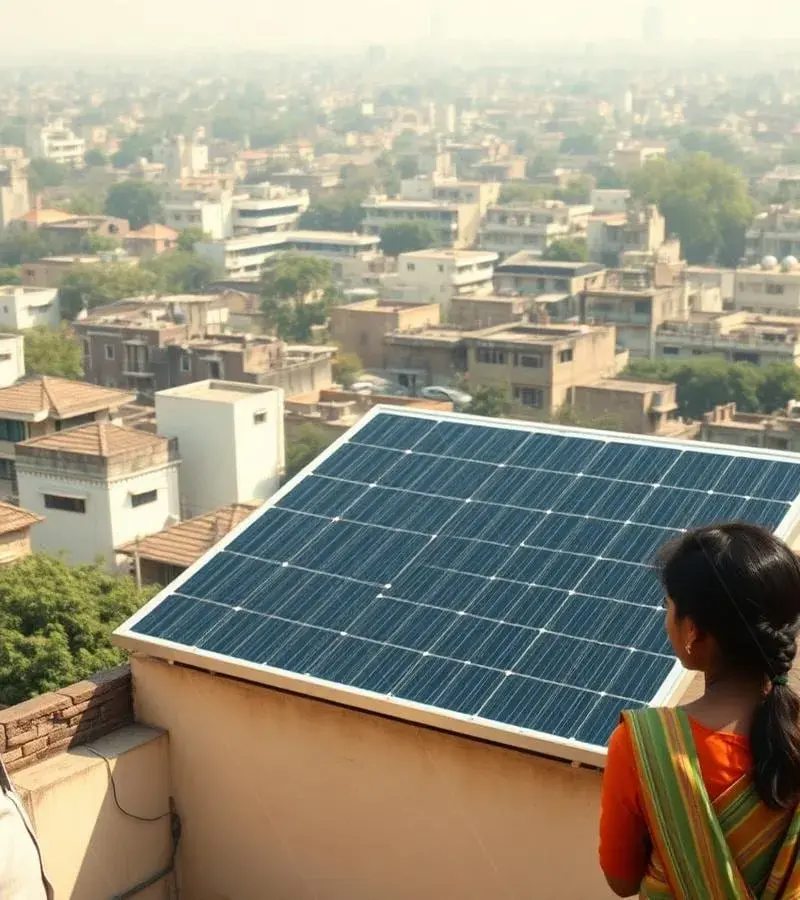
- •Net metering = solar on your own roof, credited to your own meter
- •Group Net Metering (GNM) = one owner spreading surplus credits across their own multiple connections
- •Virtual Net Metering (VNM) = many people sharing one plant elsewhere — the basis of community solar
- •No usable roof? VNM / community solar is almost always your route in Delhi
In short: These terms sound alike but solve different problems. Net metering credits solar from your own roof. Group Net Metering (GNM) lets one owner move surplus solar credits across several of their own electricity connections. Virtual Net Metering (VNM) lets many people share one solar plant that sits somewhere else — the basis of community solar, and the only option if you have no usable roof of your own. If you live in a Delhi flat with no roof rights, VNM / community solar is almost always your route.
Here''s how to tell them apart and choose the right one.
The one-table comparison
| Net metering (rooftop) | Group Net Metering (GNM) | Virtual Net Metering (VNM) / community solar | |
|---|---|---|---|
| What it is | Solar on your own roof, credited to your meter | Surplus from one solar system shared across your own multiple connections | A share of a shared solar plant elsewhere, credited to your bill |
| Do you need a roof? | Yes, your own | Yes, at least one property | No |
| Who owns the plant | You | You | You (a share) or a developer you subscribe to |
| Ideal for | Independent house with a good roof | One owner with several meters (e.g. a farmhouse + shop + home) | Flats, tenants, shaded/small roofs, RWAs, institutions |
| Upfront cost | Full system cost (subsidy applies) | Full system cost | Buy a share, or subscribe with low/no upfront |
| Roof works at your home | Yes | Yes (on the host property) | None |
| Runs under | DERC net metering | DERC group net metering | DERC virtual net metering |
When to choose each
Choose rooftop net metering if you own an independent house with a sound, unshaded roof. It''s the simplest, cheapest per-unit path and qualifies directly for rooftop subsidy.
Choose Group Net Metering if you''re a single owner with multiple electricity connections — say a home, a shop and a farmhouse — and one of them has roof space. GNM lets the surplus from that one system wipe out bills across all your connections.
Choose Virtual Net Metering / community solar if you have no roof of your own to use — you''re in a flat, you rent, your roof is shaded or too small, or your society can''t run a single rooftop project. You take a share of a shared plant and the credits land on your bill, with nothing installed at home.
A quick decision guide
- I own a good roof → Rooftop net metering.
- I own several places, one has a roof → Group Net Metering.
- I live in a flat / rent / no usable roof → Virtual Net Metering (community solar).
- We''re an RWA / society wanting solar for many flats → VNM / community solar (often with a group arrangement) — see our Dwarka society guide.
Talk to a solar engineer — not a salesperson
Check whether we install in your area, then get your answer on WhatsApp. No forms, no call centre.
Translate your bill into a system size
Frequently asked questions
Is community solar the same as virtual net metering?
Community solar is the product — you buy or subscribe to a share of a shared plant. Virtual Net Metering is the mechanism that credits that share to your electricity bill. In practice, in Delhi, they go together.
What is the real difference between GNM and VNM?
GNM shares credits across connections owned by the same person. VNM lets different people share one plant. If you don''t own a roof at all, you need VNM.
Does VNM work with BSES / TPDDL?
Yes — it runs through the DERC net-metering framework and is credited by your discom (BSES Rajdhani, BSES Yamuna or TPDDL).
Which option saves more?
Per unit, a well-sited rooftop system is usually cheapest. But if you have no roof, the honest comparison is VNM vs paying full grid tariff — and VNM wins that every time.
Not sure which fits your home or society? Share your latest bill on WhatsApp and we''ll tell you. +91 92890 27500 · sales@bridgewaypower.in
Bridgeway Power Services has been installing solar across Delhi NCR since 2019, carries the Sunson group''s 45 MW+ project legacy, holds a 4.7-star customer rating, and commissioned Delhi''s first Virtual Net Metering plant under BRPL in 2024. See also: our pillar guide — Community Solar & Virtual Net Metering in Delhi.
Sources / further reading: DERC net-metering (Group & Virtual Net Metering) guidelines; Delhi government "Pathways to install solar" (solar.delhi.gov.in).
Every 1 kW of solar on your roof offsets 1.5 tonnes of CO₂ per year
That's 40 trees planted — every year, for 25 years.
A typical 5 kW home system offsets 187 tonnes of carbon over its lifetime. That's equivalent to taking 8 cars off the road.
See your impact →How much can you save with solar?
Enter your electricity bill → get system size, subsidy amount & payback period
Get StartedTranslate your bill into a system size
Related Articles
Lock In a Fixed Electricity Rate for Your School — Before Delhi Tariffs Rise Again
Lock in your school's electricity rate before Delhi tariffs hit ₹16/unit. Learn how Community Solar offers zero-capex savings of ₹10L+ annually.
Read moreWhat Delhi's Solar Policy Means for Apartment Owners and Non-Rooftop Residents
Discover how Delhi's 2026 solar policy enables apartment owners to save 40% on bills using Virtual Net Metering. No roof access or RWA NOC required.
Read moreVirtual Net Metering (VNM) in India: How It Enables Community Solar for Homeowners
Learn how Virtual Net Metering (VNM) enables community solar in India. Discover how DERC and RERC policies allow flat owners to share solar credits without individual rooftops.
Read moreRelated guides
Housing Society Solar — RWA & CGHS
Common-area rooftop solar, subsidy and VNM/GNM for Delhi societies.
ExploreCommunity Solar — Delhi Homeowners
No rooftop needed. Govt covers 80%. Credits land on your BSES bill via VNM.
ExploreSolar Without a Roof
Flats, societies, rentals — three routes to solar when the roof isn't yours.
ExploreEnphase IQ8 10 kWp Bungalow, Gurgaon
Case study: module-level monitoring, IP67 microinverters, shade-tolerant yield.
ExploreHousing Society VNM: RWA & CGHS Steps
How a Delhi society files VNM/GNM — resolution to credits on enrolled flats.
ExploreVirtual Net Metering in Delhi
No usable roof? Own a share of a shared solar plant — credits land on your BSES bill via VNM.
Explore