
By Bhawna Thakur · Reviewed by Arshi Chadha, Founder
Solar Without Capex for Hospitals: How Delhi NCR Facilities Are Cutting Bills to Zero Investment
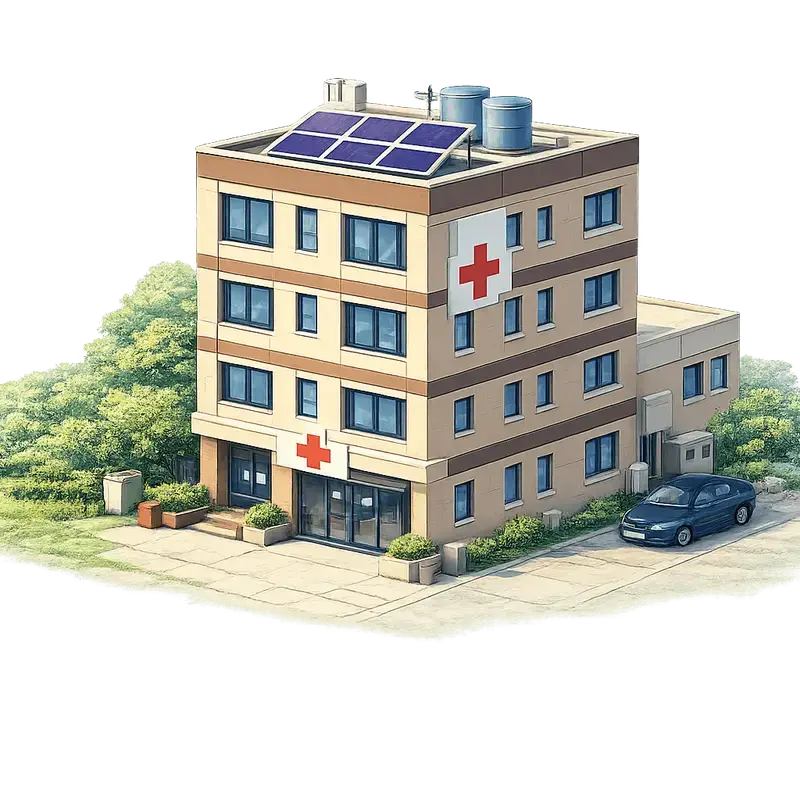
- •Investment Model: Zero Capex (OPEX/Community Solar)
- •Initial Investment: ₹0 (Zero Upfront)
- •Immediate Savings: 15% – 30% on electricity tariff
- •Maintenance: Handled entirely by Bridgeway Power
- •Disruption: Zero (No panels installed on hospital roof)
- •Target Facilities: Hospitals, Nursing Homes, and Multi-specialty Clinics in Delhi NCR
Hospitals in Delhi NCR operate under immense pressure. Beyond the clinical challenges, the administrative burden of rising operational costs is a constant battle. For a 50-bed multi-specialty facility in areas like South City Gurgaon or Rohini, electricity isn't just a utility—it’s a life-support system. Between HVAC systems running 24/7, high-end diagnostic machinery (MRI/CT scans), and intensive care units, electricity bills often run into several lakhs per month.
Until recently, the only way to tackle these bills was to "go solar" by installing panels on the hospital roof. However, most hospital administrators have historically rejected this for three reasons: the massive ₹50–80L upfront cost, the risk of rooftop structural damage, and the nightmare of construction activity in a sterile environment.
Today, a new shift is happening. By leveraging solar without capex hospital Delhi facilities are now cutting their bills to zero investment through the OPEX and Community Solar models.
Why Traditional Solar Fails the Hospital "Stress Test"
Traditional rooftop solar is a "Capex" (Capital Expenditure) model. You buy the equipment, you own the system, and you take the risk. For a hospital, this presents significant hurdles:
- Capital Diversion: A 100kW solar plant costs approximately ₹50–60 Lakhs. Most hospital boards would rather spend that capital on a new MRI machine or ICU beds than on energy infrastructure that takes 4 years to pay back.
- Structural Limitations: Many hospitals in Delhi NCR are older structures. Their roofs are already crowded with HVAC chillers, water tanks, and oxygen plants. Adding 25,000 kg of solar equipment is often structurally impossible.
- Infection Control: Solar installation is a construction project. It involves drilling, dust, and labor movement—all of which are high-risk factors for hospital infection control protocols.
This is where the zero capex solar hospital model changes the game.
Community Solar: The Zero-Capex Revolution for Healthcare
Community solar (often facilitated via Virtual Net Metering) allows a hospital to benefit from solar power without actually installing anything on its own roof. The solar plant is located at a remote, optimized site, and the "green credits" are adjusted against the hospital's BSES or Tata Power bill.
Table 1: Capex vs. OPEX (Community Solar) Comparison
| Feature | Traditional Capex Rooftop | Community Solar / OPEX Model |
|---|---|---|
| Upfront Cost | ₹50L – ₹80L (High) | ₹0 (Zero Investment) |
| Maintenance | Hospital's Responsibility | Managed by Bridgeway Power |
| Structural Impact | Risk of leaks/load issues | Zero impact on hospital building |
| Installation Time | 2-3 Months of construction | Paperwork only (Instantly active) |
| Equipment Warranty | 25 Years (Self-managed) | 25 Years (Provider-managed) |
| Scalability | Limited by roof space | Unlimited (Add more units anytime) |
For a facility in Greater Kailash or Dwarka, where space is at a premium and electricity tariffs are high, this model is the most efficient way to achieve sustainability goals.
The ROI Math: Saving from Day 1
In a Capex model, your "savings" only truly start after the payback period (the point where the cumulative savings equal the initial investment). With no upfront solar commercial Delhi models, the savings are immediate.
Table 2: ROI Timeline Comparison
| Year | Capex Model (₹60L Investment) | community solar / OPEX Model |
|---|---|---|
| Year 0 | -₹60,00,000 (Outflow) | ₹0 (No Outflow) |
| Year 1 | ₹15L Saved (Still in loss) | ₹3L to ₹5L Net Profit |
| Year 3 | ₹45L Saved (Breakeven approaching) | ₹10L to ₹15L Cumulative Profit |
| Year 5 | System pays for itself | Full Savings without any debt |
In the OPEX model, the hospital enters into a Power Purchase Agreement (PPA). You only pay for the units generated, usually at a rate significantly lower than the DERC commercial tariff. This protects the hospital from the 8–12% annual tariff hikes common in the NCR region.
Solving Hospital-Specific Constraints
Healthcare facilities face unique challenges that residential or standard commercial buildings don't. When considering community solar hospital Delhi managers must account for operational continuity.
Table 3: Addressing Hospital-Specific Constraints
| Constraint | The Problem | The Community Solar Solution |
|---|---|---|
| Structural Load | Roofs overloaded with HVAC & Tanks | No panels on-site; zero load added. |
| Infection Control | Dust and drilling during install | Zero on-site activity or labor movement. |
| Waterproofing | Piercing roof membrane leads to leaks | Roof remains untouched. |
| Expansion Plans | Solar panels block future floors | Doesn't hinder future vertical growth. |
| Roof Leasing | Complex legalities for leased buildings | Only a billing agreement is required. |
Hospitals often run on 5–10 year expansion plans. Installing a fixed rooftop system might prevent a hospital from adding a new floor in three years. Community solar provides the flexibility to move, expand, or scale without worrying about physical hardware.
Ideal for Hospital Chains and Multi-Location Clinics
One of the biggest advantages of the OPEX solar model hospital India approach is standardization. If you are a hospital chain with facilities in Noida, Gurgaon, and Faridabad, auditing and maintaining rooftop plants at each location is an administrative nightmare.
With Group Net Metering, you can source power for all your locations from a single off-site solar farm. This allows for:
- Standard Energy Pricing: All branches pay the same solar tariff.
- Centralized Monitoring: Track total savings from a single dashboard.
- Simplified Accounting: No depreciation schedules or maintenance invoices for individual sites.
Talk to a solar engineer — not a salesperson
Check whether we install in your area, then get your answer on WhatsApp. No forms, no call centre.
What would solar save on YOUR bill?
Solar Depreciation & Tax Benefit Calculator
Based on Section 32 — 40% WDV + 20% additional depreciation (Year 1)
Real-World Example: A 100-Bed Facility in Delhi NCR
Consider a mid-sized hospital in Rajouri Garden with a monthly electricity bill of ₹6,00,000 (Average consumption: 60,000 units at ₹10/unit).
Traditional Option: They would need a 500kW rooftop system costing roughly ₹2.5 Crore.
- Obstacle: The hospital doesn't have 50,000 sq. ft. of clear roof space, nor do they want to block ₹2.5 Crore in capital.
Bridgeway Power Solution: We transitioned them to a zero-capex Community Solar model.
- Investment: ₹0.
- Solar Tariff: ₹7.00 per unit (Fixed).
- Monthly Savings: They now pay ₹4,20,000 for those 60,000 units instead of ₹6,00,000.
- Net Result: An immediate monthly cash flow increase of ₹1,80,000—without touching their balance sheet.
Protection Against Rising Tariffs
Commercial electricity rates in Delhi and Haryana are subject to various surcharges, including the PPAC (Power Purchase Adjustment Cost). These hidden charges can inflate a hospital's bill by 20% overnight.
By signing a long-term agreement for solar without capex hospital Delhi becomes a predictable expense. Most PPAs offer a fixed rate for 15–25 years, ensuring that while the grid power prices rise, your solar power price remains constant.
Why Choose Bridgeway Power for Your Hospital?
With over 35 years of experience and 5,000+ installations, Bridgeway Power understands the technical and regulatory landscape of Delhi NCR. We navigate the complexities of Net Metering and DISCOM approvals so the hospital staff can focus on what they do best: saving lives.
If your facility is located in any of our serviceable areas—from Janakpuri to Noida Extension—we provide a comprehensive audit to see how much you can save with zero upfront investment.
Use our Solar Calculator to estimate your potential savings today.
Frequently Asked Questions
What does "Zero Capex" actually mean for a hospital?
Zero Capex means the hospital does not pay for the solar panels, inverters, or installation. A third party (like an investor or a solar developer) pays for the equipment and installs it (either on your roof or off-site). The hospital only pays for the electricity produced at a discounted rate.
How does community solar work if I don't have enough roof space?
Community solar uses Virtual Net Metering. A solar plant is set up in a sunny, remote location. The electricity generated is fed into the grid, and your local DISCOM (like BSES or Tata Power) credits that amount to your hospital's electricity bill. It is purely a billing arrangement.
Is the solar tariff fixed for 25 years?
In most OPEX models, the tariff is either fixed for the entire duration or has a very small, pre-agreed annual escalation (usually much lower than the 8-10% increase seen in commercial grid tariffs). This provides excellent long-term budget certainty.
Who is responsible for cleaning and maintaining the panels?
In a zero-capex or OPEX model, the solar provider is responsible for everything—cleaning, repairs, and insurance. Since the provider only gets paid when the system generates power, they are highly incentivized to ensure the system is always running at peak efficiency.
Can we switch back to the grid if the solar system fails?
Yes. Your hospital remains connected to the DISCOM grid at all times. Solar power acts as the primary source during the day, and the grid provides back-up or night-time power. There is no risk of power interruption due to the solar system.
Does this help with National Accreditation Board for Hospitals (NABH) compliance?
Yes! Many accreditation bodies, including NABH, look favorably upon green energy initiatives and sustainability practices. Moving to solar helps fulfill your Environmental, Social, and Governance (ESG) goals.
Conclusion
The era of hospitals being forced to choose between "new medical equipment" and "lower electricity bills" is over. By adopting the solar without capex hospital Delhi model, healthcare facilities can finally modernize their energy infrastructure with zero financial risk.
Whether you are a small clinic in Paschim Vihar or a large multi-specialty center in Vasant Kunj, the math is clear: zero investment, immediate savings, and zero operational disruption.
Ready to cut your hospital's operating costs? Contact Bridgeway Power for a Free Energy Audit and see how our community solar solutions can bring your electricity bills down to earth.
For more information on financing, you can also explore options with our partners like ECOFY Solar Financing, Aerem Solar Finance, or various PSU schemes like the SBI PM Surya Ghar Loan and PNB Solar Rooftop Scheme.
Every 1 kW of solar on your roof offsets 1.5 tonnes of CO₂ per year
That's 40 trees planted — every year, for 25 years.
A typical 5 kW home system offsets 187 tonnes of carbon over its lifetime. That's equivalent to taking 8 cars off the road.
See your impact →How much can you save with solar?
Enter your electricity bill → get system size, subsidy amount & payback period
Get StartedGo solar without owning a rooftop
Community Solar gives commercial & institutional consumers the same savings — zero capex, zero roof needed.
Or get a free solar quote
Tell us about your rooftop — we'll call with exact savings for your home.
Related Articles
Lock In a Fixed Electricity Rate for Your School — Before Delhi Tariffs Rise Again
Lock in your school's electricity rate before Delhi tariffs hit ₹16/unit. Learn how Community Solar offers zero-capex savings of ₹10L+ annually.
Read moreWhat Delhi's Solar Policy Means for Apartment Owners and Non-Rooftop Residents
Discover how Delhi's 2026 solar policy enables apartment owners to save 40% on bills using Virtual Net Metering. No roof access or RWA NOC required.
Read moreVirtual Net Metering (VNM) in India: How It Enables Community Solar for Homeowners
Learn how Virtual Net Metering (VNM) enables community solar in India. Discover how DERC and RERC policies allow flat owners to share solar credits without individual rooftops.
Read moreRelated guides
Delhi Electricity Rate 2026
BSES & Tata Power per-unit rates, PPAC, subsidy — sourced from DERC.
ExploreDelhi Solar Policy 2026
Free rooftop solar up to 3 kW for homes under 400 units. Eligibility & apply.
ExploreSolar Panel Price in Delhi
Live 2026 rooftop prices in Delhi after ₹1.56L subsidy. 1,200+ installs.
ExploreSolar Company in Gurgaon
Gurgaon's rooftop solar installer — 800+ systems, ₹78K PM Surya Ghar subsidy.
ExploreSolar Company in Noida
Noida & Greater Noida rooftop solar — 500+ installs, ₹1.08L stacked subsidy.
ExploreSolar Panel Price in Faridabad
Live 2026 Faridabad prices after ₹78K PM Surya Ghar subsidy. 350+ homes.
Explore