
Factories & Warehouses · Delhi NCR
Solar for Factories & Warehouses in Delhi NCR — Industrial Rooftop, Costed Honestly
Power is one of the top three input costs in Indian manufacturing. Industrial tariffs are climbing; cross-subsidy surcharge keeps growing. A rooftop solar plant locks in a fraction of that for 25 years.
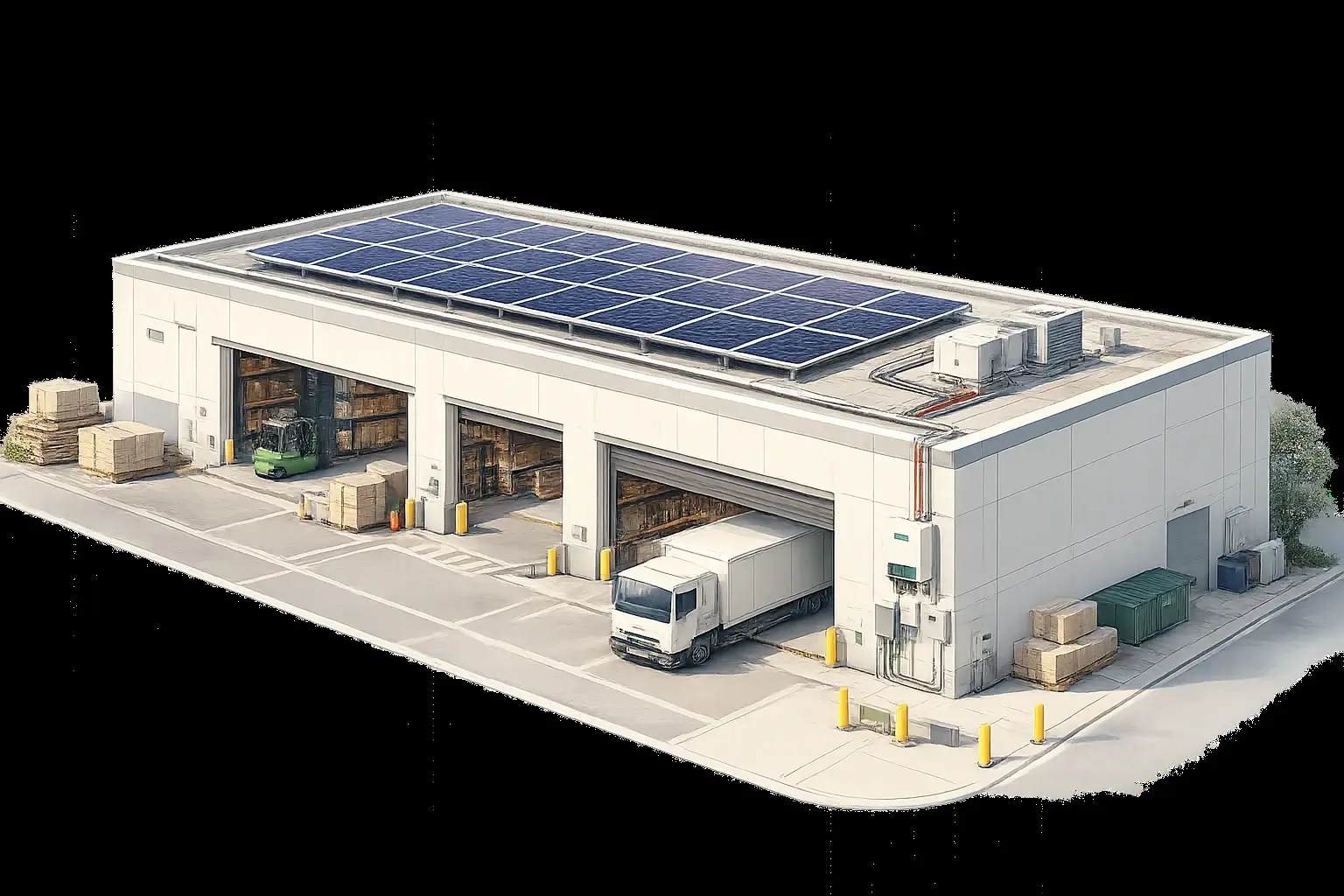
Why This Matters for Factories & Warehouses
The case for solar on a factorie, in plain numbers.
Industrial tariff with demand charges: ₹9–11 per unit effective. Solar LCOE: ₹2.8–3.5 per unit.
Accelerated depreciation: 40% in year one under section 32. Real cash benefit for profit-making units.
Group captive for sites that can't fit a big enough rooftop — we structure the SPV.
Engineered for industrial reliability — surge protection, anti-harmonic design, hot-climate inverter selection.
Engineering reality
What Actually Decides a Factories & Warehouses Plant
Not panel brands. The connection class, the load curve, and the file the DISCOM accepts — these are the four things that change the answer.
HT-11 kV or 33 kV with contract demand in kVA and a two-part tariff — energy charge plus demand charge on the highest 30-minute demand in the billing cycle. In Haryana and UP industrial areas, cross-subsidy surcharge and additional surcharge on any open-access component are the numbers that decide rooftop versus group captive.
Depends entirely on shift pattern, and this is where generic industrial solar quotes go wrong. A single-shift unit self-consumes nearly all its generation; a 24×7 three-shift plant self-consumes the daytime third and exports or banks the rest under a settlement rate that is not 1:1 above 500 kW. Warehouses are the opposite problem — very large roofs over very small loads, where the plant is capped by sanctioned load rather than by roof area.
Above 500 kW most NCR industrial files move from net metering to net billing or a captive/group-captive open-access route, which is a different application, a different timeline, and a different tariff. Rooftop capacity is also capped as a percentage of sanctioned load — a warehouse with a 4 MW roof and 300 kW of sanctioned load cannot install 4 MW without first raising the sanctioned load.
Section 32 accelerated depreciation at 40% in year one is the real financial lever for a profit-making unit, and it is claimable only under CAPEX ownership. BRSR and customer ESG audits increasingly ask for scope-2 emission factors, which generation data answers directly.
Delhi NCR Specifics
How It Works Inside Your DISCOM
National EPCs reuse the same deck whether you're in Bengaluru or Bareilly. Your factorie sits inside a specific NCR DISCOM with its own rules.
BSES Rajdhani / BSES Yamuna (Delhi)
Commercial net-metering is permitted up to your sanctioned load. We design within those limits and handle the BRPL/BYPL liaisoning end-to-end — the part most vendors leave to you.
Tata Power Delhi (TPDDL)
North/north-west Delhi runs on TPDDL with its own application portal and feasibility window. We've moved commercial connections through it; we know which documents are the actual blockers.
DHBVN (Gurugram / Faridabad)
Haryana's commercial tariff plus cross-subsidy surcharge makes solar payback the most aggressive in NCR. Open-access and group captive structures are an option for larger factories.
UPPCL (Noida / Ghaziabad / Greater Noida)
UPNEDA + UPPCL coordination is where most outsiders get stuck for months. We've done it. We'll tell you up-front what your timeline actually looks like, not what a brochure says.
Typical Capacity for Factories & Warehouses
Most factories & warehouses we design land in the 500 kW – 5 MW range. A 1 MW plant is a good reference point.
See Full 1 MW Cost BreakdownCAPEX vs OPEX/PPA — Which Fits You?
The honest answer: it depends on your tax position and your appetite for capex. We do both. Here's the side-by-side.
Ready When You Are
Talk to the factorie solar desk — Delhi NCR.
A senior engineer (not a call-centre agent) responds within one working day with a real number — not a brochure.
Factories & Warehouses Decision-Makers Ask Us
Request a factorie Solar Proposal
A senior engineer will call you back within one working day with a real number — not a generic brochure.