
By Bhawna Thakur · Reviewed by Arshi Chadha, Founder
GST on Inverter and Battery: HSN Codes Explained
- •Inverter GST (Stand-alone): 18% (HSN 8504)
- •Battery GST (Stand-alone): 28% (HSN 8507)
- •Solar System GST (Residential): ~8.9% (Blended Composite Supply)
- •Key HSN Codes: 8504 (Inverters), 8507 (Batteries), 8541 (Solar Panels)
- •Payback Impact: Lower GST via composite supply can reduce residential system costs by 7-10%.
The Indian solar market is currently navigating a complex tax landscape where a single digit in an HSN code can change your project cost by lakhs. If you are buying a battery for your home backup, you pay 28% GST—the same "luxury" tax bracket as a Royal Enfield or a high-end AC. But if that same battery is part of a residential solar system, the math changes completely. In our 35+ years of electrical lineage, we’ve seen tax structures evolve from simple excise duties to the current multi-tiered GST system, and getting the HSN code wrong is the fastest way to get a notice from the tax department or overpay your installer.
Understanding the GST Split: 12% vs 18% vs 28%
The biggest point of confusion we hear from customers in solar in Delhi or Noida is why the GST on their quote looks "weird." It’s rarely a flat number. This is because solar components fall under different tax brackets depending on how they are sold.
The Ministry of New & Renewable Energy has pushed for lower rates to encourage green energy, but the GST Council has specific buckets for electrical goods.
- Solar Panels (HSN 8541): Currently, these are at 12%.
- Solar Inverters (HSN 8504): Stand-alone, these attract 18% GST.
- Batteries (HSN 8507): These are the heavy hitters at 28% GST.
However, for residential rooftop projects, we typically use a "Composite Supply" model. According to CBIC clarifications, when you buy a solar power generating system as a single contract, the tax is calculated as a blend. The current gst_rooftop_residential rate is approximately 8.9% (derived from 70% of the value at 12% and 30% of the value at 18% for services/BOS).
HSN Codes for Inverters and Batteries
If you’re looking at your invoice, these are the codes that dictate your tax outflow. We always tell our clients to double-check these; an incorrect inverter hsn code can lead to rejected Solar Calculator ROI projections.
HSN 8504: The Inverter Code
Inverters fall under HSN 8504, specifically 850440 for static converters. Whether you are choosing a string inverter or a microinverter, this code applies. If you buy an inverter separately for a shop or home without panels, you are billed at 18%.
HSN 8507: The Battery Code
Batteries are classified under HSN 8507. For solar applications, we almost exclusively use Lithium Ferrophosphate (LFP) chemistry now because of their 6,000-cycle lifespan. Even though they are "green" tech, the tax code sees them as lead-acid alternatives, hence the 28% rate.
HSN Codes for Solar Components
| Component | HSN Code | Stand-alone GST Rate | Residential System Rate (Composite) |
|---|---|---|---|
| Solar Panels | 85414300 | 12% | ~8.9% |
| Solar Inverters | 8504 | 18% | ~8.9% |
| Lithium/Lead Batteries | 8507 | 28% | 28% (Usually excluded from blend) |
| Mounting Structure | 7308 | 18% | ~8.9% |
| Solar DC/AC Cables | 8544 | 18% | ~8.9% |
Note: For battery-based (Hybrid) systems, most DISCOMs and tax experts advise that the battery is taxed at its individual rate of 28% even if part of a solar bundle, as it is seen as a storage device, not just a "generating" component.
Tax Implications: System vs. Individual Parts
We often see homeowners trying to save money by sourcing panels from one guy, the inverter from another, and the structure from a local fabricator. This is a tax trap.
When you buy individual parts:
- You pay 18% on the inverter hsn code.
- You pay 18% to 28% on the wires and batteries.
- You pay 18% on the installation labor.
When you hire a professional EPC like Bridgeway for a rooftop solar project, we provide a composite supply GST solar invoice. By bundling the goods and services, the entire project (excluding the battery in some jurisdictions) is taxed at the concessional rate of ~8.9%. On a 10kW system costing ₹6,29,442, this tax difference alone can save you nearly ₹40,000–₹50,000.
Real Example: 5kW Hybrid System in Gurgaon
Talk to a solar engineer — not a salesperson
Enter your pincode and monthly bill. If we install in your area, an engineer answers on WhatsApp with your numbers.
What would solar save on YOUR bill?
Solar Depreciation & Tax Benefit Calculator
Based on Section 32 — 40% WDV + 20% additional depreciation (Year 1)
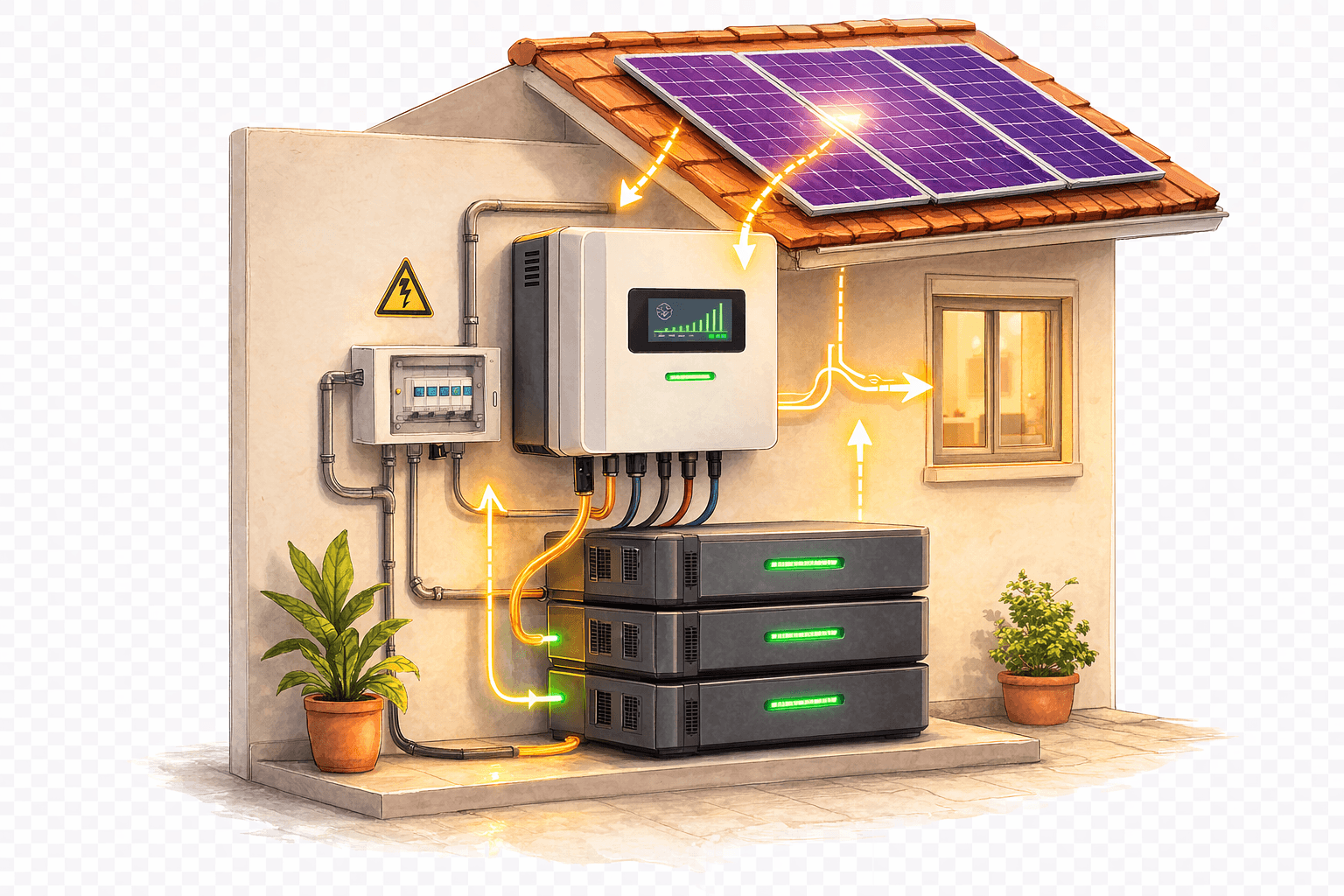
A homeowner in solar in Gurgaon wanted to install a 5kW system with a 5kWh Lithium battery to handle power cuts.
-
Scenario A (Buying Separately):
- 5kW Solar Panels (12%): ₹1,80,000 + ₹21,600 GST
- 5kW Hybrid Inverter (18%): ₹65,000 + ₹11,700 GST
- 5kWh LFP Battery (28%): ₹1,50,000 + ₹42,000 GST
- Total GST Paid: ₹75,300
-
Scenario B (Bridgeway Composite Quote):
- 5kW System (Blended 8.9%): ₹3,50,000 + ₹31,150 GST
- 5kWh Battery (28%): ₹1,50,000 + ₹42,000 GST
- Total GST Paid: ₹73,150
In the second scenario, the homeowner effectively saved on the panel and inverter tax by bundling the installation services. More importantly, they secured a workmanship warranty of 5 years that you simply don't get when buying piecemeal.
How to Claim ITC for Commercial Solar
If you are a business owner in Okhla or Manesar, solar isn't just an energy saver; it’s a massive tax shield. Unlike residential users, commercial and industrial (C&I) clients can claim the full GST paid as Input Tax Credit (ITC).
- Full Offset: The 12% GST on panels and 18% on inverters can be used to offset the GST you collect from your customers. This effectively reduces your project cost by the tax amount.
- Accelerated Depreciation: Businesses can also claim 40% depreciation in the first year.
- Financing: Partners like SBI PM Surya Ghar Loan or Aerem Solar Finance offer specific products for MSMEs where the GST portion can sometimes be funded as a separate short-term limit until you claim the ITC.
If you are a business, check out our MSME solar plant cost guide for a deeper look at the ROI math.
The "DCR" Factor in GST and Subsidy
You cannot talk about GST without mentioning DCR (Domestic Content Requirement). If you want to claim the PM Surya Ghar Muft Bijli Yojana subsidy (up to ₹78,000 for residential), you must use DCR panels. From a tax perspective, the HSN code remains the same, but the pricing is slightly higher. However, for those not seeking a subsidy—like many commercial projects—using non-DCR panels can result in a reduction of ₹10,000 per kW in the gross price.
FAQ
What is the GST rate on a solar inverter in 2024?
If you buy a solar inverter separately, the GST rate is 18% under HSN 8504. However, if it is part of a complete rooftop solar installation for a home, it is usually taxed at a blended concessional rate of approximately 8.9% as part of a composite supply.
Can I claim GST back on a home solar system?
Individual residential homeowners cannot claim GST back (Input Tax Credit). Only registered businesses with a GST number who use the electricity for business purposes can claim the ITC to offset their output tax liability.
Why is the GST on solar batteries 28%?
Solar batteries are categorized under HSN 8507 along with all other electric accumulators. The GST Council currently views batteries as general-purpose electrical goods rather than exclusive solar equipment, keeping them in the highest 28% tax bracket.
What HSN code is used for solar mounting structures?
Solar mounting structures typically use HSN 7308 (Iron or steel structures). When sold stand-alone, they attract 18% GST. When included in a turnkey solar project, they fall under the blended solar system rate of ~8.9%.
Is the GST rate different for Mono PERC vs TOPCon panels?
No, the HSN code (8541) and the GST rate (12%) are determined by the product category (Photovoltaic cells/modules), not the specific technology like Mono PERC, Half-Cut, or TOPCon.
If you are planning to install solar in Janakpuri or any part of Delhi NCR, make sure your quotation explicitly lists the HSN codes. A vague invoice is the first sign of a fly-by-night operator. For an accurate, tax-compliant breakdown of your potential savings, you can always Get a free quote from our engineering team.
Every 1 kW of solar on your roof offsets 1.5 tonnes of CO₂ per year
That's 40 trees planted — every year, for 25 years.
A typical 5 kW home system offsets 187 tonnes of carbon over its lifetime. That's equivalent to taking 8 cars off the road.
See your impact →How much can you save with solar?
Enter your electricity bill → get system size, subsidy amount & payback period
Get StartedLiked this article? Get a free solar quote
Tell us about your rooftop — we'll call with exact savings for your home.
Related Articles
What Is Captive Open Access Solar (100% Equity Model)
Learn how Captive Open Access Solar (100% Equity Model) helps Indian businesses cut electricity costs by 40% using off-site solar plants. Guide on rules, savings & ROI.
Read moreHow Rooftop Solar Can Eliminate Your Electricity Bill
Discover how Net Metering and PM Surya Ghar subsidies can reduce your monthly electricity bill to near-zero. Learn about system sizing, costs, and real-world savings.
Read moreSolar Subsidy in Uttar Pradesh 2026: ₹1,08,000 for Noida, Ghaziabad & Greater Noida
UP's stacked solar subsidy 2026: ₹78,000 central + ₹30,000 UPNEDA state top-up = ₹1.08L. Real PVVNL net-cost math for Noida, Greater Noida, Ghaziabad & Meerut.
Read moreRelated guides
Delhi Electricity Rate 2026
BSES & Tata Power per-unit rates, PPAC, subsidy — sourced from DERC.
ExploreDelhi Solar Policy 2026
Free rooftop solar up to 3 kW for homes under 400 units. Eligibility & apply.
ExploreSolar Panel Price in Delhi
Live 2026 rooftop prices in Delhi after ₹1.56L subsidy. 1,200+ installs.
ExploreSolar Company in Gurgaon
Gurgaon's rooftop solar installer — 800+ systems, ₹78K PM Surya Ghar subsidy.
ExploreSolar Company in Noida
Noida & Greater Noida rooftop solar — 500+ installs, ₹1.08L stacked subsidy.
ExploreSolar Panel Price in Faridabad
Live 2026 Faridabad prices after ₹78K PM Surya Ghar subsidy. 350+ homes.
Explore