
By Vansh Dahiya · Reviewed by Arshi Chadha, Founder
DHBVN Net Metering for Faridabad Sector Societies
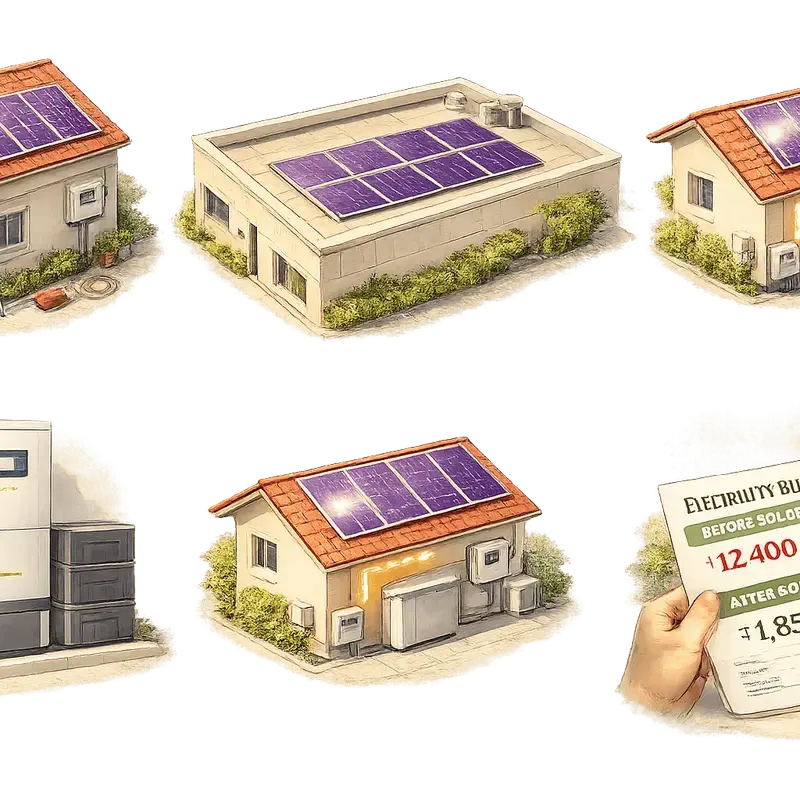
- •Eligibility: Societies with DHBVN connections (Bulk or individual).
- •Central Subsidy: Up to ₹78,000 for individual homes; ₹18,000/kW for GHS common areas.
- •Net Metering Savings: Up to 90% reduction on common area electricity bills.
- •Payback Period: 3.5 to 4.5 years for high-tariff society slabs.
Installing solar in a Faridabad sector society isn't just about putting panels on a roof; it’s about navigating the DHBVN net metering faridabad sector societies framework to ensure your investment actually shows up as a credit on your bill. At Bridgeway Power, we’ve handled the paperwork for hundreds of rooftops across Sectors 15, 21, and 37. We know that the Dakshin Haryana Bijli Vitran Nigam (DHBVN) process can feel like a maze, but if you get the documentation right the first time, you avoid the dreaded "application returned" status.
The Reality of DHBVN Net Metering for Society Connections
If you live in a multi-story society in Faridabad, you’re likely dealing with one of two scenarios: either you have an individual meter from DHBVN (common in builder floors), or the society has a Single Point Bulk Connection.
For the dhbvn net metering society process, the approval must come from the registered consumer. If it’s for common area lighting or lifts, the RWA (Resident Welfare Association) acts as the applicant. If you are an individual owner of a penthouse or top floor with roof rights, you apply under your own account, provided you have the No Objection Certificate (NOC) from the society.
Why Faridabad Societies are Going Solar Now
The Haryana residential tariff for the top slab (above 800 units) sits at ₹7.1/unit. When you add the FSA (Fuel Surcharge Adjustment) of ₹0.47/unit and electricity duty, you’re paying nearly ₹8 per unit. Solar generated on your roof costs effectively zero once the system is paid off.
We often see societies in NIT Faridabad or Ballabhgarh hesitate because of the "approval process." Let’s break down exactly what that looks like so you can stop overpaying for the grid.
Step-by-Step: DHBVN Solar Application Process
The dhbvn solar application is now largely digitized, but the physical verification remains the critical "make or break" step.
- Feasibility Analysis: Before you buy a single panel, we check the local transformer capacity. DHBVN allows solar integration up to a certain percentage of the transformer's rated capacity. In crowded sectors, this capacity fills up fast.
- Online Submission: The application is filed on the DHBVN Solar Portal. You’ll need your Latest Electricity Bill and Proof of Ownership.
- Technical Approval: A DHBVN Junior Engineer (JE) or Assistant Engineer (AE) will visit the site to verify the sanctioned load. You cannot install a solar plant larger than your sanctioned load. If you need more solar, you must first apply for a load increase.
- Installation & Work Completion: Once the "Green Signal" (Technical Feasibility) is granted, the installation begins. We ensure the system meets all MNRE and DHBVN technical standards, including the specific earthing and lightning arrester requirements.
- Inspection & Net Metering: After installation, a Work Completion Report is submitted. DHBVN inspectors verify the site, and the old meter is replaced with a "Bi-directional Net Meter."
DHBVN Society Application Checklist
Don't start your application without these documents. Missing even one can delay your faridabad society solar approval by weeks.
| Document Required | Specification | Who Provides It? |
|---|---|---|
| Latest Electricity Bill | Must be paid in full with no arrears | Homeowner / RWA |
| Identity Proof | Aadhaar or PAN of the account holder | Homeowner |
| Property Documents | Conveyance deed or Registry | Homeowner |
| RWA NOC | On society letterhead, permitting roof usage | RWA President/Secretary |
| Sanctioned Load Proof | Found on the top right of your DHBVN bill | DHBVN Bill |
| Solar Plant Layout | Detailed drawing of panel placement | Bridgeway Power |
| Inverter & Panel Datasheets | Must be ALMM approved for subsidy | Bridgeway Power |
Haryana Subsidy Status (2025-2026)
One thing we tell every customer: Haryana does not currently offer a state-level solar subsidy. While the central government provides massive relief through the PM Surya Ghar Muft Bijli Yojana, the Haryana state government (unlike Delhi or UP) does not add a cash top-up.
However, you still get the central subsidy:
- 1 kW: ₹30,000
- 2 kW: ₹60,000
- 3 kW to 10 kW: ₹78,000 (Capped)
For Group Housing Societies (GHS), the subsidy is ₹18,000 per kW for common area lighting, capped at 500 kW total. To calculate your exact expected payout, use our Solar Calculator.
From our installs
We recently completed a 10 kW system for a society penthouse in Sector 21, Faridabad.
- System Size: 10 kW (Mono PERC Half-Cut Panels)
- Locality: A high-rise society rooftop.
- Result: The owner’s monthly bill dropped from ₹12,000 to the minimum fixed charges (approx. ₹1,200).
- Caveat: The installation required an elevated structure to clear the lift room shadow, which added ₹3,000/kW to the base cost. Without that elevation, the winter generation would have dropped by 30%.
Talk to a solar engineer — not a salesperson
Check whether we install in your area, then get your answer on WhatsApp. No forms, no call centre.
Translate your bill into a system size
Solar Depreciation & Tax Benefit Calculator
Based on Section 32 — 40% WDV + 20% additional depreciation (Year 1)
Technical Hurdles in Faridabad Sectors

Faridabad's sectors often have older DHBVN infrastructure. We frequently encounter "transformer capacity reached" messages. If your society is in this situation, you have two choices: wait for DHBVN to upgrade the transformer, or look into Community Solar options.
For those who can install, the structure is the most important part. Many Faridabad roofs are used for evening walks or have water tanks clustered together. We recommend using a GI or Aluminium structure to prevent rusting during the monsoon. Since a 5 kW system weighs roughly 300–400 kg (including structure), it is significantly lighter than a full 1000L water tank, so don't worry about your roof's structural integrity.
Financing Your Society Solar Project
A 5 kW system in Faridabad typically costs around ₹3.43 Lakh (GST-inclusive). If the upfront cost is a barrier, we work with partners like SBI, PNB, and Canara Bank for low-interest loans. For faster, digital-first processing, ECOFY and Aerem provide excellent EMI options for residential consumers.
Remember, these loans are often "collateral-free" for systems up to 3 kW under the PM Surya Ghar scheme.
Why 35 Years of Experience Matters
In Faridabad, the DISCOM officers know us. Solar in Faridabad requires a localized understanding of which sub-division handles which sector. We don't just drop panels on your roof; we handle the liaison with DHBVN from the first login to the final net-metering synchronization.
If your installer disappears after putting up the panels, you’re stuck with a "dead" system that isn't saving you money. We’ve seen this happen too often, which is why we offer dedicated AMC plans to rescue orphaned systems.
FAQ
How long does the DHBVN net metering process take in Faridabad?
Typically, the entire process from online application to net-meter installation takes 45 to 60 days. The actual installation only takes 3–4 days, but the DISCOM approvals and meter testing by the M&T (Metering and Testing) lab account for the rest of the timeline.
Can I install solar if my society has a single-point bulk connection?
Yes, but the process is different. In a bulk connection, the RWA is the primary consumer. The RWA must apply for a "Gross Metering" or "Net Metering" arrangement for the common areas. Individual residents in such societies usually cannot have their own DHBVN net meter unless they have a direct connection from the DISCOM.
Does DHBVN charge for the net meter?
Yes, there are meter testing charges and connection charges payable to DHBVN. These are usually paid via a demand note issued after technical feasibility is approved. We include these in our Get a free quote breakdown so there are no surprises.
What happens to the extra power my solar panels produce?
Under DHBVN rules, any excess energy you feed into the grid is carried forward to the next month as credit. At the end of the financial year (March 31st), if you still have surplus units, the DISCOM pays you for them at a rate decided by the HERC (usually the Average Power Purchase Cost).
Is the subsidy available for 3-phase connections in Faridabad?
Yes. As per [ncr_single_phase_load_cap_kw], connections above 8 kW in the NCR region usually require a three-phase connection. The PM Surya Ghar subsidy is applicable regardless of whether you have a single-phase or three-phase connection, as long as it is a residential category.
Summary of Next Steps
If you are an RWA member or a homeowner in a Faridabad sector, start by checking your sanctioned load. If it’s less than the system size you want, apply for a load increase first. Don't wait for the summer peak—transformer capacities in Sectors 14, 15, and 21 are filling up, and once the limit is reached, DHBVN may stop accepting new solar applications for your local area.
Reviewed by: Gurubaksh Singh, Senior Solar Advisor, Bridgeway Power
Every 1 kW of solar on your roof offsets 1.5 tonnes of CO₂ per year
That's 40 trees planted — every year, for 25 years.
A typical 5 kW home system offsets 187 tonnes of carbon over its lifetime. That's equivalent to taking 8 cars off the road.
See your impact →How much can you save with solar?
Enter your electricity bill → get system size, subsidy amount & payback period
Get StartedTranslate your bill into a system size
Related Articles
What Is Captive Open Access Solar (100% Equity Model)
Learn how Captive Open Access Solar (100% Equity Model) helps Indian businesses cut electricity costs by 40% using off-site solar plants. Guide on rules, savings & ROI.
Read moreHow Rooftop Solar Can Eliminate Your Electricity Bill
Discover how Net Metering and PM Surya Ghar subsidies can reduce your monthly electricity bill to near-zero. Learn about system sizing, costs, and real-world savings.
Read moreSolar Subsidy in Uttar Pradesh 2026: ₹1,08,000 for Noida, Ghaziabad & Greater Noida
UP's stacked solar subsidy 2026: ₹78,000 central + ₹30,000 UPNEDA state top-up = ₹1.08L. Real PVVNL net-cost math for Noida, Greater Noida, Ghaziabad & Meerut.
Read moreRelated guides
Delhi Electricity Rate 2026
BSES & Tata Power per-unit rates, PPAC, subsidy — sourced from DERC.
ExploreDelhi Solar Policy 2026
Free rooftop solar up to 3 kW for homes under 400 units. Eligibility & apply.
ExploreSolar Panel Price in Delhi
Live 2026 rooftop prices in Delhi after ₹1.56L subsidy. 1,200+ installs.
ExploreSolar Company in Gurgaon
Gurgaon's rooftop solar installer — 800+ systems, ₹78K PM Surya Ghar subsidy.
ExploreSolar Company in Noida
Noida & Greater Noida rooftop solar — 500+ installs, ₹1.08L stacked subsidy.
ExploreSolar Panel Price in Faridabad
Live 2026 Faridabad prices after ₹78K PM Surya Ghar subsidy. 350+ homes.
Explore